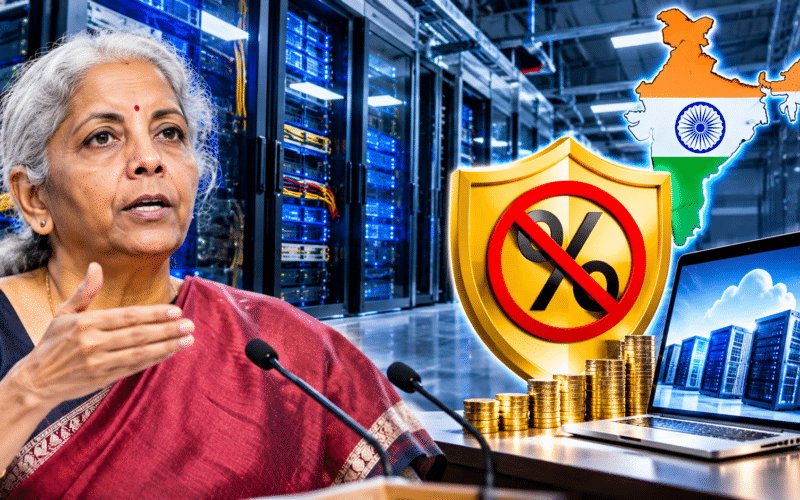
Tax policy · Data centres and foreign capital · India 2026
0% Tax Till 2047: Who Actually Gets Sitharaman’s Data Centre Tax Holiday — and Why India Is Handing Out So Many Exemptions
The zero-tax window runs to 31 March 2047, but it covers foreign cloud companies using Indian data centres, not salaried taxpayers. It is one of at least six big tax breaks India has offered foreign and specialised capital in 2026.
The headline travels fast on WhatsApp: “0% tax till 2047”. Many readers understandably hope it means them. It does not. If you are a salaried employee, a small business owner or an investor in mutual funds, nothing in this particular tax holiday changes your bill. The zero rate is reserved for a narrow and very powerful group: foreign companies that sell cloud services to the world using data centres located in India.
That still makes it one of the most striking tax promises an Indian finance minister has made. A 21-year holiday locks in a policy across several future governments. And it is not a one-off. Through 2026, Finance Minister Nirmala Sitharaman has repeatedly cut tax to zero, or close to it, for specific kinds of global money. Understanding why tells you a lot about where India thinks its next decade of growth will come from.
The Sentence in the Budget Speech That Started It
On 1 February 2026, presenting the Budget for 2026-27, Sitharaman said: “Recognising the need to enable critical infrastructure and boost investment in data centres, I propose to provide tax holiday till 2047 to any foreign company that provides cloud services to customers globally by using data centre services from India.” Services to Indian customers, she added, must go through an Indian reseller entity.
She paired it with a safe harbour: where the Indian company providing data centre services is related to the foreign cloud firm, a profit margin of 15% on cost would be accepted by the tax department without dispute. Sitharaman said the resulting tax of about 0.7% would be “much lower than in competing jurisdictions”. The legal home is Serial No. 13C of Schedule IV of the new Income-tax Act, 2025, inserted by the Finance Act, 2026.
- 31 Mar 2047Last day of the tax year in which the exemption ends
- 1.9 GWIndia’s installed data centre capacity in FY26, KPMG
- 387 MWIT capacity added in 2025, up 103% on 2024
- $56.4bnData centre investment commitments in 2025 alone, CBRE
- $15bnGoogle’s planned AI hub in Visakhapatnam, 2026 to 2030
- $17.5bnMicrosoft’s India cloud and AI commitment through 2029
What the Tax Holiday Covers, Line by Line
A tax holiday means a period in which specified income is fully exempt. Here, the exempt income is what a foreign company earns in India “by way of procuring data centre services from a specified data centre”. In plain terms: if Amazon Web Services, Microsoft Azure or Google Cloud rent computing capacity in an Indian data centre and use it to serve customers in, say, Europe or the Gulf, India will not tax the profit linked to that Indian operation.
Why would India tax it at all? Because under international tax rules, running servers in a country can create a “permanent establishment” or “significant economic presence”, letting that country tax a share of the profit. That uncertainty, more than the rate itself, had made hyperscalers wary of putting global workloads in India. The holiday removes it.
- Condition 1Foreign cloud firmServes customers outside India using Indian capacity
- Condition 2Asset-lightOwns or operates 0 physical data centre infrastructure
- Condition 3Indian operatorData centre run by an Indian company, owned or leased
- Condition 4Reseller rule100% of Indian sales routed via an Indian reseller
The domestic market is not tax-free. The Finance Ministry clarified on 4 February 2026 that income from domestic economic activities stays taxable under existing provisions. Sales to Indian customers go through an Indian reseller, which pays Indian tax, and the Indian data centre operator pays normal corporate tax on its own profit.
The quiet widening in August
The original version required the government to notify each eligible foreign company and each “specified data centre”, which also had to be owned and operated by an Indian company. Law firms noted that, as of August 2026, no such notification had been issued, so the exemption existed on paper but was not yet usable.
The Taxation and Other Laws (Amendment) Act, 2026, passed by the Lok Sabha on 6 August and the Rajya Sabha on 10 August and given assent on 17 August, loosened both conditions. Notification of the foreign company and of the data centre was dropped. A specified data centre now means one operated by an Indian company “whether by way of owning or leasing”, plus conditions to be prescribed. The Income Tax Department said the lease change answered representations that the ownership test was too restrictive, and that removing notifications would ease doing business.
A Year of Zeros: The Wider Pattern
The data centre holiday is the most eye-catching, but 2026 has been a year of targeted generosity. Each break has a specific type of foreign or strategic money in mind.
| Measure | Who benefits | Tax before | Tax after | Runs until |
|---|---|---|---|---|
| Data centre holiday (Sl. 13C) | Foreign cloud firms using Indian data centres | Up to 35% on India-attributed income | 0% | Tax year 2046-47 |
| G-Sec exemption (Ordinance, 5 June) | Foreign institutional investors and BIS | 20% withholding on interest; 12.5% LTCG | 0% | No end date announced |
| GIFT City IFSC holiday | IFSC units and offshore banking units | 100% exempt for 10 of 15 years | 0% for 20 of 25 years, then 15% | Applies from 2026-27 |
| Rough diamonds (Sl. 13F) | Foreign miners, sightholders, brokers in Mumbai and Surat zones | Display only was tax-free | 0% on sales | 31 March 2041 |
| Electronics equipment (Sl. 13A) | Foreign firms supplying equipment to contract manufacturers | Exemption with earlier end date | 0%, extended 10 years | Tax year 2040-41 |
| IT and GCC safe harbour | IT, ITeS, KPO and contract R&D firms | Threshold ₹300 crore | Common 15.5% margin | Threshold ₹2,000 crore |
There is also a domestic thread, though it predates this year. Budget 2025-26 made income up to ₹12 lakh tax-free under the new regime, or ₹12.75 lakh for salaried taxpayers after the ₹75,000 standard deduction. That is the closest most individuals get to “0% tax”, and it has nothing to do with 2047.
Years of exemption under each measure, from official summaries and the amended law. Bars scaled to the longest. Diamond and storage periods counted from 2026.
Headline rates before the 2026 changes, from Budget documents and law firm summaries. After the change, each falls to 0% for eligible income, except IFSC post-holiday income, which moves to 15%.
Why the Finance Minister Is Being So Generous
Tax holidays cost revenue, so a government that is trying to hold its fiscal deficit in check does not hand them out casually. Four reasons stand out from the government’s own statements and expert commentary.
Reason one: the AI infrastructure race is global
Cloud giants are spending at historic scale, and they can put a data centre almost anywhere with land, power and fibre. Countries such as Singapore and Ireland have long used low taxes to win digital investment. PIB described the 2047 holiday as providing “long-term visibility and certainty” so India can attract global cloud providers while anchoring critical digital infrastructure in the country. Recent commitments suggest it is working: Google has pledged about $15 billion for an AI hub in Visakhapatnam and Microsoft $17.5 billion through 2029.
Reason two: certainty matters more than the rate
Investors in 30-year assets fear disputes more than headline rates. The permanent establishment question could have led to years of litigation over how much of a cloud firm’s global profit India could tax. A clear zero, plus a fixed 15% safe harbour for related Indian operators, swaps that risk for a known number.
Reason three: India needs foreign capital and a steadier rupee
The June ordinance removing tax on foreign investors’ government bond income was aimed squarely at deeper bond market flows and global index inclusion. Standard Chartered projected about $5 billion in immediate FPI inflows from the ordinance alone. Cheaper foreign borrowing for the government and steadier inflows support the currency.
Reason four: 2047 is a political deadline as well as a fiscal one
The year is not random. It marks 100 years of independence and is the government’s target for “Viksit Bharat”, a developed India. Tying the holiday to that date signals that the policy is meant to outlast electoral cycles. It also makes reversal politically awkward for any future government.
What people get wrong: the “0% tax till 2047” is not a cut for Indian companies or individuals. Indian data centre operators like Adani, Reliance or Tata still pay corporate tax on their own profits. The gain to them is indirect: foreign cloud firms should be willing to pay more for capacity in Indian facilities that qualify.
The Money Maths: What a Zero Rate Is Worth
Installed capacity in gigawatts. FY23, FY26 and 2030 from KPMG’s July 2026 report; end-2025 from CBRE. 2030 is a projection, shown at the lower end of the 7.0 to 7.5 GW range.
Worked example, our illustrative calculation. A foreign cloud firm earns ₹1,000 crore of profit from global customers served out of an Indian data centre. Before the holiday, if India had successfully attributed all of it to an Indian permanent establishment at a 35% rate, the tax could have been up to ₹350 crore a year. Under the holiday, it is zero. In practice, attribution would usually be partial and disputed, which is exactly the uncertainty the exemption removes.
Now the Indian side. Suppose a related Indian company runs the facility at a cost of ₹400 crore. Under the 15% safe harbour, its taxable profit is ₹60 crore. At the domestic new-regime corporate rate of about 25.17% including surcharge and cess, it pays roughly ₹15.1 crore. India still collects tax on the domestic operator, but far less than it might have tried to claim from the foreign firm.
The Critics and the Costs
Not everyone is convinced. In August 2026, a parliamentary committee chaired by BJP MP Nishikant Dubey questioned the tax holiday and warned that the power and water demands of data centres could complicate India’s push for sovereign AI capacity. It listed the high cost of hardware, supply chain delays, heavy power and water use, and the tax holiday as significant issues.
Other critics focus on revenue. One open letter to the finance minister estimated around ₹95,000 crore of cumulative revenue loss for a single 1 GW data centre over two decades. That is an outside estimate and assumes India would otherwise collect substantial tax, which the government disputes. No official estimate of revenue foregone from the holiday has been published.
- Budget 2025-26 makes income up to ₹12 lakh tax-free under the new regime.
- Budget 2026-27 announces the data centre holiday till 2047 and doubles GIFT City’s holiday.
- Finance Ministry clarifies that domestic income stays taxable.
- Ordinance exempts foreign investors’ G-Sec interest and capital gains from 1 April 2026.
- Parliamentary panel red-flags the holiday over power and water strain.
- Amendment Act drops notifications and allows leased data centres.
- Rough diamond sales exemption takes effect in Mumbai and Surat zones.
- Data centre tax holiday ends.
What We Know
- The data centre holiday covers tax years 2026-27 to 2046-47 for foreign cloud firms serving global customers from India.
- It does not cover individual taxpayers or Indian companies’ own profits.
- The August 2026 amendment removed notification rules and allowed leased facilities.
- A 15% cost-plus safe harbour applies to related Indian data centre operators.
- Foreign investors’ G-Sec income is tax-exempt from 1 April 2026.
What Is Still Unclear
- The “other conditions” a specified data centre must meet, which are still to be prescribed.
- How much revenue the holiday will cost; no official estimate exists.
- Whether any foreign cloud firm has yet claimed the exemption.
- How states will manage power and water for the projected build-out.
What This Means for Ordinary Taxpayers
For most readers, the honest answer is: indirectly, at most. The data centre build-out could create construction and technical jobs and lower cloud costs for Indian businesses over time. The bond exemption could, if inflows materialise, help keep government borrowing costs in check. But your own tax rate is set by the slabs in the annual Budget, not by these exemptions.
- Ignore forwards claiming “no income tax till 2047”; no such measure exists for individuals.
- Check your own liability against the current new-regime slabs, under which income up to ₹12 lakh, or ₹12.75 lakh for salaried taxpayers, is tax-free.
- If you invest in data centre or infrastructure stocks, read company disclosures on whether their facilities qualify as specified data centres once conditions are prescribed.
- Watch the next Budget on 1 February 2027 for any estimate of revenue foregone and any changes to the conditions.
Status check, 15 November 2026: the exemption is law, but the conditions for a specified data centre still have to be prescribed by rules. Until then, how quickly hyperscalers can actually claim it remains open.
Frequently Asked Questions
Is there 0% income tax till 2047 for individuals in India?
No. The tax holiday till 2047 applies to foreign companies providing cloud services to global customers using data centres in India. Individual taxpayers pay tax under the normal slabs; under the new regime, income up to ₹12 lakh is tax-free, or ₹12.75 lakh for salaried taxpayers.
What is the data centre tax holiday till 2047?
It is an exemption under Serial No. 13C of Schedule IV of the Income-tax Act, 2025, for income a foreign company earns by procuring data centre services from a specified data centre in India. It covers tax years 2026-27 to 2046-47.
Which companies benefit from the tax holiday?
Foreign cloud service providers such as global hyperscalers that use Indian data centres to serve customers outside India, provided they do not own or operate the data centre and route Indian sales through an Indian reseller.
Do Indian data centre companies get the tax holiday?
No. Indian operators continue to pay corporate tax on their own profits. Where they are related to the foreign cloud firm, a 15% margin on cost is accepted as a safe harbour for transfer pricing.
What changed in the August 2026 amendment?
The Taxation and Other Laws (Amendment) Act, 2026 removed the need for government notification of the foreign company and the data centre, and allowed data centres operated by Indian companies on a lease, not just those they own.
Why did Nirmala Sitharaman announce a tax holiday till 2047?
The government says it wants to give long-term certainty to attract global cloud and AI infrastructure investment to India. The holiday also removes the risk that using Indian data centres creates a taxable presence for foreign firms.
Are foreign investors’ government bond earnings tax-free in India?
Yes. An ordinance on 5 June 2026, later replaced by the amendment Act, exempted interest and capital gains on government securities for eligible foreign institutional investors and the Bank for International Settlements, effective from 1 April 2026.
How much revenue will India lose from the data centre tax holiday?
No official estimate has been published. Some critics have put the potential loss in the tens of thousands of crores per gigawatt of capacity over two decades, but these are outside estimates and depend on how much India could otherwise have taxed.
The Short Version
“0% tax till 2047” is real, but it is for foreign cloud companies serving the world from Indian data centres, not for you. The holiday runs for 21 tax years, removes a costly permanent establishment risk and was widened in August to cover leased facilities. It is part of a deliberate 2026 pattern of targeted zeros for foreign bond investors, GIFT City units and diamond traders. The bet is that certainty pulls in capital and infrastructure. The open questions are the revenue cost, the rules still to come and whether India’s power and water can keep up.