EPFO Wage Ceiling Now ₹25,000: Why Your PF Deduction Changed — and Where the Problems Start
EPFO Wage Ceiling Now ₹25,000: Why Your PF Deduction Changed — and Where the Problems Start
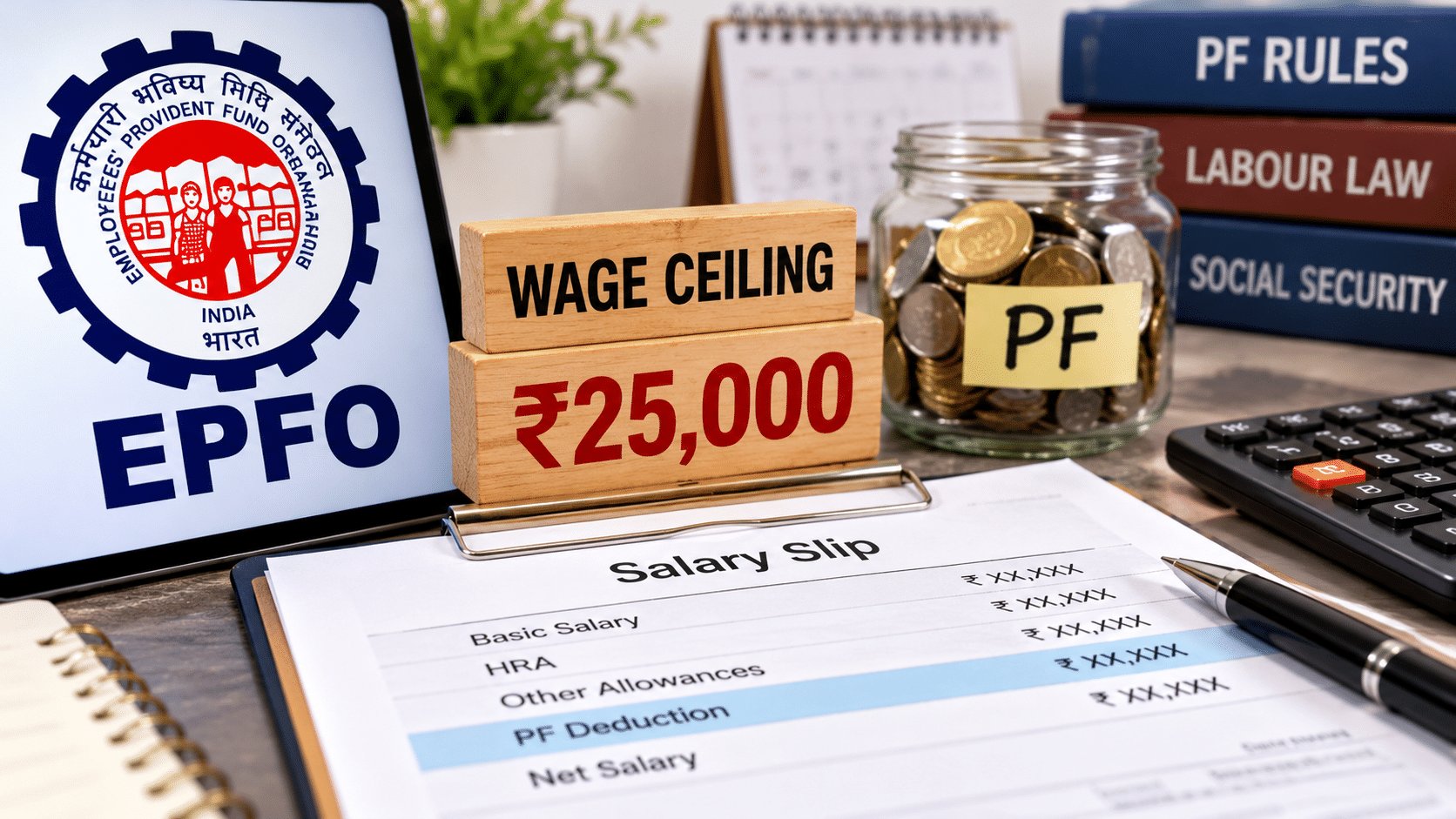
The Cabinet raised the mandatory EPF wage ceiling from ₹15,000 to ₹25,000 a month, with reports putting the effective date at 17 September 2026. More savings and a bigger pension follow, but so do lower take-home pay, a quieter shift inside the employer’s share and transition questions payroll teams are still sorting out.
Your October payslip arrives and the PF line is bigger than last month. Nothing about your salary changed, yet your take-home is lower by ₹600 or ₹1,200, or by ₹2,400 if you were never in the EPF before. The reason is a single number. For twelve years the EPFO wage ceiling sat at ₹15,000 a month. It is now ₹25,000, and every payroll system in the country has been recalculating.
The higher ceiling is good for retirement savings and for the pension. But it has also created real problems, some of them about cash in hand and some hidden inside how your employer’s contribution is split. Here is what changed, who is affected, what the numbers look like and which questions remain open.
Quick Summary
From 17 September 2026, PF is calculated on wages up to ₹25,000 instead of ₹15,000. Employees earning ₹15,000 to ₹25,000 are now compulsorily covered. Members who were capped at ₹15,000 see their 12% deduction rise from ₹1,800 to as much as ₹3,000 a month. For those already contributing on full pay, take-home is unchanged, but more of the employer’s share now goes to the pension fund and less to the withdrawable EPF account.
What We Know
- The Union Cabinet approved raising the ceiling from ₹15,000 to ₹25,000 a month, announced by PIB on 16 September 2026.
- Compliance briefings report notification S.O. 5109(E) with effect from 17 September 2026.
- Contribution rates are unchanged: 12% from the employee and 12% from the employer, of which 8.33% goes to EPS.
- Government outgo on its EPS support is estimated at ₹11,339 crore a year, against ₹10,250 crore earlier.
What Is Still Unclear
- Whether members who joined after September 2014 earning over ₹15,000, and were kept out of EPS, now enter EPS.
- How past service at the old ceiling will be treated in pension calculations.
- Final operational guidance for September 2026 wages, which compliance sites describe differently.
- Whether employers may cap contributions at ₹25,000 for higher earners without a fresh joint option.
A Ceiling That Sat Still for Twelve Years
The wage ceiling decides two things. It sets the salary level up to which EPF membership is compulsory, and it sets the maximum wage on which the mandatory 12% contribution is calculated. Basic pay plus dearness allowance above that level can be covered, but only by choice.
The ceiling was raised to ₹15,000 in September 2014. Since then, the PIB release notes, wages have grown, formal employment has expanded and minimum wages in several states have moved close to the old limit. A worker earning ₹16,000 could be left out of PF, pension and insurance entirely if the employer chose not to enrol them. The new ceiling closes that gap up to ₹25,000.
The scale explains why the change ripples so widely. Almost every private employer with 20 or more staff runs EPF, and each one had to change payroll settings within days of the announcement.
Three Kinds of Employee, Three Different Problems
The same rule lands differently depending on what you earned and how your employer was already contributing. Most confusion comes from mixing these groups up. Find yours on the scale below before reading anything else.
The newly covered worker
Someone earning ₹20,000 who was never enrolled had no PF deduction. Now the employee must contribute ₹2,400 a month and the employer ₹2,400. If the employer’s share is built into the cost-to-company package, the cash in hand falls further. This group gains the most protection, including pension and life cover, and feels the deduction most sharply.
The capped member
Many employers ran PF at 12% of ₹15,000 for everyone above that level, so the deduction stayed at ₹1,800 however high the salary. That base now moves to ₹25,000. An employee earning ₹25,000 or more sees the deduction rise to ₹3,000. Take-home falls by ₹1,200 a month, or ₹14,400 a year.
The full-wage contributor
Some employees, by joint choice with the employer, contribute 12% of their full basic pay. On ₹40,000, that is ₹4,800 from each side, and nothing changes in the deduction. But the employer’s ₹4,800 is split differently, as the next section shows.
The Payslip Arithmetic, Salary by Salary
The table below assumes the member contributes on wages up to the ceiling, as most employers apply by default. Employer EPS is 8.33% of wages up to the ceiling, and the employer’s EPF share is the balance of its 12%. Figures are rounded to the rupee, as compliance briefings report them.
| Basic plus DA | Employee PF before | Employee PF now | Employer EPS now | Employer EPF now | Take-home change |
|---|---|---|---|---|---|
| ₹15,000 | ₹1,800 | ₹1,800 | ₹1,250 | ₹550 | Nil |
| ₹20,000, existing member | ₹1,800 | ₹2,400 | ₹1,666 | ₹734 | −₹600 |
| ₹20,000, newly covered | Nil | ₹2,400 | ₹1,666 | ₹734 | −₹2,400 |
| ₹25,000 | ₹1,800 | ₹3,000 | ₹2,083 | ₹917 | −₹1,200 |
| ₹40,000, capped | ₹1,800 | ₹3,000 | ₹2,083 | ₹917 | −₹1,200 |
| ₹40,000, full wage | ₹4,800 | ₹4,800 | ₹2,083 | ₹2,717 | Nil |
Two things stand out. The biggest cash shock falls on newly covered workers, who lose ₹2,400 a month at ₹20,000. And the full-wage contributor’s take-home is untouched, but the employer’s EPF credit falls from ₹3,550 to ₹2,717 because more goes to EPS.
The Hidden Shift: Less in Your EPF Account, More in the Pension Pot
This is the change most payslip explainers skip. The employer’s 12% is not all saved in your EPF account. Up to the ceiling, 8.33% is diverted to the Employees’ Pension Scheme, and only the rest reaches your EPF balance. When the ceiling rises, the EPS slice grows from ₹1,250 to ₹2,083 a month.
For a member contributing on ₹40,000 of full wages, that means ₹833 less a month credited to the EPF account, which earns interest and can be withdrawn. The same ₹833 now goes to EPS, which pays a monthly pension later and cannot be withdrawn as a lump sum after ten years of service. Over a year, that is ₹9,996 moved from one bucket to the other.
That last point is the open question. Members who joined after 1 September 2014 with wages above ₹15,000 were not eligible for EPS under the old rules, so their whole employer share went to EPF. Whether the new ceiling brings such members into EPS has not been clearly set out in the guidance we reviewed.
The Pension Side of the Ledger
The trade-off has a reward. EPS pension is calculated as pensionable salary times pensionable service, divided by 70. A higher ceiling raises the maximum pensionable salary from ₹15,000 to ₹25,000. A payroll briefing by Keka sets out the effect: with 20 years of service, plus two years of weightage, the pension rises from ₹4,714 to ₹7,857 a month.
The catch is timing. The briefing notes the new ceiling does not apply to past service automatically. Someone with 15 years already completed at the old ceiling will not see those years revalued, so the full gain shown above applies mainly to people early in their careers. How EPFO will combine service before and after 17 September 2026 in the pension formula is one of the open questions.
One Worker, One Year: Is the Deduction a Loss or a Saving?
The word “problem” in most social media posts about the new ceiling refers to one thing: a smaller salary credit. That is real, but it is only half of the picture. The money deducted does not disappear. It moves into accounts in your name, and the employer adds its own share on top. A worked example makes the trade-off concrete.
For Priya, the deduction is a forced saving with a 30% employer top-up to her own EPF balance, plus pension and insurance. For a worker who needs every rupee of monthly cash to pay rent or a loan instalment, the same deduction can still be a strain. Both statements are true at once, and which matters more depends on the household’s finances rather than on the rule.
The tax angle for salaried employees
Under the old tax regime, the employee’s own PF contribution counts toward the familiar ₹1.5 lakh deduction limit, so a higher deduction can lower tax for those who have not already filled the limit with other investments. Under the new regime, which is the default, there is no such deduction. The employer’s contribution is generally not taxed as salary, subject to an overall annual limit that applies to employer contributions to PF, NPS and superannuation together. At the ₹25,000 ceiling, the employer’s PF share of ₹36,000 a year is far below that limit.
Why the employer may prefer the cost-to-company route
An employer whose PF bill per worker rises by up to ₹1,300 a month has an incentive to fold that cost into the salary package rather than absorb it. For a worker on a fixed offer letter, that can show up as a revised salary structure. Read any new letter for changes to basic pay, special allowance and the employer PF line. A sharp cut in basic pay to reduce PF wages is a sign to ask questions, because PF is calculated on basic pay plus DA.
How the Change Rolled Out
The September problem is the messiest. Because the change took effect mid-month, one compliance site describes splitting September wages, with the ₹15,000 ceiling for 1 to 16 September and ₹25,000 for 17 to 30 September. It also reports an EPFO circular extending the September return deadline to 31 October 2026. We could not verify that circular independently, so employers should check EPFO’s own notices.
Can Your Employer Still Cap Your PF?
For employees earning above the ceiling, the old practice of paying PF only on ₹15,000 now becomes paying PF only on ₹25,000. The mandatory contribution is calculated on wages up to the ceiling. Contributing on pay above that requires a joint choice by employer and employee, as compliance guidance has long held.
That creates a risk for full-wage contributors. An employer restructuring payroll after the change may decide to reset everyone to the ₹25,000 cap, which would cut both your deduction and the employer’s contribution. In July 2026 Zerodha Varsity described how a cap at the old ceiling could raise take-home by up to ₹8,400 a month on ₹50,000 of basic pay. The flip side is less retirement saving. The same logic now applies at ₹25,000.
What Employers Are Wrestling With
For employers, the change raises cost and work at the same time. At the ceiling, the employer’s monthly outgo rises from ₹1,950 to ₹3,250 per employee once EDLI and administration charges are included, according to one compliance briefing. That is ₹1,300 more per employee per month.
Where pay is set as cost-to-company, employers may treat their own higher share as part of the package, which lowers the employee’s cash pay further. Whether that is acceptable depends on contract terms. Employees should not assume the employer will absorb the cost, and should read any revised salary letter carefully.
Decoder: Payslip and Passbook Terms
| Term | What it means | Figure after the change |
|---|---|---|
| Wage ceiling | Pay level for compulsory cover and for the mandatory contribution base | ₹25,000 a month |
| EPF wages | Basic pay plus DA used to calculate PF | Up to ₹25,000 unless jointly opted higher |
| Employee share | 12% of EPF wages, all to your EPF account | Up to ₹3,000 |
| EPS share | 8.33% of wages up to the ceiling, from the employer, to the pension fund | Up to ₹2,083 |
| Employer EPF share | The employer’s 12% minus the EPS share | ₹917 at ₹25,000 |
| EDLI | Employer-paid insurance premium | ₹125 at ₹25,000 |
| Excluded employee | A non-member earning above the ceiling, not compulsorily covered | Above ₹25,000 |
| VPF | Extra contribution from the employee only | Up to 100% of basic plus DA |
A Six-Point Check for Your Next Payslip
Frequently Asked Questions
What is the new EPFO wage ceiling?
The Union Cabinet raised it from ₹15,000 to ₹25,000 a month, announced on 16 September 2026. Compliance briefings report it took effect on 17 September 2026.
Why did my PF deduction increase in October 2026?
If your basic pay plus DA is above ₹15,000 and your PF was calculated on the ₹15,000 ceiling, the base has moved to ₹25,000. At ₹25,000 or more, the employee deduction rises from ₹1,800 to ₹3,000 a month.
Is PF now mandatory for employees earning up to ₹25,000?
Yes. The change brings workers earning ₹15,000 to ₹25,000 under compulsory EPF, EPS and EDLI cover. The government expects more than 51 lakh additional workers to be covered.
Does the employer contribution go fully into my EPF account?
No. Of the employer’s 12%, 8.33% of wages up to the ceiling goes to the pension scheme, up to ₹2,083 a month now. The rest goes to your EPF account.
Will my EPS pension increase with the new ceiling?
The maximum pensionable salary rises to ₹25,000. Using the EPS formula, 20 years of service with weightage gives about ₹7,857 a month at ₹25,000, compared with ₹4,714 at ₹15,000. Past service is not automatically revalued.
Can my employer limit PF to the ₹25,000 ceiling if I earn more?
The mandatory contribution is calculated on wages up to the ceiling. Contributions on higher pay require a joint choice by employer and employee, so check in writing whether your existing arrangement continues.
How is September 2026 PF calculated after the mid-month change?
One compliance briefing describes using ₹15,000 for 1 to 16 September and ₹25,000 for 17 to 30 September. Employers should follow EPFO’s own circulars, as guidance has varied.
Is ESIC also affected by the EPFO wage ceiling change?
No. The ESIC wage limit is separate and, as reported in late September 2026, remains at ₹21,000, or ₹25,000 for persons with disabilities.
The Short Version
PF is now calculated on wages up to ₹25,000. Workers earning ₹15,000 to ₹25,000 are newly covered and lose up to ₹2,400 of monthly take-home. Members capped at the old ceiling pay up to ₹3,000, ₹1,200 more. Full-wage contributors see no deduction change but ₹833 a month moves from their EPF account into EPS. Pensions rise for long careers. Check your payslip, passbook and contribution basis this month.