Why Sensex and Nifty Snapped a 3-Day Slide With Brent Above $100 — and the Nifty Levels That Matter Before You Trade Again
Is the Indian market at a make-or-break moment? With geopolitical tensions flaring, the RBI holding its repo rate at 5.25%, and domestic investors pumping record SIP flows into equities, June 29, 2026 opens as one of the most watched trading days of the year. Whether you’re a seasoned trader or a first-time investor trying to decode the signals, this exclusive Indian market briefing gives you everything you need — fresh data, actionable stock picks, sector breakdowns, and expert-grade insights — all in one place.
🔴 Market Mood: What to Expect on 29 June 2026
Indian benchmark indices are set for a cautious, flat-to-negative opening on Monday as fresh geopolitical stress — stemming from renewed US-Iran military escalations over the weekend — rattles global investor confidence. GIFT Nifty, the pre-market barometer, was trading near 24,096.50, just marginally above the previous close of Nifty 50 at 24,056.00, signalling a range-bound start with downside bias unless fresh domestic triggers emerge.
Last week’s performance wasn’t entirely grim. The BSE Sensex managed to climb 297.57 points (+0.38%) over the full week, and the NSE Nifty 50 edged up 42.9 points (+0.17%), showcasing resilience despite global headwinds. Friday saw the domestic market closed on account of Muharram, and Thursday’s session closed with Sensex at 77,100.47 and Nifty 50 at 24,056.00 — both registering modest gains of +0.14%.
Today is also a critical F&O expiry day for the monthly series, which historically amplifies intraday volatility and triggers sharp directional moves in the final hour. Expect heightened swings between key support and resistance levels throughout the session.
📊 Indian Market Overview: Sensex, Nifty 50 & Bank Nifty
BSE Sensex — The Pulse of 30 Blue-Chips
The BSE Sensex, India’s most closely tracked 30-stock index, has been navigating a turbulent 2026. After touching its all-time high of 86,159.02 on December 1, 2025, the index went into a sharp bearish spiral, crashing over 5,034 points by January 21, 2026, as Donald Trump’s tariff threats and NATO tensions triggered global risk-off selling. The year began with Sensex firmly down 4% from its peak — a sobering reminder that ATH euphoria can reverse violently.
Since those lows, the market staged multiple recovery attempts. By June 24, the Sensex surged 791 points to close at 76,991 — a 1.04% single-session jump driven by falling crude oil prices, strong FII buying, and confidence in the RBI’s growth-supportive stance. However, the index dipped again on June 23, falling 893 points (−1.16%) to 76,200 amid HDFC Bank weakness and IT sector softness. As of Thursday June 26, Sensex closed at 77,100.47.
NSE Nifty 50 — India’s Benchmark 50
The Nifty 50 has followed a near-parallel trajectory to the Sensex. It hit its all-time high of 26,373.20 on January 5, 2026, only to retreat sharply. The index has since been range-bound in the 23,300–24,200 zone through most of June. On June 24, Nifty rallied 198 points to 24,022 (+0.83%), with strong contributions from IT, realty, and private banking stocks. On June 23, it fell 278.8 points (−1.16%) to 23,824. The last closing before the Muharram holiday stood at 24,056.00 on June 26.
Bank Nifty — The Banking Sector Thermometer
Nifty Bank has been the star performer in the mid-June recovery. On June 24, it rallied a sharp 967 points to close at 58,150 (+1.69%), with private banks outperforming their PSU counterparts as FII flows turned positive. It closed at 58,177.05 as of June 25. Key technical levels to watch today: support at 57,800–58,000, resistance at 58,400–58,600.
Investor Sentiment: Cautiously optimistic. Domestic Institutional Investors (DIIs) have been consistently absorbing FII selling throughout June — a trend that has become the structural backbone of Indian market resilience. SIP inflows stand at an impressive ₹26,000 crore per month, with SIP folios crossing 10 crore for the first time.
📐 Nifty 50 Today — Detailed Technical Levels
Here’s your point-by-point guide to the Nifty 50 setup for 29 June 2026 (Monthly F&O Expiry Day):
- Last Close: 24,056.00 (June 26, 2026)
- GIFT Nifty Pre-Market: 24,096.50 (+0.02%) as of early morning June 29
- Key Support Levels: 23,950 (immediate), 23,750 (strong support zone)
- Key Resistance Levels: 24,100 (immediate), 24,250–24,350 (breakout zone)
- Monthly F&O Expiry Effect: Expect high-volume rollover trades, max-pain theory points near 24,000–24,100; sharp moves in the final 30 minutes of trading are likely
- Market Bias: Neutral-to-bearish, given US-Iran war escalation, oil price spike (Brent near $73/barrel), and tech selloff in US markets heading into the weekend
- Volume Cues: Watch for above-average delivery volumes in Banking and IT heavyweights as expiry positions get squared off
- Broader Market: Midcap and Smallcap indices may outperform if banking and IT leaders come under pressure; DIIs likely to step in as net buyers during intraday dips
- Crude Impact: Brent crude at $73.39/barrel (up due to US-Iran tensions) — adverse for India as a net oil importer; pressure on OMCs, airlines, and tyre companies
📊 BSE Sensex vs NSE Nifty 50 — June 2026 Trends Compared
| Parameter | BSE Sensex | NSE Nifty 50 |
|---|---|---|
| 2025 All-Time High | 86,159.02 (Dec 1, 2025) | 26,373.20 (Jan 5, 2026) |
| Jan 2026 Low | 81,124 (Jan 21) | 24,919 (Jan 21) |
| YTD Change (Jan–June 2026) | Down 10.5% from ATH | Down 8.8% from ATH |
| June 23 Close | 76,200.68 (−1.16%) | 23,824.10 (−1.16%) |
| June 24 Close | 76,991 (+1.04%) | 24,022 (+0.83%) |
| June 26 Close | 77,100.47 (+0.14%) | 24,056.00 (+0.14%) |
| June 29 Pre-Market (GIFT) | 77,200 est. | 24,096.50 |
| Key Support (June) | 76,000–76,500 | 23,750–23,950 |
| Key Resistance (June) | 77,500–78,000 | 24,200–24,350 |
| P/E Ratio (approx.) | 23–24x fwd earnings | 22–23x fwd earnings |
| Primary Drivers | HDFC Bank, Reliance, TCS | Infosys, Reliance, HDFC Bank |
| Index Composition | 30 large-cap stocks | 50 large-cap stocks |
🌐 Foreign Indices That Influenced Indian Markets
Global cues are increasingly dominant drivers of Indian market sentiment. Here’s how key foreign indices shaped Dalal Street’s direction through June 2026:
| Foreign Index | Country/Region | Recent Movement | Impact on India |
|---|---|---|---|
| Dow Jones Industrial Avg | USA | 51,561.93 (+1.73% on June 5) | Positive correlation — US rally lifts FII sentiment toward India |
| S&P 500 | USA | 7,584.31 (+0.41%) | Tech-heavy S&P moves directly impact Nifty IT stocks |
| Nasdaq Composite | USA | Fell on tech selloff (June 28) | Dragged TCS, Infosys, Wipro; accelerated IT sector weakness |
| Nikkei 225 | Japan | −1.77% (June 5) | Asian bearishness triggered FII outflows from India |
| KOSPI | South Korea | −4.56% (June 5) | Signalled broader EM risk-off; Korean Won at 17-yr low spooked Asian FIIs |
| Hang Seng | Hong Kong | −0.40% (June 5) | China-linked EM pressure weighs on India, especially metals sector |
| Brent Crude (ICE) | Global Commodity | $73.39/barrel (June 29) | Rising crude = higher inflation risk, CAD pressure, and OMC margin squeeze |
| Gold (MCX) | Global Commodity | ₹1,56,110/10g | Safe-haven demand spikes as geopolitical tension rises; bullish for gold ETFs |
🏦 Key Economic Drivers: GDP, Inflation, RBI Policy & Employment
India’s GDP Growth Trajectory
India remains the world’s fastest-growing major economy, and the numbers back this up. India’s FY26 GDP growth came in at a strong 7.7% — well above the initial government estimate of 7.4% and comfortably outpacing the global average. The National Statistics Office’s advance estimate had pegged FY26 growth at 7.4%, powered by the “double engine” of private consumption and government capex investment.
However, the RBI has moderated its FY27 GDP forecast from 6.9% to 6.6%, factoring in headwinds from the prolonged West Asia conflict, elevated energy costs, and supply chain disruptions. The NSE’s latest macro report highlights that India’s 2026 economic outlook will hinge significantly on how the southwest monsoon performs — an El Niño risk remains in focus for rural consumption and agricultural output.
CPI Inflation — Rising but Manageable
The RBI’s June 2026 MPC raised its FY27 CPI inflation projection from 4.6% to 5.1% — a notable upward revision driven by supply-side shocks, a weaker rupee, and the ripple effects of the West Asia conflict pushing crude oil higher. This revised inflation forecast was a key reason the MPC chose to hold rates rather than cut, signalling that the easing cycle — which saw three 25 bps cuts in 2025 and one 50 bps cut in June 2025 — has now conclusively paused.
Food inflation remains the primary pressure point, especially with monsoon uncertainty. Core inflation, however, remains relatively benign, giving the RBI some comfort that demand-pull pressures are not out of control.
RBI Repo Rate — Held Steady at 5.25%
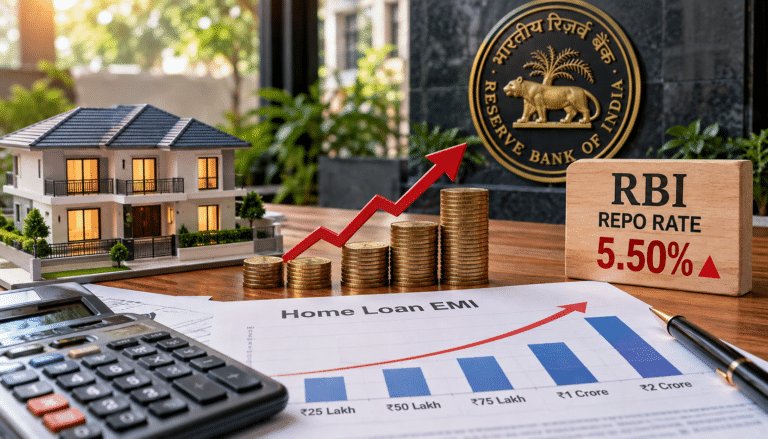
The Reserve Bank of India’s MPC, under Governor Sanjay Malhotra, unanimously voted to keep the policy repo rate unchanged at 5.25% in its June 5, 2026 meeting — the third consecutive pause. The Standing Deposit Facility (SDF) remains at 5.00%, and the Marginal Standing Facility (MSF) rate and bank rate at 5.50%.
The key 5 takeaways from this pivotal RBI MPC decision:
- Repo Rate: Paused at 5.25% — stability over action, keeping borrowing costs steady
- Neutral Stance retained — the RBI is data-dependent and neither leaning toward cuts nor hikes
- GDP forecast cut to 6.6% for FY27 — acknowledging global headwinds from West Asia conflict and supply disruptions
- Inflation forecast raised to 5.1% — supply-side shocks, weak rupee, and crude volatility cited
- Aggressive Forex measures announced — RBI relaxed NRI/OCI investment limits and provided full hedging support for FCNR(B) deposits; the rupee immediately rallied 50 paise to 95.24 vs USD
For home loan borrowers: no EMI relief in the near term. For FD investors: stable, above-average yields continue.
FII vs DII Flows: The Great Tug of War
One of 2026’s most defining market narratives has been the divergence between FII and DII behaviour. Foreign investors have pulled out approximately $17 billion from Indian equities — the largest annual outflow ever recorded — primarily driven by stretched valuations and a 50% US tariff on Indian goods. Yet the market has held up because domestic institutional investors have injected a staggering $77 billion, with SIP flows hitting ₹26,000 crore/month and SIP folios crossing 10 crore. This structural shift means Indian markets are less vulnerable to FII-driven crashes than in previous decades.
📰 Latest News Highlights — What’s Moving Markets on 29 June 2026
Here are the top market-moving news stories and their immediate implications:
1. US-Iran War Escalation Over the Weekend
Fresh US-Israel-Iran military flare-ups over the weekend have pushed Brent crude back above $73/barrel and sent Asian markets sharply lower. Indian indices are expected to open cautiously in the red as a result. Immediate impact: Negative for aviation (SpiceJet, IndiGo), oil marketing companies (BPCL, HPCL, IOC), and tyre makers (Apollo Tyres, MRF).
2. Monthly F&O Expiry Today
This is the last trading day of June 2026’s monthly F&O series, which dramatically increases intraday volatility. Positions worth thousands of crores will be squared off or rolled over. Immediate impact: High-volume moves in index heavyweights, particularly Reliance, HDFC Bank, Infosys, and Nifty Bank. Sharp directional swings in the final 30 minutes.
3. India-US Trade Deal Reportedly 99% Finalised
Reports indicate that India and the US are in the final lap of a comprehensive bilateral trade deal, with the last round of negotiations held in New Delhi. Immediate impact: Highly bullish for pharma, textiles, IT services, and engineering exporters. Watch for moves in Sun Pharma, Cipla, Rajesh Exports, and Havells.
4. SIP Folios Cross 10 Crore — Record AMFI Data
AMFI’s May 2026 data revealed that India’s SIP folio count crossed 10 crore for the first time in history, with monthly flows at ₹26,000 crore. Immediate impact: Continued structural support for mid and largecap equities; DIIs will remain net buyers on any meaningful dips — acting as a critical market stabilizer.
5. India Inc Q4 FY26 PAT Growth Accelerates to +15.1% YoY
Corporate earnings results for the quarter ended March 2026 showed aggregate net profit growing at 15.1% YoY — a sharp acceleration from 9.2% in the prior year. Standout performers included PTC Industries (PAT +143%), BSE Ltd (PAT +61%), and ideaForge (PAT turned profitable). Immediate impact: Earnings momentum justifies current valuations and reduces downside risk for bluechip stocks.
6. RBI’s Forex Measures Boost Rupee
The RBI’s June 5 announcement of relaxed NRI/OCI investment norms and FCNR(B) hedging support triggered a 50-paise rupee rally to 95.24 per USD. Immediate impact: Positive for import-heavy sectors; supports IT sector revenues when rupee stabilizes; reduces import inflation pressure on the economy.
7. Bank Credit Growth at 16.2% YoY
India’s bank credit expanded 16.2% year-on-year to ₹211.87 lakh crore as of mid-May 2026 — the fastest growth rate since June 2024. Immediate impact: Strongly positive for banking stocks; supports HDFC Bank, SBI, ICICI Bank, and Kotak Mahindra Bank earnings visibility.
🏆 Top 10 Stocks to Buy on NSE/BSE for 2026
These recommendations are based on the latest brokerage initiations, earnings momentum, sector triggers, and valuation attractiveness:
| # | Stock | Sector | Approx. CMP | Target Price | Upside | Rationale |
|---|---|---|---|---|---|---|
| 1 | BSE Ltd | Capital Markets | ₹3,999 | ₹4,850 | +21% | Record SIP folios, PAT +61% YoY; direct play on India’s retail investor boom economictimes. |
| 2 | HDFC Bank | Private Banking | ₹1,780 | ₹2,100 | +18% | Bank credit at 16.2% YoY; CASA strength; FII favourite on dips |
| 3 | Infosys | IT Services | ₹1,540 | ₹1,820 | +18% | India-US trade deal tailwind; cloud revenues accelerating; strong Q4 FY26 |
| 4 | Nykaa (FSN E-Commerce) | Beauty/Consumer | ₹298 | ₹351 | +17% | Omnichannel scale-up; GMV growth; beauty segment outperforming in consumption upturn |
| 5 | Sun Pharma | Pharma | ₹1,350 | ₹1,600 | +19% | US-India trade deal benefits; specialty drug pipeline; PAT expansion |
| 6 | Reliance Industries | Diversified Conglomerate | ₹1,290 | ₹1,520 | +18% | Jio subscriber growth, retail margin recovery, new energy investments |
| 7 | Devyani International | QSR/FMCG | ₹115 | ₹140 | +21% | KFC & Pizza Hut India expansion; consumption recovery story; attractive P/E |
| 8 | Allied Blenders & Distillers | FMCG/Spirits | ₹633 | ₹722 | +14% | Premiumisation trend in India’s spirits market; improving margins |
| 9 | ideaForge Technology | Defence/Drones | ₹820 | ₹1,100 | +34% | PAT turned positive; Rs 500 Cr QIP approved; India’s defence capex boom continues |
| 10 | NHPC Ltd | Renewable Energy | ₹82 | ₹105 | +28% | Government push for green energy; strong order book; low valuation vs peers |
📈📉 Today’s Top 10 Gainers & Losers — 29 June 2026 Watch List
Based on pre-market cues, technical positioning, and sector dynamics heading into today’s session:
🟢 Expected Top Gainers
| # | Stock | Sector | Catalyst |
|---|---|---|---|
| 1 | Sun Pharma | Pharma | India-US trade deal optimism; defensive buying |
| 2 | Cipla | Pharma | Export-oriented; benefits from weaker rupee scenario |
| 3 | HUL | FMCG | Defensive demand; rural consumption recovery |
| 4 | HDFC Bank | Banking | Credit growth 16.2% YoY; FII selective buying on dips |
| 5 | NTPC | Power/Energy | Renewable expansion; policy support for green energy |
| 6 | Coal India | PSU/Mining | Higher coal prices; energy security narrative |
| 7 | Titan Company | Consumer Discretionary | Gold rally spills over to jewellery; premium consumption |
| 8 | Wipro | IT Services | Beaten down; trade deal tailwind; bottom-fishing demand |
| 9 | ICICI Bank | Private Banking | Strong Q4 FY26 PAT; domestic credit expansion |
| 10 | Divis Labs | Pharma API | CDMO demand surge; US generics export pipeline |
🔴 Expected Top Losers
| # | Stock | Sector | Catalyst |
|---|---|---|---|
| 1 | IndiGo (InterGlobe) | Aviation | Crude at $73/barrel; fuel cost spike |
| 2 | BPCL | Oil Marketing | Crude price spike; marketing margin pressure |
| 3 | HPCL | Oil Marketing | West Asia tensions; crude import cost rise |
| 4 | Tech Mahindra | IT Services | US tech selloff; client IT spend cautious globally |
| 5 | Tata Motors | Auto | Global semiconductor supply & EV margin squeeze |
| 6 | Apollo Tyres | Auto Ancillary | Crude-linked raw material cost spike |
| 7 | Axis Bank | Banking | FII selling pressure; NPA concerns re-emerging |
| 8 | MRF | Tyres | Rubber and crude prices rising; margin compression |
| 9 | Hindalco Industries | Metals | Global demand slowdown; LME aluminium pressure |
| 10 | IOC (Indian Oil Corp) | OMC | Crude price spike; under-recovery risk if fuel prices not revised |
🏭 Sector Performance India 2026 — Deep Dive
Sector-by-Sector Analysis
| Sector | June 2026 Performance | Key Drivers | Outlook |
|---|---|---|---|
| 🏦 Banking & Finance | Nifty Bank +1.69% (June 24) | Credit growth 16.2% YoY; strong Q4 PAT | ✅ Bullish — rate pause supports NIMs |
| 💻 IT & Technology | Nifty IT +2% (June 24) | India-US trade deal; AI adoption cycle | ✅ Selectively bullish — H2 guidance key |
| 💊 Pharma & Healthcare | Outperformer in June | US export recovery; CDMO demand surge | ✅ Strongly bullish — defensive + growth |
| 🏠 Real Estate | Nifty Realty +2% (June 24) | Rate pause; housing demand resilient | ✅ Bullish — low inventory in metros |
| ⚡ Energy & Power | Moderate performer | Government capex; green energy push | ✅ Stable bullish — long-term structural |
| 🚗 Auto | Under pressure | Crude spike; EV transition costs | ⚠️ Neutral — monsoon demand key |
| ✈️ Aviation | Underperformer | Crude oil surge; West Asia tensions | 🔴 Bearish near-term |
| 🛒 Consumer Goods (FMCG) | Defensive outperformer | Rural recovery; monsoon expectations | ✅ Neutral-to-bullish |
| 🔩 Metals & Mining | Under pressure | Global slowdown; China PMI weak | ⚠️ Neutral-to-bearish |
| 🛡️ Defence | Star performer YTD | ideaForge +144% since April; Capex surge | ✅ Strongly bullish |
💼 Diversified Portfolio Recommendations for 29 June 2026
🟢 Conservative Portfolio (Low Risk — Capital Preservation First)
Suitable for investors aged 45+, those with low volatility tolerance, or investors within 3 years of a financial goal:
- HDFC Bank (30%) — Large-cap private bank; stable earnings; high CASA ratio; dividend yield 1.2%
- NTPC (20%) — PSU power utility; stable dividends; government policy support
- HUL / Nestle India (20%) — FMCG defensive giants; consistent earnings; low beta
- Sun Pharma (15%) — Defensive pharma; export upside; trade deal catalyst
- Gold ETF / Sovereign Gold Bond (15%) — Geopolitical hedge; gold at all-time highs in MCX
Pros: Low volatility, dividend income, strong balance sheets
Cons: Limited upside in a bull rally; inflation may erode real returns
🟡 Balanced Portfolio (Moderate Risk — Wealth Creation Over 3–5 Years)
Ideal for salaried professionals, first-time investors, or those with a 5-year time horizon:
- Reliance Industries (20%) — Diversified conglomerate; Jio + Retail + Energy trifecta
- HDFC Bank (15%) — Banking backbone of Indian economy
- Infosys (15%) — Technology bellwether; trade deal beneficiary
- BSE Ltd (15%) — Direct play on India’s investor base expansion
- NHPC / NTPC (10%) — Renewable energy long-term secular play
- Nykaa (10%) — India’s digital beauty commerce leader
- Midcap IT/Pharma SIP (15%) — Systematic exposure to growth sectors
Pros: Diversified across sectors; captures India’s consumption + tech + finance story
Cons: Moderate short-term volatility; IT and consumer names sensitive to global macro
🔴 Aggressive Portfolio (High Risk — Maximum Capital Appreciation)
For experienced investors under 35, or those with 7+ year horizon and high risk tolerance:
- ideaForge Technology (15%) — Defence drone leader; PAT positive; 144% rally since April
- Devyani International (10%) — QSR consumption boom; high growth;
- Suzlon Energy (10%) — Wind energy; massive order backlog; government green push
- BSE Ltd (15%) — Capital markets rally play
- Small-cap Defence PSUs (10%) — Cochin Shipyard, Paras Defence
- Nykaa (10%) — High-growth digital commerce
- Mid-cap Pharma (15%) — CDMO/API exporters; trade deal beneficiaries
- Cash/Liquid Fund (15%) — Dry powder for dip-buying on expiry-day volatility
Pros: Explosive upside potential; captures India’s most transformative growth themes
Cons: High intraday volatility; requires active monitoring; short-term drawdowns possible
🌅 Final Thought: The Big Picture on 29 June 2026
The Indian stock market in mid-2026 is a study in contradictions — and that’s precisely what makes it fascinating. On one hand, India’s FY26 GDP closed at a stellar 7.7%, corporate earnings grew at 15.1% YoY, SIP flows are at all-time highs with 10 crore folios, and the RBI has engineered a masterful soft landing with repo rates at 5.25%. On the other hand, FIIs have pulled out a record $17 billion, global geopolitics (West Asia, US-Iran war, Trump tariffs) are creating relentless headwinds, and the Sensex is still sitting over 9,000 points below its December 2025 peak.
The pivotal insight for today’s trader: Monday June 29 is not a day for aggression — it’s a day for discipline. Monthly F&O expiry, crude oil volatility, and geopolitical news-flow will create sharp two-way moves. The smart play is to let the market settle in the first 30–45 minutes, identify dips in quality names like HDFC Bank, Infosys, and Sun Pharma, and maintain tight stop-losses.
For long-term investors, the narrative is overwhelmingly positive. India’s structural story — young demographics, digital penetration, rising per-capita income, and a government committed to infrastructure capex — remains firmly intact. Every global correction so far in 2026 has been absorbed by domestic investors, and the $77 billion DII buying surge is proof that Indian savers now have the firepower to define their own market destiny.
The Reuters poll of 25 equity analysts projects the Nifty 50 to reach 28,500 and the Sensex to reach 92,400 by end-2026 — representing 18–20% upside from current levels. Whether you’re a day trader watching today’s expiry volatility or a long-term SIP investor building wealth for the decade ahead, the Indian market of 2026 offers opportunities that simply did not exist a generation ago.
Stay invested. Stay informed. And as always — trade with conviction, invest with patience.
Disclaimer: This article is for informational and educational purposes only. It does not constitute investment advice. Please consult a SEBI-registered financial advisor before making any investment decisions. Stock markets are subject to market risks; read all related documents carefully.