Indian Stock Market Trends Today (May 4, 2026): Sensex, Nifty 50, Economy & Top Stock Picks — Your Complete Monday Market Briefing
Fresh data. Real insights. Actionable picks. This is the only Indian market analysis you need to start your trading week.
Monday, May 4, 2026 — Dalal Street opens the new week carrying cautious optimism after a turbulent April that saw the Nifty 50 slip just below the psychologically vital 24,000-mark. With India’s GDP accelerating to 7.6%, CPI inflation cooling at 3.40%, and the RBI holding firm at 5.25% repo rate, the macro foundations remain rock-solid. The real question every investor is asking this Monday morning: Is the range-bound consolidation phase finally about to break — upward?
This exclusive briefing arms you with every data point, every sector trend, and every actionable call you need for today’s session and the weeks ahead. Whether you’re a retail investor monitoring bluechip stocks in Lucknow or a seasoned fund manager tracking FPI flows from Mumbai, this is your definitive Indian market analysis for May 4, 2026.
🔴 Indian Market Overview: Sensex, Nifty 50, Bank Nifty & Investor Sentiment
Where the Indices Stand Right Now
The month of April 2026 closed on a subdued note but delivered more than meets the eye. The Nifty 50 closed at 23,997.55 on April 30, slipping 180.10 points or 0.74% in its final session of the month. The BSE Sensex tracked a similar trajectory, closing near the 78,700 zone as profit-booking and global uncertainty weighed on sentiment.
Despite the weak closing print, the bigger picture paints a more encouraging story: the total market capitalisation of all listed Indian companies soared by nearly ₹51 lakh crore in April to ₹463.3 lakh crore — a staggering wealth addition that signals institutional confidence underneath the surface noise.
Bank Nifty, the bellwether of India’s financial sector, saw a mixed April. The index touched intraday highs near 55,000+ territory but faced resistance as profit-booking in large-cap banks trimmed gains. HDFC Bank, with a market cap of ₹11.26 lakh crore, remains the anchor of the banking index, followed by SBI and ICICI Bank.
📊 Investor Sentiment Snapshot
Investor sentiment entering May 4 is best described as cautiously constructive. Markets are in a defined range of 500–750 points, with 24,500–24,750 as the crucial resistance zone on the upside and 24,000 as the floor to defend on the downside, according to analysts surveyed by Business Today. The 23,836 level serves as a structural support — as long as Nifty holds above it, the medium-term bullish structure remains intact.
Domestic institutional investors (DIIs) continue to provide a critical cushion, and the mutual fund industry holds nearly ₹2 lakh crore in dry powder waiting to be deployed. Foreign Portfolio Investors (FPIs), while still net sellers in recent months, are watching India’s valuation rerating closely — India’s PE premium over emerging markets has already compressed from 100% at its peak to approximately 33%, which Unmesh Sharma of HDFC Securities describes as a “historical entry point for institutional players”.
🟢 Key Economic Drivers: GDP, Inflation, Repo Rates & What They Mean for Your Portfolio
India GDP Growth: The Fastest Major Economy, Again
India has cemented its position as the world’s fastest-growing major economy for the fourth consecutive year. Real GDP growth for FY2026 has been revised upward to 7.60%, beating the government’s own initial projection of 6.3–6.8% and accelerating from 7.10% in FY2025. This was driven by the “double engine” of consumption and investment, as highlighted in the Economic Survey 2025-26 tabled by Finance Minister Nirmala Sitharaman.
The acceleration is even more impressive given the headwinds: US tariff pressures, geopolitical volatility, and elevated crude oil prices. Yet higher government deficit spending and a resilient domestic consumer absorbed the shocks. Looking ahead, GDP is projected to moderate slightly to 6.50% in FY2027 as the base effect kicks in.
What this means for investors: Higher GDP growth supports corporate earnings, particularly in consumption-linked sectors like banking, auto, FMCG, and capital goods. Infrastructure-oriented names like L&T and HAL benefit directly from government capex. This is not the time to go defensive.
CPI Inflation: Under the RBI’s Comfort Zone
India’s retail inflation (CPI) for March 2026 came in at 3.40% — the highest reading in the past 12 months but still comfortably within the RBI’s 2–6% target band. Food inflation was 3.87%, with rural food inflation at 3.96%. February 2026 had recorded an even lower 3.21%, indicating a gradual but managed uptick driven by seasonal food price pressures.
This controlled inflation environment is a green light for equity markets. When inflation is below 4%, real returns from equities are amplified, consumer spending is buoyant, and the central bank has room to maintain its accommodative tilt without raising rates.
RBI Monetary Policy: Repo Rate Holds at 5.25%
The Reserve Bank of India, under Governor Sanjay Malhotra, concluded its 59th MPC meeting in February 2026 with a decision to hold the repo rate at 5.25% — unchanged from the December 2025 cut of 25 basis points. The stance remains neutral, balancing growth ambitions with inflation vigilance.
The December rate cut from 5.50% to 5.25% was itself a significant policy pivot after years of restrictive stance, and its transmission is gradually flowing through to lower borrowing costs for corporates and home buyers alike. Markets are pricing in a possible further 25-basis-point cut in the June or August 2026 MPC meeting, contingent on inflation staying below 4%.
What this means for investors: Stable, low rates benefit rate-sensitive sectors — banking (NIMs stabilise), real estate (home loan demand), and NBFCs. Bond yields are likely to ease further, compressing risk premiums and supporting equity valuations across the board.
📈 Nifty 50 Today — Detailed Point-by-Point Analysis
Here is a granular breakdown of what to watch on Nifty 50 on May 4, 2026:
- Last Close (April 30): 23,997.55, down 180.10 points (-0.74%)
- Previous Close (April 29): 24,177.65
- April 30 Day Range: 23,796.85 (Low) – 24,087.45 (High)
- 52-Week Range: 22,182.55 (Low) – 26,340 (High) — the 52-week high was set on January 2, 2026, as Nifty touched an all-time intraday high of 26,340
- Structural Support: 23,836 is the key support — a break below this level could trigger a slide to 23,555
- Resistance Cluster (Upside): 24,532 – 24,604 – 24,772; a decisive close above 24,750 would confirm bullish momentum
- Sentiment Trigger: GiftNifty Futures for May 26, 2026 contract were trading at 24,229.50 (+0.09%) as of early May 2 data, suggesting mild positive opening bias
- Monthly Performance: Despite the weak April-end close, Nifty outperformed on a full-month basis compared to April 2025
- FY2026 Forecast: Goldman Sachs projects Nifty to reach 28,500–29,800 by end-2026; the bull case is 29,800 per Vijaykumar’s estimates
- Key Theme for Today: Markets will watch whether the 24,000 floor holds and whether FPI data shows any return of buying interest after last week’s volatility
📊 Sensex vs. Nifty 50: Comparative Trend Table — May 2026
📰 Latest Market News Highlights: What’s Moving Indian Markets Today
1. 🕊️ India-Pakistan Ceasefire & Operation Sindoor Aftermath
The India-Pakistan ceasefire agreement signed on May 10, 2025 (effective from 5:00 PM) following Operation Sindoor was a watershed market event — Nifty surged 3.82% to 24,924.70 and Sensex jumped 3.74% to 82,429.90 on May 12, 2025, their best single-day gains since February 2021. As of May 2026, with geopolitical tensions having largely de-escalated, markets have recalibrated. However, any resurgence of border tensions remains a tail risk that investors must monitor through May 2026, especially as global attention focuses on the region.
Immediate Impact: Defence and PSU stocks saw elevated volatility throughout 2025-26. The ceasefire sustainability question continues to weigh on risk premiums for India-exposed global funds.
2. 💰 India’s ₹51 Lakh Crore Market Cap Surge in April 2026
April 2026 delivered a massive wealth creation event — total market cap of listed Indian companies surged by ₹51 lakh crore to ₹463.3 lakh crore even as Nifty appeared range-bound on the surface. This divergence — rising market cap with sideways index movement — reflects a rotation from large-caps into mid and small-cap stocks.
Immediate Impact: Broad-market bulls have reason for confidence. This is a classic “time correction” phase where markets consolidate while corporate earnings catch up to elevated valuations.
3. 🌐 US-China Trade War De-escalation Signals
A “man-made recovery” in global markets — driven by back-channel diplomatic de-escalation between the US and China — has improved the global risk-on probability curve significantly. The US Dow Jones stood at 49,499.27 (May 1, 2026) and Nasdaq at 25,114.44, with the S&P 500 at 7,230.12. Year-to-date, the Nasdaq is up 8.1% and Russell 2000 up 13.3%.
Immediate Impact: Positive global cues reduce the probability of panic selling in Indian markets. FPI repatriation risk to developed markets eases, potentially reversing the FII outflow trend that plagued Indian equities in late 2025.
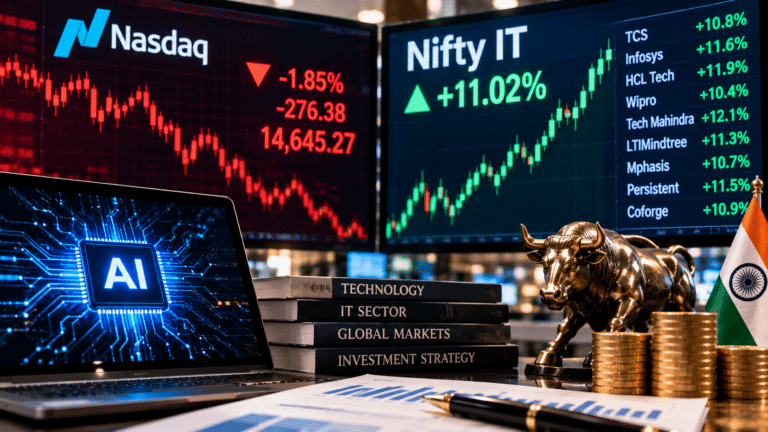
4. 📉 Indian IT Sector Under Pressure from AI Disruption
The IT sector has faced a sharp 2026 selloff, with Nifty IT significantly underperforming its 10-year historical averages. The sector is navigating a dual disruption — global tech spending slowdown and structural pressure from AI automation on headcount-based revenue models.
Immediate Impact: Short-term traders should be cautious on IT. Long-term investors, however, can find value as companies like TCS and Infosys pivot aggressively to AI-led services. Experts like Sunil Subramaniam identify IT as the “dark horse sector of 2026” for contrarian investors.
5. 📊 Q4 FY26 Earnings Season: Over 500 Companies Reporting
The ongoing Q4 FY26 earnings season with 500+ companies releasing results is the single biggest near-term market catalyst. Initial results show improving earnings trajectory — HDFC Securities’ Varun Lohchab notes an “earnings inflection” as India transitions from the low-growth FY25/26 phase into a broader, more robust recovery in FY27“.
Immediate Impact: Positive earnings surprises in banking, pharma, and capital goods will be the key re-rating triggers. Watch HDFC Bank, ICICI Bank, TCS, and Reliance results closely.
🌍 Foreign Indices That Influenced Indian Markets
A positive US market (S&P 500 up 5.6% YTD) provides a strong tailwind for Indian equities, as FPI reallocation decisions are heavily influenced by the relative performance of US vs. EM assets. The Nasdaq’s 9.93% YTD gain is particularly important as it boosts confidence in Indian IT and technology-linked stocks.
🏆 Top 10 Stocks to Buy on NSE/BSE for 2026
Based on analyst consensus from Motilal Oswal, Univest, and leading brokerage research:
1. 🏦 HDFC Bank (HDFCBANK) — CMP ₹744 | Target ₹950+
India’s largest private sector bank. Clean balance sheet, NIM recovery as rate cycle turns, and massive deposit franchise. P/E: 17x — at a 52-week low, offering exceptional value. Sector trigger: rate cuts expanding NIMs.
2. 💻 TCS (TCS) — CMP ₹2,384 | Target ₹3,200+
India’s IT bellwether, pivoting aggressively to AI-led consulting. At its 52-week low of ₹2,162, deep value is emerging. P/E: 22x — historically cheap for TCS. The AI services transformation story makes this a multi-year compounder.
3. ✈️ HAL (HAL) — CMP ₹4,200 | Target ₹5,800+
India’s defence champion in an era of record defence budgets. PLI schemes, Tejas fighter production, and helicopter exports. P/E: 35x — premium justified by 25%+ earnings CAGR. Trigger: Defence indigenisation policy.
4. 🏦 ICICI Bank (ICICIBANK) — CMP ₹1,300 | Target ₹1,600+
Credit cycle recovery, superior ROE, and digital banking leadership. P/E: 17x. Sector triggers: lower NPAs, rate cuts, and strong retail loan growth. Dividend yield: 0.8%.
5. 🏗️ Larsen & Toubro (LT) — Target ₹4,000+
India’s infrastructure mega-conglomerate directly aligned with the government’s ₹11 lakh crore capex push. Order books at all-time highs, international projects expanding. Strong earnings compounding story.
6. 💊 Sun Pharmaceutical (SUNPHARMA) — Sector Compounder
India’s largest pharma company with dominant US generics and specialty drug pipeline. GLP-1 (obesity drug) theme adds a new growth layer. P/E: 38x — premium for global-quality earnings.
7. 🏭 Dixon Technologies (DIXON) — CMP ₹13,500
India’s Apple supply chain play and EMS (Electronics Manufacturing) leader. Direct beneficiary of the PLI scheme for electronics. Explosive revenue CAGR of 45%+. High risk, high reward for growth investors.
8. 🏛️ State Bank of India (SBI) — Target ₹1,100
The engine of Indian credit with a massive balance sheet cleanup. Asset quality improvement + GDP-linked loan growth = earnings visibility. P/E: 9x — deeply undervalued by any metric.
9. ⚡ NTPC (NTPC) — Power Sector Champion
India’s power demand is surging with economic growth, and NTPC is the backbone. Renewable energy capacity expansion and consistent dividend yield of 3%+ make it ideal for conservative investors.
10. 🔋 Persistent Systems (PERSISTENT) — Mid-Cap IT Momentum
The best mid-cap IT story of 2026. Faster growth than TCS/Infosys, strong deal wins, and AI-led service revenues growing 30%+ YoY. P/E: 40x — growth premium fully warranted.
📈 Top 10 Gainers & Top 10 Losers (April 30, 2026 Session)
🟢 Top 10 Gainers — April 30, 2026
🔴 Top 10 Losers — April 30, 2026
🏭 Sector Performance Overview: India 2026
💼 Analysis & Recommendations: Portfolio Strategies for Every Risk Profile
🟢 Conservative Investor (Low Risk) — Capital Preservation + Steady Income
Allocation strategy: 50% large-cap banking + financials, 25% FMCG, 25% pharma
- SBI (P/E 9x, target ₹1,100): Undervalued public sector giant with 3%+ dividend yield
- ITC: FMCG compounding story with 3.5% dividend yield — defensive fortress
- Sun Pharma: Pharma resilience, US drug approvals, GLP-1 optionality
- HDFC Life/LIC: Insurance penetration in India is still low; premiums to compound for a decade
Pros: Steady dividends, low beta, portfolio cushion during downturns
Cons: Capped upside vs. mid-caps; may lag during sharp bull rallies
🟡 Moderate Investor (Balanced Risk) — Growth + Stability
Allocation: 40% large-cap banks + IT, 30% capital goods/defence, 30% pharma + auto
- HDFC Bank (₹744, near 52W low): Banking value play with AI-driven personalisation story
- HAL: Defence compounding at ₹4,200 with a target of ₹5,800+
- Bajaj Auto: EV transition winner, strong Q4 momentum, +4.72% on April 30
- L&T: Infrastructure supercycle beneficiary; order book at record highs
Pros: Diversified across growth sectors; manages volatility better than pure-growth plays
Cons: Requires active monitoring; banking sector has NIM uncertainty risks
🔴 Aggressive Investor (High Risk) — Maximum Growth, High Conviction
Allocation: 50% mid-cap growth, 30% sectoral thematic, 20% large-cap tech
- Dixon Technologies (₹13,500): Apple supply chain, PLI electronics leader, 45%+ revenue CAGR
- Persistent Systems: Best mid-cap IT compounder, AI-driven deal wins
- 360 One WAM: Wealth management explosion as Indian HNIs multiply
- Power sector (Power Finance Corp, REC): India’s energy demand is structural, not cyclical
Pros: Massive multi-year upside; aligned with India’s structural growth story
Cons: High volatility; vulnerable to global risk-off events, FPI outflows
🎯 Stock Recommendations for Today — May 4, 2026
Based on technical and fundamental analysis from multiple research sources:
- BUY HDFC Bank (₹744): At its 52-week low zone, the risk-reward is overwhelmingly favourable. Target ₹920 in 12 months. Stop-loss at ₹710. Banking credit cycle has bottomed.
- BUY Bajaj Auto (₹9,994): Strong fundamental momentum confirmed by +4.72% April 30 surge. EV volume ramp-up in FY27 is the next re-rating trigger. Target ₹11,500.
- BUY HAL (₹4,200): Defence budget at record highs; order pipeline visibility is exceptional. Long-term hold with target ₹5,800.
- ACCUMULATE TCS (₹2,384): Near 52-week lows, the AI pivot justifies a re-entry. Hold with 18-month horizon. Target ₹3,200.
- BUY SBI (target ₹1,100): Asset quality improvement + rate cycle tailwinds. Low P/E of 9x leaves significant upside.
- AVOID Nifty IT broadly (short-term): Sector facing structural headwinds from AI and global IT capex cuts. Stock-specific plays only.
- AVOID Metals (short-term): Nifty Metal down 6.63% in February 2026; China’s demand uncertainty lingers.
- HOLD Nifty Pharma positions: Sector is structurally sound (+1.47% Feb, 10-year export CAGR of 11%). Trim only on sharp rallies above fair value.
- WATCH Nifty at 24,500 resistance: A weekly close above 24,750 on the Nifty 50 will confirm the next upmove toward 25,500–26,000.
- Monitor FII data daily: FPI flows are the swing factor. Any reversal from net selling to net buying will accelerate the breakout.
🌟 Final Thought: The Real Story Behind the Numbers
Here is what the data is quietly screaming that most investors miss: India’s market is not broken — it is digesting. The Nifty 50 is consolidating 9% below its all-time high even as GDP roars to 7.6%, inflation cools to 3.4%, and the RBI has pivoted to rate cuts. The total market cap of listed Indian companies just added ₹51 lakh crore in a single month. Goldman Sachs, Morgan Stanley, and HSBC have all turned bullish on Indian equities for 2026.
The convergence of macro tailwinds — controlled inflation, falling rates, record government capex, and a resilient domestic consumer — sets the stage for what HDFC Securities calls the “next leg of the Indian bull market”. The ₹2 lakh crore of mutual fund dry powder is ammunition waiting for the right trigger.
The key levels to watch this week: Hold above 23,836 on Nifty (support), and aim for a weekly close above 24,750 (confirmation of the next upmove). For long-term wealth creation, the call is unambiguous — accumulate quality Indian bluechips, diversify across banking, defence, pharma, and consumption, and let India’s structural growth story do the compounding for you.
The greatest risk for Indian investors right now is not being in the market — it’s underestimating how fast sentiment can shift when FIIs return to a market that has corrected, re-rated, and is ready to run.
📌 Disclaimer: This article is for informational and educational purposes only and does not constitute financial advice. All investment decisions should be made after consulting a SEBI-registered financial advisor. Past performance is not indicative of future results. Data sourced from NSE India, BSE, RBI official communications, PIB, CNBC-TV18, Business Today, Reuters, and leading brokerage research reports.