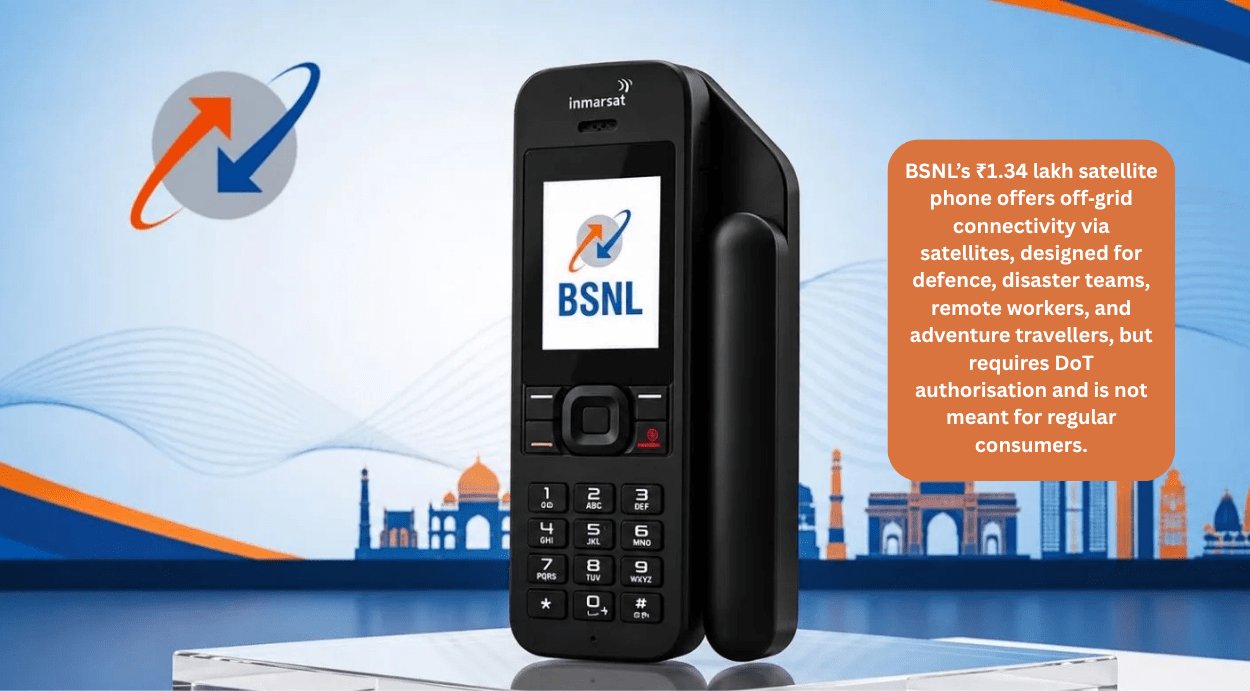
Beyond Mobile Towers: What Makes BSNL’s New ₹1.34 Lakh Satellite Phone So Special For Remote India?
BSNL’s new satellite phone priced at ₹1.34 lakh is a specialised safety and connectivity tool meant for users who operate beyond the reach of normal mobile networks, rather than a mass‑market gadget for everyday consumers. Understanding who can actually buy it and what makes it special is crucial if you are considering it for remote work, disaster management, defence, maritime operations, or extreme adventure travel.
BSNL’s satellite phone launch in India
India’s state‑run telecom operator Bharat Sanchar Nigam Limited (BSNL) has introduced a satellite phone in the Indian market at a price of ₹1,34,166 inclusive of taxes. This device connects directly to communication satellites instead of relying on terrestrial mobile towers, offering voice connectivity in locations where conventional networks fail or do not exist at all. BSNL is positioning this satellite phone as part of a broader mission to extend reliable communication infrastructure to remote, high‑risk, and strategically important regions of the country. The handset is tied to BSNL’s satellite phone service, which historically builds on Inmarsat systems and is regulated tightly by India’s Department of Telecommunications (DoT).
What exactly is a satellite phone
A satellite phone, often called a sat‑phone, is a mobile communication device that uses satellites placed in orbit to route voice calls and limited data instead of cellular base stations on the ground. Unlike typical smartphones that depend on 4G or 5G towers, satellite phones can operate over oceans, deserts, mountains, forests, and border areas where even basic mobile signal bars are non‑existent. These devices tend to be bulkier, more rugged, and more expensive because they integrate specialised radios and antennas, and they are part of a managed ecosystem governed by strict regulatory and security frameworks. For India, satellite phone use also intersects with national security considerations, which is why BSNL’s new phone does not function as a casual consumer gadget you can simply pick up off the shelf.
Price, tariffs, and cost of ownership
The headline price of BSNL’s satellite phone is ₹1,34,166, making it one of the most expensive communication handsets publicly announced by an Indian operator. This amount covers the specialised hardware and applicable taxes, but users must also factor in service plans and per‑minute call charges, which, for satellite connectivity, typically run significantly higher than standard mobile tariffs. Satellite services require dedicated bandwidth via orbital infrastructure, and BSNL’s offering is designed for mission‑critical communication rather than casual chatting, so usage costs reflect this reality. For organisations, the relevant financial question is not just the handset price, but the total cost of ownership when multiple devices, ongoing satellite service, and any regulatory or licensing overhead are included.
Who can buy BSNL’s satellite phone
Although BSNL has launched the satellite phone for the Indian market, it is not open for unrestricted purchase by the general public. India maintains strict rules around satellite phone usage, and BSNL clearly states that interested buyers must secure official authorisation from the Department of Telecommunications (DoT) before they can purchase or use the device. This regulatory filter is designed to ensure that sat‑phones are deployed only in legitimate scenarios where off‑grid communication is essential, and where security and lawful interception requirements are respected. As a result, the phone is effectively targeted at organisations and individuals operating in specialised domains rather than mainstream smartphone users.
Key user groups: defence, disaster, and remote workers
BSNL’s description and media reports indicate that the satellite phone is meant for professionals and teams whose work regularly takes them into communication dead zones. Primary user groups include defence personnel operating in border areas and high‑altitude or forested terrains, maritime crews working on ships and offshore installations, and disaster response teams managing relief and rescue missions during floods, earthquakes, landslides, or cyclones. The device also suits mining staff, infrastructure and energy workers, and field engineers who must maintain connectivity from remote project sites with little or no cellular coverage. Additionally, BSNL and local reports highlight that pilgrims on difficult routes and adventure travellers undertaking trekking, mountaineering, or deep‑forest expeditions are part of the intended audience, provided they secure the necessary DoT permissions.
Regulatory permissions and DoT authorisation
A central aspect that makes BSNL’s satellite phone different from an ordinary mobile is the requirement for prior government approval. In India, you cannot simply walk into a store, pay ₹1.34 lakh, and start using a satellite phone; you must first obtain formal authorisation from the DoT, which reviews the purpose, location, and nature of your usage. This process helps authorities track satellite phones, prevent misuse for illicit activities, and ensure that they remain tools for genuine safety, development, and national‑interest applications. BSNL’s own enterprise documentation for global satellite phone services aligns with these rules, emphasising coordination through designated officers and channels for enquiries, approvals, and operational support.
What makes BSNL’s satellite phone special
BSNL’s satellite phone stands out because it offers connectivity in areas where regular networks simply do not exist, turning communication from “impossible” to “reliably possible.” The device links directly to satellites, giving users the ability to make voice calls and maintain contact from high mountains, dense forests, deserts, deep rural regions, and open seas where standard smartphones drop to zero signal. It is engineered as a robust, mission‑grade tool, typically with durable construction and support for emergency communication scenarios, rather than as a sleek consumer handset focused on apps and entertainment. Combined with BSNL’s backing as a state‑owned operator and the country’s regulatory endorsement, this positions the new satellite phone as a trusted instrument for critical operations in challenging environments.
Off‑grid connectivity as a safety lifeline
A defining value of satellite phones is their role as safety lifelines when conventional infrastructure collapses or is absent. During natural disasters, cell towers can be damaged or power‑starved, leaving local communities and first responders cut off; a satellite phone bypasses this by reaching orbiting satellites unaffected by ground‑level disruption. For mountaineers or trekkers in high‑risk terrain, the ability to place a distress call from an isolated location can mean swift rescue instead of prolonged vulnerability. Similarly, maritime crews can use satellite phones to maintain consistent contact with shore authorities and coordinate emergency responses far from any terrestrial network footprint.
Limitations: why it is not for everyone
Despite the appeal of “signal anywhere,” BSNL’s satellite phone is intentionally not designed for ordinary consumers who simply want better coverage in patchy urban areas. The high cost of the handset, the expensive nature of satellite call tariffs, and the administrative overhead of securing DoT authorisation collectively limit its practicality as a daily communication device for the average user. Moreover, satellite phones are typically bulkier, with visible antennas and limited data features compared to modern smartphones, so they are optimised for reliability, not entertainment or app‑heavy use. For most people, improving standard mobile coverage using traditional operators or waiting for future satellite‑enabled consumer smartphones will be a more realistic path than investing in a specialised sat‑phone today.
How BSNL’s satellite phone fits into India’s telecom landscape
The launch of a regulated satellite phone by BSNL complements India’s broader telecom ecosystem, which now spans legacy 2G and 3G networks, widespread 4G, expanding 5G, and niche satellite services for specialised needs. BSNL’s offering fills a critical gap by serving government agencies, security forces, remote‑area workers, and emergency services that cannot depend solely on terrestrial towers for coverage. It also signals India’s intent to leverage satellite communication more systematically for national resilience, infrastructure management, and development projects in hard‑to‑reach regions. In the medium term, this ecosystem may evolve toward hybrid solutions where consumer phones gain limited satellite messaging or emergency calling capabilities, but BSNL’s current satellite phone remains focused on high‑stakes professional use.
Should you or your organisation consider buying it
Whether BSNL’s satellite phone makes sense for you depends entirely on your use case and your ability to secure regulatory approval. If you are part of defence forces, disaster management agencies, maritime operations, remote mining or infrastructure projects, or organised adventure expeditions, a satellite phone can be an indispensable communication and safety asset. The upfront cost of ₹1.34 lakh and higher calling charges may be justified when weighed against operational continuity, crew safety, and the cost of communication breakdowns in remote environments. However, if your challenges revolve mainly around inconsistent coverage within urban or semi‑urban settings, satellite phones are overkill; you would be better served by network optimisation, multi‑SIM strategies, or upgraded handsets on robust 4G or 5G networks.
Practical steps if you want one
For organisations or authorised individuals who see a clear need for BSNL’s satellite phone, the journey starts with clearly defining the operational scenarios where satellite connectivity is essential. The next step is to move through the DoT authorisation process, documenting your identity, purpose, and deployment plans, and aligning with any security and compliance requirements specified by regulators. In parallel, you would consult BSNL’s enterprise or satellite services division to understand available plans, hardware procurement options, support arrangements, and any integration with existing communication systems. Once approved, training staff to use the satellite phone properly, maintain it, and treat it as a critical emergency asset rather than a casual accessory becomes part of building a resilient communication strategy.
BSNL’s satellite phone
Evaluating BSNL’s satellite phone calls for experience‑driven and expert analysis rather than hype. Real‑world use cases from defence, maritime, and disaster‑response environments show that satellite phones are often the only reliable communication tools when everything else fails, underscoring their authoritativeness in safety‑critical operations. BSNL’s status as a government‑owned operator and the involvement of the DoT in regulating satellite phone deployment strengthen trustworthiness because both entities are accountable to public‑interest and security mandates. At the same time, transparent discussion of the device’s high price, regulatory constraints, and limited appeal for casual users helps maintain credibility by setting realistic expectations rather than promising universal utility.
In day‑to‑day terms, BSNL’s ₹1.34 lakh satellite phone is best understood as a specialised lifeline for professionals and missions operating at the edge of India’s connectivity map, not as a luxury tech toy for regular smartphone users. If your work or expeditions truly take you beyond every signal bar and into regions where communication can be a matter of safety or survival, exploring authorised access to such a satellite phone may be worth your attention.