Apple's ₹2,99,900 iPhone Duo on EMI: What the Instalment Really Costs and Who Can Actually Afford It
Personal Finance · Consumer Credit · India 2026
Apple’s ₹2,99,900 iPhone Duo on EMI: What the Instalment Really Costs and Who Can Actually Afford It
Apple’s first foldable iPhone opens at ₹2,99,900 in India, with pre-orders from 16 October 2026. This explainer sets out the instalment arithmetic at every tenure, the lending data behind India’s EMI habit, and the income level at which a phone loan stops being a risk.
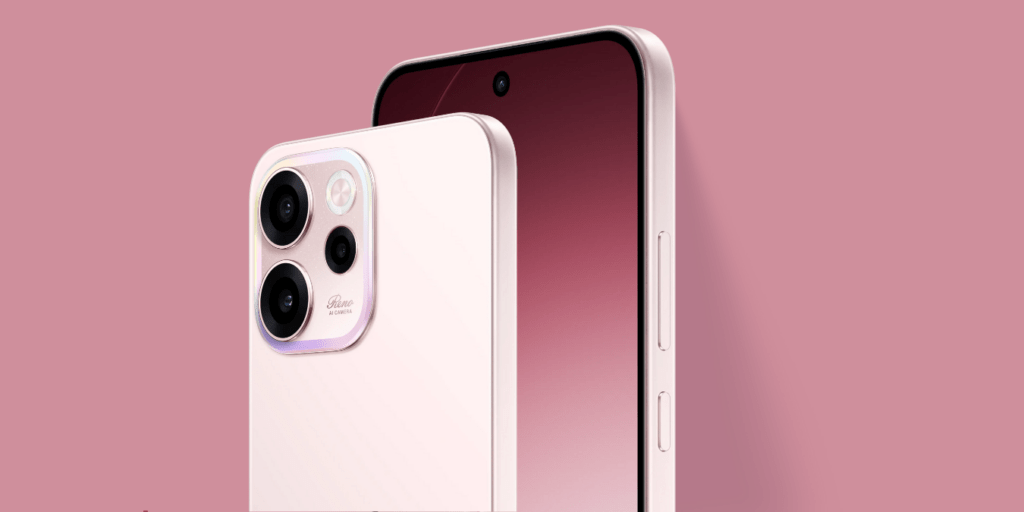
The phone is a foldable. The price is not. Apple has put its first folding iPhone into the Indian market at ₹2,99,900 for the 256GB model, and within hours the conversation online had moved from the hinge to the instalment: how many months, which card, how much a month. That shift is the real story. A device priced like a used hatchback is being discussed as a monthly line item, and the monthly line item is what hides the cost.
Quick Summary
The entry iPhone Duo costs ₹2,99,900, which is ₹1,35,000 more than the iPhone 18 Pro at ₹1,64,900. Financed in full over 24 months at an indicative 16% a year, the instalment works out to roughly ₹14,684 and the total outgo to about ₹3,52,417. A phone instalment is genuinely comfortable only when it stays under about 5% of monthly take-home pay, which at that tenure implies an income near ₹2.9 lakh a month. Counterpoint expects financing to cover 42% of all Indian smartphone sales this year.
The price ladder India climbed in ten days
Two Apple launches landed in quick succession this month, and both moved the ceiling. The iPhone 18 Pro opened at ₹1,64,900 and the 18 Pro Max at ₹1,79,900, each ₹30,000 above the corresponding iPhone 17 Pro launch price a year earlier. Nine days later the iPhone Duo arrived at ₹2,99,900, with pre-orders from 16 October and sales from 23 October.
The Duo is not a slightly dearer flagship. It sits 82% above the 18 Pro, and the top 2TB configuration is reported at ₹4,49,900. Technosports noted that a straight dollar conversion of the Duo’s international price lands near ₹1,90,400, leaving a gap of roughly ₹1,09,500 against the Indian sticker. Some of that gap is tax: at the 18% rate applying to smartphones, about ₹45,747 of the ₹2,99,900 is GST.
Higher prices have not dented Apple’s Indian business. Counterpoint estimates iPhone shipments rose 24% year on year to 14 million units, with India revenue crossing 10 billion dollars in FY26, while IDC put Apple’s June quarter share at 8.5% even as the overall market shrank.
Why the instalment, not the price, is now the product
India did not suddenly get richer between the iPhone 17 and the iPhone Duo. What changed is the plumbing. Counterpoint expects financing, through non-bank lenders and card EMI schemes, to account for 42% of all smartphone sales in India during 2026, and its research has found EMI use crossing half of purchases in tier-2 cities. Techarc’s Faisal Kawoosa counts 24 models now selling above ₹1 lakh and more than 40 in the ₹50,000 to ₹1 lakh band, which is why tenures keep stretching.
Samsung has pushed a 30-month no-cost EMI on its latest foldables. Apple’s own India offers at launch ran to no-cost EMI for up to six months and instant cashback of up to ₹7,000 on eligible cards. One finding from a Trakin Tech and Techarc study deserves more attention than it got: buyers who had financed a phone before were 3.5 times more likely to finance the next one. Financing is not a one-off decision. It becomes the default.
CRIF High Mark’s most recent quarter makes the point sharper still. Consumer durable loan originations rose 27.4% year on year to 2.9 crore accounts in the first quarter of FY27, origination value rose 36.6%, and the category accounted for 45.5% of all new-to-credit borrower volumes. Outstanding consumer durable loans reached ₹1.2 lakh crore in June 2026. For a very large number of Indians, a gadget loan is now the first credit product of their lives, and their credit history begins with a screen.
The wider context nobody puts on the product page
The RBI reported household debt at 41.3% of GDP at end-March 2025, above the five-year average, led by consumption-oriented retail loans rather than asset-building ones. A home loan buys an appreciating asset. A phone loan buys a device that loses value from the day the box opens. Both show up identically on a credit report, but only one of them leaves you with something worth more than the debt.
What “no cost” actually costs: a checkout decoder
Most buyers never see an interest rate. They see a monthly figure and a phrase. The phrases are where the money hides, and the same phrase can mean different things at Apple’s store, a marketplace and a large-format retailer.
| What you see | What it actually means | Where the cost sits |
|---|---|---|
| No-cost EMI | Interest is charged by the lender, then offset by a discount funded by the brand or the seller | The cash-purchase discount you forgo by choosing EMI |
| Processing fee | A one-time charge to set up the loan | Commonly ₹99 to ₹999 plus GST, deducted upfront |
| GST on interest | 18% tax levied on the interest component, not the phone | Payable even on many no-cost schemes |
| Flat rate | Interest quoted on the full amount for the whole tenure | Roughly 1.8 times the equivalent reducing rate |
| Down payment | The upfront share you pay before financing | Cash out today, lower interest later |
| Foreclosure charge | Penalty for repaying the loan early | Typically a share of the outstanding principal |
| Trade-in or buyback | Credit for your old device, or a guaranteed future value | Conditional on grading, timelines and fine print |
| Card EMI limit block | The financed amount is blocked against your credit limit | Reduced headroom for emergencies until repaid |
| Bounce charge | Fee when an instalment mandate fails | Charged per attempt, plus a bureau record |
One test cuts through all of it: ask what the price is if you pay in full today. If the cash price is lower, the difference is your interest, whatever the offer is called. If a ₹7,000 cashback disappears the moment you select a 24-month plan, that ₹7,000 is the cost of the plan.
The instalment maths the product page does not print
Here is the arithmetic on the entry Duo at ₹2,99,900, financed in full, at an indicative 16% a year on a reducing balance. That rate is representative of unsecured consumer finance for a high-ticket device rather than a quoted Apple offer, and your own rate will depend on the lender and your credit score.
Read the chart backwards and the trap is obvious. The 36-month plan looks like the affordable one because ₹10,544 sounds manageable, but it costs ₹79,669 in interest, which is more than the entire price of a decent mid-range phone. The instalment falls by 80% between the six-month and the 36-month plan while the interest bill rises more than fivefold.
| Tenure | No down payment | 10% down (₹29,990) | 20% down (₹59,980) | 30% down (₹89,970) | Interest saved at 30% down |
|---|---|---|---|---|---|
| 6 months | ₹52,342 | ₹47,107 | ₹41,873 | ₹36,639 | ₹4,245 |
| 12 months | ₹27,210 | ₹24,489 | ₹21,768 | ₹19,047 | ₹7,986 |
| 18 months | ₹18,851 | ₹16,966 | ₹15,081 | ₹13,195 | ₹11,824 |
| 24 months | ₹14,684 | ₹13,216 | ₹11,747 | ₹10,279 | ₹15,755 |
| 30 months | ₹12,195 | ₹10,975 | ₹9,756 | ₹8,536 | ₹19,781 |
Worked example: Rohit, 28, Pune
Rohit earns ₹95,000 a month in hand. He picks the 24-month plan with no down payment: ₹14,684 a month, or 15.5% of his take-home pay, for two years. Over the tenure he pays ₹3,52,417 in all, of which ₹52,517 is interest. Had he paid ₹89,970 upfront and financed the rest, the instalment would fall to ₹10,279 and the interest to ₹36,762, a saving of ₹15,755. Had he instead put ₹14,684 a month into a 12% equity SIP for the same 24 months, he would have finished with roughly ₹4,00,039. The phone is not wrong. The two-year lock on 15.5% of his income is what deserves the second thought.
The income test: at what salary does this stop being risky
Lenders assess whether you can pay. Nobody at checkout assesses whether you should. The standard planning rule is that total EMIs across all loans should stay under 40% of take-home pay, and that a depreciating discretionary purchase should occupy a small slice of that. For phones, a practical threshold used by planners is 5% of monthly income, with 10% as the outer limit.
₹2.94 L and above
₹1.47 L to ₹2.94 L
₹98,000 to ₹1.47 L
₹59,000 to ₹98,000
Below ₹59,000
Apply the same rail to the 30-month plan at ₹12,195 and the comfortable band starts near ₹2.44 lakh a month. The question is never whether the EMI is payable today. It is whether it is payable in the month an appraisal is deferred, rent rises, or a medical bill arrives. Thirty months is long enough for at least one of those to happen.
What actually happens if the instalments stop
Device financing has a recovery mechanism that most buyers have never read about. The RBI issued revised draft amendment directions on the conduct of regulated entities in loan recovery on 20 May 2026, proposed to take effect from 1 October 2026, which for the first time set out when a lender may restrict the functions of a phone bought on a device loan. The safeguards are meaningful, and so is the underlying fact that the option exists.
The limits that protect you, and the one that does not
Under the draft framework, incoming calls, internet access, emergency SOS and government or public safety alerts must remain available at all times, blanket disabling is not permitted, and restriction cannot be used to enforce an unrelated loan. What no rule protects you from is the credit record. A default on a ₹2,99,900 phone sits on your bureau file alongside a home loan application three years later.
What we know
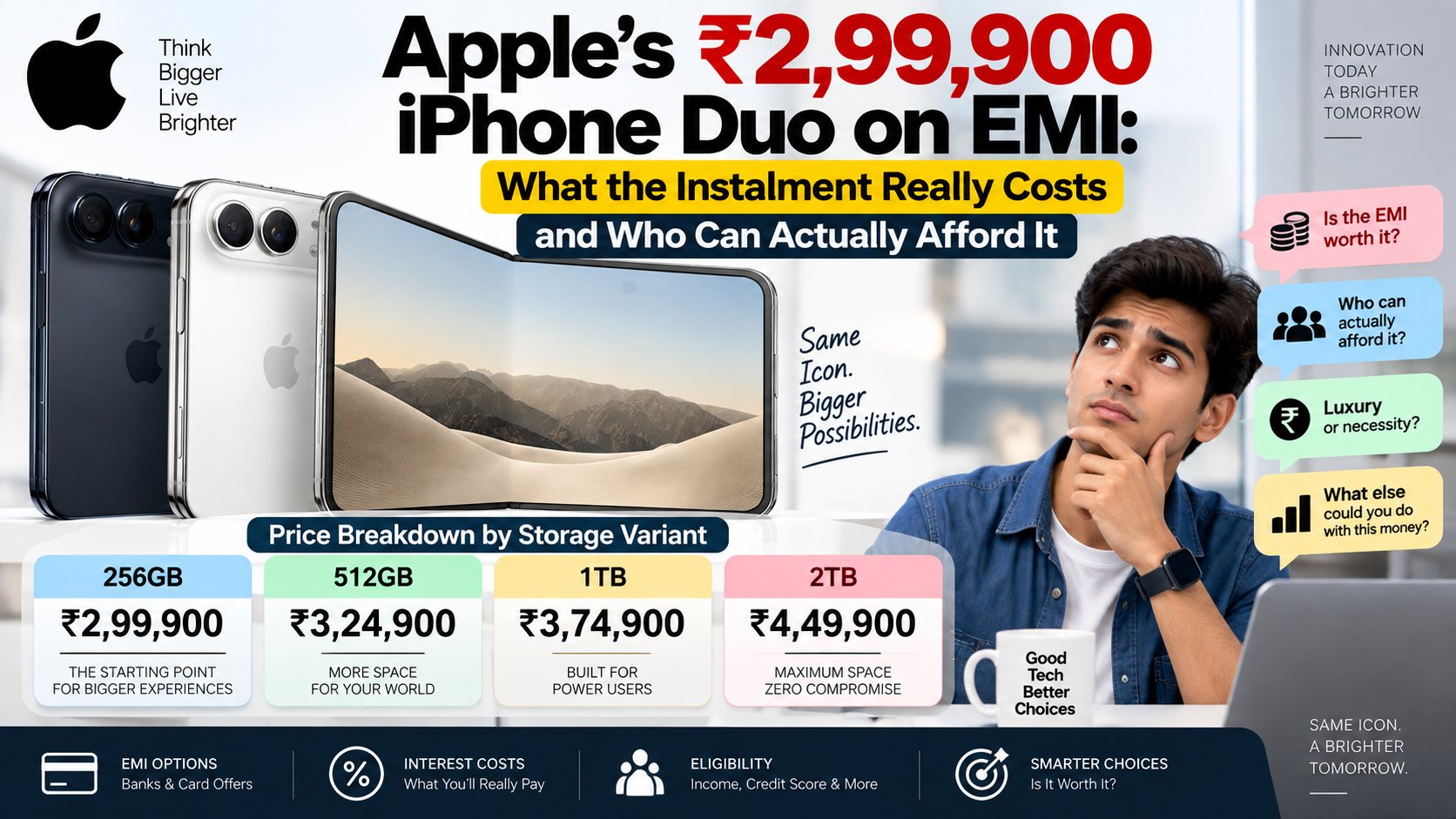
- The iPhone Duo starts at ₹2,99,900 for 256GB, with 512GB at ₹3,24,900 and 1TB at ₹3,74,900. Pre-orders open on 16 October 2026 and sales begin on 23 October.
- The iPhone 18 Pro and 18 Pro Max opened at ₹1,64,900 and ₹1,79,900, each ₹30,000 above the equivalent iPhone 17 Pro launch price.
- Counterpoint expects financing to account for 42% of Indian smartphone sales in 2026, with EMI use above 50% in tier-2 cities.
- Consumer durable loan originations rose 27.4% year on year in the first quarter of FY27 and made up 45.5% of new-to-credit borrower volumes, per CRIF High Mark.
- The RBI recorded household debt at 41.3% of GDP at end-March 2025, driven by consumption loans.
- The NCFE national survey found 27% of Indian adults financially literate, and SEBI’s register held 967 investment advisers as of August 2025.
What is still unclear
- Apple India has not published the financing schemes that will apply to the Duo specifically. Launch offers on the 18 Pro ran to six months of no-cost EMI and up to ₹7,000 cashback, but Duo terms may differ at pre-order.
- The 2TB price has been reported in a narrow range around ₹4.45 lakh to ₹4,49,900 and should be confirmed on the Apple India store.
- Whether lenders will extend 30-month or 36-month tenures to a device at this price point, and at what rate, is not yet published.
- The RBI recovery framework was still in draft at the time of writing, with a proposed commencement date of 1 October 2026. The final text may differ.
- No published data yet shows default rates specific to ultra-premium device loans, so the risk at this ticket size is untested.
If you still want it, buy it this way
None of this is an argument against owning an expensive phone. It is an argument for owning it on terms that do not quietly claim two years of your income. The sequence below is the one a planner would walk you through.
- Check the cash price first. Ask the retailer what you would pay today in full, then compare it with the total of all instalments. The difference is your true interest, regardless of what the scheme is called.
- Cap the instalment at 5% of take-home pay, and treat 10% as an absolute ceiling. For the 24-month plan at ₹14,684, that means ₹2.94 lakh and ₹1.47 lakh a month respectively.
- Pay the largest down payment you can without touching the emergency fund. Each ₹29,990 slice cuts the 24-month instalment by ₹1,468.
- Pick the shortest tenure your budget allows. Going from 36 months to 18 months saves ₹40,257 in interest on the same device.
- Rebuild the emergency fund before you buy, not after. Six months of expenses in a liquid account is what stops a missed salary from becoming a missed EMI.
- Read the foreclosure clause before signing. If a bonus in month eight would let you close the loan, you need to know what closing it costs.
Where to get guidance without being sold something
The reluctance to consult anyone about money is not irrational. Most people who call themselves advisers in India are paid by the products they place, and the fear of being misguided is a reasonable response to that structure. The answer is not avoidance. It is knowing which tier you are talking to, and what each one is paid for.
Fewer than 1,000 SEBI-registered advisers serve more than 20 crore investors, roughly one fiduciary adviser for every two million people in the market. That scarcity, not dishonesty, is the real reason good advice feels inaccessible.
Three questions that filter out bad advice fast
Ask how the person is paid, in rupees and by whom. Ask for the registration number and check it on the regulator’s public register. Ask them to explain the same recommendation in terms of what it costs you if you are wrong. Anyone who cannot answer all three plainly is selling, not advising.
Frequently asked questions
What is the actual monthly EMI on the ₹2,99,900 iPhone Duo?
Financed in full at an indicative 16% a year on a reducing balance, the instalment is about ₹52,342 over 6 months, ₹27,210 over 12 months, ₹14,684 over 24 months and ₹10,544 over 36 months. Total outgo ranges from ₹3,14,050 to ₹3,79,569 depending on tenure. Your actual rate depends on the lender, your credit score and any no-cost scheme applied at checkout.
Is no-cost EMI on an iPhone really free?
Not usually. The lender still charges interest, which is offset by a discount funded by the brand or retailer. If the cash price is lower than the sum of all instalments, that gap is your interest. Processing fees and GST on the interest component are often charged on top. Ask for the full-payment price before choosing any plan.
What income do I need before a ₹2,99,900 phone EMI is safe?
Using the common planning threshold of 5% of monthly take-home pay for a discretionary depreciating purchase, the 24-month instalment of ₹14,684 implies an income near ₹2.94 lakh a month. At the outer limit of 10%, it implies about ₹1.47 lakh. Below roughly ₹98,000 a month the instalment crosses 15% of income, which most planners treat as a warning sign.
How much more does the iPhone Duo cost than the iPhone 18 Pro?
The Duo starts at ₹2,99,900 against ₹1,64,900 for the iPhone 18 Pro, a difference of ₹1,35,000 or about 82%. Against the iPhone 17 Pro’s ₹1,34,900 launch price a year ago, the gap is ₹1,65,000. The top 2TB Duo variant has been reported at ₹4,49,900.
Does buying a phone on EMI affect my credit score?
Yes, in both directions. A device loan is reported to credit bureaus, so instalments paid on time build history, which is why consumer durable loans are now the largest source of new-to-credit borrowers in India. Missed instalments are reported too, and a default stays visible on your file for years, affecting later applications for home or car loans.
Can a lender lock my phone if I miss an EMI?
Not immediately. The RBI’s draft recovery directions of 20 May 2026, proposed to take effect from 1 October 2026, allow function restriction only after the loan is 90 days past due, following a first notice at 60 days with at least 21 days to pay and a second notice allowing at least 7 more. Incoming calls, internet, emergency SOS and public safety alerts must stay available.
Should I choose a longer tenure to reduce the monthly instalment?
Only if the shorter tenure genuinely does not fit your budget. On the entry Duo at 16%, moving from 18 months to 36 months cuts the instalment from ₹18,851 to ₹10,544 but raises total interest from ₹39,412 to ₹79,669. You are also holding debt on a device for longer than most people keep the device.
How many Indians buy smartphones on EMI?
Counterpoint Research expects financing, across non-bank lenders and card EMI schemes, to cover 42% of all smartphone sales in India in 2026, with EMI use already above 50% in tier-2 cities. A Trakin Tech and Techarc study found buyers who had financed once were 3.5 times more likely to finance again.
Where can I get financial advice in India without being sold a product?
Start with free material from the RBI, SEBI and NCFE, then a bank financial literacy centre. For personalised advice, a SEBI-registered investment adviser is paid by you rather than by product commissions and is bound by fiduciary duty. Verify the INA registration number on SEBI’s public register, and ask for written fee disclosure before the first meeting.
Is it ever sensible to buy an expensive phone on EMI?
Yes, when the instalment sits under 5% of take-home pay, the emergency fund is already funded, no other large EMI is running, and the tenure is short. Professionals who earn from the device, such as photographers and creators, can also justify it as a working asset. The problem is not the purchase. It is buying on a tenure longer than your financial visibility.
The short version
Apple’s foldable opens at ₹2,99,900, roughly 82% above the iPhone 18 Pro, and India will mostly buy it by the month. Financing already covers an expected 42% of smartphone sales this year, and consumer durable credit is growing at 20.8% a year while home loans grow at 9.4%. Financed in full over 24 months at 16%, the Duo costs ₹14,684 a month and ₹3,52,417 in total. That instalment is comfortable above roughly ₹2.94 lakh of monthly income and risky below ₹98,000. The device is not the problem. The tenure is.