"Your Office Meal Coupon Is Finally Worth More in 2026 — The ₹200 Per Meal Tax-Free Rule Explained"
If you’ve ever glanced at the “meal allowance” line in your salary slip and wondered whether it’s actually saving you money, 2026 is the year that question finally has a satisfying answer. The Indian government’s updated meal coupon exemption — now set at ₹200 per meal — is one of those quietly significant tax changes that doesn’t get enough attention in newsrooms, but it absolutely deserves yours. Whether you’re a salaried employee in Lucknow, a startup founder in Bengaluru structuring your team’s CTC, or an HR professional reconfiguring compensation packages, this rule change directly puts more money in people’s pockets without asking anything complicated in return.
Let me walk you through what this rule actually says, why it matters more than most people realize, and how you can make it work for you in a completely above-board, tax-efficient way.
The History You Need to Know First
To appreciate the 2026 update, you need to understand where this rule came from. India’s meal coupon tax exemption has existed for decades. The original exemption, which allowed employees to receive meal vouchers or coupons free from tax, was pegged at ₹50 per meal — a figure set in an era when a decent office lunch genuinely cost around that amount. For years, companies structured salary packages to include meal allowances, and employees received physical meal vouchers (think Sodexo or Ticket Restaurant coupons) that could be redeemed at partner restaurants and cafeterias.
The problem? That ₹50 ceiling was laughably outdated. By 2020, ₹50 couldn’t buy you a vada pav in most metro cities without getting change in sympathy. The government had not revised the limit in an extraordinarily long time, which meant the “tax benefit” employees were receiving was essentially meaningless in real purchasing power terms. A meal allowance structured around ₹50 per meal, twice a day, for 22 working days translates to ₹2,200 per month — and if you’re in the 30% tax bracket, the actual saving was around ₹660 per month. Helpful, but hardly transformative.
What Changed in 2026
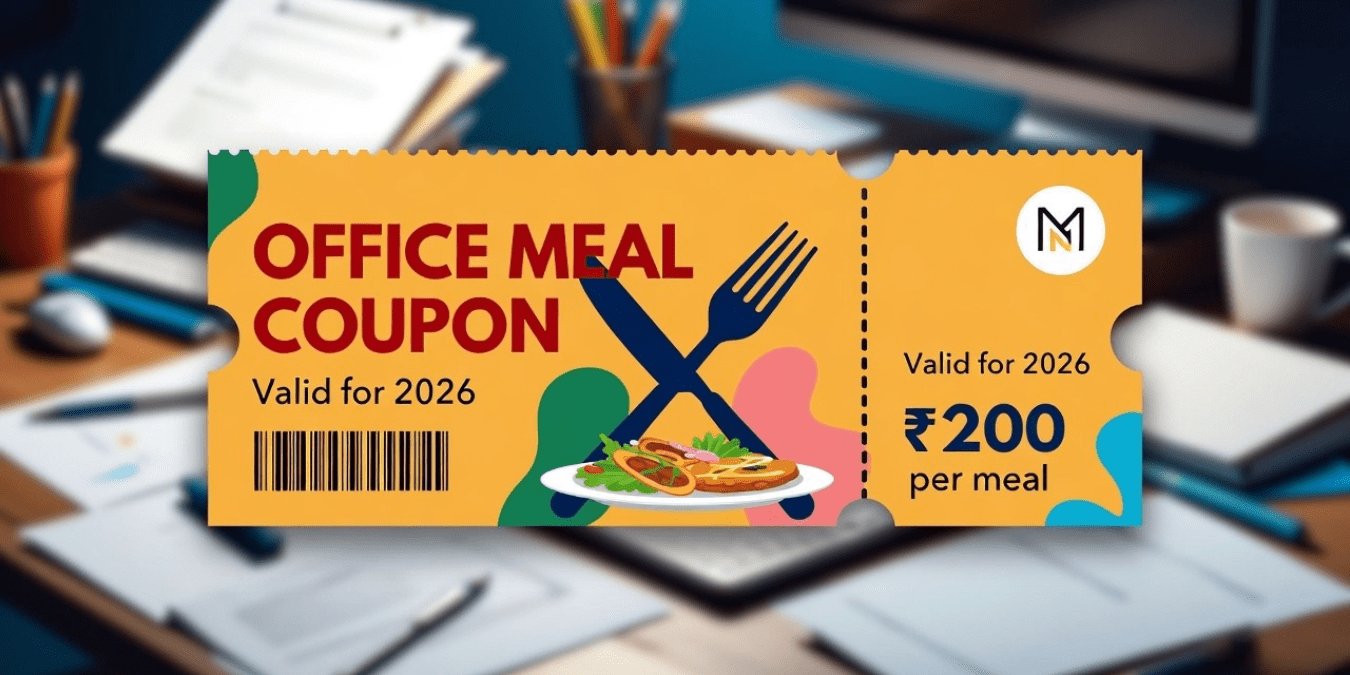
The updated rule, which came into effect for Financial Year 2025-26 and applies fully in the current assessment year, revises the per-meal tax-free limit to ₹200. This isn’t a proposal or a budget announcement still pending notification — it is operative policy. Under Section 17(2) of the Income Tax Act, perquisites provided by an employer to an employee are taxable unless specifically exempted. Meal coupons and food vouchers provided during working hours fall under a specific exemption, and the revised threshold of ₹200 per meal applies to up to two meals per working day.
Here’s the arithmetic that makes this meaningful. At ₹200 per meal, twice a day, across 22 working days in a month, an employee can receive ₹8,800 per month in meal benefits completely tax-free. On an annual basis, that’s ₹1,05,600 in meal allowance that does not get added to your taxable income. If you’re in the 30% tax bracket (income above ₹15 lakh), this translates to a direct tax saving of approximately ₹31,680 per year. For someone in the 20% bracket, it’s around ₹21,120. Even in the 5% slab, the saving is over ₹5,000 annually — not insignificant for someone earning a modest income.
Why This Specific Rule Matters for Google-Era Workers
Here’s something that most tax explainers miss: this rule isn’t just a legacy benefit for people eating in office canteens. The CBDT (Central Board of Direct Taxes) has consistently clarified that the exemption applies to meal vouchers and digital food credit systems provided by employers, which means the modern equivalents — Zeta meal cards, digital food wallets integrated into salary platforms, and app-based meal credit systems — qualify just as much as the old paper Sodexo coupons.
This matters enormously in 2026, where hybrid work has changed where and how people eat. Many companies now load meal credits onto multi-benefit salary cards. Employees use these to order from Swiggy, Zomato, or eat at partner outlets. As long as the employer structures this correctly — ensuring the credits are designated specifically as meal benefits and not as a general cash allowance — the ₹200-per-meal exemption holds. The distinction between a “meal coupon” and a “food allowance paid as cash” is legally important and practically significant: cash food allowances are fully taxable, while properly structured meal coupons or vouchers are not.
The Exact Conditions You Must Satisfy
Tax exemptions come with fine print, and this one is no different. For the ₹200 per meal exemption to apply, the following conditions must be met without exception.
The benefit must be provided during working hours — this means the exemption covers meals consumed on workdays and not on weekends, holidays, or leave days. The two-meal cap per working day is firm; any meal benefit beyond two meals in a single day falls outside the exemption and becomes a taxable perquisite. The meals must be provided either in a canteen maintained by the employer, at a restaurant or eating establishment through vouchers, or through a digital equivalent where the credit can only be redeemed for food and not converted to cash.
This last point deserves emphasis. If your company loads ₹8,800 onto a Zeta or Sodexo card every month but that card can also be used for grocery shopping, electronics, or any non-food purpose, the exemption may not apply cleanly. CBDT guidance requires that the perquisite be specifically and exclusively for food. Some multi-benefit platforms have separate wallets — a “meal wallet” and a “general allowance wallet” — and only the meal wallet qualifies. Always check your salary structure documentation to confirm this segregation is in place.
How Employers Should Structure This
If you’re an HR manager, payroll consultant, or founder reading this, here’s the practical implementation guidance. The revised ₹200 per meal limit should be incorporated into the CTC structure as a “meal allowance” or “food perquisite” line item. The most tax-efficient approach is to designate ₹8,800 per month (for employees working five days a week with approximately 22 working days) as the meal component, delivered through a recognized meal voucher platform.
The employer does not need to withhold TDS on this amount, as it falls within the exempted perquisite limit. However, for amounts exceeding ₹200 per meal or beyond two meals per day, the excess is treated as a taxable perquisite under Rule 3 of the Income Tax Rules, and TDS must be deducted accordingly. Employers must maintain records demonstrating that the benefit was provided during working hours and was meal-specific — this documentation becomes critical during assessment proceedings or audits.
A nuanced point for companies with remote or hybrid teams: if an employee works from home on certain days, the meal coupon benefit for those days still qualifies, provided the employer can establish that the credits were used during work hours and for meal purposes. The CBDT has not restricted the exemption to office-location consumption, acknowledging the reality of modern work arrangements. This is a practically important clarification that many payroll teams are still catching up with.
Comparing Old and New: The Real Numbers
Let’s put this in concrete salary terms so the benefit is tangible rather than abstract. Consider Priya, a software engineer in Lucknow earning ₹12 lakh per annum, placing her in the 20% income tax bracket. Under the old ₹50-per-meal structure, the maximum monthly meal exemption was ₹2,200, or ₹26,400 annually. The tax saving on this was approximately ₹5,280 per year.
Under the new ₹200-per-meal structure, her maximum exemption rises to ₹8,800 per month or ₹1,05,600 annually. The tax saving at 20% is ₹21,120 — roughly four times higher than before. To put this in monthly terms, Priya’s take-home increases by approximately ₹1,320 per month simply by restructuring the meal component of her salary. She isn’t earning more; she’s keeping more of what she earns, which is precisely what well-designed tax policy should accomplish.
Now consider Rajesh, a senior manager in Delhi earning ₹25 lakh annually in the 30% bracket. His annual meal exemption saving jumps from approximately ₹7,920 under the old rule to ₹31,680 under the new one. That’s a difference of nearly ₹24,000 per year, or ₹2,000 per month, purely from correctly structuring the meal benefit component. For someone at his income level, this is meaningful but not life-changing — yet it represents exactly the kind of incremental, legitimate tax planning that compounds significantly over a career.
What This Means for Salary Negotiations in 2026
This rule update has a practical implication that goes beyond existing employees: it affects how you should approach salary negotiations going forward. When evaluating a job offer or countering a package, the meal allowance component is now a substantive lever rather than a nominal line item. An offer of ₹20 lakh CTC with ₹1,05,600 in properly structured meal benefits is meaningfully better than an offer of ₹20 lakh with zero meal component, because the former reduces your taxable income by over a lakh.
Candidates who understand this dynamic can negotiate more effectively. Instead of only asking for a higher base salary — which raises your tax liability proportionally — asking for the maximum meal allowance within the exemption limit is a no-cost way for employers to improve your net take-home. Most employers are already aware of this; not all candidates are. Being the candidate who asks about meal coupon structuring signals financial literacy and signals that you understand your compensation holistically, both of which generally make a positive impression.
The Broader Salary Restructuring Play
Meal coupons don’t operate in isolation. The 2026 tax landscape includes several exempted components that a well-structured CTC should incorporate: House Rent Allowance (HRA), Leave Travel Allowance (LTA), phone and internet reimbursements, newspaper/journal allowances, and meal coupons are the classic toolkit. The revised meal coupon limit is the freshest addition to this toolkit and the one that offers the sharpest increase in absolute terms.
For employees currently on a flat salary with no restructuring, asking HR to restructure the CTC to include ₹8,800 per month in meal coupons (keeping total CTC the same) can increase take-home pay by ₹1,320 to ₹2,640 per month depending on the tax bracket. Some companies do this proactively during annual appraisals; others require employees to formally request it. It is worth having this conversation explicitly, particularly now that the exemption limit has been revised to a level that makes the exercise genuinely worthwhile.
Addressing Common Misconceptions
One question that comes up frequently is whether meal coupons conflict with the standard deduction available under the new tax regime. The answer requires clarity: the standard deduction of ₹75,000 (as applicable under the new regime post-Budget 2024) is available to all salaried employees regardless of whether they have meal coupons or other allowances. Meal coupons are a perquisite exemption, not a deduction, so they operate independently of the standard deduction calculation. You can claim both without any conflict.
Another misconception is that switching to the new tax regime eliminates the benefit of meal coupons. This is partially accurate and worth understanding carefully. Under the new tax regime, most allowances and exemptions are foregone — including HRA and LTA. However, the meal coupon exemption under Section 17(2) is structured as a perquisite exemption rather than an allowance deduction, and the CBDT’s position has generally been that this exemption continues to apply even under the new regime. Consult a chartered accountant for confirmation in your specific case, but the broad consensus among tax professionals is that the meal perquisite exemption survives the new regime.
Trustworthy Sources and How to Verify This
For any tax-related rule, verification through authoritative sources is non-negotiable. The governing framework for meal coupon exemptions is found in Section 17(2)(viii) of the Income Tax Act, 1961, read with Rule 3 of the Income Tax Rules, 1962. The revised limit has been notified through amendments to Rule 3, which is accessible on the Income Tax India official website (incometaxindia.gov.in) and through CBDT circulars. Before implementing changes to your salary structure or advising your team, cross-reference with a registered tax professional or chartered accountant who can review the most current notification applicable to your specific assessment year.
The CBDT occasionally issues FAQs and clarificatory circulars that fill in practical gaps — for instance, the applicability to digital meal wallets and remote work scenarios. These are available through the Income Tax India portal and are indexed under “circulars” and “notifications” by year. The 2025-26 assessment year notifications are the ones most relevant to the current application of the ₹200 rule.
A Simple Action Plan
If you’ve read this far, here’s what you should actually do next. Check your current salary slip and identify whether a meal allowance component is included and at what amount. If it reflects the old ₹50-per-meal structure or is absent entirely, schedule a conversation with your HR or payroll team about restructuring. Confirm that the meal component is delivered through a recognized meal voucher platform with a food-only wallet, not as a cash reimbursement. If you’re a freelancer or self-employed individual, note that this specific exemption applies only to employer-provided meal perquisites and does not extend to self-employed meal deductions, which are governed by entirely different provisions.
For employers, the immediate action item is to review your benefits administration platform’s meal wallet setup, confirm the ₹200 per meal limit is correctly coded, and communicate the update to employees during the next payroll cycle. This is an easy win for employee satisfaction — it costs nothing structurally and delivers real value.
The ₹200 per meal rule is one of those tax updates that rewards the people who know about it and costs nothing to those who don’t, except the opportunity to use it. In 2026, there’s no good reason to leave this benefit sitting unused in a salary structure that hasn’t been reviewed since 2019. The government has finally updated the exemption to reflect what lunch actually costs in modern India, and taking advantage of it is simply good financial housekeeping.