What Is Input Tax Credit Under GST — and Why Does Yours Lapse on 30 November?
GST · Input Tax Credit · India, FY 2026-27
What Is Input Tax Credit Under GST — and Why Does Yours Lapse on 30 November?
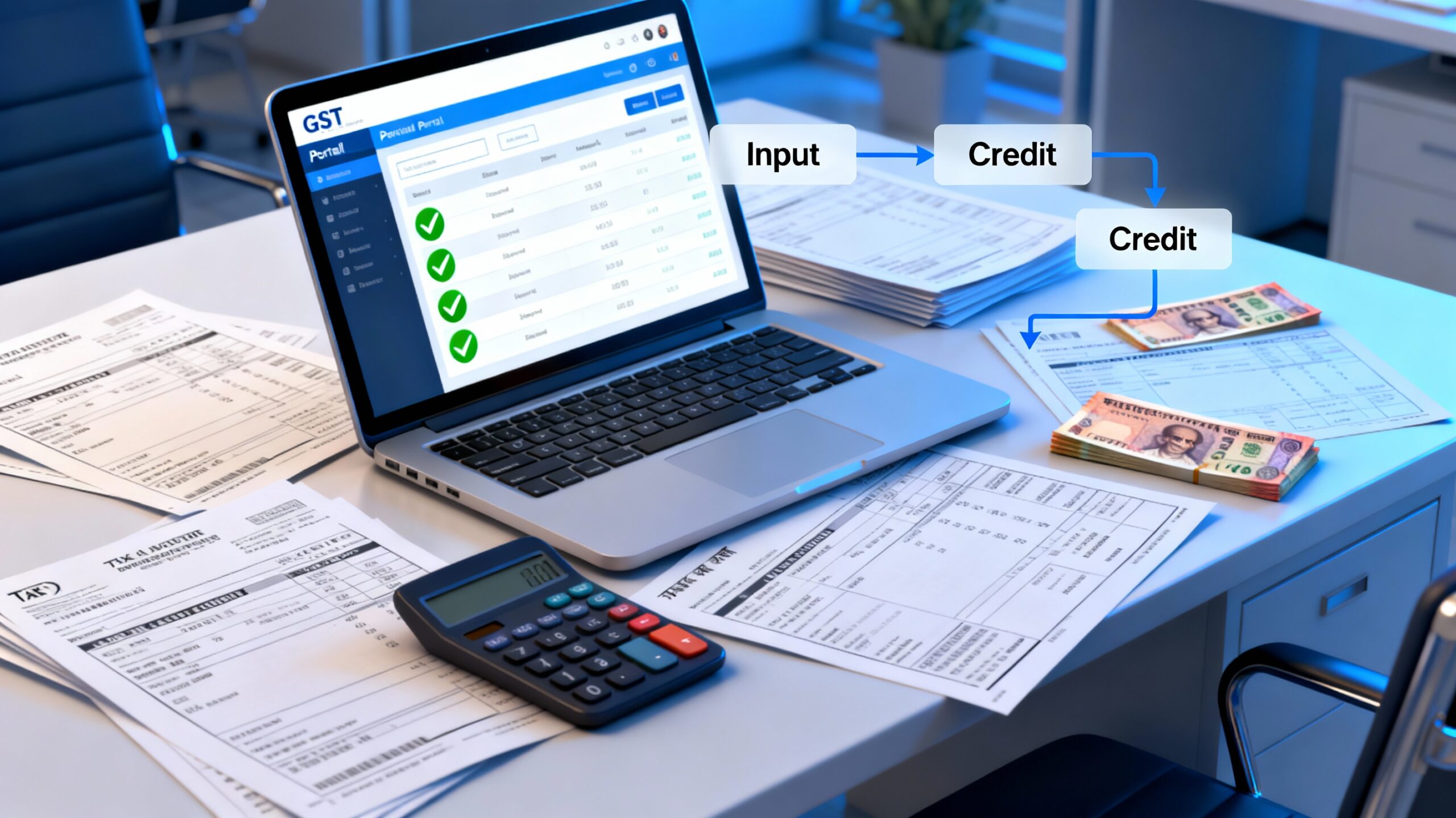
Your books show ₹18,000 of GST paid on purchases. Your GSTR-2B shows ₹12,000. The difference is not an accounting error, it is cash: ₹6,000 you will pay again out of your own bank account unless you find out why the supplier’s invoice never arrived. Input tax credit is the mechanism that makes GST a tax on value addition rather than a tax on turnover, and since April 2026 it has stopped being something you claim and become something you must actively manage every month.
Quick Summary
ITC is the credit of GST paid on business purchases, set off against GST on your sales, so tax lands only on the value you add. Buy for ₹1,00,000 plus 18% and sell for ₹1,50,000 plus 18%, and you pay ₹9,000 in cash, not ₹27,000. Five conditions in Section 16 must all hold, including one you do not control: the supplier must have paid the tax. Since 1 April 2026 the Invoice Management System is mandatory, so credit flows only from invoices you accept before the 14th. And credit for any FY 2025-26 invoice dies on 30 November 2026, or the day you file GSTR-9, whichever comes first.
The one sentence that explains the whole mechanism
GST is charged at every stage of a supply chain, but it is not meant to accumulate at every stage. Without credit, a product passing through four hands would be taxed four times on its full value, and the final price would carry tax on tax. That cascading effect is exactly what the pre-2017 system produced, and it is what Section 16 of the CGST Act, 2017 exists to prevent.
The definition is narrow and worth reading closely. ITC is the credit of GST paid on inputs, input services or capital goods that are used or intended to be used in the course or furtherance of business. Every word in that phrase does work. A purchase that is personal, or that is not connected to your business, does not qualify however clean the invoice looks.
The practical test is the cash impact. In the standard illustration, a trader buys goods for ₹1,18,000 including 18% GST, of which ₹18,000 is tax, and sells them for ₹1,77,000 including ₹27,000 of tax. The output tax of ₹27,000 minus the credit of ₹18,000 leaves ₹9,000 payable in cash. That ₹9,000 is precisely 18% of the ₹50,000 of value the trader added. The chart below shows what happens as the margin moves.
Four things credit does that a rate cut cannot
The first effect is the obvious one: a lower net tax outgo, because you pay on the margin instead of the sale value. The second is cash flow, and it is the one finance teams feel most. Credit sits in the electronic credit ledger and discharges liability without touching the bank account, so a business with heavy input purchases can meet a large output liability with very little cash. The third is the removal of cascading, which is what stops a four-stage supply chain from carrying tax on tax and keeps the final price honest.
The fourth is competitive, and it is underrated. When your buyer can claim credit on what you charge, your price to them is the basic value, not the tax-inclusive figure. A registered supplier who invoices correctly is effectively cheaper than an unregistered one quoting the same number, because the tax comes back to the buyer. That is why large buyers screen vendors on filing history before they screen on price.
The rule of thumb worth remembering
Correct credit lowers your cost base, which lowers the price you can quote, which is why the chain rewards compliance. Broken credit does the reverse: it converts somebody else’s default into a real cost you must either absorb or pass on. Right ITC equals lower cost equals more competitiveness, and the arithmetic behind that slogan is simply ₹27,000 minus ₹18,000.
The five conditions, and the one you cannot control
Section 16 sets conditions that operate together, not as alternatives. Fail any one and the credit is not available, no matter how well documented the other four are.
- You must be a registered person under GST. Composition dealers cannot claim ITC at all, and cannot pass it on.
- The goods or services must be used, or intended to be used, in business. Intention counts, which is why credit on capital goods is available before the asset earns anything.
- You must hold a tax invoice, debit note or other prescribed tax-paying document, carrying the particulars the rules require. A quotation, proforma or bank statement is not a tax-paying document.
- You must have actually received the goods or services. Where delivery is in lots, credit arises only on receipt of the last lot. Bill-to-ship-to deliveries are deemed received by the buyer.
- The supplier must have paid the tax to the government, and the invoice must be communicated to you through the prescribed system. This is Section 16(2)(c) read with the new Section 38, and it is the condition that turns a supplier’s default into your cash loss.
Why condition five moved from theory to enforcement
Section 38 of the CGST Act was substituted with effect from 1 October 2025, removing the description of GSTR-2B as a merely auto-generated statement and tying eligible credit to records accepted through the Invoice Management System. The Central Goods and Services Tax (Fourth Amendment) Rules, 2025 then codified the procedure. In short, the statement that used to be a reconciliation aid became the statutory basis of your claim.
The monthly clock that now decides your credit
IMS went live in October 2024 as an optional dashboard. From 1 April 2026 it applies to every regular taxpayer filing GSTR-3B, and the portal enforces credit against GSTR-2B rather than against your purchase register. That changes the shape of the month.
Suppliers file
Act in IMS
2B locks
Reconcile, file
18% interest
The trap is inaction. If you take no action on a record before GSTR-2B is generated on the 14th, it is deemed accepted and flows straight into your credit. A duplicated, inflated or simply wrong invoice raised in your GSTIN becomes your claim by default, and the burden of explaining it later sits with you.
What each IMS action actually does
Four buttons, four different consequences. This is the table worth keeping open on the 12th of every month.
| Action in IMS | What happens to the credit | What you should do |
|---|---|---|
| No action | Deemed accepted on the 14th. The record flows into GSTR-2B and auto-populates GSTR-3B. | Never rely on this. Review before the 14th, every month. |
| Accept | Flows into GSTR-2B as ITC available, in the table for eligible credit. | Tick it against the purchase register and the goods inward record. |
| Reject | Excluded from GSTR-2B. No credit. The rejection is visible to the supplier. | Ask the supplier to correct it through GSTR-1A, then accept the amended record. |
| Pending | Deferred to a later period. For specified records the hold is limited to one tax period for monthly filers. | Use for goods in transit. Diarise it, or the window closes on you. |
| Rejected credit note | The supplier’s output liability is re-added under Rule 67B, inserted in 2025. | Reject only where you genuinely never reversed the corresponding credit. |
| Auto-flagged ineligible | Shown for information but not creditable, such as records outside the Section 16(4) window. | Do not override it in GSTR-3B. Interest and penalty follow. |
What ITC is worth to you in cash
Read the table across for the effect of the tax rate, and down for the effect of margin. Every figure assumes a purchase with a basic value of ₹1,00,000 and full eligible credit.
| Your margin | Net GST at 5% | Net GST at 18% | Net GST at 40% | Cash cost if 18% credit denied |
|---|---|---|---|---|
| 10% (sell ₹1.10 L) | ₹500 | ₹1,800 | ₹4,000 | ₹19,800 |
| 25% (sell ₹1.25 L) | ₹1,250 | ₹4,500 | ₹10,000 | ₹22,500 |
| 50% (sell ₹1.50 L) | ₹2,500 | ₹9,000 | ₹20,000 | ₹27,000 |
| 75% (sell ₹1.75 L) | ₹3,750 | ₹13,500 | ₹30,000 | ₹31,500 |
| 100% (sell ₹2.00 L) | ₹5,000 | ₹18,000 | ₹36,000 | ₹36,000 |
Worked example: one supplier default, one quarter of profit
A Nashik trader buys stock with a basic value of ₹1,00,000 and 18% GST of ₹18,000, then sells at ₹1,50,000 plus ₹27,000 of tax. With credit, cash GST is ₹9,000. The supplier files GSTR-1 but never files GSTR-3B, so the credit fails Section 16(2)(c) and Rule 37A forces a reversal. The trader now pays the full ₹27,000. On a gross margin of ₹50,000, an ₹18,000 hit is 36% of the profit on that consignment, gone because of somebody else’s filing.
Where credit is blocked outright
Section 17(5) lists purchases on which credit is denied even when every condition in Section 16 is satisfied. These are policy choices, not accidents, and they are the most commonly missed items in a GST audit.
| Clause | What is blocked | Typical example | When it is still allowed |
|---|---|---|---|
| 17(5)(a) | Motor vehicles for passenger transport with up to 13 seats | Company car for the sales head | Resale, passenger transport service, driving school |
| 17(5)(ab) | Insurance, servicing and repair of those vehicles | Annual insurance on the company car | Where the vehicle itself is eligible |
| 17(5)(b)(i) | Food, beverages, outdoor catering, beauty and health services | Client lunch, staff Diwali catering | Same-category outward supply, or obligatory under labour law |
| 17(5)(b)(ii) | Club, health and fitness centre membership | Gym plan for senior staff | No exception |
| 17(5)(b)(iii) | Travel benefits to employees on leave | Leave travel concession tickets | Where an employer is obliged to provide it by law |
| 17(5)(c) and (d) | Works contract and construction of immovable property on own account | Building your own office or godown | Plant and machinery, or an input to a further works contract |
| 17(5)(e) | Goods or services on which composition tax was paid | Buying from a composition dealer | No exception |
| 17(5)(g) and (h) | Personal consumption, gifts, free samples, goods lost, stolen or written off | Diwali gift hampers, damaged stock | No exception |
| 17(5)(i) | Tax paid on certain demands and detention or confiscation proceedings | Tax paid after a fraud demand | Scope was narrowed by the Finance Act 2024; check the period |
The reversal rules nobody reads until a notice arrives
Availing credit is not the end of the matter. Three rules can claw it back after the fact, and two of them depend on events months later.
Three clocks running against your credit
Rule 37: pay your supplier the invoice value plus tax within 180 days, or reverse the credit with interest. Re-avail it when you eventually pay. Rule 37A: if the supplier has not filed GSTR-3B by 30 September following the financial year, reverse by 30 November. Rules 42 and 43: where you make both taxable and exempt supplies, common credit is apportioned monthly, with capital goods spread across 60 months and a true-up at year end. Re-availment under Rules 37 and 37A is not barred by the Section 16(4) time limit; a plain missed invoice is.
One more reversal became live with the rate reform. When GST 2.0 took effect on 22 September 2025, collapsing the slabs into 5% and 18% with a 40% demerit rate, a rate cut alone did not require reversal. But where an output supply became fully exempt, Section 18(4) does bite and the credit attributable to it must go back. Businesses that simply carried on claiming after their product moved to nil are the ones now receiving queries.
The deadline that ends every argument
Section 16(4) fixes an outer limit. Credit on any invoice or debit note for a financial year must be taken in a GSTR-3B filed by the earlier of two dates: 30 November of the following year, or the date you file the annual return for that year.
That last point catches people every year. If you file GSTR-9 for FY 2025-26 in October 2026, your ITC window shuts in October, not in November. Reconcile first, file the annual return second. There is no amendment, no DRC-03 and no appeal that recovers a credit lost to Section 16(4), with one narrow exception: Sections 16(5) and 16(6), inserted by the Finance (No. 2) Act 2024, retrospectively validate credit for FY 2017-18 to FY 2020-21 taken in any GSTR-3B filed up to 30 November 2021, and courts have been setting aside old demands on that basis.
Why the department is watching this number
ITC is the single largest leakage point in GST, and the enforcement data is not subtle. In a Rajya Sabha reply, the Ministry of Finance reported that central tax formations detected fraudulent ITC of ₹74,782 crore across 30,162 cases in FY 2025-26, with 358 arrests. Cases have more than doubled in a year.
This matters to an honest business for one reason. Analytics systems such as ADVAIT and BIFA look for anomalous credit flows and circular trading across networks, and a genuine buyer sitting two steps downstream of a shell entity gets pulled into the same investigation. Vendor diligence is no longer a procurement nicety; it is credit protection.
If your credit is stuck, work up this ladder
The monthly ITC checklist
Frequently asked questions
What is input tax credit under GST in simple words?
It is the GST you paid on business purchases, which you set off against the GST you collect on sales. If you paid ₹18,000 of tax on inputs and collected ₹27,000 on your sales, you deposit only the ₹9,000 difference. The effect is that tax lands only on the value you added, not on the whole sale price at every stage.
Why does my ITC lapse on 30 November?
Section 16(4) of the CGST Act sets the outer limit for claiming credit at the earlier of 30 November following the financial year, or the date you file that year’s annual return. For FY 2025-26 invoices, the November 2026 GSTR-3B is the last return that can carry the credit. After that it is permanently forfeited; no amendment or appeal restores it.
What are the five conditions to claim ITC under Section 16?
You must be registered; the goods or services must be used or intended for business; you must hold a tax invoice or other prescribed document; you must have received the goods or services; and the supplier must have paid the tax and reported the invoice through the prescribed system. All five must hold together. Failing any one denies the credit entirely.
Is the Invoice Management System mandatory now?
Yes for regular taxpayers filing GSTR-3B, with effect from 1 April 2026. Composition taxpayers are outside it. Every B2B invoice, debit note and credit note your supplier saves appears on your IMS dashboard, and only accepted or deemed-accepted records flow into GSTR-2B. Take your actions before the 14th, when GSTR-2B is generated.
What happens if I take no action on an invoice in IMS?
It is treated as accepted. The record flows into your GSTR-2B on the 14th and auto-populates your GSTR-3B, including any invoice that is duplicated, inflated or raised in your GSTIN by mistake. Explaining it afterwards is your problem, not the supplier’s, so a monthly review is now part of the compliance routine rather than an optional check.
Can I claim ITC if my supplier has not filed their return?
No. Section 16(2)(c) requires the tax to have actually reached the government. If the supplier has not filed GSTR-3B by 30 September following the financial year, Rule 37A requires you to reverse the credit by 30 November. You can re-avail it once the supplier files, and that re-availment is not blocked by the Section 16(4) deadline.
Which purchases are blocked under Section 17(5)?
Motor vehicles up to 13 seats and their insurance and repair; food, beverages, outdoor catering, beauty and health services; club and gym memberships; employee leave travel; construction of immovable property on your own account; goods bought from composition dealers; personal consumption, gifts, free samples and written-off stock. Several carry narrow exceptions, mainly where the same category is your outward supply.
Did the GST rate changes of September 2025 affect my existing credit?
A rate cut on its own does not require reversal, because the supply remains taxable and credit already availed stays valid. Reversal arises under Section 18(4) where an output supply became fully exempt from 22 September 2025, or where you moved to composition. If your product went to nil, revisit the credit attributable to it and the closing stock immediately.
What is the interest and penalty on wrongly claimed ITC?
Interest runs at 18% a year under Section 50 where credit was wrongly availed and utilised. Penalty follows the nature of the default, rising sharply where fraud or wilful misstatement is alleged, and offences above ₹5 crore are cognizable and non-bailable under Section 132. Voluntary reversal with interest before a notice is issued is materially cheaper than defending one.
Can ITC be claimed on capital goods and how?
Yes, if the asset is used in the course of business, and the condition of intended use means you need not wait for revenue. You cannot claim both ITC and depreciation on the tax component, so the GST must be excluded from the capitalised cost. Where the asset serves both taxable and exempt supplies, Rule 43 spreads the credit over 60 months.
The short version
ITC exists so that GST taxes value addition rather than turnover, which is why a trader adding ₹50,000 of value at 18% pays ₹9,000 and not ₹27,000. Five conditions in Section 16 govern it, and the fifth depends entirely on your supplier’s discipline. Since April 2026 the credit chain runs through IMS, so the 12th to the 14th of every month is when your claim is actually decided. Blocked items under Section 17(5) never enter the ledger, Rules 37, 37A, 42 and 43 can pull credit back afterwards, and Section 16(4) ends the conversation on 30 November. Reconcile monthly, vet vendors, and file the annual return only after the year has been swept.