Can You Apply Yet for the ₹25 Lakh Family Cover — and What to Do Until Registration Opens?
Oommen Chandy Health Insurance Scheme: Can You Apply Yet for the ₹25 Lakh Family Cover — and What to Do Until Registration Opens?
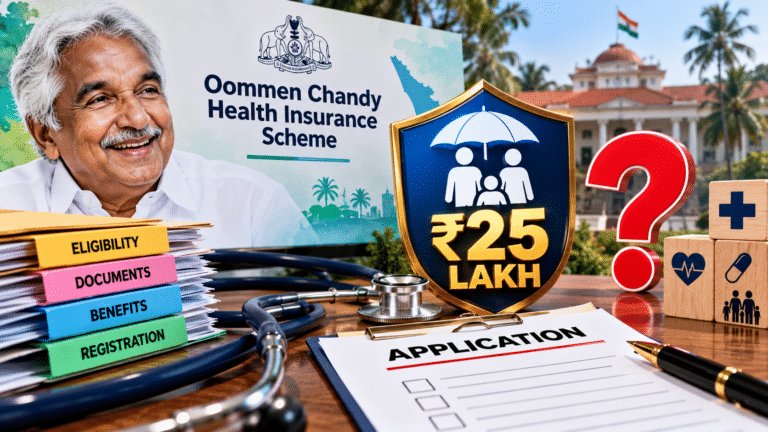
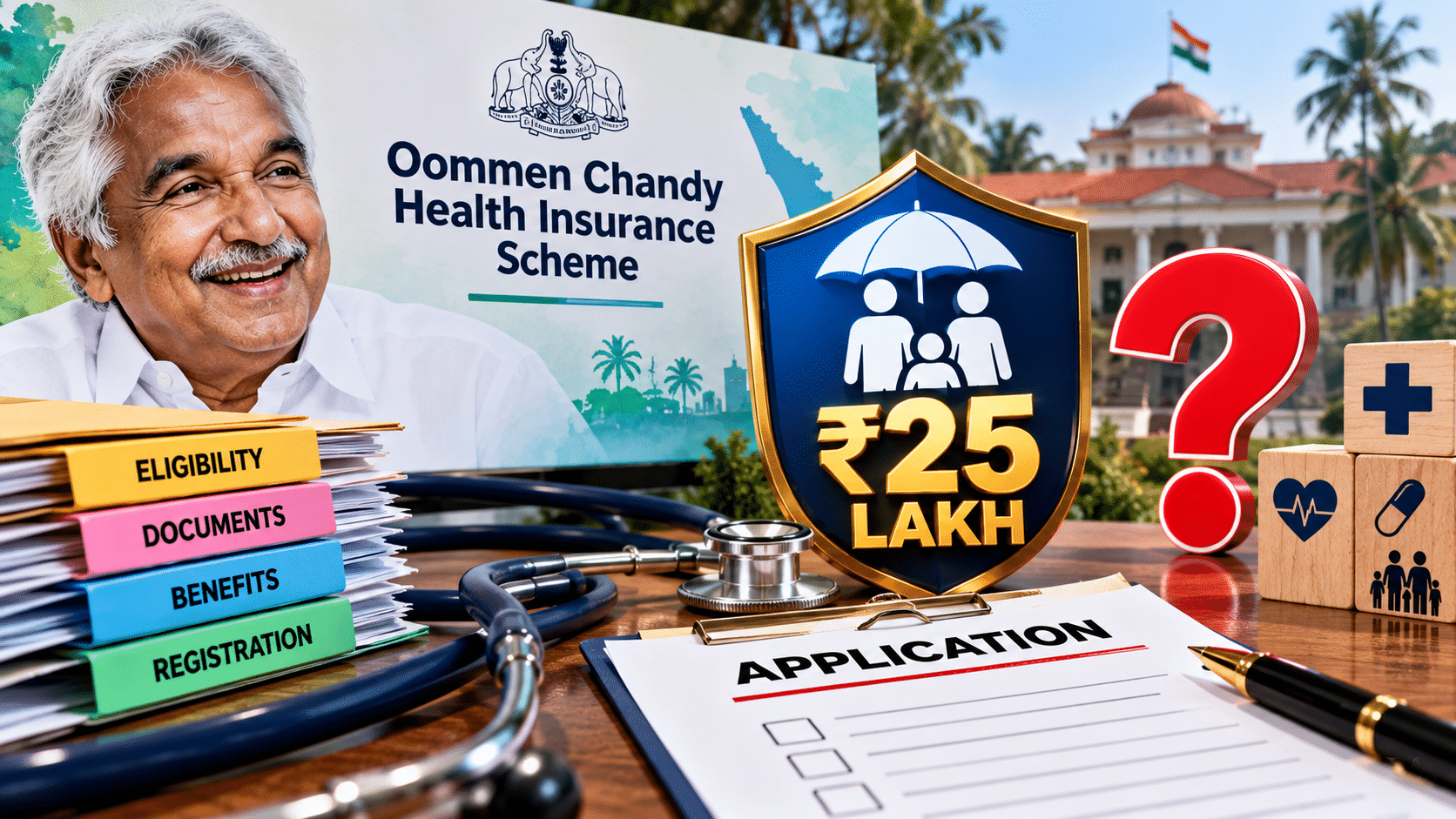
Kerala’s government has announced a health insurance scheme with up to ₹25 lakh cover per family, named after former Chief Minister Oommen Chandy. An expert panel is still preparing the project report, and no official application process has been released.
Messages saying “Oommen Chandy health insurance: apply now” are circulating, and many Kerala families are searching for the form. The honest answer is that there is no form yet. The scheme has been announced, funded for preparatory work and handed to a technical committee, but the rules that decide who gets what, and how to enrol, have not been published.
That gap matters for two reasons. Families who need hospital care today still have to rely on existing schemes such as KASP. And any website or agent asking for your Aadhaar or bank details to “register” you now is not acting on behalf of the government. Here is what has actually been decided, what has not, and how to prepare.
Why ₹25 Lakh Is Such a Big Jump
The headline number stands out because Kerala’s main existing scheme, Karunya Arogya Suraksha Padhathi or KASP, covers up to ₹5 lakh per family per year. The proposed scheme would raise that ceiling five times and, unlike KASP, aims to include every family rather than a pre-identified group.
The reason for the push is cost. Kerala households spend more on hospital care than the national average. MoSPI’s Comprehensive Annual Modular Survey for 2022-23, as cited by Ditto, puts average out-of-pocket hospitalisation spending in Kerala well above the all-India figure in both cities and villages.
From Poll Promise to Project Report: The Story So Far
The scheme is named after Oommen Chandy, who served as Chief Minister of Kerala from 2004 to 2006 and from 2011 to 2016, and died in July 2023. Kerala Kaumudi notes that his government was associated with the earlier Karunya health assistance programme. The UDF promised the new scheme before the 2026 Assembly election and won with a large majority.
The early Onam target was missed, which is normal for a scheme of this size. Insurance companies cannot quote a premium until the benefit packages, hospital rates and number of covered families are fixed, and those are exactly the questions the committee is examining.
The People Designing It
According to Onmanorama, the committee is headed by the Principal Secretary of the Health and Family Welfare Department. Its members include the Finance and Planning secretaries, the executive director of the State Health Agency, and three insurance industry veterans: Girish Radhakrishnan, a former chairman of United India Insurance and former Insurance Ombudsman for Kerala; P J Joseph, a former IRDAI member; and K Sanath Kumar, a former chairman of National Insurance Company.
One option under study is running the scheme through the Kerala State Health Agency, which already manages KASP, with cashless treatment at empanelled government and private hospitals. That would allow the new scheme to build on an existing network rather than start from scratch.
Free for Some, Paid for Others? The Premium Question
The scheme is often described as free health insurance for every family, but that is not quite what the Chief Minister has said. Speaking in the Assembly on June 22, 2026, V D Satheesan said cover need not be free for high-income families, Onmanorama reported. BPL and economically backward families are expected to be exempt from premiums, while higher-income households may pay.
What people often get wrong is assuming “cover for all families” means “free cover for all families”. On current statements, every family may be eligible to join, but not every family will join free. The premium amount will be fixed only when the government signs agreements with insurance companies.
| Scheme | Maximum cover | Who it covers | Premium for member | Status |
|---|---|---|---|---|
| Oommen Chandy scheme | ₹25 lakh per family | All families, as proposed | Free for poorer families; likely paid for higher income | Project report in progress |
| KASP | ₹5 lakh per family per year | Pre-identified families, SECC and RSBY/CHIS lists | Free | Active; to be merged |
| Karunya Benevolent Fund | Treatment assistance | Low-income patients outside KASP | Free | Active; to be merged |
| Ayushman Vay Vandana | ₹5 lakh per year | People aged 70 and above | Free | Active nationally |
| Medisep | ₹3 lakh a year at 2022 launch | State employees and pensioners | Deducted from salary or pension | Merger under consideration |
Six Questions the Committee Must Settle
The four-month project report is where the scheme’s real shape will be decided. Based on what ministers and reports have said so far, these are the questions that matter most to families.
- Who pays and how much. The income line between free and paid cover, and the premium for those above it, will decide how many households actually join.
- Family size. Onmanorama reported that the government had not decided whether single-member and multi-member families get the same cover. A flat ₹25 lakh per family favours larger households.
- Hospital rates. Private hospitals are to be partners, but they will join only if package rates cover their costs. Low rates have been a common complaint under government schemes across India.
- Merging existing schemes. KASP and the Karunya Benevolent Fund are to be merged. Medisep and central schemes are still being studied, and each has its own funding and rules.
- Insurance or trust model. The state could buy cover from insurers or pay hospitals directly through the State Health Agency. The choice affects cost control and claim settlement.
- Enrolment method. Whether families are enrolled automatically from existing records or must register will decide how quickly cover reaches people.
How the Scheme Could Affect Different Families
Because the final rules are not out, nobody can say exactly what each household will receive. But the statements so far make it possible to sketch the likely position for common situations. Treat these as possibilities, not entitlements.
Families already in KASP
These families stand to gain the most directly. They already receive free cover of up to ₹5 lakh, and the government’s plan to merge KASP into the new scheme suggests they would move across without paying a premium, with a much higher ceiling.
Middle-income families with no cover
This is the group the scheme is designed to bring in. Many such families are outside KASP but cannot easily afford private insurance. If they fall above the income line for free cover, they may pay a premium, which could still be cheaper than a comparable private policy. The premium has not been set.
Government employees and pensioners
They are covered by Medisep, funded through salary and pension deductions. Whether Medisep is folded in is still under consideration, so these families should assume their current cover continues unchanged for now.
Families with private health insurance
Nothing announced so far requires anyone to give up a private policy. Until the new scheme’s terms, waiting periods and hospital list are known, dropping existing cover would be risky.
What You Can Do Right Now
With no registration open, the most useful steps are to protect your existing cover and get your paperwork ready for whatever the final rules require.
- If your family is in KASP, keep using it. Check eligibility at an empanelled hospital or through the State Health Agency helpline, 1056 or 0471 4063121.
- Make sure your ration card lists every family member correctly, since existing state schemes identify families through such records.
- Check that each member’s Aadhaar is linked to a working mobile number for OTP verification.
- Keep an income certificate handy if you expect to claim free cover as a lower-income family. The final income limit is not yet known.
- Follow the State Health Agency website, sha.kerala.gov.in, and official government announcements for the notification.
- Do not pay anyone or share bank details to “register early”. Official enrolment has not started.
What Happens to KASP and Karunya
For current beneficiaries, the biggest question is continuity. Onmanorama reported in July 2026 that the Karunya Arogya Suraksha Padhathi and the Karunya Benevolent Fund are to be merged into the new scheme, with Medisep, public sector employee schemes and Ayushman Bharat-linked programmes still under consideration.
No date has been announced for any merger, and existing schemes remain in force. A merger would most likely be timed with the new scheme’s launch, so families do not face a gap in cover. KASP itself is tied to the central Ayushman Bharat PM-JAY programme for many beneficiaries, which means the state will need to settle how central funding and state funding fit together under the new name.
Using KASP while you wait
KASP is open only to pre-identified families: those with valid RSBY or CHIS cards from 2018-19, and those identified through the SECC 2011 data who received the Prime Minister’s letter, according to Ditto. New registrations are not widely open beyond these groups. If your family is on the list, treatment is cashless at empanelled hospitals for more than 1,500 listed procedures, with hospital help desks handling verification.
Bring your ration card and Aadhaar when you are admitted, and ask the help desk to confirm your eligibility before treatment starts. If your family is not on the list, ask the hospital or the State Health Agency helpline about the Karunya Benevolent Fund and other assistance. Do not wait for the new scheme if you need treatment now.
Frequently Asked Questions
How can I apply for the Oommen Chandy Health Insurance Scheme?
You cannot apply yet. As of October 27, 2026, no official application form, portal or registration process has been released. A technical committee is preparing the detailed project report, after which the government must approve and notify the scheme.
What is the cover under the Oommen Chandy scheme?
The government has said the scheme aims to provide up to ₹25 lakh health cover per family. Final terms, including treatment packages and conditions, will be set after the project report and agreements with insurers.
Is the Oommen Chandy health insurance free for everyone?
Not necessarily. Chief Minister V D Satheesan said in the Assembly on June 22, 2026 that cover need not be free for high-income families. BPL and economically backward families are expected to be exempt from premiums.
When will the Oommen Chandy scheme start?
No launch date has been announced. The technical committee formed in September 2026 has four months to submit its report, which points to around January 2027, before cabinet approval and notification.
Will KASP continue until the new scheme starts?
Yes. KASP remains in force, offering up to ₹5 lakh per family per year to eligible families. The government plans to merge it into the new scheme, but no merger date has been announced.
Who is eligible for the Oommen Chandy scheme?
The government intends to cover all families in Kerala, with minimal income restrictions. Detailed eligibility rules, including income limits for free cover and treatment of single-member families, have not yet been notified.
Which hospitals will be covered?
Treatment is expected to be cashless at empanelled government and private hospitals, possibly through the State Health Agency, which runs KASP. No hospital list has been published for the new scheme.
Is the WhatsApp link to register for the scheme genuine?
No official registration link has been issued. Do not share Aadhaar, bank or OTP details through such links. Wait for an announcement from the Kerala government or the State Health Agency.
The Short Version
The Oommen Chandy Health Insurance Scheme is Kerala’s plan to give every family up to ₹25 lakh of health cover, five times KASP’s ₹5 lakh. It was announced in the June 2026 budget with ₹10 crore for groundwork, and a technical committee has until about January 2027 to prepare its project report. There is no application process yet, so “apply now” messages are premature. Poorer families are expected to get free cover, while higher-income families may pay a premium. Until launch, keep using KASP, update your records and ignore unofficial registration links.