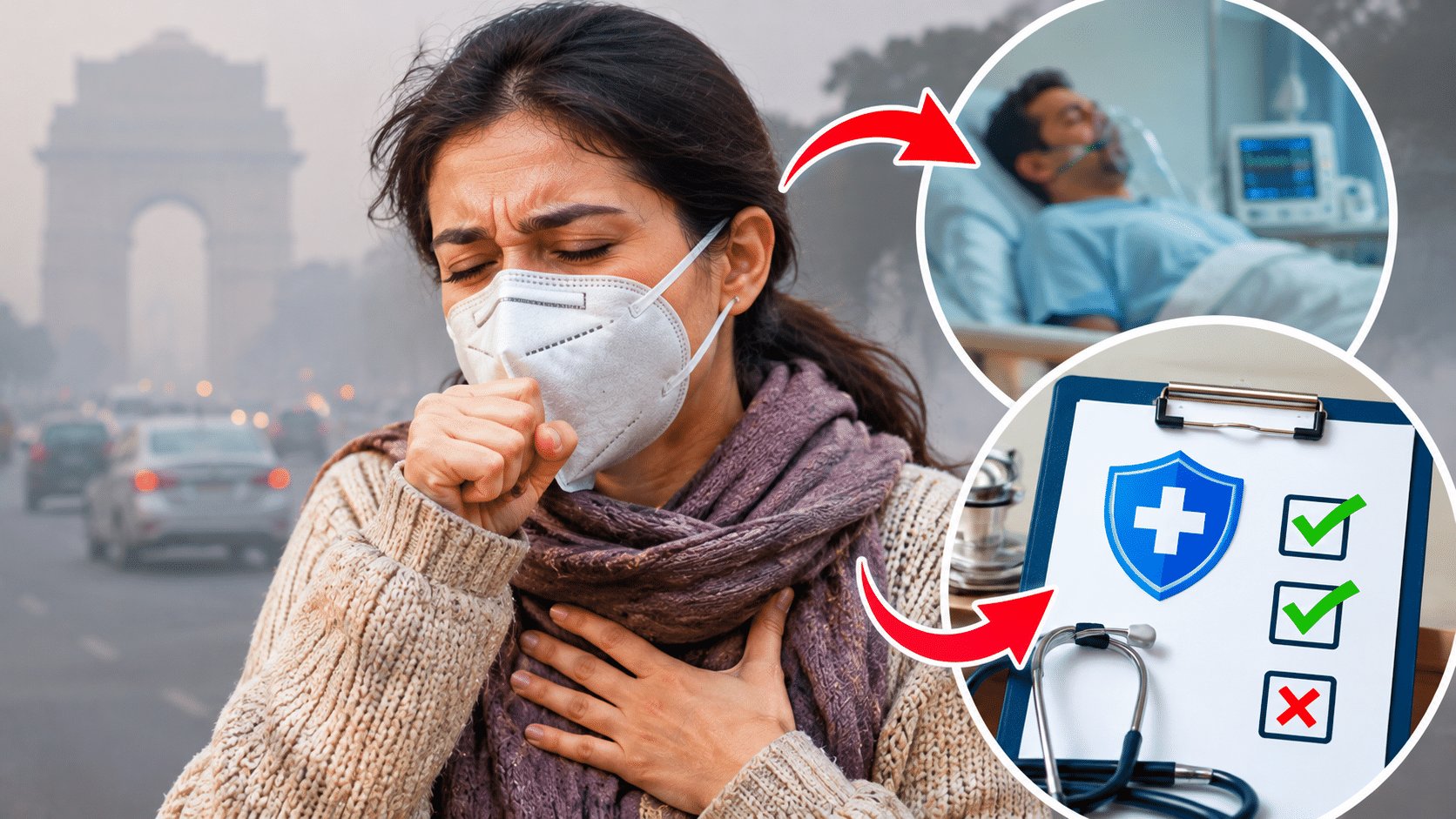
Does Health Insurance Cover Pollution-Related Illness? What Your Policy Pays For — and Where Smog-Season Claims Fall Apart
Health insurance · Air pollution · India 2026
Does Health Insurance Cover Pollution-Related Illness? What Your Policy Pays For — and Where Smog-Season Claims Fall Apart
Indian health policies do not exclude illness because air pollution caused it. Hospital stays for asthma, COPD and pneumonia are covered; inhalers, clinic visits and air purifiers usually are not.
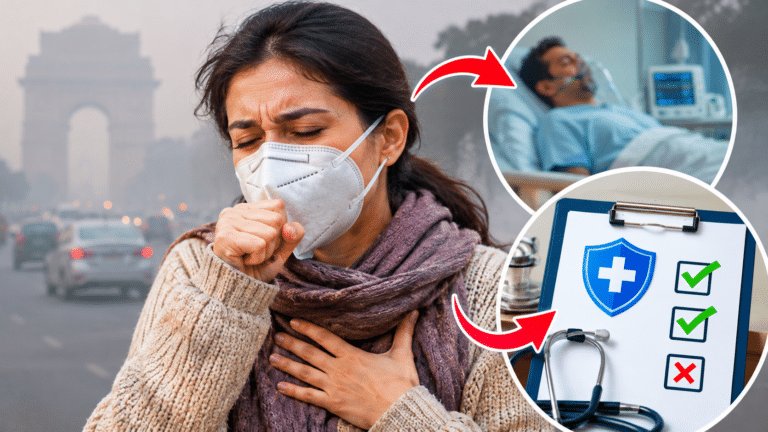
Delhi’s air quality index stood at 117 on 31 October 2026. Four days later it was 379, and Jahangirpuri had crossed 449. Somewhere in that week, a child woke up wheezing, a 64-year-old with COPD could not finish a sentence without stopping for breath, and a family started wondering whether their health policy would actually pay. Air pollution is not written into any policy as a cause of illness, covered or excluded. That turns out to matter less than three other things: whether you were admitted, whether the condition was declared, and whether your add-ons cover the costs that happen outside a hospital.
The smog is already showing up in claim files
Insurers do not record “pollution” as a diagnosis, so analysts link claims to pollution by the conditions treated: asthma, COPD, bronchitis, arrhythmia, eczema and conjunctivitis. Using that method, Policybazaar told CNBC TV18 in November 2025 that pollution-linked illnesses made up 6.4% of hospitalisation claims in 2022 and 9% in 2025. In September 2025, almost one in ten hospitalisation claims fell into this group.
- 1.72 mnDeaths in India attributed to PM2.5 in 2022, per the Lancet Countdown
- 9.5%Share of GDP lost to premature deaths from outdoor air pollution, 2022
- 38%Delhi’s share of pollution-linked claims, per Policybazaar
- 14%Relative rise in pollution-linked claim share, 2022 to 2025
- ₹19,076Average daily hospitalisation cost on these claims
- 10-15%Premium hike that some insurers were considering for high-pollution zones
The health toll behind those claims is large. The Lancet Countdown on Health and Climate Change, released on 29 October 2025, attributed about 1.718 million deaths in India in 2022 to fine particulate (PM2.5) pollution, 38% more than in 2010. It valued the premature deaths at USD 339.4 billion, or 9.5% of GDP.
City average AQI, CPCB readings as reported by Business Today, 4 November 2026. Hotspot figure is Jahangirpuri on 3 November.
“Pollution illness” is not a category your insurer uses
This is the most common misunderstanding about the topic. A health insurance policy in India does not list causes it pays for. It lists treatments it pays for, such as in-patient admission, day-care procedures, ICU, ambulance and the bills before and after a stay. The standard list of exclusions that IRDAI requires insurers to use covers things like cosmetic surgery, adventure sports and substance abuse. It does not exclude illness caused by bad air.
So an asthma attack set off by smog is treated the same way as one set off by pollen or a cold. The real questions are whether the treatment needed hospital care, whether the condition is new or pre-existing, and whether your policy’s sub-limits will shrink the payout.
Where the line actually falls: covered, partly covered, not covered
- Usually coveredHospital careAdmission of 24 hours or more for asthma, COPD flare-ups, pneumonia or a heart event. ICU, oxygen, nebulisation in hospital, tests during the stay, plus 30 days of bills before and 60 days after, in a standard policy.
- Depends on planGrey zoneDay-care procedures, home treatment that replaces a hospital stay, AYUSH treatment, health check-ups, and consultations under an OPD or teleconsultation add-on.
- Rarely coveredDaily living costsMasks, air purifiers, routine inhalers and nebulisers for home use, ordinary clinic visits, and admissions mainly for tests or observation.
The middle column is where people get caught out. A child given a nebuliser in an emergency room and sent home after four hours may not count as an in-patient admission. Whether that visit is paid depends on your policy’s definitions of day care, emergency care and OPD.
| Expense in smog season | Base hospitalisation policy | With OPD or wellness add-on | What to check in your wording |
|---|---|---|---|
| Admission for asthma or COPD flare-up | Covered | Covered | Pre-existing disease waiting period, room-rent cap |
| ICU and oxygen support | Covered | Covered | ICU limit, such as 5% of sum insured |
| Tests and medicines in the 30 days before admission | Covered | Covered | Number of days, linked to the same illness |
| Follow-up medicines in the 60 days after discharge | Covered | Covered | Number of days, bills and prescriptions kept |
| Doctor consultation without admission | Usually not | Up to OPD limit | Annual OPD cap, network clinics |
| Inhaler or home nebuliser | Usually not | Sometimes, as pharmacy cover | Pharmacy limit, prescription needed |
| Air purifier or N95 masks | Not covered | Rarely | Wellness rewards may give discounts |
| Home treatment instead of admission | Policy-specific | Policy-specific | Domiciliary or home-care clause |
Who is filing these claims — the age split is surprising
Children account for far more pollution-linked claims than any other group. Policybazaar data reported in November 2025 showed that 43% of pollution-linked claims were for children aged 0 to 10. Adults aged 31 to 40 made up 14%, and people over 60 made up 7%.
Percentage of pollution-linked claims. Source: Policybazaar data reported by Insurance Business Asia and Tribune/ANI, November 2025. Other age groups not separately reported.
The “all other ages” row is our calculation: what remains of 100% once the three reported groups are taken out. It is not broken down further in the published data. Universal Sompo’s chief customer officer, Varsha Gujarathi, told Business Standard that children under 14 and adults over 60 were the most affected, and that claim frequency peaks in the two to three winter months.
Delhi leads, but it is not alone
Delhi accounted for 38% of pollution-linked claims in the Policybazaar data. Other cities had a high share of pollution-linked claims within their own claim books too, including some that are not usually thought of as smog capitals.
Percentage of claims linked to pollution. Source: Policybazaar data as reported by Insurance Business Asia, November 2025.
What a smog-season hospital stay actually costs
Pollution claims are not unusually large. They are frequent. Business Standard, citing Policybazaar, put the average pollution-related claim at ₹55,263, against ₹61,319 for other claims, with an average daily hospital cost of ₹19,076. Universal Sompo told the paper that typical claims ran between ₹60,000 and ₹80,000, rising above ₹2 lakh in severe ICU cases.
₹ per claim. Sources: Policybazaar and Universal Sompo via Business Standard, November 2025. Universal Sompo’s figures are the insurer’s own estimate of typical ranges.
Costs are also rising faster than general prices. Policybazaar’s data showed respiratory treatment costs up 11% and cardiac complication costs up 6% between FY23 and FY24. WTW’s 2026 Global Medical Trends survey of 346 insurers in 82 countries forecast a 14% rise in medical costs across Asia-Pacific for 2026.
Worked example: a four-day asthma admission. Take four days at the average daily cost of ₹19,076. That is a bill of ₹76,304, our calculation. Suppose the patient has Arogya Sanjeevani, the standard policy every insurer must sell, with a ₹3 lakh sum insured. Its 5% co-payment means the family pays ₹3,815 and the insurer about ₹72,489, before any deductions for items the policy does not pay for.
Now suppose the family chose a ₹7,500-a-day room. Arogya Sanjeevani caps room rent at 2% of the sum insured, up to ₹5,000 a day, which is ₹5,000 here. Many policies then cut linked charges, such as doctor fees, in the same ratio: ₹5,000 out of ₹7,500 is 66.7%. On a bill like this, choosing a room above the cap can cost far more than the ₹2,500-a-day difference in rent. Our illustration; how deductions are worked out varies by policy.
Why pollution claims get cut or rejected
When a pollution-linked claim is reduced or refused, the reason is rarely the pollution. It is usually one of four policy rules, and each is avoidable if you know about it in advance.
1. Asthma or COPD you did not declare
If you were diagnosed with asthma, allergic bronchitis or COPD before buying the policy, it counts as a pre-existing disease. You must declare it on the proposal form. Under IRDAI’s 2024 master circular, insurers can make you wait up to 36 months before covering it, down from 48 months earlier. If you hide it, the insurer can reject a claim. After 60 months of continuous cover, the moratorium period, it can no longer question the policy over non-disclosure, except in cases of fraud.
2. An admission that looks avoidable
An admission that is mainly for tests or observation, with no active treatment, is a classic reason for rejection. Ask the treating doctor to record the clinical reasons for admission clearly: oxygen saturation, breathing rate, and response to emergency treatment.
3. Room-rent and ICU caps
Caps, such as 2% of the sum insured for a room and 5% for ICU in standard policies, can trigger proportionate deductions across the whole bill. A policy with no room-rent limit removes this problem.
4. The initial waiting period
Most new policies do not pay for illness, as opposed to accidents, in the first 30 days. Buying cover in the middle of a smog emergency will not help with an admission that week.
What people get wrong: assuming a child’s earlier “wheezing” visits do not count. If a doctor diagnosed or treated a respiratory condition before you bought the policy, declare it. A declared condition with a waiting period is far better than an undeclared one that leads to a rejected claim.
Rules that work in your favour
IRDAI’s master circular on health insurance, issued in May 2024, set several timelines that matter when someone is admitted with breathing trouble at 2 a.m.
- Deadline for an insurer to decide on a cashless request
- Deadline to authorise final discharge on a cashless claim
- Longest pre-existing disease waiting period allowed
- Moratorium, after which non-disclosure cannot be raised except for fraud
The same reforms removed the upper age limit for buying a new health policy, which helps older people living in polluted cities who never had cover. Outlook Money also reported that annual premium increases for senior citizens are capped at 10%.
Timeline: how we got here
- Baseline year for the Lancet’s 38% rise in PM2.5 deaths
- IRDAI master circular sets 1-hour and 3-hour cashless timelines
- Lancet Countdown reports 1.718 million PM2.5 deaths in India in 2022
- Data shows pollution-linked claims at 9%; insurers consider 10-15% hikes
- HDFC ERGO reports a significant rise in respiratory claims in north India
- Delhi AQI at 117
- Jahangirpuri hotspot hits 449
- City AQI 379; GRAP Stage II in force
Will your premium go up because you live in Delhi?
It might. Gujarathi told Business Standard in November 2025 that insurers were considering premium increases of 10% to 15% in zone- or city-based pricing, with location and season used as risk factors. As of this update, no regulator-approved, pollution-specific surcharge had been announced across the industry.
Do not drop cover to save on premium. If you let a policy lapse and buy a new one later, the waiting periods for pre-existing conditions start again. Asthma diagnosed in the gap counts against you on the new policy.
A smog-season claim, step by step
- Save your insurer’s or TPA’s helpline number and the e-card on your phone before the winter peak.
- Prefer a network hospital so you can request cashless treatment; the insurer must respond within 1 hour.
- Ask the doctor to record the clinical reason for admission, not just “observation”.
- Keep pharmacy bills, prescriptions and test reports from the 30 days before admission.
- Choose a room within your policy’s room-rent limit if there is one.
- After discharge, file follow-up bills within the time limit for the 60-day post-hospitalisation period.
- If the claim is cut, ask for the reason in writing, complain to the insurer’s grievance cell, then the Insurance Ombudsman.
Your pre-winter policy audit
- Sum insured of at least ₹5 lakh for a metro family; ICU stays can exceed ₹2 lakh
- Room rent: no cap, or a cap that fits your city’s hospitals
- Pre- and post-hospitalisation: at least 30 and 60 days
- Asthma or COPD declared; note when its waiting period ends
- Day-care list includes respiratory procedures
- OPD or teleconsultation add-on if a child has frequent wheezing
- Restore benefit for a second admission in the same year
- Co-payment: know your share, such as 5% in Arogya Sanjeevani
- Network hospitals within 5 km of home
- Super top-up if your base cover is ₹5 lakh or less
Pollution and health cover: the questions people search most
Does health insurance cover illness caused by air pollution?
Yes, if the treatment fits the policy’s terms. Policies cover treatment, not causes, so a hospital admission for asthma, COPD, pneumonia or a heart problem linked to pollution is paid like any other admission, subject to waiting periods and sub-limits.
Is asthma covered by health insurance in India?
New asthma diagnosed after you buy the policy is covered after the initial waiting period. Asthma diagnosed earlier is a pre-existing disease that must be declared and may have a waiting period of up to 36 months.
Are inhalers and nebulisers covered?
Usually not for use at home, unless you have an OPD or pharmacy add-on. They are covered when used in hospital, and often within the 30 days before or 60 days after an admission.
Can I claim the cost of an air purifier from my insurer?
Generally no. Air purifiers and masks are not treated as medical treatment. Some wellness programmes offer discounts but do not reimburse them.
Is a short emergency visit for nebulisation covered?
It depends on your policy’s definitions of day care, emergency care and OPD. An emergency visit of a few hours without admission is often not paid under a basic hospitalisation policy.
Will my premium rise because I live in a polluted city?
Some insurers were reported to be considering increases of 10% to 15% in zone-based pricing, but no industry-wide pollution surcharge had been announced as of November 2026.
Can I buy health insurance during smog season and claim right away?
Not for illness. Most policies have an initial 30-day waiting period for illness, and conditions you already had are subject to longer waiting periods.
How quickly must an insurer approve a cashless claim?
Under IRDAI’s 2024 master circular, insurers must decide on a cashless request within 1 hour and authorise discharge within 3 hours.
The short version for a smoggy morning
Your health policy does not care that the cause was smog. It pays for hospital treatment of asthma, COPD, pneumonia and heart problems the same way it pays for any other illness, subject to waiting periods, co-payments and room-rent caps. It usually will not pay for clinic visits, home inhalers or purifiers unless you have an OPD add-on. Declare any existing respiratory condition, keep your cover continuous, pick a policy without a room-rent cap if you can, and check these details before winter, not in the emergency room.