Credit score · Credit cards and loans · India 2026
Clear Credit Card Dues or Prepay a Loan First? What Actually Lifts Your CIBIL Score Faster in 2026
For most borrowers, paying down card balances moves the score faster than prepaying an EMI loan, because card utilisation is recalculated every cycle. It is usually the cheaper choice too. Overdue payments are the exception: clear those before anything else.
A bonus has landed, or perhaps a tax refund. You have ₹1.2 lakh to spare and two nagging debts: a credit card bill you have been rolling over and a personal loan with three years left. You also need a better credit score, because a home loan application is coming in six months. Which debt should the money go to?
The intuitive answer is the bigger debt, the loan. For your credit score, that is usually the wrong one. Credit scores in India treat revolving card balances and instalment loans very differently, and since July 2026, lenders report your data to credit bureaus every week, so the right move now shows up faster. Here is how the choice works, with the numbers.
What Your Score Is Actually Measuring
TransUnion CIBIL does not publish its exact algorithm, but bank and bureau explainers consistently describe four factor groups with approximate weights. Payment history, whether you pay EMIs and card bills on time, carries about 30%. Credit exposure or utilisation, how much of your available credit you are using, about 25%. Credit type and duration, the mix of products and length of history, about 25%. Other factors, including recent enquiries and new accounts, about 20%.
Share of score, %, as commonly cited by banks and bureau explainers such as Axis Bank and Moneyview. CIBIL does not publish exact weights. Bars scaled to the largest.
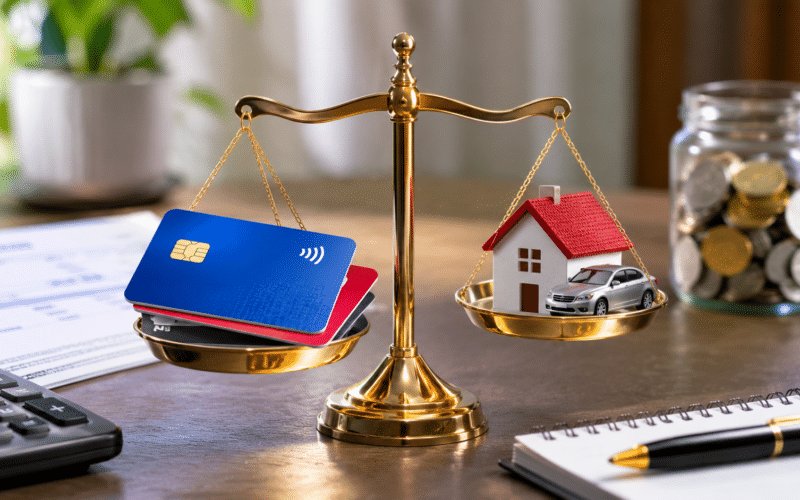
The key difference is in how cards and loans feed into these factors. A credit card is revolving credit: your limit stays open and your balance moves every month. Utilisation compares that balance with your limit, so it can change sharply in a single billing cycle. A personal, car or home loan is instalment credit: the outstanding amount falls on a fixed schedule. Paying it down early reduces your total debt, but scoring models do not treat a loan balance the way they treat a card’s percentage of limit used.
What people get wrong: assuming the biggest debt hurts the score most. A ₹20 lakh home loan paid on time can sit alongside an excellent score. A ₹1.5 lakh card balance on a ₹2 lakh limit, at 75% utilisation, can drag the same score down noticeably, even if every bill is paid.
Why Card Dues Usually Move the Needle First
Credit utilisation is the fastest-moving lever in your score. As one widely circulated explainer on UNI puts it, unlike payment history, which takes years to build, utilisation can be improved in a single billing cycle. Most banks and bureau guides recommend keeping utilisation below 30% of your total card limits, and below 10% if you can.
- 0% to 10%StrongSignals restraint; best for scores
- 10% to 30%HealthyCommonly recommended range
- 30% to 50%CautionCan start to weigh on the score
- Above 50%High riskSignals reliance on credit
Worked example, our illustration. Ankit has two credit cards with a combined limit of ₹3 lakh and a balance of ₹1.5 lakh, so his utilisation is 50%. He also has a personal loan with ₹4 lakh outstanding, paid on time. He has ₹1.2 lakh to put towards debt.
If he pays the cards, his balance falls to ₹30,000 and utilisation drops to 10%. If he prepays the loan instead, the loan falls to ₹2.8 lakh, but card utilisation stays at 50%. The first choice changes a heavily weighted factor in one cycle. The second barely touches it. If he also asked for a limit increase to ₹4.5 lakh without spending more, his utilisation at the original balance would fall to about 33%.
Card balance as % of total card limit, our calculation from the worked example. Lower is better. Bars scaled to the highest.
Score and savings point the same way
Card debt is usually also the most expensive debt you carry. Credit card interest in India commonly runs at 3% to 3.75% a month on rolled-over balances, roughly 36% to 45% a year, while personal loans typically cost much less and secured loans less still. That means paying the card first usually saves the most money as well as lifting the score. Rates vary by bank, card and borrower, so check your own statements.
₹ per year, our illustration using assumed annual rates: card 42%, personal loan 13%, car loan 9.5%, home loan 8.5%. Simple interest on a constant balance; your rates will differ. Bars scaled to the highest.
In Ankit’s case, using the same assumed rates, ₹1.2 lakh paid to the cards would avoid about ₹50,400 a year in interest, against about ₹15,600 if prepaid on the personal loan. Both the score and the wallet favour the cards.
When the Loan Should Come First
There are clear exceptions. The first is any overdue payment. Payment history carries the most weight, and a CIBIL analysis reported by the Financial Express found that a 30-day delinquency can reduce a score by around 100 points. If an EMI is overdue, bringing it current matters more than cutting card utilisation. The same applies to an overdue card bill: paying at least the minimum due on time protects payment history, even if the full balance cannot be cleared.
| Your situation | Pay first | Effect on score | Effect on interest | Watch out for |
|---|---|---|---|---|
| Card utilisation above 30%, all payments current | Card balances | Usually the fastest lift | Usually the biggest saving | Do not close the card after paying |
| An EMI or card bill is overdue | The overdue amount | Stops further damage to payment history | Avoids late fees and penal charges | Ask the lender to update the bureau |
| Card utilisation already below 10% | Highest-rate loan | Small | Saves interest | Check prepayment charges |
| Applying for a home loan soon | Cards, then any small personal loans | Lower utilisation and lower EMIs both help | Improves eligibility | Avoid new credit applications |
| Loan near its end | Cards | Closing the loan changes credit mix slightly | Little interest left to save | Get a no-dues certificate on closure |
| Settled or written-off account | Close it as “paid in full” if possible | Settlement remarks hurt for years | Varies | Confirm the bureau status changes |
Reducing loans matters for approval, not just score
A lender looks beyond the score. Your existing EMIs reduce how much new loan you qualify for, because banks cap total monthly obligations as a share of income. If a home loan application is close and a small personal loan is eating into your eligibility, closing it can matter even if the score barely moves. The order still usually holds: bring card utilisation down first, then close small, high-rate loans.
Why “settling” a card can backfire
When card debt becomes unmanageable, banks and recovery agents sometimes offer a one-time settlement for less than the full amount. It ends the immediate pressure, but the account is typically reported as “settled” rather than “closed”, and lenders read that as a sign the borrower did not repay in full. That remark can weigh on loan approvals for years. If you can manage it, negotiating a payment plan to repay the full balance, or converting the outstanding into an EMI with the same bank, usually protects the score better than a settlement. If you have already settled, paying the waived amount later and asking the lender to update the status to closed can help.
How Fast Will the Score Change Now?
Speed has changed this year. Under the RBI’s Credit Information Companies amendment directions, issued on 4 December 2025, lenders have reported data to bureaus four times a month since 1 July 2026, as on the 9th, 16th, 23rd and last day of each month, according to bank and fintech explainers. Before that, reporting was fortnightly from January 2025, and monthly earlier.
Days, approximate, as summarised by CardTrail and IIFL. A visible score change can still take longer depending on lender and bureau cycles. Bars scaled to the longest.
- RBI announces fortnightly credit information reporting.
- Fortnightly reporting takes effect, as on the 15th and month-end.
- RBI releases draft directions for weekly reporting.
- Final amendment directions issued.
- Weekly reporting in force, as on the 9th, 16th, 23rd and month-end.
Time your payment to the statement, not the due date. Card issuers usually report the balance on your statement. Paying a large part of the balance before the statement is generated can mean a lower utilisation is reported, rather than waiting for the due date three weeks later.
- 750 to 900Score band commonly described as excellent
- About 100 pointsPossible drop from a 30-day delinquency, per a CIBIL analysis
- 9, 16, 23, month-endReporting dates each month since July 2026
- 2 to 6 weeksTypical time for a payment to show in your score, per IIFL
- 4 bureausCIBIL, Experian, Equifax and CRIF High Mark
- Under 10%Utilisation level often linked with the strongest scores
Check the report before you pay anything
Before deciding where the money goes, download your report from at least one bureau. Errors are more common than most people assume: a closed card still showing a balance, a loan you repaid marked as overdue, or an account that is not yours at all. Fixing a wrong overdue entry can do more for your score than any payment. Raise the dispute with both the lender and the bureau in writing, keep the reference number, and follow up if the record is not corrected.
What We Know
- Payment history and utilisation are the most heavily weighted factors, at about 30% and 25%.
- Card utilisation can change in one billing cycle; a loan balance moves slowly.
- Lenders have reported to bureaus four times a month since 1 July 2026.
- A 30-day delinquency can cut a score by about 100 points.
- Card interest on rolled-over balances is usually far higher than loan interest.
What Is Still Unclear
- CIBIL’s exact formula and precise factor weights, which are not published.
- How many points a given cut in utilisation adds for a specific borrower.
- Whether each bureau weighs utilisation thresholds identically.
- Some early reports cited 1 April 2026 for weekly reporting; most later sources give 1 July 2026.
Your Credit Score Repair Order
- Download your free credit report and check every account for errors or wrong overdue marks.
- Bring any overdue EMI or card bill current, and pay at least the minimum due on every card.
- Pay down card balances until utilisation is below 30%, then aim for 10%.
- Pay before the statement date so the lower balance is reported.
- Keep old cards open, even with a small recurring charge, to protect credit age.
- Prepay the highest-rate loan once cards are under control, checking foreclosure charges.
- Avoid new loan or card applications for a few months before a big loan.
- Dispute any reporting error with the lender and bureau in writing.
Frequently Asked Questions
Should I pay off my credit card or loan first to improve my credit score?
If all payments are current, paying down credit card balances usually lifts your score faster, because it lowers credit utilisation, which is recalculated every billing cycle. It is also usually the more expensive debt. Clear any overdue payment first.
Does prepaying a loan increase my CIBIL score?
It reduces your total debt and can help loan eligibility, but the effect on the score is usually smaller than cutting card utilisation. Closing a loan can also slightly change your credit mix.
What is a good credit utilisation ratio?
Most banks and bureau guides suggest keeping card balances below 30% of total card limits, and below 10% for the strongest scores.
How quickly will my credit score improve after paying my card?
Lenders now report to bureaus four times a month, so the record can update within about a week. A visible score change commonly takes two to six weeks.
Does paying only the minimum due hurt my credit score?
Paying the minimum on time protects payment history, but the remaining balance keeps utilisation high and attracts heavy interest. Pay the full amount whenever possible.
Should I close my credit card after paying it off?
Usually not. Closing a card removes its limit, which can raise utilisation, and closing an old card can shorten your credit history. Keep it open with light use.
How much does a late payment reduce my credit score?
A CIBIL analysis reported by the Financial Express found a 30-day delinquency can reduce a score by around 100 points. Longer delays and defaults hurt more.
Does asking for a higher credit limit improve my score?
It can, by lowering utilisation if your spending stays the same. But the bank may run a credit check, and a higher limit only helps if you do not spend more.
The Short Version
If every bill is current, clear credit card dues first. Card utilisation, about a quarter of your score, is recalculated each cycle, so cutting a 50% utilisation to 10% can lift your score within weeks, and card interest is usually the costliest debt you hold. Prepaying a loan saves interest and helps eligibility but moves the score less. The exception is any overdue payment, which should be cleared before anything else. With weekly bureau reporting since July 2026, the right move now shows up faster.