ICICI Bank's 2026 Shock: Fees Up, Rewards Slashed – Your Wallet Hit?
1% stealth fees on your weekly wallet loads and gaming spends? Buy-1-Get-1 movies gutted, premium rewards vanished overnight. RBI’s hidden push exposed—why your “free money” hacks die, and one urgent move saves your score before January hits. Shocking details inside!
A 1% “extra” charge on something you already use every week. A silent cap that slashes your rewards right when your spend is rising. A wildly popular Buy-1-Get-1 offer that will technically “continue” in 2026—but in a way that may be almost useless for many urban cardholders. What if this quiet 2026 overhaul by ICICI Bank is not just a routine fee update, but a turning point in how India’s middle class uses credit cards altogether?
ICICI Bank’s upcoming changes to credit card fees and rewards from January–February 2026 are far bigger than a few tweaks to lounge access or movie offers. They target exactly the categories where urban Indians are spending aggressively in 2025—wallet loads, gaming, travel, and lifestyle—and quietly shift the game from “earn more rewards” to “pay more for convenience”. For aspirational, digitally savvy users chasing financial freedom, this is both a wake-up call and a rare opportunity: learn the new rules now, or watch your rewards vanish and your costs silently climb.
This blog uncovers the hidden angles behind ICICI’s 2026 overhaul that most headlines are not talking about—how it links to RBI’s tighter card rules, the rise of UPI credit, gaming spends, and why banks are suddenly punishing the exact “smart hacks” that made credit cards feel like free money. More importantly, it breaks down what to do next: how to adjust your spending, protect your credit score, and still stay on track for wealth-building in a world where banks are rewriting the rules in their favour.
What exactly is changing in 2026?
ICICI Bank will roll out a phased overhaul of credit card fees, reward caps, and lifestyle benefits between January and February 2026, impacting almost its entire retail portfolio—Emeralde, Sapphiro, Rubyx, Coral, Platinum, co-branded cards like Manchester United, CSK and more. These are not niche changes; they touch everyday categories like travel, cash payments, and even how you convert spends to EMIs.
Key visible changes include:
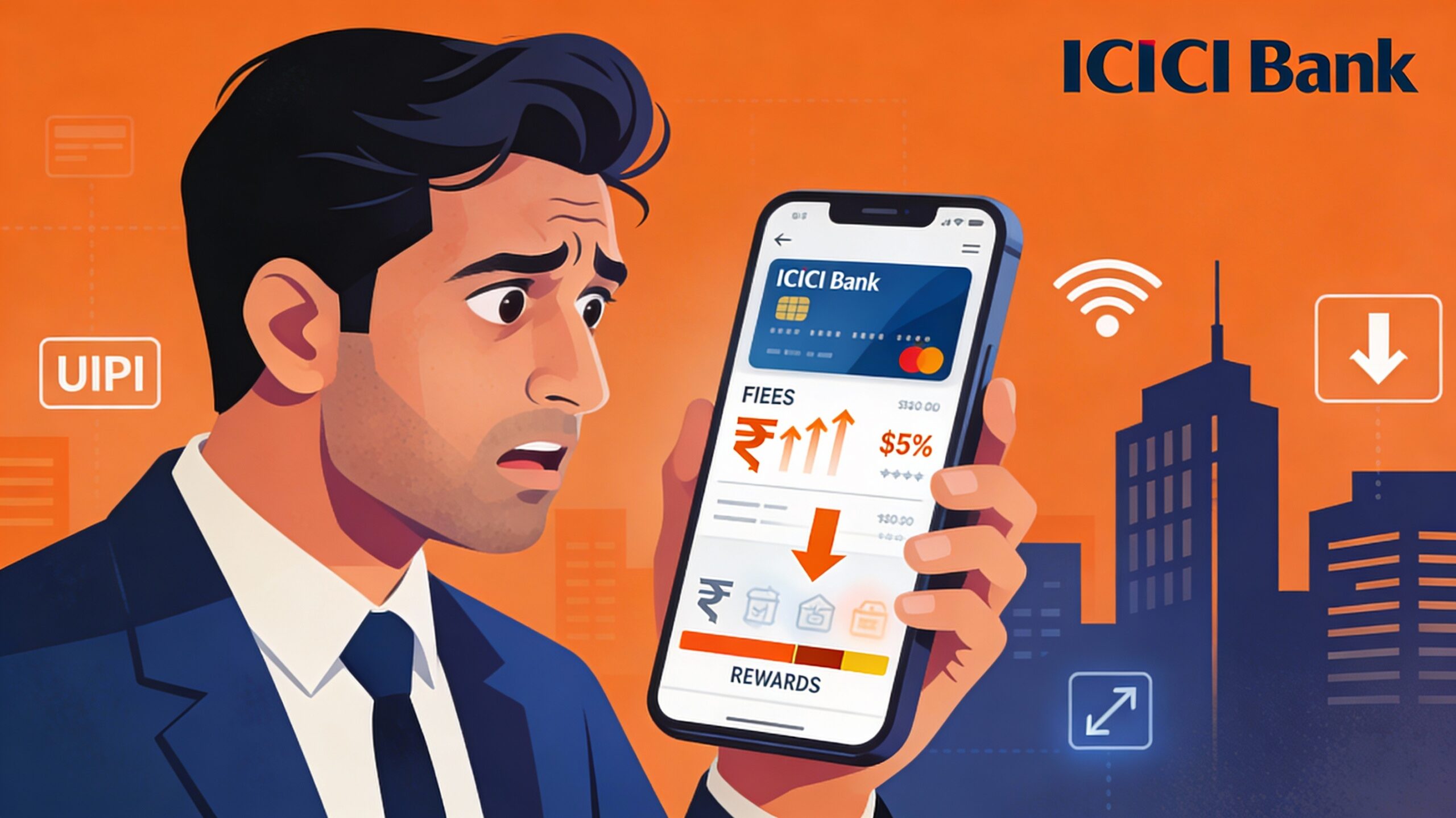
- A 1% fee on wallet-loading transactions above ₹5,000, hitting users who load Paytm, PhonePe, or other wallets using credit cards.
- A 1% charge on high-value transportation spends (typically above ₹50,000) under specific MCCs—affecting big-ticket travel bookings such as flights and packages.
- Tighter conditions and caps on entertainment benefits like BookMyShow Buy-One-Get-One (BOGO), which will continue but with stricter usage rules and lower effective value.
- Increased branch cash payment charges, discouraging in-branch payments.
- Foreclosure charges if you cancel Instant EMIs mid-way—earlier treated more flexibly.
- For super-premium Emeralde Metal and related variants: higher Dynamic Currency Conversion (DCC) fees (up to 2%) and no rewards on government, rent, property management, fuel, tax, or wallet spends.
Most changes will kick in from 15 January 2026, with some reward caps and benefit withdrawals applying from 1 February 2026. For a typical Indian cardholder, this means the card that once felt like a painless way to game the system will increasingly behave like a tightly controlled, revenue-focused product.



The hidden story: why is ICICI really doing this?
On the surface, the official explanation is “portfolio optimisation”, “sustainable rewards”, and “alignment with market dynamics and regulatory expectations”. Underneath, three big undercurrents are silently driving this reset.
1. RBI pressure: goodbye easy debt traps
In 2025, the RBI tightened credit card rules to reduce hidden charges and debt traps by enforcing clearer billing, higher minimum payments, and more transparent fee disclosures. Key changes include:
- Mandatory detailed transaction breakdowns within 24 hours, including any fees or charges.
- Minimum due must now include at least 5% of outstanding balance plus all fees, making it harder for banks to keep customers stuck in low-payment, high-interest debt cycles.
When minimum payments go up and disclosures become sharp, banks lose some of the easy profit they quietly earned from interest and confusion. To protect margins, they are shifting monetisation to visible, upfront fees—like 1% on large wallet loads or fuel/utility spends above certain thresholds. ICICI’s 2026 changes are part of this new era where banks must show charges openly rather than bury them in interest and fine print.
2. The death of “free” hacks: rent, wallets, gaming
From 2024 onwards, ICICI began systematically killing the most abused “hacks”: reward points on rent payments and e-wallet loading were removed across most cards (except Amazon Pay ICICI), and DCC fees were introduced. By 2026, this trend has matured into a clear strategy:
- High-velocity, low-margin categories like rent, wallet loads, government payments, and some fuel spends now either earn no rewards or attract extra charges.
- Online gaming and wallet-based spends are being singled out by multiple banks (including HDFC and ICICI) for higher charges from 2025 onwards.
Banks have realised that savvy users were using credit cards not just for lifestyle spends but for “manufactured” transactions—paying rent via apps, loading wallets, cycling money—to farm rewards or float free credit. The 2026 ICICI overhaul is a clear attempt to close these loopholes and push rewards back towards “profitable” categories like shopping, travel, and select co-branded spends.
3. UPI credit and competition: rewards are no longer a must
The rise of RuPay credit cards on UPI and bank-backed fintech apps has changed how Indians use credit. Many now expect instant, free, and reward-rich transactions via UPI, BNPL, and co-branded fintech cards. Traditional banks, under margin pressure, cannot keep offering aggressive rewards on every transaction type.
Instead of competing on “free rewards for everything”, ICICI appears to be repositioning its credit cards as:
- Premium lifestyle tools with selective, capped benefits.
- Controlled credit instruments aligned with RBI’s responsible lending guidelines.
- Profit-conscious products that discourage low-yield usage types through zero rewards and extra fees.
For Indian consumers chasing financial freedom, this means one uncomfortable truth: the era of easy, blanket credit card rewards is ending. The game is shifting to optimising specific cards for specific spends.
How these changes quietly hit your daily life
The most dangerous part of the 2026 overhaul is not the headline fee. It is the silent, cumulative effect on your monthly money flow, especially if you are an urban, digital-first spender in cities like Delhi, Mumbai, Bengaluru, or Hyderabad.
1. Wallet and gaming spends: paying extra for convenience
From 2026, a 1% fee on wallet loads above ₹5,000 means:
- Loading ₹20,000 into a wallet for rent, bills, or shopping could mean ₹200 in extra charges.
- If you used to load ₹50,000–₹1,00,000 a month to route spends and earn points, you now pay ₹500–₹1,000 just for the privilege.
For frequent online gamers or those who use prepaid wallets for in-app purchases, this is effectively a “convenience tax” on digital lifestyle. Emotionally, this feels like being charged extra for the same freedom and flexibility that made digital spending attractive in the first place—a direct hit to aspirational users who value experience and speed.
2. Travel and transportation: your big-ticket spends get clipped
High-value transportation transactions above ₹50,000 under specific merchant categories will attract a 1% fee. This typically hits:
- International flight tickets or large holiday packages booked on one card.
- Corporate-style self-paid travel for freelancers, consultants, and gig workers.
If you are someone who loved swiping an Emeralde or Sapphiro on a big travel spend to rack up points and lounge access, your real net benefit shrinks once the new fee is factored in—especially when paired with caps on transport-related reward earnings.
3. Super-premium users: lifestyle cards, less lifestyle
Emeralde Metal and its private variants will face:
- Higher DCC fee (around 2%) on foreign currency transactions, making overseas card swipes more expensive.
- No rewards for spends on government services, rent, property management, taxes, fuel, and wallet transactions.
- A one-time fee on new add-on cards (around ₹3,500 on certain variants).
For HNIs and global professionals, this is a subtle repositioning of the card away from “unlimited luxury everywhere” to “curated lifestyle with clear boundaries”. The emotional undercut: the card that once made you feel financially invincible now comes with small but noticeable frictions that quietly chip away at that feeling.
4. Everyday users: branch visits and EMIs get costlier
The increase in branch cash payment charges and the introduction of foreclosure fees on cancelled Instant EMIs shows a clear behavioural nudge: ICICI wants you to go fully digital and think twice before gaming EMI options.
- Paying via branch instead of online is now a costlier habit, hitting older users or those less digitally comfortable.
- Cancelling a “0% EMI” early may now come with a cost, reducing the flexibility that many Indians rely on to manage cash flow shocks.
For families already juggling EMIs on gadgets, education, travel, and medical expenses, these changes can add to stress if not planned for in advance.
RBI rules, credit scores, and hidden risks you might miss
Many cardholders focus only on “fees and rewards”, but the deeper risk sits in how their behaviour interacts with RBI rules and credit bureau scoring.
1. Higher minimum dues mean less room to breathe
RBI’s insistence that minimum payment must cover at least 5% of outstanding plus all fees means that as fees rise, the minimum due on your credit card will climb too. Combine that with:
- 45% annual interest (3.75% per month) on revolving balances and cash advances, as seen in ICICI’s earlier revisions.
- New transaction-level fees on wallets, utilities, travel, and more.
A user who continues to revolve credit while absorbing these new fees risks entering a faster, harder-to-escape debt spiral. For credit bureaus, consistent high utilisation and repeated near-minimum payments are negative signals that can pull down your credit score over time.
2. Score damage through “angry reactions”
When benefits are cut or fees appear, many users react emotionally—closing old cards, missing a payment in protest, or maxing out alternate cards instead. These reactions can hurt more than the fee itself:
- Closing a long-held card shrinks your total credit limit and shortens your average account age, both of which can hurt your credit score.
- Missing even a single payment (especially with higher minimum dues) can trigger late fees and a negative bureau report entry.
In the new regime, calm, strategic response matters more than ever. The emotional urge to “show the bank” by cancelling impulsively can cost far more in lost credit health and future loan eligibility.
How to adapt: practical money moves for 2025–26
Here are clear, step-by-step actions you can take right now to protect yourself, cut waste, and still stay on course for your financial goals.
Step 1: Map your spends category-wise (15 minutes)
- Open your last 3–6 ICICI credit card statements and categorise spends into: travel, fuel, utilities, wallets, rent, gaming/entertainment, groceries, EMI, and others.
- Identify where you frequently cross thresholds like ₹5,000 (wallet loads), ₹10,000 (fuel), ₹50,000 (utilities or travel), which banks are now targeting for 1%+ charges.
This single exercise will reveal whether the 2026 changes affect you mildly, moderately, or severely.
Step 2: Stop using cards for “penalised” spends
Where banks are clearly discouraging usage, treat that as a red zone:
- Avoid using ICICI cards for wallet loading above ₹5,000, rent payments via intermediaries, and large government or tax payments, especially on super-premium cards where rewards are removed.
- Shift unavoidable spends (like taxes) to net banking, UPI, or debit cards where there is no punitive fee.
Think of credit cards as tools for rewarded spends (shopping, select travel, curated offers), not as a universal payment instrument.
Step 3: Use the “specialist card” strategy
Instead of one card for everything, optimise:
- Use one or two cards for high-reward categories (like online shopping or fuel) where benefits remain strong or uncapped.
- Keep a separate, perhaps lifetime-free, card for emergency or backup purposes with minimal usage to maintain your credit profile.
If ICICI is heavily devaluing your primary category (say, rent or gaming), consider diversifying to another bank or a RuPay-on-UPI credit card that still aligns with your spend pattern.
Step 4: Set strict payment rules to protect your score
To stay ahead of RBI’s tighter environment and rising fees:
- Always pay the full amount due, not just minimum due, unless there is a genuine emergency.
- If you must revolve, aim to clear at least 25–50% of the outstanding amount each cycle, and avoid new discretionary spends until it is under control.
- Set auto-debit for “Total Amount Due” from your main bank account to avoid accidental misses, especially as minimum dues rise with added fees.
This alone can save you tens of thousands in interest and protect your credit score for future big goals like home loans.
Step 5: Re-evaluate super-premium cards honestly
If you hold Emeralde or similar premium ICICI products:
- List out the benefits you actually use: lounges, golf, concierge, movie BOGO, hotel privileges, forex usage.
- Subtract the new and existing costs: annual/joining fees, DCC charges, lost rewards on certain categories, add-on card fees.
If the net annual value (benefits minus costs) is not clearly positive for your real lifestyle, it might be time to downgrade to a mid-range card or shift to a bank that still rewards your specific usage pattern. Prestige is not worth silent annual leakage.
Step 6: Combine card reset with a bigger financial plan
Use this forced reset as a trigger to reorganise your money life:
- Set a firm monthly card spend cap (for example, 30–40% of your take-home) and avoid using cards beyond that.
- Redirect savings from avoided fees and interest into SIPs, emergency funds, or debt prepayment instead of chasing marginal cashback.
- If you are carrying card debt, consider a structured repayment plan, balance transfer to a lower-interest product, or a short-term personal loan to close the costliest card balance first.
This shift—from reacting to bank changes to proactively designing your own money rules—is where real financial freedom begins.
What this signals about India’s financial future
ICICI Bank’s 2026 credit card overhaul is not a one-off move; it is a preview of where Indian personal finance is headed over the next 3–5 years.
- More transparency, but less “free lunch”: RBI rules will keep forcing banks to show you charges more clearly, even as those charges rise in carefully chosen categories.
- Smarter, more segmented rewards: Banks will reward profitable behaviours and penalise low-margin or abused categories like rent and wallet spends.
- A sharper divide between casual users and optimisers: Those who read terms, track categories, and plan card usage will still benefit. Those who stay on autopilot may lose heavily without realising it.
For Indian consumers in 2025, especially in cities like Delhi where digital spending is exploding, this is both a warning and an invitation. The warning: if you keep using credit cards like it is 2018—randomly swiping, chasing offers, and ignoring statements—you will pay more, earn less, and risk your credit health. The invitation: if you are willing to learn the new rules, read the fine print, and align your cards with your goals, you can still use banks’ products to accelerate your path to wealth, not derail it.
Final thought: the next quiet shock you can’t ignore
Over the next few years, more private banks are likely to follow ICICI’s path—higher charges on “gaming-style” spends, tighter reward caps, and personalised pricing based on how profitable you are as a customer. At the same time, RBI may push even harder on transparency, data protection, and responsible credit, especially as UPI credit and fintech lending scale up.
For you, this means the real battle for financial freedom will not be fought in eye-catching “lifetime free” headlines or flashy 10X reward banners. It will happen quietly—inside your statements, your app notifications, and the invisible algorithms deciding what you pay and what you earn. The 2026 ICICI overhaul is just the opening move. The real question is: when the next wave of policy shifts, fee tweaks, and digital credit products hits India, will you be the customer who wakes up shocked, or the one who saw it coming and rearranged your money life in time?
Disclaimer: The use of any third-party business logos in this content is for informational purposes only and does not imply endorsement or affiliation. All logos are the property of their respective owners, and their use complies with fair use guidelines. For official information, refer to the respective company’s website.