The GST Portal Shows a Different Turnover From Your Books — Which Number Actually Decides Your Compliance?
GST Address Check, GST Number Search by PAN and Company Name: The Complete Verification Playbook
A practical field guide for finance, procurement and compliance teams | Updated August 2026
Quick Summary
Every GST verification you will ever need runs through one free government tool: the Search Taxpayer menu at gst.gov.in, which works without logging in. Enter a GSTIN to see legal name, trade name, registered address, status, jurisdiction and return filing history. Enter a PAN to see every GST registration held by that entity across India, with the state and status of each.
The one search the official portal does not offer is a free-text company name lookup. Any tool promising that is working from data compiled outside the portal, so the correct method is to resolve the company name to a PAN first and then search the PAN. Address verification matters more than most teams realise, because a mismatch between the registered premises and the invoice or delivery documents is usually the earliest visible signal of a paper entity.
The reason to bother: under Section 16(2)(c) of the CGST Act, your input tax credit depends on your supplier actually paying the tax. If they never do, the recovery notice comes to you. Verification costs nothing and takes under a minute per vendor.
Why This Stopped Being a Clerical Task
There is a particular sinking feeling that finance teams across India know intimately. A supplier invoice clears internal approval, payment goes out, input tax credit is claimed in the return, and eighteen months later a departmental notice arrives asking why credit was taken against a taxpayer whose registration was cancelled retrospectively, or whose declared principal place of business turned out to be a shuttered unit in an industrial lane nobody has visited in years. The credit reverses. Interest accrues from the date of the original claim. Penalty follows. And in nearly every one of these files, the same uncomfortable fact sits in plain view: thirty seconds on the public GST portal, before the first rupee moved, would have surfaced a warning. GST verification is not paperwork buried at the bottom of a vendor onboarding checklist. It is the cheapest financial control available to any Indian business, it requires no software licence and no professional fee, and the entities most exposed to skipping it are precisely the small and mid-sized businesses least able to absorb a reversal.
The enforcement record makes the risk concrete rather than theoretical. In answers placed before Parliament in July 2026, the Ministry of Finance disclosed the scale of fake GST registrations obtained through misuse of forged PAN and Aadhaar credentials over three financial years, together with the value of detections attached to them. The direction of travel is genuinely encouraging and reflects real tightening at the registration gate, including biometric Aadhaar authentication, geo-tagging of business premises and physical verification visits. But read the chart carefully. The number of fake registrations fell sharply while the detected value fell far more slowly, which means the average case is getting larger. The operators still in the system are better documented, better capitalised and considerably harder to spot from an invoice alone. That is the population your vendor master is now screening against.
Source: Ministry of Finance replies in Parliament, July 2026.
Read the Number Before You Search It
A GSTIN is structured, not random, which means a trained eye can reject an obviously fabricated number without opening a browser. Fifteen alphanumeric characters carry four distinct pieces of information, and each one gives you a cross-check you can perform against documents already sitting in your file. The immediate practical payoff is this: if a Bengaluru vendor sends an invoice carrying a GSTIN that begins with 07, while their address, delivery challan and bank account all point to Karnataka, something is wrong before any verification tool has been touched. Equally, if the ten characters embedded in the middle of the GSTIN do not match the PAN printed on that same vendor’s invoice or on the TDS declarations they filed with you last year, the document is either careless or manufactured. This step is free, instant, and skipped by almost everybody.
The PAN sitting inside the GSTIN carries a further layer worth knowing. PAN itself follows a rigid pattern of five letters, four digits and a closing letter, and the fourth character encodes the constitution of the entity: C for company, P for individual or proprietor, F for firm or LLP, T for trust, H for Hindu Undivided Family and A for association of persons. So a counterparty presenting itself as a private limited company whose embedded PAN carries a P in the fourth position is a proprietorship, whatever the letterhead says. That single character has settled more than one argument about who you are actually contracting with, and it is visible without any search at all.
The Official Route: Search Taxpayer on the GST Portal
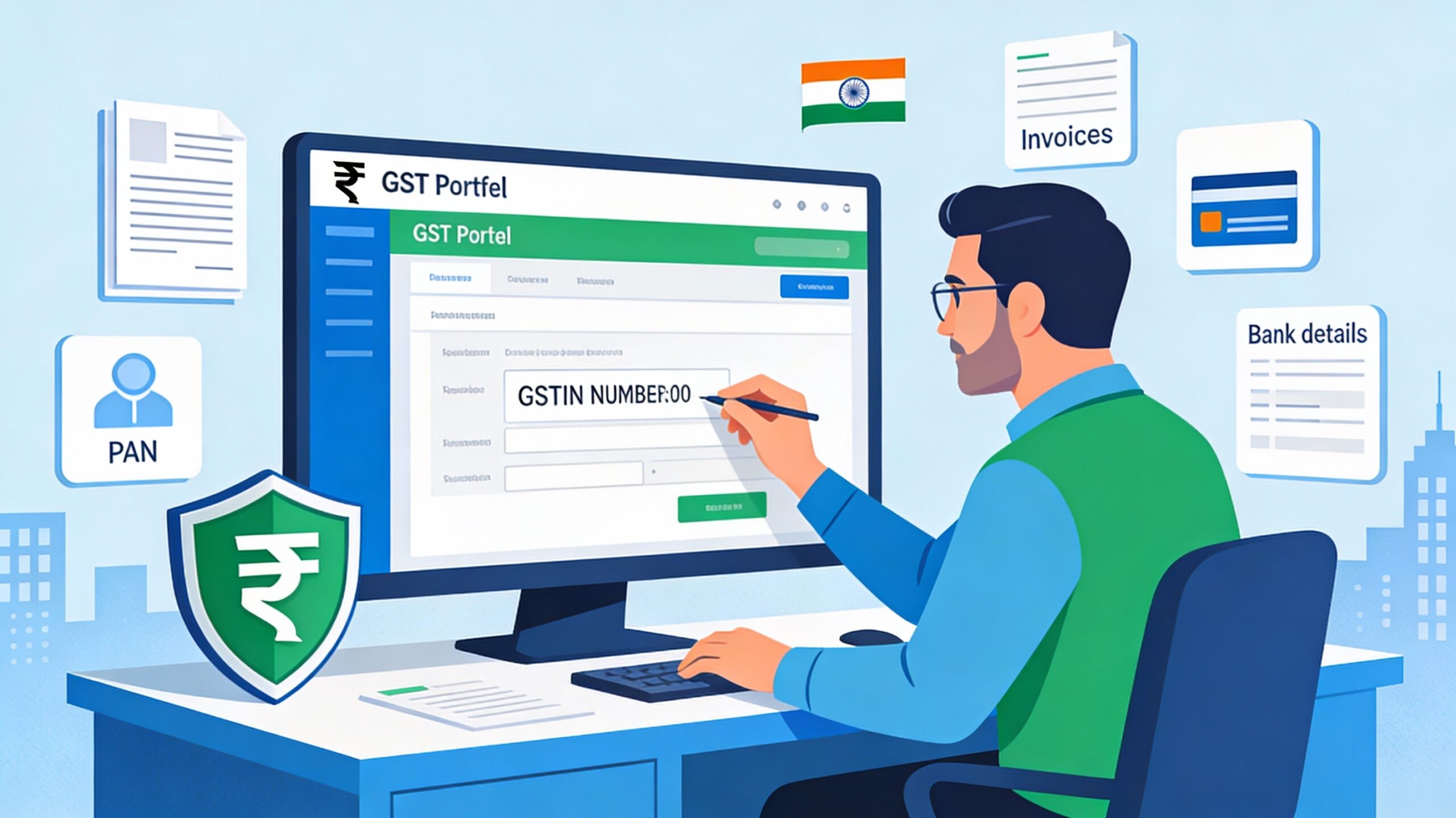
Every credible verification path begins and ends at gst.gov.in, because every third-party lookup tool in the market is ultimately reading the same GST Network data, frequently with a caching lag measured in hours or days. The Search Taxpayer menu sits on the portal homepage and is fully accessible without logging in, which matters operationally: a procurement executive with no portal credentials can run checks independently, without routing every request through the finance team. Choose Search by GSTIN or UIN, enter the fifteen characters, complete the captcha and submit. Without login you will see the legal name of business, the trade name, the principal place of business, additional places of business, the effective date of registration, constitution of business, taxpayer type, GSTIN status, the state and central jurisdiction offices, the nature of business activities, and the return filing history showing which periods of GSTR-1 and GSTR-3B have been filed and when.
Logging in with your own registered credentials unlocks a further layer that is worth the extra step whenever a transaction is material. The portal then reveals the names of the proprietor, partners, directors or karta, along with any Letter of Authorisation details on record. Matching a director name pulled from the GST portal against an independent check on the Ministry of Corporate Affairs registry closes a loop that a GSTIN alone cannot, and it is the fastest way to detect the situation where a legitimate-looking registration has been quietly repurposed. One practical caution: the portal throttles heavy manual querying and the captcha will start failing if you push it. If you are checking more than a handful of vendors in one sitting, batch the work across a session or move to an authorised programmatic route rather than fighting the interface.
GST Number Search by PAN: Seeing the Whole Entity at Once
The second search mode on the same menu answers a question the GSTIN search structurally cannot. Enter a ten-character PAN, clear the captcha, and the portal returns every GST registration mapped to that PAN, each tagged with its state and its current registration status. This single function earns its place in three separate workflows. In procurement, it tells you whether the vendor quoting from Gujarat also holds registrations in the states where they claim to warehouse or deliver, which is the fastest available sanity check on a place-of-supply position before it hardens into a dispute. In due diligence, it exposes the true shape of a counterparty: a supplier presenting itself as a single-location operation that turns out to hold nine active registrations across seven states is not necessarily doing anything improper, but it is a materially different entity than the one described in the pitch deck, and your credit exposure should be sized accordingly.
The third use is the one almost nobody runs, and it is the one that protects you rather than your vendor. Put your own business PAN, and the PANs of your directors, through Search by PAN on a fixed quarterly rhythm. If a registration appears that you never obtained, the portal provides a reporting mechanism against that specific entry, generating an Application Reference Number you can track through the Track ARN facility. Given that forged PAN and Aadhaar credentials remain the primary vector for fake registrations, and given that the resulting shell can issue invoices in your name for months before anyone notices, a five-minute quarterly self-check is diligence at essentially zero cost. Registrations that migrated imperfectly from the pre-GST regime sometimes cannot be reported through this route and need a jurisdictional approach instead, which the portal will indicate.
GST Address Check: Three Comparisons, Not One
The address returned by a GSTIN search deserves far more attention than it usually receives, because address is where paper businesses break down first. What the portal displays is the principal place of business, meaning the location declared in the registration application and accepted by the officer, alongside any additional places of business such as branches, godowns or job-work premises. A meaningful address check involves three comparisons rather than one. Compare the portal address against the address printed on the vendor’s invoice, because a tax invoice is required to carry the supplier’s registered address and a persistent discrepancy points either to an undeclared premises, which is a compliance failure with consequences for the vendor, or to an invoice template assembled without reference to an actual registration. Compare the portal address against your delivery documentation, e-way bill origin points and shipping records, since goods that consistently move from a location the supplier has never declared warrant a direct conversation. Compare it, finally, against reality using ordinary open mapping tools, because a registered address resolving to a residential flat is perfectly legitimate for a consultant or trading intermediary but difficult to reconcile with a supplier claiming heavy manufacturing capacity.
This area has tightened considerably, which raises the stakes on ignoring it. Geo-tagging of business premises is now part of the registration workflow, physical verification visits are conducted for new and flagged registrations, and entities that cannot be verified at their declared principal place of business face suspension. The practical implication is that an address that looks wrong to you has a reasonable probability of already being under departmental scrutiny, and continuing to transact against it means your credit is riding on a registration that may be suspended retrospectively. Address is also the field most resistant to forgery, because unlike a name or a number it has to correspond to a physical location that can be visited by an officer.
Check GST Number by Company Name: What Actually Works
Here the guidance has to be blunt, because a great deal of published advice on this specific point is simply wrong. The official GST portal does not offer a free-text search that accepts a company name and returns its GSTIN. The searches it supports are by GSTIN or UIN, by PAN, by temporary ID, and by composition scheme status. Any service advertising a straight name-to-GSTIN lookup is working from data assembled outside the portal’s search interface, typically compiled from taxpayer division lists published by state and central authorities, from filed returns and e-invoice data, or from crawled public records. The quality of that data varies enormously and none of it carries the authority of a portal record. The workable route therefore runs indirectly, through PAN.
For a company or LLP, obtaining the PAN is straightforward, because it appears on invoices, purchase orders, TDS certificates and bank detail forms, and can be corroborated through the MCA21 portal using the corporate identification number. With the PAN in hand, Search by PAN returns every GSTIN that entity holds, sourced directly from GSTN. Where you genuinely have nothing but a name, a commercial name-search tool can produce a candidate GSTIN as a starting point, but treat that output as a hypothesis and never as a verified fact. Take the candidate number straight back to the official portal, run the GSTIN search, and confirm that legal name, trade name, address, constitution and jurisdiction all align with the counterparty you believe you are dealing with. Two failure modes make this discipline non-negotiable. Similar trade names across entirely unrelated legal entities are extremely common in Indian commerce, and legal name frequently differs from the brand a business trades under, so a name match that feels convincing can easily be the wrong company altogether.
Reading the Result: Signals That Should Slow You Down
| What you see | What it means for you | Action |
| Status: Suspended | The taxpayer may still be issuing invoices while proceedings run under Rule 21A. Credit taken against those invoices is exposed. | Hold payment |
| Status: Cancelled, retrospective date | Invoices you accepted in good faith weeks earlier can fall on the wrong side of the cancellation date. | Stop and escalate |
| Registered very recently | A three-week-old registration offering large volumes on extended credit is a pattern that recurs constantly in fake invoicing networks. | Tighten terms |
| GSTR-1 filed, GSTR-3B not filed | Outward supplies declared without discharging the liability. This is precisely the profile that creates a Section 16(2)(c) problem downstream. | High risk |
| Taxpayer type: Composition | A composition dealer cannot pass on input tax credit at all. An invoice charging you tax in creditable form is invalid. | Reject invoice |
| Business activity mismatch | A taxpayer registered for one commodity class suddenly supplying an unrelated category deserves a question before a payment. | Query vendor |
A search that returns a result is not the same as a search that returns comfort. Status is the first field to read, and Suspended is the state that causes the most avoidable damage, precisely because it looks less alarming than Cancelled and is routinely waved through. Read the return filing history properly rather than glancing at it, because the pattern of what has been filed tells you more about a counterparty’s trajectory than any single status flag. Note the jurisdiction fields too, since they give you the exact officer and range to approach if you ever need to escalate, and having that recorded at onboarding saves days when it matters.
Turning Verification Into a Process That Survives Staff Turnover
One-time checks at onboarding leave the largest gap in the whole control, because registration status is a live attribute that changes without anyone notifying you. A workable process looks roughly like this. At onboarding, verify the GSTIN on the official portal, capture a dated screenshot or PDF of the result, match the address against invoice and delivery documents, confirm the embedded PAN matches the PAN on file, run a PAN search to see the full registration footprint, and store all of it in the vendor master rather than in someone’s inbox. On an ongoing basis, re-verify status before releasing payment on any invoice above a materiality threshold you set deliberately, and re-verify the entire active vendor base at least quarterly. Reconcile every purchase invoice against your auto-populated GSTR-2B rather than treating the vendor’s paperwork as sufficient, and use the Invoice Management System on the portal to accept, reject or hold invoices as a conscious decision rather than by default.
Beyond a few hundred vendors, manual portal checks stop scaling and the answer is an authorised GST verification API through a GST Suvidha Provider, integrated into the ERP so that status is validated at purchase order creation and validated again at the payment run. Build one further habit alongside all of this, because it catches what the portal cannot: pay by banking channel into an account held in the registered entity’s own name, and treat any request to route payment to a third-party account or a differently named entity as a stop signal regardless of how clean the GSTIN looks. Bank account validation through micro-deposit is now part of the registration process itself, which means a legitimate registered taxpayer has no good reason to ask you to pay somewhere else.
The Mistakes That Keep Recurring
- Verifying the number and ignoring everything around it. A green Active status is one field among a dozen, not a complete answer.
- Accepting a screenshot supplied by the vendor. Trivially editable, and it proves nothing about the position today.
- Verifying once and never again. This leaves you fully exposed to the retrospective cancellation scenario.
- Never comparing the embedded PAN to the PAN in your own vendor master. Two strings, ten seconds, and almost nobody checks.
- Verifying diligently and keeping no record. Undocumented diligence is legally close to worthless when a notice arrives two years later.
Frequently Asked Questions
Can I search a GST number using only a company name on the official portal? No. The GST portal supports search by GSTIN or UIN, by PAN, by temporary ID and by composition status. Resolve the company name to a PAN first, then search the PAN.
Do I need to log in to check a GSTIN? No. Search Taxpayer works without login and returns status, address, registration date, constitution and filing history. Logging in adds proprietor, partner or director names.
How do I check the registered address of a GST number? Run Search by GSTIN and read the principal place of business and any additional places of business, then compare those against the invoice, the delivery documentation and an independent map check.
What if I find a GST registration under my own PAN that I did not obtain? Use Search by PAN, mark the unrecognised registration for reporting through the portal facility, and track the resulting Application Reference Number. Registrations migrated from the pre-GST regime may need a jurisdictional approach instead.
Is there any charge for GST verification or registration? No. Both the Search Taxpayer facility and GST registration itself are free on the official portal.
The Bottom Line
GST verification rewards a small, boring, repeated effort with wildly disproportionate protection. The tools are public, free and maintained by GSTN itself. Read the GSTIN structure before you search it, run Search by GSTIN for status and address, run Search by PAN to see the entire registration footprint, resolve company names to PAN before trusting any name-based lookup, read the filing history as carefully as the status flag, and keep dated evidence of every check you perform. Run your own PAN through the search each quarter so that identity misuse against your business surfaces in weeks rather than years. None of this requires specialist software or professional fees, and all of it stands between your working capital and a reversal notice you did nothing to deserve. For transactions of real size or complexity, bring in a qualified chartered accountant or GST practitioner, because the portal tells you what is registered while a professional tells you what it means for your position.
Sources and Method
Portal functionality described here reflects the Search Taxpayer facility documented in GSTN’s own user guidance at tutorial.gst.gov.in. Enforcement figures on fake registrations are drawn from Ministry of Finance replies placed before Parliament in July 2026. Statutory references are to the Central Goods and Services Tax Act, 2017 and the CGST Rules, 2017. Portal features and rules change; verify against gst.gov.in before relying on any procedural detail.
Disclaimer
This article is published for general information and education. It is not tax, legal or professional advice, and it does not create a client relationship. GST positions turn on specific facts. Consult a qualified chartered accountant or GST practitioner before acting on anything described here.