Best RuPay Credit Cards for UPI This Festive Season: Which One Pays Most When You Scan and Pay?
Best RuPay Credit Cards for UPI This Festive Season: Which One Pays Most When You Scan and Pay?
Rewards on RuPay credit cards used through UPI range from about 0.5% to 3.2% in October 2026, and most come with monthly caps or app conditions. Here is how the main cards compare for Diwali spending at shops, sweet stalls and online.
The festive season is when the humble UPI QR code earns its keep. The mithai shop, the diya seller, the cloth merchant, the auto driver who takes you to the market: almost all of them accept UPI, and very few take cards. If your credit card is a RuPay card linked to UPI, every one of those scans can earn rewards that a debit-linked UPI payment never would.
But “UPI credit card” is not one product. Some cards pay a flat percentage on every scan, some only through one app, and some pay generously until a small monthly cap and then nothing. A few pay less on UPI than on a normal swipe. This guide compares the cards people are actually choosing this Diwali, using the terms in force in October 2026.
Quick Summary
For heavy scan-and-pay users, Google Pay Flex currently pays the most, up to 3.2% for Google One members above ₹15,000 a cycle, within a ₹1,500 cap. Axis SuperMoney pays up to 3% through its own app but caps that by your other spending; Tata Neu Infinity pays up to 1.5% through Tata Neu with a 500-coin monthly cap; Eternal SBI pays 1% on general UPI but 10% on Zomato and Blinkit; Scapia Federal is lifetime free with travel perks and around 1% in practical value. Remember that RuPay credit on UPI works only for merchant payments, and Amazon’s SBI festive discount excludes RuPay credit cards paid through UPI.
What We Know
- Only RuPay credit cards can be linked to UPI for merchant QR payments; Visa and Mastercard cards generally cannot.
- RBI allowed RuPay credit cards on UPI in June 2022.
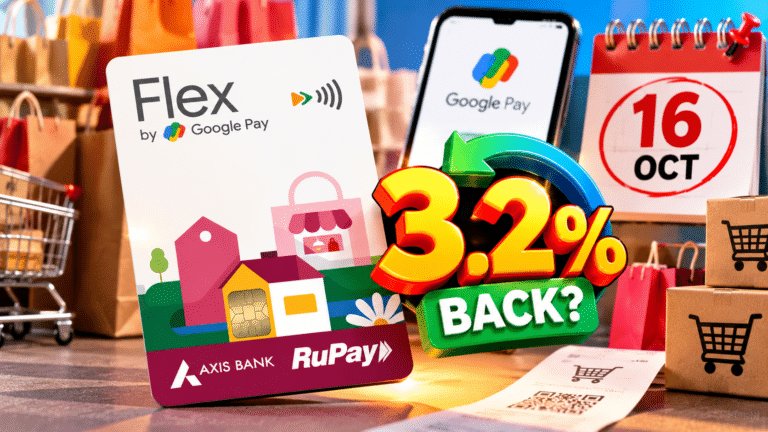
- Google Pay Flex raised its rewards to as much as 3.2% from 16 October 2026.
- Rewards on UPI depend on each issuer’s terms, not on the UPI app, except for app-specific campaigns.
- Payments to individuals, wallet loads and rent typically earn nothing.
What Is Still Unclear
- Several issuers changed UPI caps in 2025 and 2026, and some published summaries conflict; check current terms.
- Whether Flipkart’s Big Bang Diwali bank offers accept RuPay credit cards through UPI.
- Exact monthly caps on some cards, such as Kiwi, which vary by issuer and membership.
- Official 2026 NPCI data on credit-on-UPI volumes; the most recent widely reported figures are from 2024 and 2025.
How Credit on UPI Went From Niche to Normal
When RBI allowed RuPay credit cards to be linked to UPI in June 2022, few people noticed. Since then, credit on UPI has become one of the fastest-growing corners of Indian payments. Ministry of Finance data reported by Business Standard showed 362.8 million RuPay credit transactions on UPI worth ₹33,439 crore in FY24, and more than 750 million worth ₹63,826 crore in the first seven months of FY25 alone.
The way people use these cards is also different. Kiwi’s data, reported by Business Standard in January 2025, showed users making about 40 transactions a month, eight times the frequency of traditional card users, at an average ticket of ₹1,125 against about ₹4,000 on conventional cards. About 75% of those transactions were at small stores. In short, UPI credit cards earn on the small, frequent payments that festive shopping is made of.
Three Rules That Decide Whether a Scan Earns Anything
Before comparing cards, it helps to know the rules that apply to all of them. Most disappointment with UPI credit cards comes from one of these three.
Merchant payments only
RuPay credit on UPI is for paying merchants. You cannot use it to send money to a friend, a family member or a personal QR code, and attempts to do so are blocked. A small trader who displays a personal UPI ID instead of a merchant QR may therefore not accept your credit card, even though the code looks the same.
The issuer sets the reward, not the app
CardSpot’s guide notes that rewards are governed by each issuer’s most important terms and conditions, not by whichever UPI app you scan with. The exceptions are cards tied to an app, such as Tata Neu, SuperMoney or Google Pay Flex, where the highest rate applies only when you pay through that app.
The standard exclusions still apply
Rent, wallet loads, insurance, education, fuel on many cards, government payments and EMI-converted transactions generally earn nothing, whether you pay by swipe or scan. During the festive season, jewellery and gold coins are the exclusion that catches most people out.
The Shortlist: Seven RuPay Cards Built for Scan-and-Pay
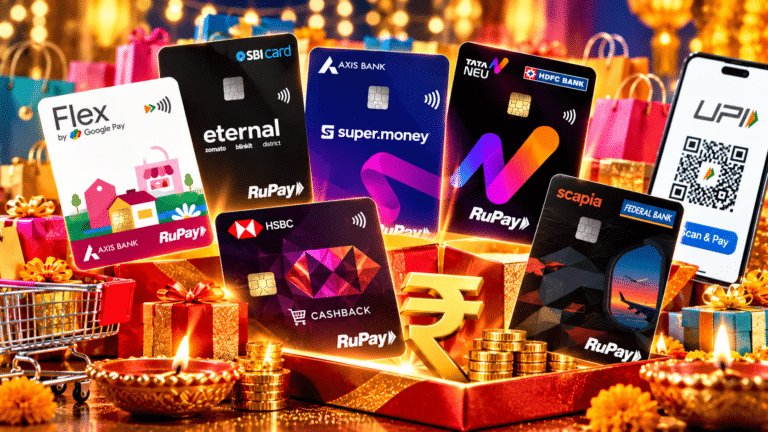
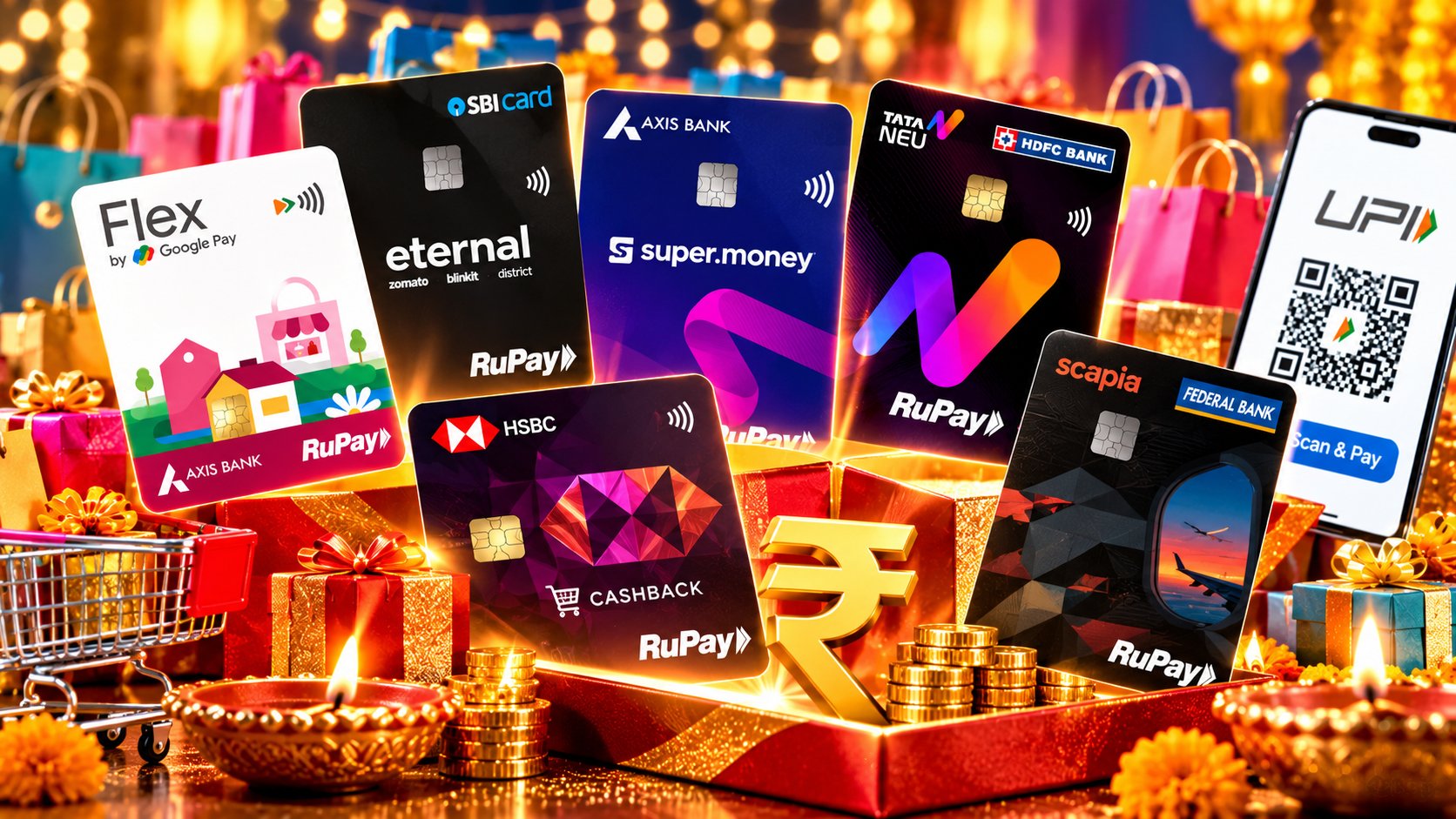
The table summarises the main RuPay credit cards for UPI as of October 2026. Rates are for eligible merchant UPI payments and come from the sources named, which sometimes differ; always check the issuer’s current terms.
| Card | Annual fee | UPI reward | Cap or condition | Best for |
|---|---|---|---|---|
| Google Pay Flex, Axis Bank | Nil, as reported | 0.8% to 3.2% in Stars | ₹1,500 a cycle; top rate needs Google One and ₹15,000 | Heavy Google Pay users |
| Google Pay Flex, SBI Card | ₹499, waived at ₹1 lakh | 0.8% to 3.2% in Stars | Same as Axis variant | Those wanting a Visa option too |
| Axis SuperMoney | Lifetime free | 3% via SuperMoney app, 1% elsewhere | App cashback capped by cashback on other spends; none under ₹100 | Mixed spenders using one app |
| Tata Neu Infinity HDFC | ₹1,499, waived at ₹3 lakh | Up to 1.5% via Tata Neu UPI, about 0.5% elsewhere | 500 NeuCoins a month | Tata brand shoppers |
| Eternal SBI | ₹499, waived at ₹2 lakh | 1% on general UPI | ₹500 a month on 1% spends | Zomato and Blinkit users |
| HSBC Cashback RuPay | ₹499 | 1% to 10% cashback | ₹400 a month on the 10% tier | Small, steady spenders |
| Scapia Federal RuPay | Lifetime free | About 1% practical value on ₹500 or more | Coins valued at 5 to ₹1 | Travellers wanting 0% forex |
Google Pay Flex terms are from Google’s help page; SuperMoney, Tata Neu, HSBC and Scapia figures are from SaveSage’s June 2026 guide; Eternal SBI from SmartSpend’s summary of SBI’s terms; fees for Flex SBI and Tata Neu from PickMyCard and CardSpot. Kiwi, a popular UPI-first card, is not ranked because its rates and caps vary by issuing bank and paid membership, according to SaveSage.
Card by Card: Where Each One Shines, and Where It Stumbles
Google Pay Flex: the new rate leader, with strings
Since 16 October, Flex pays 0.8% below ₹15,000 a cycle and 1.6% above it, doubled for eligible Google One members. Crossing ₹15,000 lifts the rate on the whole cycle, which suits festive months. The catches are the ₹1,500 cycle cap and Stars that can only be spent inside Google Pay, expiring after a year.
Axis SuperMoney: free, but app-dependent
SaveSage describes SuperMoney as lifetime free, paying 3% on UPI through the SuperMoney app and 1% on eligible UPI elsewhere. The in-app 3% is capped at the cashback you earn on other eligible spends in the same statement month, and transactions under ₹100 earn nothing, which matters for small festive purchases like flowers or a cup of tea.
Tata Neu Infinity: strongest inside the Tata world
Infinity pays up to 1.5% in NeuCoins on UPI through Tata Neu and about 0.5% through other apps, with a cap of 500 NeuCoins a month, according to SaveSage. NeuCoins are worth ₹1 each at Tata brands such as BigBasket, Croma and Westside, so the card suits households that already shop there.
Eternal SBI: a food card that also scans
Eternal SBI’s real strength is 10% off on Zomato, District and Bistro and 5% to 10% on Blinkit, applied as instant discounts. On general UPI it pays 1%, capped at ₹500 a month. Use it for food and quick commerce, and another card for everything else.
Scapia Federal: the traveller’s free card
Scapia is lifetime free with 0% forex markup and lounge benefits, making it attractive if festive plans include a trip. On UPI its advertised 5% in Scapia coins works out to about 1% in practical value, according to SaveSage, because five coins equal ₹1.
What a Festive Month of Scanning Is Worth on Each Card
Headline rates hide the caps. The table applies each card’s rate and monthly cap to four levels of festive UPI spending, assuming all payments are eligible and made through the card’s preferred app where needed.
| Monthly UPI spend | Flex with Google One | Flex without | Tata Neu Infinity | 1% card |
|---|---|---|---|---|
| ₹10,000 | ₹160 | ₹80 | ₹150 | ₹100 |
| ₹20,000 | ₹640 | ₹320 | ₹300 | ₹200 |
| ₹40,000 | ₹1,280 | ₹640 | ₹500, capped | ₹400 |
| ₹60,000 | ₹1,500, capped | ₹960 | ₹500, capped | ₹600 |
| Fee before GST | Nil on Axis, plus ₹59 a month Google One | Nil on Axis | ₹1,499 | Varies, often nil |
The “1% card” column applies to Scapia’s practical value, Eternal SBI’s general UPI rate up to its ₹500 cap, and SuperMoney outside its app. Flex figures use the ₹15,000 cycle threshold; below it, Flex pays half as much. Our calculations; indicative.
Worked example: Ananya’s Diwali month
Ananya expects about ₹25,000 of UPI spending between 16 October and 15 November: ₹8,000 at local clothes and gift shops, ₹5,000 on sweets and dry fruits, ₹4,000 on decorations and diyas, ₹3,000 on electricity and mobile bills, and ₹5,000 on grocery apps. On Google Pay Flex with Google One, she crosses ₹15,000, so she earns 3.2% on all ₹25,000, which is ₹800, plus a ₹450 bill bonus and a ₹250 grocery bonus. That is ₹1,500, exactly the cap, or 6% of her spending. On a flat 1% card she would earn ₹250. Without Google One, Flex would pay ₹400.
The Festive Sale Catch: Bank Discounts Often Exclude UPI Credit
Big online sales add a twist. Amazon’s Great Indian Festival 10% SBI instant discount, which applies to SBI credit cards with a cap of ₹13,750 per card, explicitly excludes RuPay credit cards used through UPI, according to PickMyCard’s reading of the 2026 terms. So paying by scanning with an SBI RuPay card on Amazon loses the discount, while entering the same card’s details as a normal card payment may qualify, if the card is otherwise eligible.
The lesson applies more broadly. Instant bank discounts on e-commerce sales are usually designed for card-network payments. A 10% discount beats any UPI reward on this list, so for large online purchases, pay with the card itself and keep UPI scans for local shops, where no bank discount exists anyway.
What people often get wrong
Many cardholders assume their card earns the same rewards on UPI as on a swipe. On several cards it does not: Tata Neu Infinity pays about 1.5% only through Tata Neu’s UPI, and roughly 0.5% through other apps, according to SaveSage. SuperMoney’s 3% applies only inside its app. Paying the festive grocery bill through the wrong app can cut your rewards by two thirds without any warning on screen.
Pick Your Card by How You Spend
- Check that your card is RuPay, not Visa or Mastercard, before linking it to UPI.
- Link it in the app that unlocks the top rate, such as Google Pay for Flex or Tata Neu for Infinity.
- Ask small shops for their merchant QR; personal UPI IDs will reject credit cards.
- Use the card’s own details, not UPI, on e-commerce sites offering instant bank discounts.
- Track your monthly cap and switch to a second card once it is reached.
Small Payments, Big Bill: Keep Festive Credit in Check
The convenience that makes UPI credit attractive also makes it easy to overspend. Forty small scans a month at ₹1,125 each add up to ₹45,000, far more than many people intend to put on a card. The rewards on this list, between 1% and 3.2%, are wiped out many times over by credit card interest, which runs at about 3.75% a month on cards such as Google Pay Flex, according to PickMyCard.
Fact box: why only RuPay works on UPI
UPI is run by NPCI, which also runs RuPay. When RBI permitted credit cards on UPI in 2022, it began with RuPay credit cards, and merchant QR payments with credit still run on that network. Visa and Mastercard cards cannot be linked to UPI in the same way, which is why, according to PickMyCard, only the RuPay variant of Google Pay Flex SBI can be used on UPI.
Frequently Asked Questions
Which RuPay credit card gives the highest rewards on UPI in 2026?
Google Pay Flex currently advertises the highest rate, up to 3.2% in Stars for Google One members who spend more than ₹15,000 a cycle, capped at ₹1,500. Axis SuperMoney pays up to 3% through its own app, subject to its cap rules.
Can I use a Visa or Mastercard credit card on UPI?
Generally no. Only RuPay credit cards can be linked to UPI for merchant QR payments in India.
Can I send money to friends using a RuPay credit card on UPI?
No. RuPay credit on UPI works only for payments to merchants. Transfers to individuals, bank accounts and personal QR codes are not allowed.
Do I get Amazon’s festive bank discount if I pay by UPI with an SBI RuPay card?
No. Amazon’s 2026 SBI 10% offer excludes RuPay credit cards used through UPI. Pay with the card details at checkout instead, if the card is otherwise eligible.
Do UPI credit card payments earn the same rewards as card swipes?
Not always. Some cards pay less on UPI or only pay their best rate through one app, such as Tata Neu Infinity through Tata Neu and SuperMoney through its own app. Check each issuer’s terms.
Is there a free RuPay credit card for UPI?
Yes. Axis SuperMoney and Scapia Federal are described as lifetime free, and the Axis Bank variant of Google Pay Flex is reported as having no annual fee.
Do rent and wallet payments through UPI earn credit card rewards?
Usually not. Rent, wallet loads, insurance, education, government payments and EMI conversions are commonly excluded from rewards on these cards.
Is it safe to use a credit card on UPI?
UPI credit payments need your UPI PIN, like any UPI payment. Never share the PIN, and only scan QR codes at genuine merchants. Paying the full bill on time avoids interest of about 3.75% a month.
The Short Version
RuPay credit cards turn festive UPI scans into rewards, but rates vary from about 0.5% to 3.2% and almost every card has a cap or app condition. Google Pay Flex leads for heavy users with Google One, up to 3.2% and ₹1,500 a cycle. Axis SuperMoney and Scapia Federal are strong free options around 1% to 3%; Tata Neu Infinity suits Tata shoppers; Eternal SBI suits Zomato users. Use merchant QRs, pay through the right app, use card details rather than UPI for e-commerce bank discounts, and pay the bill in full.