Can You Buy a Maruti Alto on a ₹10,000 EMI? The Real Maths Behind the "Alto 2027 Loan Scheme"
Can You Buy a Maruti Alto on a ₹10,000 EMI? The Real Maths Behind the “Alto 2027 Loan Scheme”
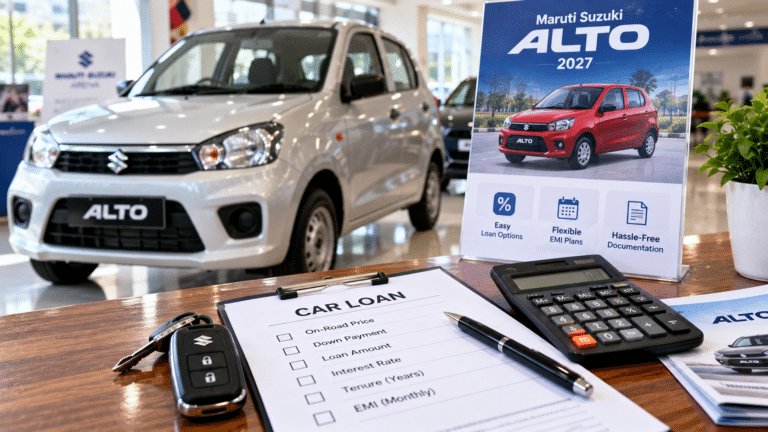
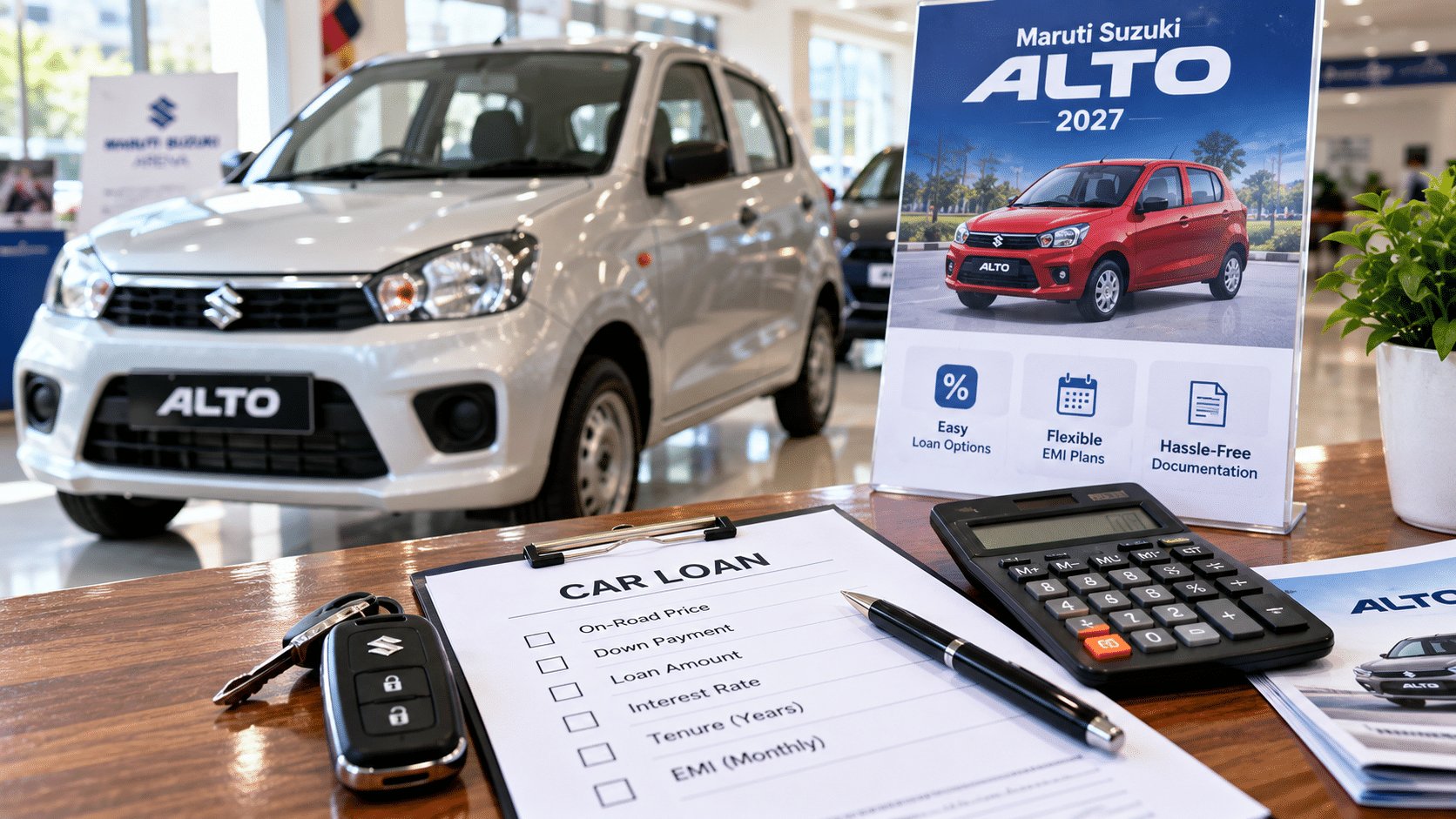
Social posts promise a new Suzuki Alto 2027 for ₹10,000 a month. No such official scheme has been announced, and the next-generation Alto has not been confirmed for India. But a ₹10,000 EMI can buy today’s Alto K10. Here is exactly how, and what it really costs to own.
- Not foundAn official Maruti “₹10,000 monthly” Alto scheme
- ReportedA lighter 10th-generation Alto, first for Japan, timing 2026 to 2027
- UnconfirmedAny India launch date or price for a new-generation Alto
- PossibleAn Alto K10 at about ₹10,000 a month with the right down payment and tenure
The pitch is everywhere this festive season: “New Alto 2027, just ₹10,000 a month.” For a first-time buyer moving up from a scooter, it sounds like the moment to finally own a car. But a monthly figure on its own tells you almost nothing. It hides the down payment, the interest rate, the number of years, and the costs that start the day you drive out of the showroom.
We checked what has actually been announced, then did the arithmetic. The short answer: there is no official ₹10,000 “scheme” from Maruti Suzuki that we could find, and the much-discussed next-generation Alto has so far been reported only for Japan. But a ₹10,000 EMI genuinely can buy the current Alto K10, India’s entry-level Maruti. Whether it is a good idea depends on three numbers most advertisements leave out.
Quick Summary
Yes, an Alto K10 is possible on about ₹10,000 a month, but not without a down payment, and not as a special 2027 scheme. At 9% interest, a ₹10,000 EMI supports a loan of about ₹4.02 lakh over four years. The Alto K10 costs ₹3.70 lakh to ₹5.45 lakh ex-showroom and ₹4.07 lakh to ₹5.94 lakh on-road in Delhi, according to CarWale. A mid-range variant fits with a down payment of about ₹40,000. Owning the car, including fuel, insurance and depreciation, costs closer to ₹12,000 a month on our assumptions.
What We Know
- The Alto K10 is priced from ₹3.70 lakh to ₹5.45 lakh ex-showroom, CarWale lists, after a ₹2,500 revision on 16 September 2026.
- GST on small cars fell from 28% plus 1% cess to 18% from 22 September 2025, cutting Alto K10 prices by 8.53%, per AckoDrive.
- Suzuki has said the next Alto will be about 100 kg lighter, CarWale and RushLane reported.
- Reports put the 10th-generation Alto’s arrival in Japan between 2026 and 2027.
What Is Still Unclear
- Whether, or when, a next-generation Alto will come to India.
- What any new model would cost here, and whether it would replace the Alto K10.
- Whether Maruti or its finance partners will announce a specific low-EMI scheme for the Alto.
- Where car loan rates settle after the RBI’s 7 October rate rise.
Is There Really an “Alto 2027”?
Suzuki sells a car called the Alto in Japan, a small “kei” car built to that country’s strict size rules. It is a different model from the Alto K10 sold in India. Reports since 2024 say Suzuki is developing a 10th-generation Japanese Alto that will be about 100 kg lighter than the current model. CarWale reported it was expected by 2027; RushLane and CarLelo reported a possible 2026 debut in Japan.
The same reports describe a target of more than 30 km per litre, helped by a 48-volt mild-hybrid system, and a kerb weight of roughly 580 to 660 kg. RushLane noted the current Japanese Alto costs ¥1,068,000 for petrol, then about ₹5.83 lakh. None of these reports gave an India launch date or price. So when a post advertises a “new Alto 2027” with an Indian EMI, it is either describing a car that has not been confirmed here, or attaching a new name to the existing Alto K10.
- 2000Maruti Alto launched in India
- Jul 2024Reports: next Alto to be 100 kg lighter
- 22 Sep 2025GST on small cars cut from 29% to 18%
- 16 Sep 2026Alto K10 prices revised by ₹2,500
- 2026 to 202710th-gen Alto expected in Japan; India unconfirmed
What the Alto K10 Costs Today
Three different prices matter when you finance a car, and buyers confuse them constantly. The ex-showroom price is what the manufacturer lists. The on-road price adds road tax, registration and insurance, and is what you actually pay. The loan amount is the on-road price minus your down payment. In Delhi, CarWale lists the Alto K10 at ₹3.70 lakh to ₹5.45 lakh ex-showroom and ₹4.07 lakh to ₹5.94 lakh on-road.
What a ₹10,000 EMI Can Actually Buy
An EMI is set by three things: the loan amount, the interest rate and the tenure. Flip the question around and you can work out how much a fixed ₹10,000 a month will borrow. The table shows the loan amount a ₹10,000 EMI supports at different rates and tenures, on a reducing-balance basis.
| Interest rate | 3 years | 4 years | 5 years | 7 years |
|---|---|---|---|---|
| 8% | ₹3,19,118 | ₹4,09,619 | ₹4,93,184 | ₹6,41,593 |
| 9% | ₹3,14,468 | ₹4,01,848 | ₹4,81,734 | ₹6,21,540 |
| 10% | ₹3,09,912 | ₹3,94,282 | ₹4,70,654 | ₹6,02,367 |
| 11% | ₹3,05,449 | ₹3,86,914 | ₹4,59,930 | ₹5,84,029 |
Desk calculations. Car loan rates vary by lender, credit score and income. As of mid-2026, public sector banks advertised new-car rates from about 7.4% to 7.5%, with most large lenders between about 8% and 9.5%; verify current rates after the RBI’s October rate rise.
Four ways to reach about ₹10,000 a month
All four plans land near ₹10,000, but they are very different loans. The mid-range plan pays ₹77,793 in interest over four years. The zero-down top variant over seven years pays ₹2.09 lakh in interest, more than double, and keeps you in debt three years longer.
The Hidden Risk: Owing More Than the Car Is Worth
A new car loses value fastest in its first year, while your early EMIs are mostly interest. Borrow most of the price over a long tenure, and for years you can owe the bank more than the car would sell for. That matters if you need to sell, upgrade, or if the car is stolen or written off, because insurance pays the car’s value, not your loan balance.
With ₹40,000 down and a four-year loan, you are underwater for about 16 months and the worst gap is around ₹13,000. With nothing down over seven years, the gap peaks at about ₹92,700 and lasts nearly five years. The EMI difference between the two is under ₹3,000 a month; the risk difference is enormous.
Cover that closes the gap
Two add-ons address this risk directly. Return-to-invoice cover, sold with motor insurance, pays the difference between the car’s insured value and its invoice price if it is stolen or written off. Some lenders also offer loan protection cover. Both cost extra, so treat them as options to price rather than must-haves. The cheaper protection is simply a larger down payment and a shorter loan.
The Real Monthly Cost of Owning an Alto
The EMI is not the cost of the car. Fuel, insurance, servicing and the value the car loses each year all add up, and for a small car they often outweigh the interest. On our assumptions, owning a mid-range Alto K10 for five years costs about ₹7.34 lakh in total.
A lender may approve far more than Ravi should borrow. At a 50% limit on income going to EMIs, which many lenders use, his ₹35,000 salary would support a loan of about ₹7 lakh. That is the maximum a bank may allow, not a sensible budget.
Petrol or CNG?
The Alto K10’s CNG variants cost more upfront, about ₹4.84 lakh to ₹5.34 lakh ex-showroom on CarWale’s listing, but usually cost less per kilometre to run where CNG stations are convenient. The higher price means a bigger loan or down payment, so the choice depends on how far you drive. A buyer covering 12,000 km a year or more in a city with good CNG access is more likely to recover the extra cost than someone who drives mainly at weekends. Run your own numbers with local fuel prices before deciding.
“0% Interest” and Flat-Rate Offers, Decoded
Dealer finance offers often quote a flat interest rate, calculated on the original loan for the whole tenure, rather than on the reducing balance. That makes the rate look roughly half of what it really is. A 5% flat rate on ₹4 lakh over four years produces an EMI of about ₹10,000, the same as a 9.24% reducing-balance loan. In other words, the true rate is 1.85 times the advertised one.
- Step 1Ask the cash priceThe price with every discount, if you paid in full today
- Step 2Ask the finance priceTotal of down payment plus all EMIs and fees
- Step 3Get the reducing rateAsk for the APR in the Key Fact Statement, not a flat rate
- Step 4Compare a bank quoteA pre-approved loan is leverage at the dealership
“Zero interest” schemes are usually funded somewhere: a smaller cash discount, higher-priced insurance or accessories, or a processing fee. The difference between the cash price and the total finance price is the real cost of the loan, whatever the advert calls it.
Should You Buy on a ₹10,000 EMI? A Checklist
A widely used planning rule for car buyers is to put down at least 20%, keep the loan to five years or less, and keep total car costs to a modest share of take-home pay. On an entry-level car like the Alto K10, that is achievable for many first-time buyers, if they resist stretching for a higher variant on a longer loan.
What lenders typically ask for
Banks and NBFCs usually look for a credit score of around 700 or more, a stable income with one to two years in a job for salaried buyers, and identity, address and income proof such as salary slips and bank statements. Many lenders will fund 80% to 100% of the ex-showroom price for strong profiles. Being able to borrow nearly the full price is not a reason to do so. The car is hypothecated to the lender until the loan is repaid, after which you collect a no-objection certificate and have the hypothecation removed from the registration certificate.
- Budget from the on-road price, not ex-showroom
- Put down at least 10% to 20% of the on-road price
- Keep the tenure at 5 years or less
- Keep all car costs well under a third of take-home pay
- Get the reducing-balance rate and APR in writing
- Compare at least 1 bank quote with the dealer offer
- Check foreclosure charges if you may prepay
- Budget about ₹6,000 a month beyond the EMI for fuel, insurance and servicing
Frequently Asked Questions
Is there a Maruti Alto 2027 ₹10,000 EMI scheme?
We found no official Maruti Suzuki scheme by that name. A ₹10,000 EMI is possible on the current Alto K10 with a suitable down payment and tenure, but terms depend on the lender and dealer.
When will the new generation Alto launch in India?
No India launch date has been confirmed. Reports describe a lighter 10th-generation Alto expected in Japan in 2026 or 2027.
What is the on-road price of the Alto K10?
CarWale lists about ₹4.07 lakh to ₹5.94 lakh on-road in Delhi, against ₹3.70 lakh to ₹5.45 lakh ex-showroom, in October 2026. Prices vary by state.
What is the EMI for an Alto K10 on a ₹4 lakh loan?
At 9% reducing balance, about ₹9,954 a month over four years, ₹8,303 over five years, and ₹12,720 over three years.
How much down payment do I need for an Alto on a ₹10,000 EMI?
For a mid-range variant at an estimated ₹4.40 lakh on-road, about ₹40,000 with a 4-year loan at 9%. Higher variants need more, or a longer tenure.
Is a 7-year car loan a good idea?
It lowers the EMI but raises interest and keeps you owing more than the car is worth for longer. On a zero-down Alto, our estimate is nearly five years underwater.
What is a flat interest rate on a car loan?
Interest calculated on the original loan for the whole tenure. A 5% flat rate over four years equals about 9.24% on a reducing-balance basis.
Did the RBI rate hike increase car loan EMIs?
Most car loans are fixed-rate, so existing EMIs do not change. Rates on new loans may rise; check current offers before buying.
The Short Version
There is no official “Alto 2027 ₹10,000 scheme” that we could find, and a next-generation Alto is so far reported only for Japan. But today’s Alto K10, priced from ₹3.70 lakh ex-showroom and about ₹4.07 lakh on-road in Delhi, can be bought on roughly ₹10,000 a month with a down payment of about ₹40,000 and a four-year loan at 9%. Avoid zero-down, seven-year deals, which keep you underwater for years. Budget for the true cost, about ₹12,000 a month on our estimate, not just the EMI.