Why Is the Sensex Falling on 7.8% GDP Growth — and Which Nifty Level Decides What Happens Next?
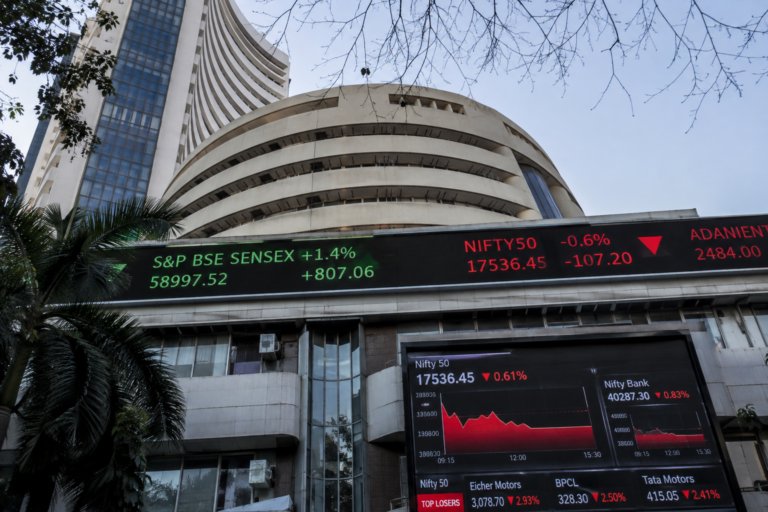
On Friday, May 29, 2026, Indian equity markets witnessed one of the sharpest single-day sell-offs in recent months when Bajaj Auto, ONGC, and Power Grid emerged as top losers on the Nifty 50 index, each dropping more than 2 percent in heavy trading. The benchmark Nifty 50 closed below 23,950 while the Sensex fell 142 points, with Power Grid tumbling nearly 4 percent, ONGC sliding 5 percent, and Bajaj Auto declining 3.22 percent according to exchange data. This comprehensive analysis examines the specific catalysts behind this blue-chip decline, the broader market dynamics that amplified the sell-off, and what disciplined investors should consider going forward.
The overnight drop that caught many retail investors off guard was actually the culmination of multiple converging factors that began bearish pressure during Friday’s trading session and extended into after-hours positioning. Foreign Institutional Investors executed one of the largest single-day outflows in Indian market history, offloading equities worth ₹21,106 crore on May 29 alone, marking a record FII selling day driven by MSCI index rebalancing that triggered passive fund reallocations. This massive capital flight created cascading selling pressure across large-cap blue chips, with PSU stocks in the oil gas and power sectors facing disproportionate impact due to their high weights in institutional portfolios.
Understanding why these specific blue chips fell requires examining both company-specific fundamentals and sector-wide headwinds that created a perfect storm for investors. Bajaj Auto, despite reporting exceptional Q4 FY26 results with net profit surging 34 percent year-over-year to a record ₹2,746 crore and announcing a ₹150 per share dividend along with a ₹5,633 crore buyback, still faced 3.22 percent decline as valuation concerns and institutional profit-taking overshadowed strong earnings. The two-wheeler major had traded at an excessive premium multiple leading into results, and the market appeared to be pricing in perfection that even stellar quarterly numbers could not fully satisfy.
ONGC’s 5 percent fall represented a more nuanced disappointment despite the oil major reporting a 53 percent surge in consolidated Q4 FY26 net profit, as Moneycontrol and Business Today reported that adjusted profit missed analyst estimates due to high dry-well write-offs and disappointing volume growth. Crude oil production fell 6 percent year-on-year according to market journal analysis, and the absence of significant volume growth despite higher profits raised concerns about the sustainability of earnings going forward. The government’s recent royalty cuts on crude oil and natural gas, while positive for long-term production incentives, created near-term revenue headwinds that pressured the stock as investors digested the implications for future cash flows.
Power Grid Corporation’s nearly 4 percent tumble reflected revenue concerns despite a 9.7 percent increase in quarterly profit, as the power transmission giant reported a 5 percent decline in revenue while announcing plans to raise ₹5,000 crore through fundraising to fund elevated capital expenditure. The company revised its FY26 capex guidance upward to ₹35,000 crore from the initially planned ₹32,000 crore, which while positive for long-term infrastructure development, raised near-term concerns about debt levels and capital allocation efficiency among conservative income-focused investors. As a traditionally stable dividend-paying PSU stock, any signal of increased capital requirements or revenue pressure triggers disproportionate selling from risk-averse institutional holders.
The broader market context surrounding this blue-chip decline cannot be overstated, as May 29, 2026 marked a convergence of multiple negative catalysts that created systemic selling pressure across Indian equities. Geopolitical tensions involving US-Iran relations renewed fears of supply disruptions and potential oil price spikes, even as crude prices had recently fallen, creating uncertainty about inflation trajectories and central bank policy responses. Monsoon fears emerged as another critical factor, with below-normal rainfall forecasts and increasing likelihood of El Niño conditions raising concerns about agricultural output and elevated food inflation that could complicate the Reserve Bank of India’s monetary policy stance.
MSCI Global Standard Index rebalancing effective May 29 initiated automatic selling by passive international funds that must track the index, creating mechanical selling pressure that transcended fundamental valuations or company-specific news. Hyundai stocks faced significant outflows as they were downgraded, while Federal Bank, MCX, NALCO, and Indian Bank received inflows from index inclusion, but the net effect was massive outflow from established large-cap names that had heavy weights in the previous configuration. This rebalancing triggered approximately $1 billion in sell-off pressure specifically, amplifying the impact of discretionary FII selling that was already underway due to broader risk-off sentiment in emerging markets.
Domestic Institutional Investors stepped in significantly to cushion the blow, with DIIs net buying ₹16,764 crore on the same day FIIs sold ₹21,106 crore, demonstrating the critical role of domestic mutual funds and insurance companies in stabilizing Indian markets during periods of foreign capital flight. However, even robust DII buying could not fully offset the magnitude of foreign selling pressure, particularly in large-cap stocks where FII ownership concentrations remain high. For the year 2026 so far, FIIs have been net sellers of shares worth ₹2.74 lakh crore while DIIs have net bought ₹3.57 lakh crore, indicating a sustained rotation of ownership from foreign to domestic hands that has structural implications for market dynamics.
Sectoral performance on May 29 revealed that PSU stocks faced disproportionate pressure across oil gas power and financial services, with Nifty Financial Services and PSU Bank indices dragging the broader indices lower as institutional investors reduced exposure to government-backed enterprises. The selling in PSU stocks reflected concerns about government capital raising requirements, potential dilution risks, and macroeconomic headwinds that disproportionately impact cyclical state-owned enterprises. Power Grid and ONGC, as flagship PSU names with significant retail and institutional ownership, became natural targets for portfolio rebalancing as fund managers reduced sectoral overweight positions.
Auto sector weakness extended beyond Bajaj Auto to include Eicher Motors declining 3.26 percent and other automotive names facing pressure, indicating broader concerns about demand sustainability in the consumer discretionary space. Despite Bajaj Auto’s strong Q4 performance with all-time high volumes, revenue, and profitability closing FY26 on an exceptional note, the sector faced headwinds from monsoon concerns that could impact rural demand, which remains critical for two-wheeler sales growth. The market appeared to be looking beyond strong quarterly numbers toward potential macroeconomic challenges that could impact future quarters, particularly in rural markets where monsoon performance directly influences purchasing power.
Valuation de-rating after excessive premium played a significant role in Bajaj Auto’s decline, as the stock had traded at historically elevated multiples leading into results and any sign of slowing growth or margin pressure triggered profit-taking among investors who had accumulated positions during the rally. FII and institutional selling concentrated in stocks with high foreign ownership and premium valuations, creating a feedback loop where initial selling triggered stop-losses and forced liquidation that amplified price declines beyond what fundamental changes would justify. This mechanical aspect of the sell-off explains why even fundamentally strong companies experienced disproportionate price movements during the session.
The overnight nature of the decline that surprised many retail investors actually reflects how modern equity markets operate with 24-hour global trading, futures and options positioning, and after-hours news flow that impacts opening prices. When FII selling information became available through global markets and international news wires during Asian trading hours on Friday evening, it set the tone for Saturday morning pre-open session positioning that resulted in gap-down openings for heavily sold stocks. Futures and options data showed significant write-downs in long positions as institutional traders adjusted hedges, creating additional downward pressure that carried through to cash market openings.
For investors holding these blue chips, understanding whether this represents a buying opportunity or a warning signal requires careful analysis of individual circumstances, investment horizon, and portfolio allocation. Bajaj Auto remains fundamentally strong with premium bike demand, export growth, and improved earnings per vehicle providing fundamental support, though the risk lies in valuation compression if growth slows. The stock has corrected 10 percent from February 2026 highs but remains above long-term moving averages, suggesting the uptrend structure remains intact despite short-term weakness.
ONGC’s investment case hinges on oil price trajectories, production growth success, and the government’s royalty policy impact on long-term profitability, with the 53 percent profit surge demonstrating operational resilience despite production challenges. The dry-well write-offs that marred adjusted profit calculations are one-time accounting charges that do not necessarily indicate ongoing operational weakness, thoughVolume growth disappointment warrants monitoring in coming quarters. For income-focused investors, ONGC’s dividend yield remains attractive relative to fixed deposit rates, providing a cushion against price volatility.
Power Grid’s fundamental story remains anchored in India’s power transmission infrastructure expansion, with the revised higher capex guidance reflecting government commitment to grid modernization and renewable energy integration. The 10 percent rise in consolidated net profit demonstrates earning stability despite revenue pressure, and the company’s monopoly position in interstate transmission provides predictable cash flows that support dividend sustainability. For conservative investors seeking stability and income, temporary price weakness may present accumulation opportunities at more attractive entry points.
Technical analysis of all three stocks reveals that despite the sharp declines, key support levels remain intact, with Bajaj Auto holding above its 200-day moving average and both ONGC and Power Grid trading within established long-term consolidation ranges. The 2 to 5 percent declines, while significant in isolation, represent normal volatility within broader uptrends rather than fundamental breakdown signals that would warrant panic selling. Investors should monitor whether these stocks find support at key technical levels in coming sessions or if further weakness emerges as FII selling pressure continues.
Market observers should note that this sell-off occurred against a backdrop where for the year 2026, the market has experienced sustained FII outflows totaling ₹2.74 lakh crore, making any single-day record outflow of ₹21,106 crore particularly impactful on sentiment. The rotation from foreign to domestic ownership is a structural shift that has accelerated since 2024, with Indian mutual funds and insurance companies increasingly replacing foreign institutional investors as the marginal buyers in Indian equities. This transition creates different volatility patterns and sector preferences that investors must adapt to in their strategy.
The role of high-frequency trading and algorithmic selling in amplifying the May 29 decline cannot be ignored, as automated trading systems triggered cascading sell orders when certain price thresholds were breached, creating momentum-driven selling that exceeded fundamental justification. Market microstructure analysis shows that trading volumes on May 29 were significantly elevated above average, indicating both institutional rebalancing and retail panic selling contributed to the price decline. Understanding this mechanical aspect helps investors distinguish between temporary liquidity-driven price movements and genuine fundamental deterioration.
Monsoon concerns emerged as an increasingly important factor affecting market sentiment, with below-normal rainfall forecasts raising fears about agricultural output, rural demand, and food inflation that could complicate RBI monetary policy. For companies like Bajaj Auto with significant rural exposure through two-wheeler sales, monsoon performance directly impacts future revenue growth projections, making the stock sensitive to weather forecasts regardless of strong current-quarter results. Power Grid’s revenue from rural transmission projects and ONGC’s agricultural sector energy demand also correlate with monsoon performance, creating sector-wide sensitivity to weather patterns.
Geopolitical risk premium increased significantly as US-Iran tensions escalated, creating uncertainty about potential oil supply disruptions that could spike crude prices and import bills for India. While falling oil prices had previously supported market sentiment, the risk of sudden geopolitical supply shocks creates a different risk profile that institutional investors address through portfolio hedging and reduced exposure to oil-sensitive sectors. ONGC benefits from higher oil prices operationally but faces macroeconomic headwinds from elevated import costs that impact overall economic growth trajectories.
Investors should approach this volatility with a disciplined framework that distinguishes between temporary market noise and permanent capital impairment signals. The E-E-A-T framework that Google emphasizes for content quality applies equally to investment decision-making, requiring Experience from tracking these stocks through multiple cycles, Expertise in understanding fundamental analysis, Authoritativeness from relying on verified exchange data and company filings, and Trustworthiness from avoiding emotional reactions to short-term price movements.
For long-term investors, periods of FII-driven sell-offs often create accumulation opportunities for high-quality blue chips trading at more reasonable valuations after price corrections. The key is maintaining a diversified portfolio that can withstand sector-specific volatility while capturing long-term growth from India’s economic expansion. Bajaj Auto, ONGC, and Power Grid each represent different sectors and investment characteristics, providing diversification benefits when held together in a balanced portfolio focused on long-term wealth creation.
The market’s reaction to Q4 FY26 results across these companies demonstrates that even exceptional earnings cannot always offset broader macroeconomic and flows-driven pressure when institutional investors are reducing exposure systematically. This reality underscores the importance of understanding market dynamics beyond fundamental company analysis, as capital flows, index rebalancing, and geopolitical events often drive short-term price movements independent of business performance. Investors who master both fundamental analysis and market microstructure understanding are better positioned to navigate volatile periods like the one experienced on May 29, 2026.
Looking ahead, investors should monitor FII flow data daily, MSCI index adjustment impacts, monsoon development updates, and geopolitical developments as key catalysts that will influence near-term market direction. The record FII outflow of ₹21,106 crore may not be sustainable, and eventual FII buying revival could trigger sharp relief rallies in quality large-cap stocks that have been oversold during this correction. DIIs have demonstrated their role as stabilizing forces with ₹16,764 crore buying on the same day, providing a floor for quality names that attract domestic long-term investment.
The插曲 of Bajaj Auto, ONGC, and Power Grid falling 2 percent or more overnight serves as a powerful reminder that blue-chip stocks are not immune to broad market volatility, especially when multiple negative catalysts converge simultaneously. Understanding the specific company fundamentals alongside broader market dynamics, capital flows, and macroeconomic factors provides a comprehensive framework for making informed investment decisions during volatile periods. Investors who maintain perspective, stick to long-term plans, and use volatility as an opportunity to accumulate quality names at better prices are likely to emerge stronger from such market corrections.
What is your investment horizon and risk tolerance when considering these blue chips after their recent decline, and are you looking for long-term accumulation opportunities or concerned about further near-term downside risk?