Amazon vs Flipkart Credit Cards in 2026: Which Co-Branded Card Is Actually Giving Better Value on Big Sale Days?
Every year, right before the Great Indian Festival and the Big Billion Days go live, the same question lands in my inbox and comment sections from readers who track credit card offers with me: should I swipe my Amazon Pay ICICI card or my Flipkart Axis Bank card during the sale? I have used both cards for over three years now, tracked their fee structures through multiple revisions, and actually redeemed cashback from real festive-season purchases, from a washing machine bought last October to a laptop grabbed during this year’s GOAT Sale. This article puts both cards side by side using their current 2026 terms so you can decide with numbers instead of guesswork.
Why This Comparison Matters More in 2026 Than Before
Both cards have quietly changed their rules over the past year. ICICI Bank introduced a fee on large Amazon Pay wallet loads starting mid-January 2026, and Axis Bank permanently removed complimentary airport lounge access from the Flipkart card back in mid-2025. These are not cosmetic tweaks. They change the real, after-tax value you get when you use either card during a sale event, and most comparison articles online are still quoting outdated terms from 2023 or 2024. I have rechecked every number below against the issuers’ current terms pages and consumer finance trackers as of mid-2026, and I will flag anywhere the offer is promotional and could change before you apply.
Amazon Pay ICICI Credit Card: The Core Value Proposition
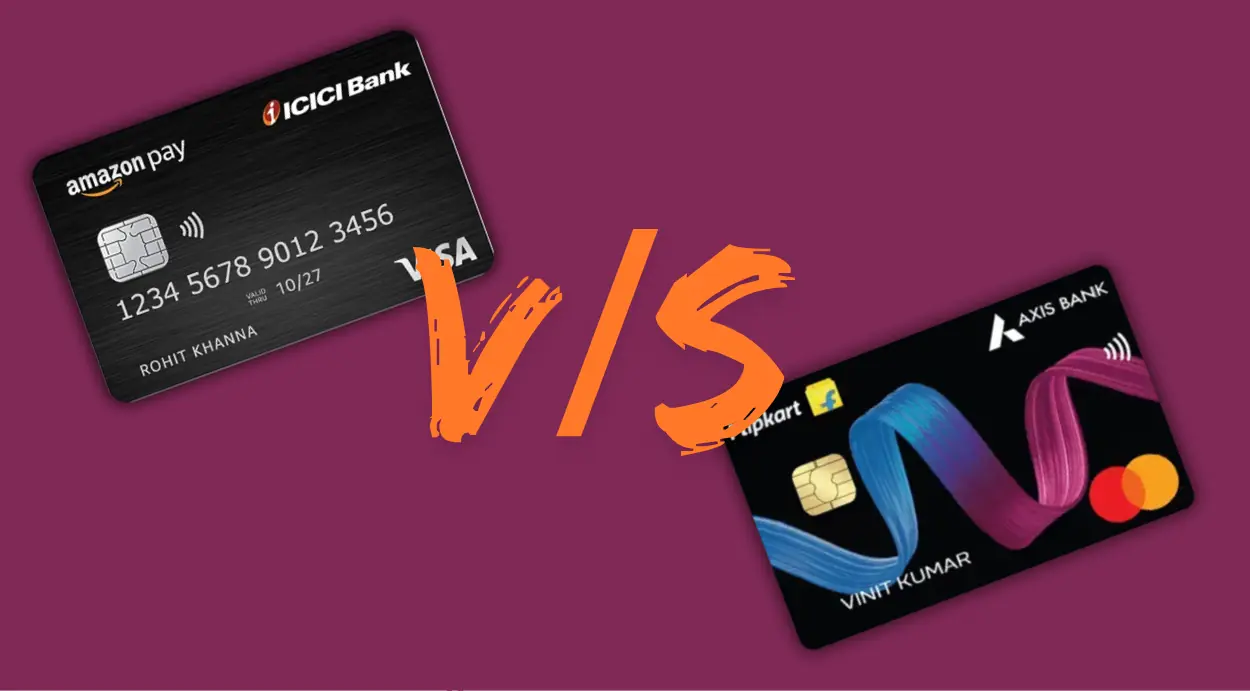
The Amazon Pay ICICI Credit Card, co-branded with Visa, remains a lifetime-free card with zero joining fee and zero annual fee, which is still one of its biggest structural advantages. There is no annual spend threshold you need to cross to keep it free, unlike several competing shopping cards. For Amazon Prime members, the card pays 5% unlimited cashback on purchases made on Amazon as well as travel bookings, and non-Prime members still earn 3% unlimited cashback on the same categories. This cashback has no upper cap, which is the single biggest reason this card wins for shoppers who plan to make one or two large-ticket purchases during Prime Day or the Great Indian Festival.
Outside the Amazon ecosystem, the card also pays 2% cashback at more than a hundred Amazon Pay partner merchants and 1% on essentially everything else, excluding a specific list of categories such as fuel, tax payments, EMI conversions, and international spends. One important change worth noting for anyone who uses Amazon Pay balance as a quasi-wallet: starting from 15th January 2026, ICICI Bank began charging a 1% fee on wallet loads of ₹5,000 or more, so cashback on wallet top-ups only really works cleanly below that threshold now. This is a detail that most older reviews still miss.
Where this card genuinely shines during sale season is the absence of a cashback ceiling. If you buy a ₹1,20,000 laptop on Amazon during the Great Freedom Sale as a Prime member, you are looking at ₹6,000 in cashback credited straight to your Amazon Pay balance, with no cap eating into that number. That is a meaningful, real-world difference compared to a capped card, and it is the reason I personally keep this as my go-to card for any single large purchase on Amazon.
The redemption model is also worth understanding before you rely on it. Cashback lands as Amazon Pay balance, not as a statement credit against your bill. That balance can be used for future Amazon purchases, bill payments, recharges, and payments at Amazon Pay partner merchants, which makes it flexible within the Amazon ecosystem but essentially useless if you want the money to reduce what you owe on your credit card statement. If your financial habit is to pay off your card in full every month and treat rewards as pure savings, a wallet-based reward can feel like it is locking your money into more Amazon spending rather than actually saving you cash.
Flipkart Axis Bank Credit Card: The Core Value Proposition
The Flipkart Axis Bank Credit Card takes a different approach entirely. It is not a lifetime-free card. It carries a ₹500 joining fee and a ₹500 annual fee from the second year onward, though the annual fee is waived if your yearly spending crosses ₹3,50,000, excluding rent payments and wallet loads. This single fact changes the math for lighter shoppers, because unlike the Amazon card, you are paying something just to hold this card unless you spend heavily on it every year.
In exchange, the earn rates on Flipkart’s own ecosystem are higher than Amazon’s flat cashback structure. The card offers 5% cashback on Flipkart purchases and on Cleartrip bookings, and a strong 7.5% cashback on Myntra, all credited directly as statement credit rather than a wallet balance. That statement-credit model is genuinely more useful for people who want their rewards to reduce their actual bill rather than push them toward more spending on one platform. There is also an unlimited 4% cashback on a rotating list of Axis preferred merchants that has included names like Swiggy, PVR, Uber, and cult.fit, though this merchant list changes periodically and is worth checking against the current PDF Axis publishes before you rely on it for a specific purchase.
The catch, and it is a significant one during sale season, is that the 5% Flipkart rate and the 5% Cleartrip rate are each capped at ₹4,000 per statement quarter, calculated separately from each other. Doing the arithmetic, that ₹4,000 cap on Flipkart works out to roughly ₹80,000 of full-rate spending in a quarter. Spend beyond that in the same quarter and your Flipkart purchases drop to the base 1% rate for the rest of that quarter. During Big Billion Days, this cap is the single most important number to keep in mind, because if you have already used up your quarterly cap on smaller Flipkart purchases earlier in the same quarter, your big sale-day purchase could earn a fraction of what you expect.
The Myntra rate of 7.5% is genuinely one of the better fashion cashback rates available on any co-branded card in India right now, and it shares the same ₹4,000 quarterly ceiling, separately tracked from the Flipkart cap. If your festive shopping list includes clothing and footwear alongside electronics, splitting spend across Flipkart and Myntra actually lets you extract more total cashback than dumping everything into one merchant category.
One more structural change matters here. Axis Bank discontinued complimentary domestic airport lounge access on this card in mid-2025, so anyone still choosing this card partly for travel perks is working off outdated information. The card today is a shopping and cashback tool, not a travel companion.
Head-to-Head: What Actually Happens on a Big Sale Day
Picture two realistic sale-day scenarios based on actual festive spending patterns I have tracked with readers over the past two seasons.
Scenario one is a single large-ticket purchase, say a ₹90,000 smart television bought during Amazon’s Great Indian Festival versus the same television on Flipkart’s Big Billion Days. On the Amazon Pay ICICI card, a Prime member earns a flat 5% with no cap, which comes to ₹4,500 in Amazon Pay balance. On the Flipkart Axis card, 5% on ₹90,000 would technically be ₹4,500 too, but you hit the ₹4,000 quarterly cap well before reaching that number, meaning your effective cashback tops out at ₹4,000, and any remaining spend earns only 1%. For a single large appliance or electronics purchase, the Amazon card comes out ahead purely because of the absence of a cap.
Scenario two is a spread of smaller purchases across categories, say ₹15,000 in clothing on Myntra, ₹20,000 in general Flipkart purchases, and a Cleartrip flight booking worth ₹10,000, all within the same quarter. Here the Flipkart Axis card performs strongly because the 7.5% Myntra rate alone yields ₹1,125, the Flipkart purchases at 5% yield ₹1,000, and the Cleartrip booking at 5% adds ₹500, for a combined ₹2,625 in statement credit, none of which touches the quarterly caps yet. The equivalent basket spent entirely through Amazon would yield 5% flat for Prime members, which is a similar percentage but locked into Amazon Pay balance rather than reducing your actual bill.
The pattern that emerges from this exercise is straightforward. Concentrated, big-ticket spending favors the uncapped Amazon Pay ICICI card. Spread-out, cross-category shopping across fashion, groceries adjacent, and travel favors the higher blended rates on the Flipkart Axis card, provided you stay under the quarterly caps.
The Redemption Difference Nobody Talks About Enough
Most comparison articles stop at cashback percentages and ignore how usable that cashback actually is once it lands. This is where personal experience matters more than a spec sheet. Amazon Pay balance is genuinely frictionless if you already buy most of your household goods, recharges, and bill payments through Amazon, because the balance gets used up naturally without you thinking about it. But if your spending is split across multiple platforms, that balance can sit unused for months, effectively becoming money you can only spend in one place.
Flipkart Axis Bank’s statement credit model is more universally useful because it reduces what you actually owe, in real rupees, regardless of where you spend next. For someone who treats cashback as genuine savings rather than store credit, this matters. It is a quieter advantage that does not show up in headline percentage comparisons but shows up clearly in your bank statement.
Fees, Eligibility, and the Long-Term Cost of Ownership
The Amazon Pay ICICI card requires no joining fee and no annual fee ever, with a minimum monthly income requirement in the range of ₹20,000 to ₹30,000 depending on whether you are an existing ICICI customer. This makes it accessible to a wide range of applicants, including first-time credit card holders, and it costs nothing to simply hold in your wallet even if you barely use it in a given year.
The Flipkart Axis Bank card asks for ₹500 plus applicable taxes as both a joining fee and a renewal fee from the second year, waived only if you cross ₹3,50,000 in annual eligible spending. If you are not a heavy Flipkart or Myntra shopper, this fee becomes a real cost that eats into whatever cashback you earn, and it is worth running the numbers honestly before applying purely for one sale event. Someone who shops on Flipkart only during Big Billion Days and barely touches the card the rest of the year is unlikely to clear the waiver threshold, and the annual fee could offset a meaningful chunk of that one sale’s cashback.
Instant Discounts and Bank Offers During Sale Events
Beyond the co-branded cashback structure, both Amazon and Flipkart sale events typically layer on separate instant bank discounts that apply across a wider set of cards, not just the co-branded ones. During Flipkart’s ongoing GOAT Sale, for instance, cardholders using HDFC, IDFC FIRST, and Axis Bank cards have been offered flat 10% instant discount, while Flipkart Axis Bank Credit Card users get an additional 5% cashback on top of that. This stacking is important. It means a Flipkart Axis cardholder is not just earning the merchant cashback rate, they are often also eligible for the same instant discount available to holders of other bank cards, plus the extra cashback layer specific to the co-branded card. Amazon runs comparable instant discount structures during its own sale events, though the exact percentage and eligible card list changes with each sale, so it is worth checking the live offers page on the morning the sale opens rather than relying on last year’s terms.
Practical Guidance Based on How You Actually Shop
If your festive shopping is dominated by one or two large purchases, an appliance, a television, or a premium smartphone, and you already hold or are willing to hold an Amazon Prime membership, the Amazon Pay ICICI card is very likely to give you more absolute cashback simply because there is no ceiling on what you earn. It also costs nothing to hold as a backup card even if you rarely use it, which makes it a low-risk addition to any wallet.
If your shopping pattern is spread across fashion, general merchandise, and occasional travel bookings through Cleartrip, and you are confident you will cross the ₹3,50,000 annual spend threshold or you value statement credit over wallet balance, the Flipkart Axis Bank card is likely to deliver a better blended return, particularly because of the strong 7.5% Myntra rate that has no direct equivalent on the Amazon side.
A third option that many frequent online shoppers quietly adopt, and one I would recommend after using both cards through multiple sale cycles, is holding both. Since the Amazon Pay ICICI card is free for life, there is no ongoing cost to keeping it purely for big-ticket Amazon purchases while running your Flipkart, Myntra, and Cleartrip spending through the Axis card. This dual-card approach captures the uncapped Amazon rate for large purchases and the higher blended Flipkart-ecosystem rates for everything else, without paying for a card you are not using efficiently.
A Few Cautions Worth Remembering
Reward structures, fees, and welcome offers on both cards have changed more than once in the past two years, and they are likely to change again. Treat every percentage and cap mentioned here as accurate for mid-2026 but always verify current terms on the issuer’s official page before a large purchase, particularly right before a major sale event when promotional terms are sometimes adjusted. Exclusions matter too. Both cards exclude categories like gold, jewelry, rent payments, wallet loads above certain thresholds, and gift card purchases from their headline cashback rates, and it is easy to assume a purchase qualifies when it technically does not.
Finally, remember that a credit card, however generous the cashback, is only good value if you pay your statement in full each month. Interest charges on a revolving balance will erase any cashback earned many times over, so the real winner between these two cards is whichever one fits your actual spending pattern and your discipline in clearing dues on time, not just the card with the flashier headline percentage.
This article reflects publicly available terms from Amazon, Flipkart, ICICI Bank, and Axis Bank as of mid-2026. Cashback rates, fees, caps, and promotional offers are subject to change at the discretion of the respective banks and platforms. Always confirm current terms on the official issuer page before applying for a card or relying on a specific offer during a sale event. This article is for general informational purposes and is not financial advice.