Westside’s ₹49 Credit Card Fee: Is a Flat Charge at the Billing Counter Legal in India?
Westside’s ₹49 Credit Card Fee: Is a Flat Charge at the Billing Counter Legal in India?
The Tata-owned fashion chain has started adding a ₹49 “convenience fee” to every in-store credit card payment. RBI has no explicit rule for credit cards, but lawyers say disclosure, consumer law and card network practice still apply.
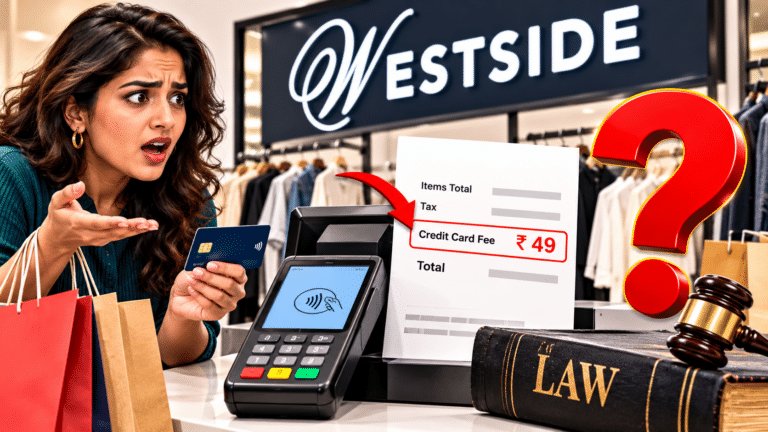
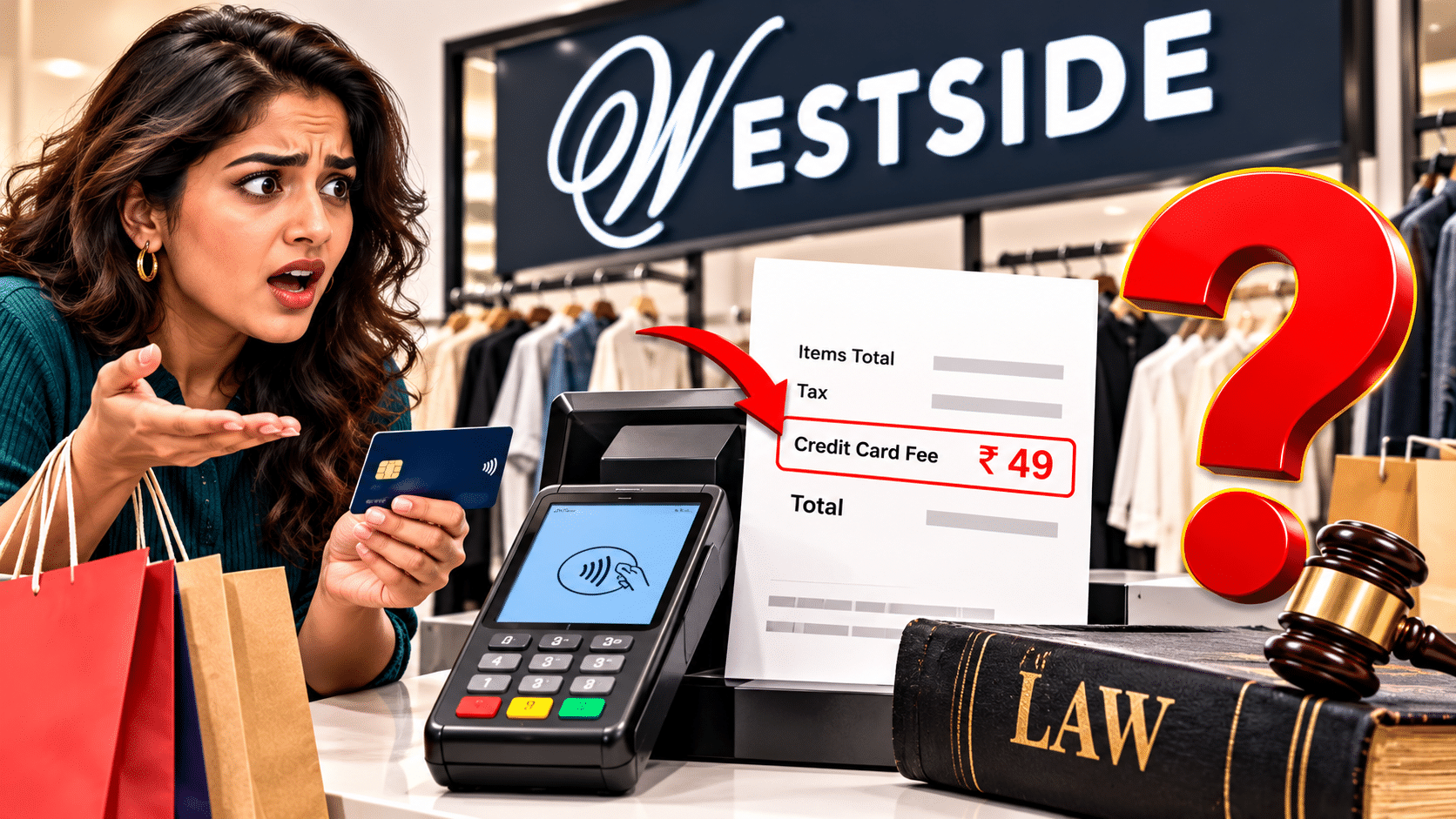
You pick up a shirt for ₹999, walk to the counter and hand over your credit card. The bill comes back at ₹1,048. That extra ₹49 is now standard at Westside stores, and since reports of the charge spread on October 23, 2026, shoppers have been asking a blunt question online: can a retailer simply charge you for using a credit card?
The honest answer is that it sits in a grey zone. India’s central bank explicitly bars merchants from passing debit card processing costs to customers, but has issued no equivalent rule for credit cards. That does not make every surcharge lawful. Whether this one holds up depends on how it is disclosed, whether you had a free alternative, and how card networks and consumer law treat it.
A Small Fee Landing on a Very Large Payment Habit
₹49 sounds trivial until you consider how many people it touches. RBI data reported by Outlook Money shows 122.86 million credit cards in force at the end of July 2026, with monthly spends of ₹2.08 trillion. Credit card spending has stayed above ₹2 trillion a month for three months in a row.
Westside itself is not a small shop. Trent, the Tata Group retailer behind it, reported 300 Westside stores as of March 31, 2026, alongside 963 Zudio outlets. A policy decision at one large chain can quickly shape what shoppers come to accept elsewhere, which is part of why the reaction has been so sharp.
Convenience Fee, Surcharge or MDR? The Words Matter More Than They Look
Every card payment has a cost. The shop’s bank, known as the acquirer, charges the merchant a merchant discount rate, or MDR, for each transaction. Part of that goes to the bank that issued your card and part to the card network. Industry explainers put credit card MDR at roughly 1% to 2.5% of the bill, depending on the card and merchant category.
When a merchant passes that cost to you, it is a surcharge. A convenience fee traditionally means something different: a charge for using a channel the merchant does not normally offer, such as paying a utility bill by card online. Advocate Rahul Hingmire told NewsBytes that passing MDR to customers is effectively a payment surcharge, and that calling it a convenience fee does not change its nature.
| Term | What it means | Who normally bears it |
|---|---|---|
| MDR | Fee the merchant’s bank charges per card payment, typically a percentage | Merchant |
| Interchange | Part of MDR paid to the bank that issued your card | Merchant, via MDR |
| Surcharge | Extra amount added to your bill because you paid by card | Customer, if the merchant imposes it |
| Convenience fee | Charge for using an optional channel the merchant does not usually offer | Customer, if disclosed upfront |
| Acquirer | The bank or payment firm that provides the card machine | Not a fee; a party you can complain to |
| Zero MDR | No merchant fee on UPI and RuPay debit payments under government policy since 2020 | Nobody |
That distinction is why the label on Westside’s notice matters. A charge on the payment method most shoppers ordinarily use looks more like a surcharge than a convenience fee, and surcharges are what card network rules and consumer lawyers tend to scrutinise.
What RBI Has Said, and the Gap It Left Open
RBI has drawn a hard line on debit cards. In December 2017 it rationalised debit card MDR and told banks to ensure merchants did not pass those charges on to customers, with effect from January 1, 2018. The Free Press Journal notes that this instruction should not be assumed to apply in the same way to credit cards.
For credit cards, RBI has not issued a specific instruction on merchant surcharges. Lawyers quoted in the coverage say that silence is not the same as permission. A merchant’s agreement with its acquiring bank, and the rules of networks such as Visa, Mastercard and RuPay, can restrict surcharging even where no RBI direction exists. Those agreements are private, so their exact terms cannot be checked publicly.
The policy gap explains the retailer’s choice of payment modes. UPI and RuPay debit carry no MDR for the shop. Other debit cards carry capped MDR that cannot be passed on. Credit cards are the costliest mode for merchants and the only one without an explicit RBI bar on passing that cost along.
Why ₹49 Hurts Small Bills Far More Than Big Ones
A flat fee behaves very differently from a percentage. On a small purchase it is a steep markup; on a large one it barely registers. That is the core of the fairness argument shoppers are making online.
Compare that with what the store likely pays its bank. If credit card MDR is around 2%, the merchant’s cost on a ₹500 bill is about ₹10, and on a ₹1,000 bill about ₹20. The ₹49 fee only drops below that indicative cost when the bill crosses ₹2,450. Below that line, shoppers paying by card are covering more than the likely processing cost.
Why Credit Cards Became the Only Target
Westside’s choice to charge only credit card users is not random. It tracks how much each payment mode costs the shop. UPI and RuPay debit payments carry zero MDR under the government’s 2020 policy. Other debit cards carry MDR that RBI capped in its December 2017 framework, at up to 0.9% for larger merchants with a ceiling of ₹1,000 per transaction, and that cost cannot be passed on. Credit cards are uncapped by regulation and typically the most expensive.
That gives a retailer a strong commercial reason to nudge shoppers away from credit cards. It also means the fee is effectively a price signal. The shop is telling you that the cheaper way to pay, from its point of view, is the one where the bank and the network take nothing or very little.
The chart also shows why the reaction has focused on fairness rather than legality. On a mid-sized bill, ₹49 is close to the upper end of what the store might pay. On a smaller bill, it is well above it, and on a large bill well below. A flat fee applied to everyone cannot match the cost of every transaction.
Rewards Versus the Fee: When Paying by Card Still Wins
Many shoppers use credit cards for points, cashback or interest-free credit. The ₹49 changes the maths. The table below compares a basic card earning 1% in reward value with a co-branded card earning 5%, a level some fashion and shopping cards advertise on partner spends.
| Bill | Fee as % of bill | 1% reward earned | Net with 1% card | Net with 5% card |
|---|---|---|---|---|
| ₹500 | 9.80% | ₹5 | −₹44 | −₹24 |
| ₹1,000 | 4.90% | ₹10 | −₹39 | +₹1 |
| ₹2,000 | 2.45% | ₹20 | −₹29 | +₹51 |
| ₹3,000 | 1.63% | ₹30 | −₹19 | +₹101 |
| ₹5,000 | 0.98% | ₹50 | +₹1 | +₹201 |
| ₹10,000 | 0.49% | ₹100 | +₹51 | +₹451 |
What shoppers often miss is that the fee itself usually earns nothing. Card issuers commonly exclude surcharges and fees from reward points, so the ₹49 is a pure cost, not a spend that earns its way back.
Is It Legal? Four Tests Lawyers Are Applying
No court or regulator has ruled on Westside’s fee. But the lawyers quoted in coverage of the issue point to a consistent set of questions. The answers decide whether a surcharge is merely unpopular or open to a complaint.
On the first two tests, a clear store notice and a free alternative help the retailer. The weaker points are the label and the size of the fee relative to small bills. That is why lawyers advise shoppers to object politely, keep their receipts and let the formal channels decide.
How to Push Back If You Are Charged
A ₹49 dispute is unlikely to go to court on its own. But complaints tend to move processes when they come in volume, and the steps are not difficult. Start at the counter and go up only if needed.
What This Could Mean Beyond One Store
Retailers have long absorbed card costs as part of doing business, building them into prices. A visible per-transaction fee changes that bargain. If shoppers accept it, other chains facing similar costs may follow. If the reaction is strong enough, or if acquirers and networks object, the fee may be withdrawn or reshaped.
There is also a broader policy question. India has pushed hard to make digital payments free at the point of sale, with zero MDR on UPI and RuPay debit since 2020. Credit cards sit outside that framework because they carry real credit costs for banks. A retailer passing those costs to customers highlights the gap between the payment modes the government made free and the one that remains expensive for merchants.
What to watch next
- Whether Westside revises the fee, exempts small bills or switches to a percentage.
- Whether any card network, acquiring bank or RBI comments publicly on merchant surcharges.
- Whether the Central Consumer Protection Authority, which acts on unfair trade practices, takes note of complaints.
Frequently Asked Questions
Is it legal for Westside to charge ₹49 on credit card payments?
There is no explicit RBI rule banning credit card surcharges, unlike debit cards. Lawyers quoted in coverage say the fee could still be challenged if it is not disclosed before purchase, is misleadingly called a convenience fee, or breaches card network and acquirer rules. No regulator or court has ruled on it so far.
Can shops charge extra for debit card payments in India?
No. RBI directed in December 2017, effective January 1, 2018, that merchants must not pass debit card MDR charges to customers. If a shop adds a surcharge for a debit card payment, you can raise it with your bank and the merchant’s acquiring bank.
How can I avoid the ₹49 fee at Westside?
Westside has said the fee applies only to credit card transactions in-store, and that shoppers can avoid it by paying through UPI, a debit card or cash. If you want card rewards, weigh them against the fee; on a 1% reward card, you break even only on bills of about ₹4,900.
What is MDR on credit cards?
MDR, or merchant discount rate, is the fee a merchant pays its bank for accepting a card payment. Industry explainers put credit card MDR at roughly 1% to 2.5% of the transaction, depending on the card and merchant category. The rates are set in private agreements and are not published.
Where can I complain about a credit card surcharge?
Start with the store, then your card-issuing bank, which can raise it with the merchant’s acquirer and card network. You can also file with the National Consumer Helpline on 1915 or 1800-11-4000. For persistent unfair charges, a complaint can go to the District Consumer Commission under the Consumer Protection Act, 2019.
Do I earn reward points on the ₹49 convenience fee?
Usually not. Many card issuers exclude fees and surcharges from reward earning. Check your card’s terms; if fees are excluded, the ₹49 is a pure added cost on top of whatever rewards the purchase itself earns.
Is there a convenience fee on UPI payments at stores?
UPI payments to merchants carry zero MDR under government policy since 2020, so shops have no processing cost to pass on. Westside has said UPI payments do not attract the ₹49 fee. If any store adds a charge for UPI, ask for it in writing and raise it with the payment provider.
Does the ₹49 fee apply to Westside online orders?
The store notice reported in the media refers to credit card transactions in-store. It has not been confirmed whether online orders on Westside’s website or app attract the same fee, so check the payment page for any added charge before confirming an order.
The Short Version
From October 8, 2026, Westside adds a flat ₹49 to every in-store credit card payment, and says UPI, debit card and cash payments are free. RBI explicitly bans passing debit card processing costs to customers but has no equivalent rule for credit cards, so the fee sits in a grey area. Lawyers say it may still be challenged if not disclosed upfront or if mislabelled. On small bills it is steep: 9.8% of a ₹500 purchase. Pay by UPI if you can, keep the receipt if charged, and raise objections through your bank or the National Consumer Helpline.