Credit Cards · Debt & Interest · India 2026
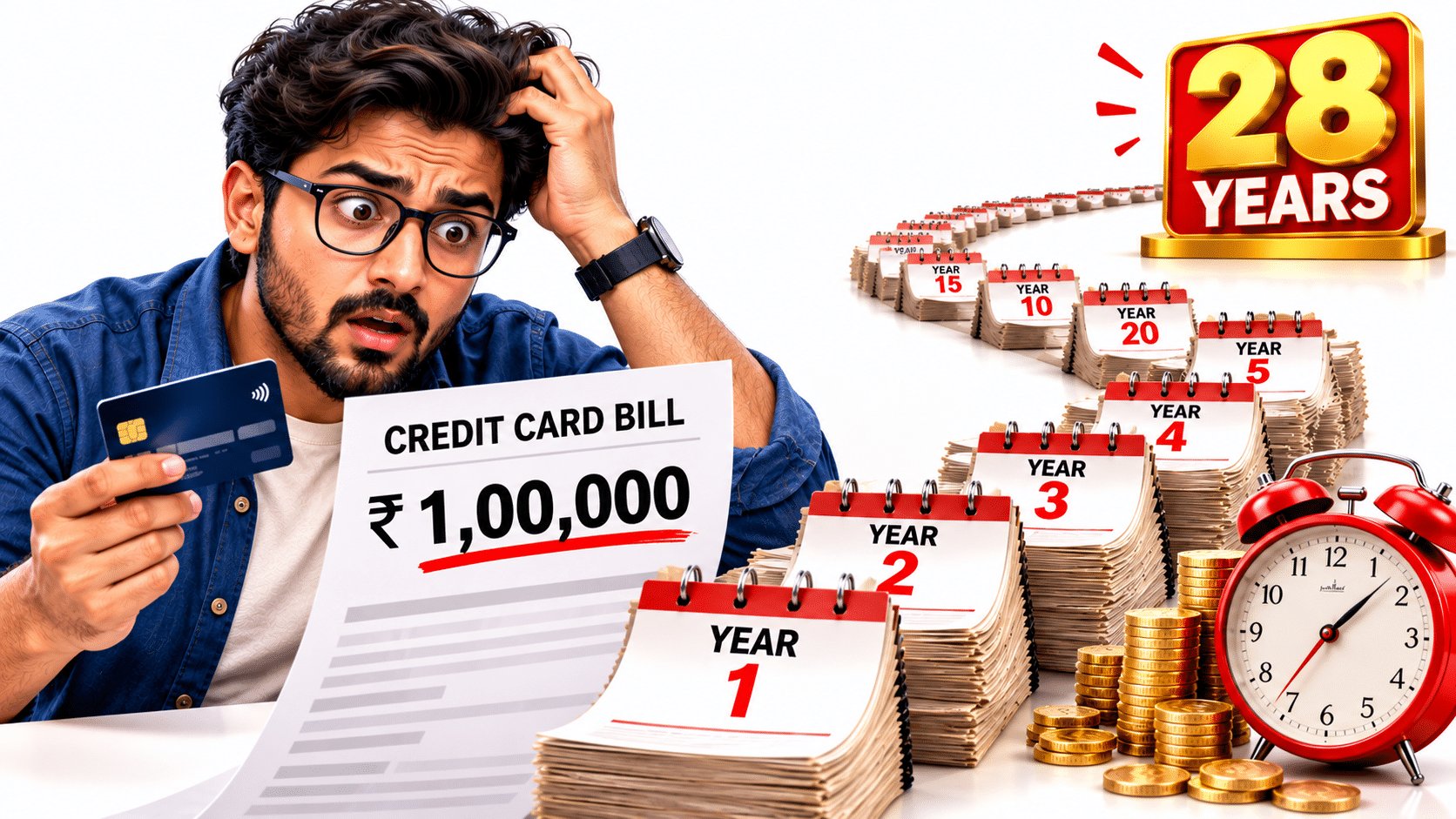
Paying Only the Minimum on Your Credit Card? A ₹1 Lakh Bill Could Take About 28 Years to Clear
The minimum amount due keeps your card in good standing, but it barely touches what you owe. At card interest of 42% a year plus GST, most of each minimum payment goes to interest, and the debt can outlast a home loan.
Your statement arrives with two numbers. One is large and uncomfortable. The other is small and reassuring. Paying the small one feels responsible: no late fee, no hit to your credit score, no call from the bank. Many people do it for months without a second thought.
The problem is that the minimum amount due was never designed to clear your debt. It is designed to keep the account current while interest keeps running on everything you have not paid. On Indian cards, that interest is among the most expensive borrowing available to ordinary consumers, and 18% GST is added on top.
A ₹2.95 Lakh Crore Habit, and the Cracks Showing in It
India’s credit card market has grown fast. A written reply in the Rajya Sabha, reported in March 2026, shows credit card advances at scheduled commercial banks rose from ₹2,10,400 crore in 2023 to ₹2,95,084 crore by March 31, 2025. Over the same period, gross NPAs in credit card loans rose from ₹4,072 crore to ₹6,778 crore, and write-offs nearly doubled from ₹8,208 crore to ₹15,674 crore.
Card debt becomes an NPA when payments are missed for more than 90 days. The minimum-only borrower is not in that group: by paying the minimum, they stay current. But revolving balances are the pipeline that feeds later defaults, and RBI signalled concern in November 2023 by raising the risk weight on credit card receivables to 150%.
Minimum Due Is a Floor, Not a Plan
The total amount due is everything you owe on the statement date. The minimum amount due, or MAD, is the smallest payment that keeps your account regular. Pay at least the MAD by the due date and you avoid a late payment fee and a negative mark on your credit report. Pay less than the total, and the rest becomes a revolving balance.
RBI’s 2022 card directions tightened how MAD is set. Banks must ensure the minimum does not lead to negative amortisation, where your payment is so small that the debt grows. A typical formula, set out in a bank intimation reported by Outlook Business, is the higher of all interest, fees and taxes, or 5% of the total due, plus any EMIs, over-limit amounts and past dues. That protects you from a growing balance, but not from a very slow one.
The two costs most people miss
- Interest on new purchases. Once you carry a balance, the interest-free period of 20 to 50 days is suspended. New spends attract interest from the transaction date.
- GST on interest. 18% GST applies to finance charges and fees, so a 3.5% monthly rate effectively costs 4.13% of the balance each month.
How One Billing Cycle Turns Into Many Years
The mechanics are simple, which is why they are easy to underestimate. Each month, interest is charged on your average daily balance, GST is added to that interest, and your minimum payment is applied. With a 5% minimum and 4.13% going to interest and tax, only about 1% of the balance is actually repaid each month.
The Price Tag at Every Balance Size
The same arithmetic scales up. The table shows how long it takes to clear different balances by paying only the minimum, and how much interest and GST you hand over in the process. The last row shows what happens if your card charges 3.75% a month, the level listed by several large banks, instead of 3.5%.
| Starting balance | Monthly rate | Months to clear | Total paid | Interest and GST |
|---|---|---|---|---|
| ₹25,000 | 3.5% | 212 (17.7 years) | ₹1,10,123 | ₹85,123 |
| ₹50,000 | 3.5% | 277 (23.1 years) | ₹2,31,036 | ₹1,81,036 |
| ₹1,00,000 | 3.5% | 341 (28.4 years) | ₹4,72,861 | ₹3,72,861 |
| ₹2,00,000 | 3.5% | 405 (33.8 years) | ₹9,56,512 | ₹7,56,512 |
| ₹1,00,000 | 3.75% | 452 (37.7 years) | ₹6,39,300 | ₹5,39,300 |
What people get wrong is thinking of the minimum as a smaller version of an EMI. An EMI is built to reach zero on a fixed date. The minimum is built to keep you current, and it shrinks as your balance shrinks, which stretches repayment out almost indefinitely.
Four Ways to Pay Off the Same ₹1 Lakh
The fastest way to see the cost of the minimum is to compare it with fixed payments. All four routes below start with the same ₹1 lakh balance and no new spending.
A fixed ₹5,000 looks almost the same as the first minimum payment of ₹5,207. The difference is that it does not shrink. That alone cuts the payoff time from 341 months to 44. Converting the balance into an EMI at a lower rate, if your bank offers it, can cut the cost further still, but always check the rate, processing fee and any foreclosure charges first.
Reading the Statement Line by Line
Credit card statements use terms that sound similar but cost very different amounts. This decoder covers the lines you are most likely to see when you carry a balance.
| Statement term | What it means | Typical cost or rule |
|---|---|---|
| Total amount due | Everything owed on the statement date | Pay this to avoid all interest |
| Minimum amount due | Smallest payment that keeps you regular | Often 5% of dues or all interest and fees, plus EMIs |
| Finance charges | Interest on the unpaid balance and new spends | Roughly 3.5% to 3.75% a month at major banks |
| GST | Tax on interest and fees | 18% |
| Late payment fee | Charged if MAD is not paid within 3 days of due date | Slab-based, up to ₹1,300 at SBI Card |
| Over-limit fee | Charged when dues exceed your credit limit | ₹600 or 2.5% at SBI Card, whichever is higher |
| Cash advance fee | Charge for ATM withdrawals on a credit card | 2.5% or ₹500 at SBI Card, plus interest from day one |
| Interest-free period | Days between purchase and due date with no interest | 20 to 50 days, lost if a balance is carried |
| Past due | Unpaid minimum after the due date | Reportable to credit bureaus after 3 days |
Missing the minimum altogether adds a second layer of cost. SBI Card’s late fee, as listed by Paisabazaar, runs from nil for dues up to ₹500, to ₹400, ₹750, ₹950 and ₹1,100 across higher slabs, and ₹1,300 above ₹50,000, with an extra ₹100 if the minimum is missed for two cycles in a row.
What the Courts and the Regulator Have Said
For years, many borrowers believed there was a legal ceiling on card interest. In 2008, the National Consumer Disputes Redressal Commission held that charging more than 30% a year on late or partial payments was an unfair trade practice. On December 20, 2024, the Supreme Court set that ruling aside, holding that the commission had no jurisdiction to cap rates that fall under RBI’s regulatory framework.
RBI’s position is that rates must not be excessive and must be disclosed, but it does not fix them. Each bank’s board sets its own. In practice, that leaves the decision about how much interest to pay with the cardholder, through how much of each bill they choose to clear.
Why the Minimum Is Set So Low in the First Place
A low minimum is not a mistake in the design of credit cards. It serves two purposes at once. For the cardholder, it is a safety valve: in a month of medical bills or a delayed salary, you can stay current without finding the full amount. For the bank, it keeps a borrower paying interest for longer without the account turning delinquent.
That is why banks earn far more from cardholders who revolve than from those who pay in full. Someone who clears the total every month pays no interest at all and enjoys up to 50 days of free credit. Someone who pays only the minimum on ₹1 lakh pays about ₹46,728 in interest and GST in the first year in our illustration. The same card produces very different economics depending on how the bill is paid.
When paying the minimum can make sense
- A genuine one-off cash crunch. Paying the minimum for a month or two is far better than missing the payment, which brings late fees and credit reporting.
- A known inflow is days away. If a bonus or refund will arrive soon after the due date, paying the minimum and then clearing the rest quickly limits the damage.
- You are moving the debt to something cheaper. Paying the minimum while an EMI conversion or a lower-cost loan is being arranged keeps the account clean in the meantime.
If you cannot pay even the minimum
Call the bank before the due date rather than after. Many issuers can offer an EMI plan, a revised payment schedule or a temporary arrangement, and these are usually far less damaging than a missed payment. A one-time settlement may reduce the amount owed, but it is typically reported as “settled” rather than “closed”, which can affect future borrowing for years. If a bank’s handling of your account seems unfair, you can complain to the bank’s grievance officer and then to the RBI Ombudsman.
A Five-Step Exit From the Minimum-Due Loop
Getting out does not require a windfall. It requires turning a shrinking payment into a fixed one, and stopping the balance from refilling.
Before You Pay This Month’s Bill
Frequently Asked Questions
What happens if I pay only the minimum amount due on my credit card?
Your account stays regular, so there is no late fee and no negative credit report. But interest of roughly 42% to 45% a year, plus 18% GST, is charged on the unpaid balance, and new purchases lose the interest-free period. In our illustration, ₹1 lakh paid at the minimum takes about 28 years to clear.
Does paying the minimum due affect my CIBIL score?
Paying at least the minimum on time means the account is not reported as past due. But a large revolving balance raises your credit utilisation, which can weigh on your score. Missing the minimum for more than three days after the due date can be reported to credit bureaus.
How is the minimum amount due calculated on Indian credit cards?
It varies by bank, but a common formula is the higher of all interest, fees and taxes, or 5% of the total due, plus any EMIs, over-limit amounts and past dues. RBI rules require that the minimum does not cause negative amortisation, meaning the debt must not grow if you pay it.
What interest rate do credit cards charge in India?
Most major banks list rates of about 3.5% to 3.75% a month, or 42% to 45% a year, on revolving balances, with some cards higher or lower. GST of 18% is added to interest. The Supreme Court in December 2024 set aside an earlier 30% cap, so there is no fixed legal ceiling.
Do I lose the interest-free period if I pay only the minimum?
Yes. If any balance from the previous statement is unpaid, the interest-free period is suspended, and new purchases attract interest from the date of the transaction until the full balance is cleared.
Is it better to convert my credit card balance into an EMI?
Often, if the EMI rate is well below the card’s revolving rate. In our illustration, a 12-month EMI at 16% costs about ₹10,475 in interest and GST on ₹1 lakh, compared with ₹3.73 lakh at the minimum. Check processing fees, foreclosure charges and the effect on your credit limit before converting.
When does an unpaid credit card become an NPA?
Card dues are generally classified as a non-performing asset when the minimum amount due remains unpaid for more than 90 days. That damages your credit history and can lead to recovery action. Paying at least the minimum avoids this, but does not reduce the debt quickly.
Is GST charged on credit card interest and late fees?
Yes. GST of 18% applies to finance charges, late fees and other card fees. RBI rules say unpaid charges, levies and GST cannot be capitalised to charge further interest, but the GST itself is still payable.
The Short Version
Paying only the minimum amount due keeps your credit card account current, but it is the most expensive way to carry debt. At about 42% a year plus 18% GST, roughly four-fifths of each early payment goes to interest and tax. Our illustration shows ₹1 lakh taking about 28 years and ₹3.73 lakh in charges to clear, while a fixed ₹10,000 a month clears it in 14 months for about ₹31,664. RBI rules stop the debt from growing, but not from lingering. Stop new spending, pay a fixed amount above the minimum, and consider an EMI at a lower rate.