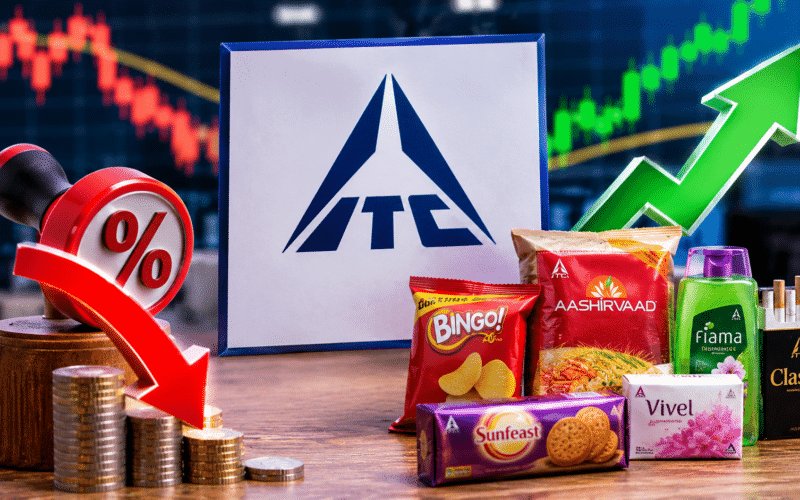
Markets · Stock analysis · ITC Ltd, November 2026
ITC Stock After the 40% GST Shock: Is the Worst Over or Still Ahead — What Q2 FY27 Numbers Really Show
Cigarette profits are still falling year on year, but they rose from the June quarter. With the stock near multi-year lows and a 5% dividend yield, the next test arrives with the Budget on 1 February 2027.
If you bought ITC at its September 2024 peak of about ₹500, the past year has been hard to watch. A stock long treated as a safe, dividend-paying defensive fell to ₹252.80 on 28 October 2026, its lowest in more than four years. It now trades around ₹285. In between came the biggest change to cigarette taxation in nearly a decade, a 2.91% stake sale by one of its best-known foreign holders, and two quarters of falling profit.
The question every ITC shareholder is asking is simple: has the damage been done, or is there more to come? The honest answer is that the numbers now point both ways. The tax shock is clearly still working through cigarette earnings. But for the first time this year, there are signs the decline is slowing. Here is what the data actually says.
How a Tax Notification Wiped Out a Third of the Stock
On 31 December 2025, the government notified a new tax structure for cigarettes and tobacco, effective 1 February 2026. GST on cigarettes rose from 28% to 40%, and the valuation basis moved to the retail sale price. The compensation cess was phased out and replaced by a specific excise duty of ₹2,050 to ₹8,500 per 1,000 sticks, depending on length. ITC described it as an unprecedented rise in cigarette tax incidence.
The market’s verdict was immediate. ITC fell nearly 10% on the first trading day of 2026, its steepest single-day drop since March 2020, and about 14% in two days. Brokerages including Motilal Oswal, JPMorgan, Jefferies, Nuvama and Morgan Stanley downgraded the stock.
- 40%GST on cigarettes from 1 Feb 2026, up from 28%
- 76%ITC’s estimated share of India’s legal cigarette market
- ₹2,050 to ₹8,500Excise duty per 1,000 sticks, by length
- 33% to 40%Price hikes CLSA and Jefferies said were needed to offset the tax
- 84%Cigarettes’ share of ITC’s FY26 standalone segment results
- ₹500.01All-time high, 27 September 2024
The reason the hit was so large is concentration. Cigarettes made up about 84% of ITC’s standalone segment results in FY26, according to an IndMoney analysis of the filings. Hotels, foods, personal care and paper are growing, but they are still a small share of profit. When the profit engine stalls, the whole company feels it.
Gross Revenue Up 78%, Profit Down 27%: Decoding the Q2 Paradox
ITC’s Q2 FY27 results, announced on 2 November 2026, look contradictory at first glance. Gross cigarette revenue jumped 78.1% to ₹15,536 crore, yet net cigarette revenue fell 21% and segment profit fell 27.2% to ₹3,813 crore on a standalone basis. The explanation is that gross revenue includes the taxes ITC collects and passes to the government. More tax inflates gross revenue without adding a rupee of profit.
Year-on-year change, quarter ended 30 September 2026, from ITC’s results and reports on them. Bars scaled to the largest move.
Consolidated net profit fell 18.5% to ₹4,229 crore from ₹5,187 crore, while standalone profit fell 20.1% to ₹4,137 crore. ITC did not disclose a cigarette volume figure. Brokerage previews had expected volumes to fall 8% to 9% year on year.
The other ITC is having its best run in years
Outside cigarettes, the quarter was strong. FMCG-Others revenue grew 19.1%, its fastest in 14 quarters. Paperboards, paper and packaging revenue rose 35.9% and its segment result jumped 47.6% to ₹282 crore. Non-cigarette segment results grew 24% overall. The problem is scale: those gains could not offset the ₹1,428 crore fall in cigarette segment profit.
The Number That Matters Most: Cigarette Profit Quarter by Quarter
Year-on-year comparisons will look terrible until February 2027, because they compare a heavily taxed quarter with an untaxed one. The more useful signal is the quarter-on-quarter trend after the tax took effect.
₹ crore, standalone segment results as reported. Q1 figures from reports on the Q1 FY27 results; Q2 from the Q2 FY27 results. Bars scaled to Q2 FY26.
From ₹3,341 crore in Q1 to ₹3,813 crore in Q2 is an improvement of about 14%, by our calculation. In Q1, ITC said cigarette volumes fell 5% to 6%, better than the 8% to 10% decline analysts had feared. That pattern — volumes hit, but less than expected, and profit recovering sequentially as staggered price hikes land — is the core of the “worst is over” argument.
ITC has used calibrated, staggered price increases instead of passing the full tax on at once. Gold Flake (10) went from ₹170 to ₹240, Classic (20) from ₹340 to ₹480, and Gold Flake Super Star from ₹59 to ₹89 by September. That spreads the shock to smokers but delays margin repair.
Percentage increase in pack price after the February 2026 tax change, from reported retail prices. Classic Connect from the ₹300 level. Bars scaled to the largest increase.
Why Some Investors Fear the Worst Is Still Ahead
The bear case is not about the last two quarters. It is about what could happen next.
Risk one: the illicit trade spiral
The Tobacco Institute of India estimates that one illicit cigarette is already sold for every three legal ones. Legal cigarettes account for only about 10% of tobacco consumption but nearly 80% of tobacco tax revenue. When legal prices jump, smuggled and counterfeit cigarettes get relatively cheaper. Kotak Institutional Equities called the tax change “two steps back”, warning of volume shifts to illicit trade. Brokerages also pointed to Australia, where illicit tobacco’s share rose from under 2% to about 14% after repeated tax hikes between 2012 and 2020. Once entrenched, that shift is hard to reverse.
Risk two: another tax increase in February 2027
The next Union Budget is due on 1 February 2027. CLSA’s earlier view was that ITC’s cigarette business could recover in FY28 if there is no further tax hike. Any fresh increase would reset the clock. Nothing has been announced, but the government has shown it is willing to raise cigarette taxes sharply.
Risk three: the overhang from big holders
On 8 October 2026, GQG Partners sold 36.5 crore ITC shares, or 2.91% of the company, at an average of ₹257.35 for ₹9,395.44 crore. The stock closed at ₹255 that day, its lowest close since June 2022. British American Tobacco, still ITC’s largest shareholder, has sold down too: 3.5% for about $2 billion in 2024 and 2.5% at ₹413 a share in May 2025. More large sales are possible, though GQG’s block was absorbed by Fidelity, SBI, ICICI Prudential and other funds, and the stock rose 5% the next day.
What people get wrong: treating ITC’s 5% dividend yield as a safety net on its own. The dividend is paid out of profits, and cigarettes still fund most of them. If cigarette earnings keep shrinking, the payout can come under pressure too. A high yield on a falling price can also signal that the market expects lower future earnings.
Why Others Think the Bottom Is Being Built
The bull case rests on three points. First, base effects: from February 2027, ITC laps the tax change, so year-on-year comparisons should turn far less ugly. Second, sequential recovery: cigarette profit rose from Q1 to Q2 even as volumes were under pressure. Third, valuation and income: at about ₹285, ITC trades at roughly 18.5 times trailing earnings, with a dividend yield of about 5.2%, well below its historical multiples.
- All-time high of ₹500.01
- BAT sells 2.5% at ₹413 a share
- New cigarette tax structure notified
- Stock falls nearly 10% in a day
- 40% GST and new excise take effect
- Q1 FY27: cigarette EBIT down 35%
- GQG sells 2.91% for ₹9,395 crore
- 52-week low of ₹252.80
- Q2 FY27: cigarette profit up 14% on Q1
Where the brokerages stand now
After the Q2 results, brokerages remained split, with most targets clustered close to the current price.
₹ per share, targets reported between 2 and 4 November 2026; share price about ₹285 on 11 November 2026. Bars scaled to the highest target.
Morgan Stanley cut its target to ₹312 from ₹340 and remains cautious about the pace of cigarette earnings recovery. Prabhudas Lilladher upgraded the stock to Accumulate from Hold. The spread from ₹260 to ₹390 shows how uncertain the outlook still is.
Three Scenarios for the Next 12 Months
Rather than a single forecast, it helps to think in scenarios. The table below is our framework, built from the risks and data above. It is not a price prediction.
| Factor | Bear case | Base case | Bull case |
|---|---|---|---|
| Budget, 1 Feb 2027 | Fresh cigarette tax hike | No major change | Tax held steady, illicit crackdown |
| Cigarette volumes | Fall more than 10% as illicit share grows | Mid-single-digit decline, stabilising | Volumes stabilise by late FY27 |
| Cigarette profit trend | Sequential gains reverse | Slow quarterly recovery | Returns to growth from Q4 FY27 base |
| FMCG and paper | Input costs squeeze margins | Double-digit revenue growth continues | Margins expand; bigger profit share |
| Dividend | Payout per share falls | Held near FY26’s ₹14.50 | Maintained or raised |
| Brokerage targets | Near ₹260 or lower | ₹290 to ₹312 | Towards ₹390 |
Worked example, our calculation. ITC paid ₹6.50 as an interim dividend in February 2026 and ₹8.00 as a final dividend in May 2026, a total of ₹14.50 a share. At ₹285, that is a yield of about 5.1%. On 1,000 shares worth ₹2.85 lakh, the payout would be ₹14,500 a year, before tax, if maintained.
Now the drawdown. An investor who bought 1,000 shares at the ₹500 peak paid ₹5 lakh; at ₹285 they are worth ₹2.85 lakh, a paper loss of 43%. At ₹14,500 a year, dividends would take roughly 15 years to recover that ₹2.15 lakh gap on their own. Income alone does not repair a capital loss quickly. A recovery needs earnings growth.
What We Know
- GST on cigarettes rose to 40% and a new excise began on 1 February 2026.
- Q2 FY27 cigarette segment profit fell 27.2% year on year to ₹3,813 crore but rose from ₹3,341 crore in Q1.
- FMCG-Others revenue grew 19.1%, its fastest in 14 quarters.
- GQG sold 2.91% of ITC on 8 October 2026 at ₹257.35 a share.
- The stock hit a 52-week low of ₹252.80 on 28 October 2026.
What Is Still Unclear
- The exact Q2 cigarette volume decline, which ITC did not disclose.
- Whether the 2027 Budget will change cigarette taxes again.
- How much legal volume has shifted to illicit cigarettes.
- Whether ITC will hold its dividend per share for FY27.
A Checklist Before You Buy, Hold or Sell
Whatever your view, these are the signals worth tracking over the next two quarters.
- Cigarette segment profit in Q3 FY27: above ₹3,813 crore keeps the recovery story alive.
- Any volume commentary from management; declines narrowing below 5% would be a strong sign.
- Budget speech on 1 February 2027 for any change to GST valuation, excise or NCCD.
- FMCG-Others growth staying in double digits, with stable margins.
- Fresh block deals by BAT or other large holders, and the price at which they clear.
- The FY27 final dividend, due around May 2027, against FY26’s ₹14.50 total.
Position sizing matters more than prediction. ITC’s earnings are still dominated by one heavily taxed product. Even investors who believe the worst is over should consider how much of their portfolio rides on a single tax decision.
Frequently Asked Questions
Why did ITC share price fall in 2026?
Mainly because GST on cigarettes rose from 28% to 40% and a new specific excise duty of ₹2,050 to ₹8,500 per 1,000 sticks took effect on 1 February 2026. Cigarettes generate most of ITC’s profit, so the higher tax hit earnings, triggered brokerage downgrades and drove the stock down about 31% over a year.
What were ITC’s Q2 FY27 results?
For the quarter ended 30 September 2026, consolidated net profit fell 18.5% to ₹4,229 crore, while net revenue rose 5.1% to ₹20,454 crore. Cigarette segment profit fell 27.2% to ₹3,813 crore, while FMCG-Others revenue grew 19.1%.
Is the worst over for ITC stock?
Not certainly. Cigarette profit improved about 14% from Q1 to Q2 FY27 and the tax change is lapped from February 2027, which should ease comparisons. But risks remain, including a possible further tax increase in the 2027 Budget, volume losses and illicit trade.
What is the GST on cigarettes in India now?
Cigarettes attract 40% GST from 1 February 2026, calculated on the retail sale price, plus a specific excise duty of ₹2,050 to ₹8,500 per 1,000 sticks depending on length. The earlier 28% GST and compensation cess structure was replaced.
Why did GQG Partners sell ITC shares?
GQG did not give a stock-specific reason. On 8 October 2026 it sold 2.91% of ITC for ₹9,395 crore at ₹257.35 a share, as part of a wider reduction in its Indian holdings in 2026. Mutual funds and foreign investors, including Fidelity, bought the shares.
What is ITC’s target price after Q2 FY27?
Reported targets after the Q2 results ranged from ₹260 (Axis Direct, Hold) to ₹390 (CLSA), with Morgan Stanley at ₹312, Prabhudas Lilladher at ₹294 and Goldman Sachs at ₹290. Targets are brokerage opinions, not guarantees.
What is ITC’s dividend yield?
ITC paid ₹14.50 per share for FY26 (₹6.50 interim plus ₹8.00 final). At about ₹285, the yield is roughly 5.1% to 5.2%. Future dividends depend on profits and are not guaranteed.
How much of ITC’s profit comes from cigarettes?
Cigarettes accounted for about 84% of ITC’s standalone segment results in FY26, according to an analysis of its filings. That concentration is why cigarette tax changes move the stock so sharply.
The Bottom Line on ITC
The 40% GST and new excise have already done heavy damage: cigarette profit is down about a quarter from last year and the stock has lost roughly a third of its value. The first quarter-on-quarter recovery, strong FMCG growth and the February 2027 base effect suggest the steepest fall may be behind it. But the worst is only over if the 2027 Budget leaves cigarette taxes alone and illicit trade does not eat into legal volumes. Until those two questions are answered, ITC is a recovery story with a policy-sized asterisk.