EPFO Slashes 13 Withdrawal Rules Into Just 3 Categories — The Simplest Guide to Claiming Your PF in 2026
If you have ever tried to withdraw your Provident Fund and felt like you were navigating a maze blindfolded, you are not alone. For decades, the Employees’ Provident Fund Organisation (EPFO) operated under a complex system of 13 separate withdrawal provisions, each with its own eligibility norms, documentation requirements, service period conditions, and withdrawal limits. The result was widespread confusion, claim delays, and frustrated employees who had earned every rupee in their PF accounts but could not access it without a bureaucratic ordeal. That era is now officially over. In a landmark decision approved by the EPFO’s Central Board of Trustees on October 13, 2025, those 13 overlapping provisions have been consolidated into just three clear, easy-to-understand categories — and 2026 is the year these reforms take full effect for over seven crore EPFO subscribers across India.
Why the Old System Failed Employees
The original 13-provision framework was built in an era when digital infrastructure barely existed and manual verification was the only option. Over time, it grew into an unwieldy structure where a member withdrawing for medical reasons had to follow a completely different set of rules than someone withdrawing for housing, marriage, or education. Forms differed, documentation thresholds differed, and the eligible withdrawal amounts differed — often without any clear logic that an ordinary employee could follow. Employer attestation was mandatory in most cases, meaning even after a job change, the employee remained dependent on their former employer to approve a financial need. This created bottlenecks that sometimes stretched claim processing to weeks, even months. EPFO data consistently showed a high volume of rejected or returned claims — not because employees were ineligible, but because they filled the wrong form or missed a document the system had never properly communicated to them. The reform of 2025-26 directly addresses this systemic failure by making the rules something that any working Indian can understand without a financial advisor by their side.
The Three New Categories Explained
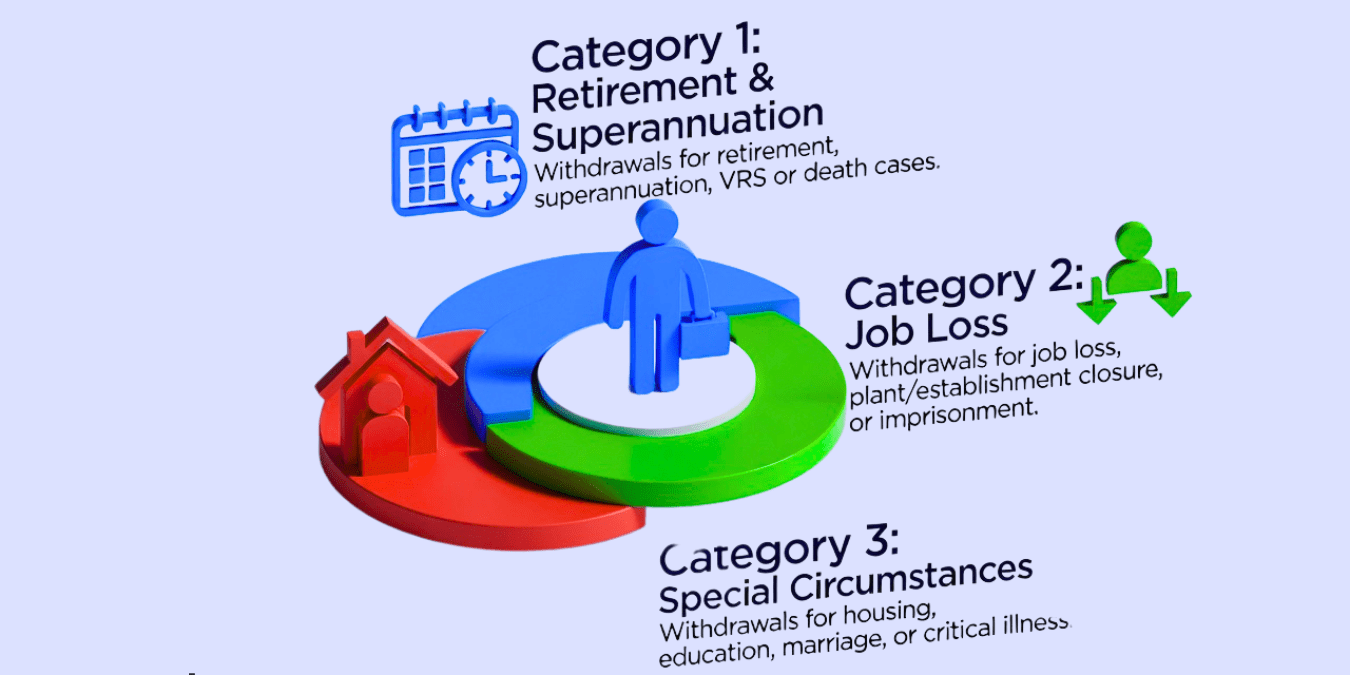
The cornerstone of EPFO’s 2026 reform is the consolidation of all partial withdrawal purposes into three broad, logical categories. Here is exactly what each category covers and what you need to know before submitting a claim.
Category 1: Essential Needs
This is the broadest and most frequently used category, covering the day-to-day life emergencies and social obligations that most Indian families face at some point. Essential Needs include medical treatment for yourself or a dependent family member, expenses related to higher education, and costs associated with marriage — whether your own or that of a child or sibling. What makes this category significantly more generous than the old rules is the revised withdrawal frequency. Under the previous framework, education and marriage withdrawals were clubbed under a combined limit of just three lifetime withdrawals. Under the new 2026 rules, members can make up to ten withdrawals for education-related expenses and up to five withdrawals for marriage-related expenses, which is a substantial improvement that reflects the real-world costs Indian families bear over a lifetime. For medical emergencies, claims in this category are now eligible for auto-settlement within three days, with no documentation upload required if your KYC is complete and linked to your UAN. The auto-settlement limit has been raised to Rs. 5 lakh, which means most urgent medical claims will be processed and credited to your bank account without any human intervention on the EPFO side.
Category 2: Housing Needs
The second category covers all property-related financial needs — purchasing a plot or flat, constructing a house, or repaying an existing home loan. This is one of the most significant upgrades in the 2026 reform because housing in India is one of the largest financial commitments a middle-class family makes, and the old rules placed restrictive caps on how much could be withdrawn and how many times the facility could be used. Under the new framework, housing-related withdrawals now allow access to both the employee’s own contribution and the employer’s contribution, along with accrued interest. Previously, some withdrawal categories permitted only the employee’s share, which limited the usefulness of the facility. The new rules also standardize the minimum service requirement to just 12 months for all housing-related withdrawals, removing the earlier inconsistency where different sub-reasons had different qualifying periods. This means a first-time homebuyer with just one year of PF service can now tap into their full eligible PF balance for housing, which was simply not possible under the old system.
Category 3: Special Circumstances
The third category is a forward-thinking addition that recognizes life does not always follow a predictable script. Special Circumstances cover scenarios such as natural calamities, unforeseen financial distress, job loss, physical disability, and other exceptional situations that do not neatly fit into the first two categories. This is where the most flexible and emergency-oriented withdrawal provisions now live. If you lose your job, EPFO’s 2026 rules allow you to withdraw up to 75% of your EPF balance after just one month of unemployment, with minimal documentation and no employer attestation required. If unemployment continues beyond two months, the remaining balance becomes accessible as well. This is a significant safety net for the millions of salaried workers in India who face sudden job loss and need immediate financial support without the additional burden of complex paperwork. For natural calamities and similar extraordinary events, the government has put in place a fast-track claim process under this category that is expected to process claims in under three days using the auto-settlement mechanism.
The 25% Retention Rule — Protecting Your Future Self
One of the most important balancing acts in the 2026 reform is the mandatory 25% retention requirement. While EPFO now allows members to withdraw up to 100% of their eligible EPF balance in certain circumstances, the new rules require that at least 25% of the total corpus must remain in the account unless it is a final settlement upon retirement or permanent account closure. This rule is deliberately designed to prevent the PF account from being fully depleted during a member’s working years, ensuring that the retirement fund remains meaningful even after partial withdrawals. Critics of the old system had long pointed out that some members, particularly those going through financial crises, would exhaust their PF balances and arrive at retirement age with nothing saved. The 25% floor addresses this concern head-on, striking a balance between accessibility and long-term financial security. Think of it this way: EPFO is giving you the keys to the house but asking you to keep the foundation intact. You can use the rooms as needed, but the structure must remain standing for your future.
How to Claim Your PF in 2026 — Step by Step
The process of actually submitting a PF claim has also been overhauled as part of EPFO 3.0, the digital transformation initiative that underpins all these reforms. Here is a step-by-step guide to claiming your PF under the new system.
Step 1: Ensure Your KYC Is Complete. Log into the EPFO member portal using your UAN and check that your Aadhaar, PAN, and bank account are linked and verified. This is the single most important prerequisite for a smooth claim because KYC-complete accounts are eligible for auto-settlement without employer attestation.
Step 2: Identify Your Category. Based on the reason for your withdrawal, determine whether you fall under Essential Needs, Housing, or Special Circumstances. This will determine the form you need to use and the maximum amount you can withdraw.
Step 3: Use the Composite Claim Form. EPFO has replaced the older, purpose-specific forms with a unified Composite Claim Form. If your Aadhaar is seeded to your UAN, you can use the Aadhaar-based version, which requires self-certification of your eligibility and does not require your employer’s signature in most cases.
Step 4: Submit Online via EPFO Portal or UMANG App. Log in at the EPFO unified member portal (unifiedportal-mem.epfindia.gov.in) or through the UMANG app. Navigate to “Online Services” and select “Claim (Form-31, 19, 10C & 10D).” Choose the appropriate claim type, verify your bank account details, and submit.
Step 5: Track Your Claim. After submission, you can track your claim status in real time through the EPFO portal or UMANG. For auto-settlement eligible claims, expect credit within three business days. If your claim requires manual verification, processing times may vary but are expected to be significantly faster than under the old framework.
Step 6: UPI-Based Withdrawal (Available from April 2026). EPFO 3.0 introduces a groundbreaking new facility — UPI-based EPF withdrawals — expected to go live in April 2026. This means eligible members will be able to receive their PF withdrawal amount directly through UPI, much like receiving a bank transfer, making the process as simple as collecting a payment on PhonePe or Google Pay. This is especially significant for members in rural and semi-urban areas who may not have traditional banking infrastructure readily accessible.
The ATM Card Revolution — PF Access Like Never Before
Perhaps the most talked-about feature of EPFO 3.0 is the planned PF ATM card, which is part of EPFO’s partnership with HDFC Bank and India Post Payments Bank (IPPB). Under this initiative, members will be able to withdraw up to 75% of their PF balance directly from ATMs, without logging into any portal, filling any form, or waiting for claim approval. The ATM card essentially treats your PF account the way a savings account works — you swipe, and the money comes out instantly up to the eligible limit. This is particularly powerful for Special Circumstances withdrawals, where emergencies demand immediate financial access. EPFO has already begun rolling out this facility and it is expected to reach nationwide coverage through IPPB branches, which have a presence even in remote parts of India. For a country where delayed claim processing has historically been one of the biggest complaints about EPFO, this development is nothing short of transformational.
Changes to EPS Pension Withdrawal — Read This Carefully
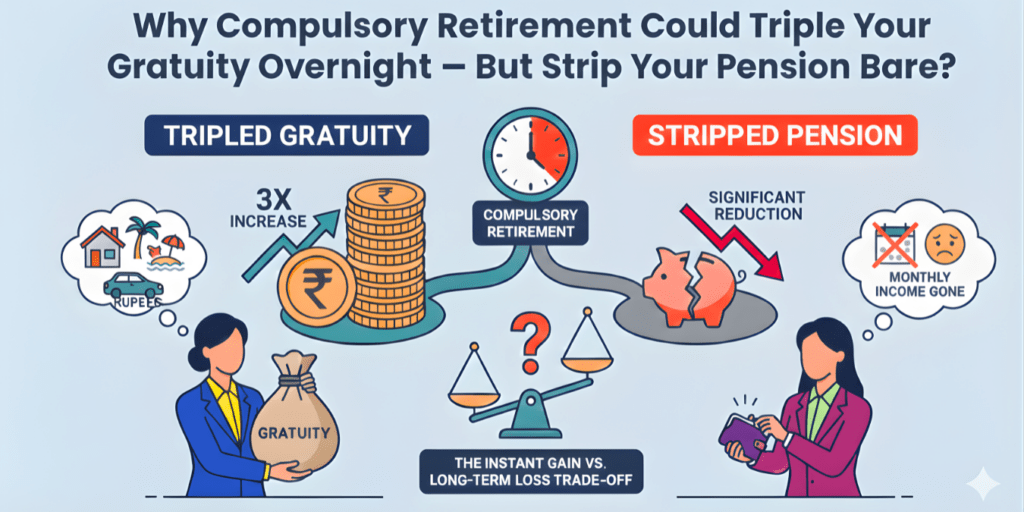
While the EPF withdrawal rules have become significantly more flexible, the Employee Pension Scheme (EPS) withdrawal rules have actually become stricter in one important respect. Previously, members with fewer than 10 years of service could withdraw their EPS pension amount after just 2 months of unemployment. Under the new 2026 rules, this waiting period has been extended to 36 months. This change is designed to discourage premature pension withdrawals and ensure that members who might find another job within a few years do not permanently lose their pension benefit by withdrawing too early. If you have worked for fewer than 10 years and are currently between jobs, think carefully before applying for an EPS withdrawal. The 36-month window gives you three full years to find new employment and preserve your pension eligibility. Only after 36 continuous months of unemployment should you consider a full EPS withdrawal, and even then, you should weigh it against the long-term cost of losing a government-backed pension.
Interest Rate and Auto-Settlement Limit in 2026
EPFO has maintained the EPF interest rate at 8.25% for 2025-26, which remains one of the highest guaranteed returns on a debt instrument available to salaried employees in India. On the operational side, the auto-settlement limit has been raised to Rs. 5 lakh, meaning claims up to this amount will be processed without any human review if your KYC is complete and the claim falls within eligible categories. According to EPFO data, approximately 95% of all eligible claims are now being processed automatically, a dramatic improvement from the era when almost every claim required manual scrutiny and employer attestation. DigiLocker integration now allows members to access their PF balance, claim history, and passbook directly from the DigiLocker app without logging into EPFO’s portal separately. These digital improvements collectively mean that for most members, submitting and receiving a PF claim in 2026 should feel as seamless as an online banking transaction.
Automatic PF Transfer on Job Change
One of the most persistent pain points in the old EPFO system was the manual PF transfer process when an employee changed jobs. Members had to raise transfer requests, get employer attestations, and often follow up multiple times before funds moved from the old account to the new one. Under EPFO 3.0, PF transfer on job change is now automatic for all KYC-compliant, Aadhaar-seeded accounts. When you join a new employer and your UAN is linked to your Aadhaar, the system automatically triggers a transfer request, ensuring your PF corpus consolidates without any manual action on your part. This is especially important because fragmented PF accounts across multiple employers often led to members forgetting old accounts entirely, losing both the corpus and the interest it was earning.
Who Benefits the Most from These Changes?
The 2026 EPFO reforms are not just a bureaucratic overhaul — they represent a meaningful shift in how the Indian government thinks about workers’ rights to their own savings. Young employees who switch jobs frequently benefit from automatic transfers and simplified KYC-based claims. Blue-collar workers and those in semi-formal employment benefit from IPPB partnerships and ATM-based access that bring EPFO services to their doorstep. Women in the workforce benefit from more flexible marriage and education withdrawal limits that reflect the financial realities of managing family milestones. Senior employees approaching retirement benefit from the 25% protection floor that ensures their retirement corpus is not accidentally depleted before they need it most. And every EPFO member, regardless of age or income, benefits from the three-category simplification that finally makes it possible to understand your own rights without expert help.
Common Mistakes to Avoid When Claiming PF in 2026
Even with the simplified rules, there are a few pitfalls that can delay your claim or result in rejection. First, ensure your mobile number is linked to your Aadhaar-verified UAN, because OTP-based verification is central to the digital claim process. Second, do not submit a claim for an amount that would leave less than 25% in your account, as this will trigger a rejection under the new mandatory retention rule. Third, avoid withdrawing your EPS balance prematurely if you have been unemployed for less than 36 months — the long-term pension loss almost always outweighs the short-term liquidity gain. Fourth, use the composite form rather than older purpose-specific forms, as outdated forms may still be circulating online and their submission can cause unnecessary delays. Fifth, verify your bank account number and IFSC code before submission, as incorrect bank details are still one of the top reasons for failed PF disbursements even in the digital-first EPFO 3.0 era.
The Bigger Picture — What EPFO’s Transformation Means for India
India has one of the largest provident fund systems in the world, covering over seven crore active contributors and managing a corpus that runs into several lakh crore rupees. For decades, this system’s complexity served as an unintended barrier between workers and their own money. The 2026 reforms, driven by EPFO 3.0 and backed by the Central Board of Trustees’ October 2025 resolution, mark a decisive turn toward making social security truly accessible in India. When a factory worker in Kanpur can withdraw emergency medical funds through an ATM card in minutes, or a software engineer in Bengaluru can trigger a PF transfer automatically when changing jobs, the promise of a welfare state moves closer to fulfillment. The simplification of 13 rules into 3 is not just an administrative convenience — it is a statement that the government trusts its workers to manage their money and that the system exists to serve them, not the other way around. As 2026 unfolds, every EPFO member should update their KYC, review their UAN dashboard, and familiarize themselves with these three categories — because understanding your rights is the first step to exercising them.
This blog post is written based on publicly available EPFO guidelines, circulars, and announcements as of April 2026. For specific claim-related advice, always refer to the official EPFO portal at epfindia.gov.in or consult a certified financial advisor.