GST Fake Invoice Penalty: Who Faces What Consequence Under Sections 122, 74 and 74A
GST · Fake invoicing · India, law as on 28 August 2026
GST Fake Invoice Penalty: Who Faces What Consequence Under Sections 122, 74 and 74A
A role-by-role breakdown of demand, interest, penalty and prosecution exposure, with the Section 74A change that most notices still get wrong.
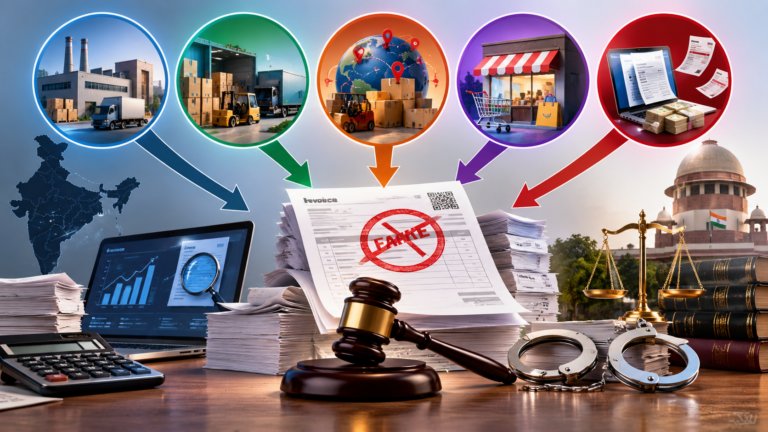
The costliest mistake in a fake invoicing case is assuming the department can pick whichever section it likes. It cannot. The law ties each consequence to a specific fact: whether goods moved, whether credit was merely taken or actually used, and whether the person issued further invoices down the chain.
This matters more in 2026 than at any point since GST began. Central tax officers detected fraudulent input tax credit of about Rs 74,782 crore across 30,162 cases in FY 2025-26, with 358 arrests, according to figures placed before the Rajya Sabha by the Minister of State for Finance. That is more than double the value detected two years earlier.
Quick Summary
- Issuing an invoice without any underlying supply is not a supply under Section 7, so no tax demand arises against the issuer under Section 73 or 74.
- The issuer still faces penalty under Section 122(1)(ii), which is Rs 10,000 or the tax involved, whichever is higher.
- Credit availed and utilised without receipt of goods is recovered under Section 74 with interest under Section 50(3) and a penalty equal to the tax.
- Where credit is availed and passed on by issuing further fake invoices, Circular 171 says both Section 122(1)(ii) and Section 122(1)(vii) apply.
- For FY 2024-25 onwards, Section 74A replaces Sections 73 and 74 entirely, with a single 42-month notice window.
- A supplier’s later default or retrospective registration cancellation does not, by itself, prove fake invoicing against a buyer who can show real receipt.
Why one fake invoice produces five completely different outcomes
A tax invoice is a document. A supply is an event. GST taxes the event, not the paper. That single distinction is the engine behind every conclusion in this article, and it is the reason the consequences fan out so widely depending on who you are in the chain.
CBIC issued Circular No. 171/03/2022-GST on 6 July 2022 precisely because field formations were applying the same sections to everyone. It sets out three scenarios and tells officers to adapt the principles to the facts before them. Two further situations, credit availed but never used and the position of a genuine buyer, sit outside the circular but arise constantly.
The line that decides most cases
The controlling question is not whether an invoice looks irregular. It is whether goods or services actually moved. Section 16(2)(b) makes receipt a condition for credit, and Circular 171 anchors its whole analysis on that clause. Every document evidencing movement, an e-way bill, a lorry receipt, a gate entry, a bank payment, outweighs any argument about the supplier’s registration status.
What CBIC Circular 171 actually says, scenario by scenario
The circular runs to four pages and covers three fact patterns. Reading it in the original wording removes most of the confusion around this subject.
| Scenario in Circular 171 | Facts | Tax demand | Penalty |
|---|---|---|---|
| Scenario 1 | A issues invoice to B with no underlying supply | None. Not a supply under Section 7, so no recovery under Section 73 or 74 | Section 122(1)(ii) on A |
| Scenario 2 | B avails the fake credit and utilises it against genuine outward supplies | Recovery of the credit under Section 74 with interest under Section 50 | Section 74 penalty. Section 75(13) bars a second penalty under Section 122 for the same act |
| Scenario 3 | B avails the credit and passes it on to C through further fake invoices | None on B, because there was no supply either way | Both Section 122(1)(ii) and Section 122(1)(vii) on B |
| General rider | Any person retaining the benefit, at whose instance the transactions ran | Not applicable | Section 122(1A), equal to tax evaded or credit passed on |
| Prosecution rider | Wrongful availment or utilisation, or issuance of invoices without supply | Not applicable | Section 132 may be invoked subject to the conditions in that section |
Two points repay attention. In Scenario 3 there is no tax demand at all, only penalties, because nothing was supplied at either end. Officers raise a demand anyway, and that is a jurisdictional objection worth taking. Second, Section 75(13) is a real shield: once penalty is imposed under Section 74, the same act cannot be penalised again under Section 122.
The scenario the circular does not cover
Credit availed but never utilised is not one of the three scenarios in Circular 171. In practice it is treated as reversible credit attracting penalty under Section 122(1)(vii). Interest is different. Section 50(3), as amended by the Finance Act 2022, charges interest only where credit is wrongly availed and utilised, and Rule 88B runs it from the date of utilisation. Where the ledger balance never fell below the disputed amount, no interest should follow.
The Section 74A switch that many 2026 notices still get wrong
Circular 171 was written in July 2022 and speaks in the language of Sections 73 and 74. That language is now only half correct. The Finance (No. 2) Act, 2024, acting on the 53rd GST Council recommendation of 22 June 2024, inserted Section 74A with effect from FY 2024-25.
From 1 April 2024, every demand travels under one section regardless of whether fraud is alleged. Sections 73 and 74 continue to govern periods up to FY 2023-24, so the two regimes now run in parallel and will do so for years. A notice that cites Section 74 for a FY 2024-25 period, or Section 74A for FY 2022-23, carries a foundational defect.
| Feature | Section 73 (to FY 2023-24) | Section 74 (to FY 2023-24) | Section 74A (FY 2024-25 onwards) |
|---|---|---|---|
| Applies to | Non-fraud cases | Fraud, wilful misstatement, suppression | Both, in one provision |
| Notice window | 3 years from annual return due date | 5 years from annual return due date | 42 months from annual return due date |
| Order window | 3 years | 5 years | 12 months from notice, extendable by 6 months |
| Penalty on fraud | Not applicable | 100% of tax | 100% of tax |
| Penalty on non-fraud | 10% of tax or Rs 10,000, higher | Not applicable | 10% of tax or Rs 10,000, higher |
| Reduced penalty window | 30 days | 30 days | 60 days |
| Minimum demand | No floor | No floor | No notice below Rs 1,000 |
The extension of the settlement window from 30 to 60 days is the most commercially useful part of the amendment. Timing of payment is often the largest single determinant of the final number, and doubling that window gives a mistaken recipient real room to close the file cheaply.
What we know
These points are supported directly by the statute, the circular or official replies placed before Parliament.
- Circular No. 171/03/2022-GST is dated 6 July 2022 and was issued under Section 168(1) of the CGST Act.
- Issuance of an invoice without underlying supply does not satisfy the definition of supply in Section 7, so no tax liability arises against the issuer.
- Section 122(1) prescribes a penalty of Rs 10,000 or an amount equivalent to the tax evaded or credit availed, passed on or distributed irregularly, whichever is higher.
- Section 122(1A) imposes a penalty equal to the tax evaded or credit passed on, on the person who retains the benefit and at whose instance the transaction was conducted.
- Section 74A applies from FY 2024-25, with a 42-month notice window and a 60-day reduced-penalty window.
- Central tax formations booked 30,162 fake credit cases involving about Rs 74,782 crore in FY 2025-26, against 15,283 cases and about Rs 58,772 crore in FY 2024-25.
- Registrations obtained on forged PAN and Aadhaar numbered 5,699 in FY 2023-24, 3,977 in FY 2024-25 and 1,517 in FY 2025-26, linked to credit of Rs 15,085 crore, Rs 13,109 crore and Rs 9,940 crore respectively.
What is still unclear
Four things in this area remain genuinely unsettled, and no honest guide should present them as decided.
- Whether penalty can be imposed where credit is availed but never used. Circular 171 does not address this fact pattern, and outcomes at the adjudication stage vary between formations.
- How Circular 171 reads alongside Section 74A. CBIC has not, as far as can be verified, issued a revised circular replacing the references to Sections 73 and 74 for periods from FY 2024-25.
- Where the boundary of Section 122(1A) sits. Courts have held that an employee who does not personally retain a benefit falls outside it, but the reach of the provision over directors and group entities is still being litigated.
- How far a buyer’s documentary proof must go. There is no prescribed evidentiary standard for establishing actual receipt, and the sufficiency of e-way bills, transport records and bank trails is decided case by case.
How the penalty maths actually works on Rs 1 crore of fake credit
Percentages hide the size of the exposure. The chart converts each role into rupees on one assumption: fake invoices carrying Rs 1,00,00,000 of GST, with a 24-month gap between availment and recovery where interest applies.
Worked example: the 60-day window is worth Rs 75 lakh
A manufacturer availed Rs 1,00,00,000 of credit on invoices later found to have no supply behind them, and utilised it against output tax. Under Section 74A the department demands the credit of Rs 1,00,00,000, interest at 18% for 24 months of Rs 36,00,000, and penalty equal to the tax of Rs 1,00,00,000. Total: Rs 2,36,00,000. Pay the tax and interest within 60 days of the show cause notice and the penalty drops to 25%, or Rs 25,00,000, bringing the total to Rs 1,61,00,000. The delay in deciding whether to fight costs Rs 75,00,000 in penalty alone.
Where each role sits on the escalation scale
Read left to right, this is the order in which exposure climbs. It is also the order in which the department’s evidentiary burden falls, because proving goods never moved is far harder than proving credit was taken.
Defensible
122(1)(ii)
122(1)(vii)
74 or 74A
Both penalties
How large the fake credit problem has become
Enforcement is not slowing, and the data explains why notices are landing on businesses that never knowingly touched a fake invoice. Case counts have grown faster than detected value, so the average case is shrinking and the net is widening.
The number that should worry an honest business
Fake registrations built on forged PAN and Aadhaar credentials fell from 5,699 in FY 2023-24 to 1,517 in FY 2025-26, yet the credit linked to them stayed high at Rs 9,940 crore. Fewer, larger shell entities means a single compromised supplier can now contaminate a much longer list of downstream buyers. Supplier due diligence is no longer a formality.
The genuine buyer question after the Supreme Court’s 2026 ruling
This is where careful reading matters most, because two questions get collapsed into one. The first is whether a buyer committed fake invoicing. The second is whether a buyer keeps the credit when the supplier never paid. They have different answers.
On the first, the position is stable. Where actual receipt is established, a supplier’s later default or retrospective cancellation of its registration does not, by itself, convert a real transaction into a fake one. Fraud must be alleged with particulars and proved, and the department must examine the transaction rather than the paper.
On the second question, the law has hardened. The Supreme Court, in an order reported on 24 July 2026 in the Bhandari Scrap Traders matter, dismissed challenges to Section 16(2)(c) and affirmed the Gujarat High Court judgment of 1 May 2026, holding that credit is a statutory concession subject to conditions rather than a vested right. The reasoning relied on the safety valve in the law, that credit reversed for a supplier’s non-payment can be re-availed once the supplier pays.
Two questions, two answers
Is it fake invoicing? No, if goods or services genuinely moved and the buyer can evidence it. A supplier’s later default is not proof of collusion. Is the credit safe? Not automatically. Section 16(2)(c) requires the tax to have actually reached the government, and that condition now has explicit apex court endorsement. A buyer can therefore lose the credit under Section 16(2)(c) while still successfully resisting a fraud allegation, a penalty under Section 122 and any prosecution under Section 132.
This splits the defence into two tracks. On the fraud track, the buyer leads evidence of movement and payment. On the credit track, the buyer argues recovery must first be attempted against the defaulting supplier, and points to re-availment once that supplier files. The two should never be merged into one paragraph. [INTERNAL_LINK: GST notice reply checklist for ITC mismatch cases]
Decoder: the provisions that appear in every fake invoice notice
Most notices cite a handful of provisions in a block. This table gives each its plain meaning and practical effect.
| Provision | What it does | Practical effect |
|---|---|---|
| Section 7 | Defines supply | No supply means no tax demand on the issuer |
| Section 16(2)(b) | Requires actual receipt of goods or services | The clause fake invoice cases are built on |
| Section 16(2)(c) | Requires the supplier to have paid the tax | Upheld by the Supreme Court in July 2026 |
| Section 50(3) | Interest on credit wrongly availed and utilised | 18% per annum, computed under Rule 88B |
| Section 73 | Demand without fraud, to FY 2023-24 | Penalty 10% of tax or Rs 10,000, higher |
| Section 74 | Demand with fraud, to FY 2023-24 | Penalty equal to the tax, 5-year window |
| Section 74A | Single demand provision from FY 2024-25 | 42-month notice window, 60-day settlement |
| Section 75(13) | Bars double penalty for the same act | No Section 122 penalty once Section 74 penalty is imposed |
| Section 122(1)(ii) | Issuing an invoice without supply | Rs 10,000 or the tax involved, whichever is higher |
| Section 122(1)(vii) | Taking or utilising credit without receipt | Rs 10,000 or the credit involved, whichever is higher |
| Section 122(1A) | Penalty on the person retaining the benefit | Equal to tax evaded or credit passed on |
| Section 132 | Prosecution for specified offences | Up to 5 years where the amount exceeds Rs 5 crore |
| Rule 86A | Blocking of the electronic credit ledger | Freezes credit before any demand is raised |
| Rule 88B | Manner of computing interest | Interest runs from the date of utilisation |
What people get wrong, and the order to work through a notice
The most expensive error is treating a Rule 86A blocking order as a finding of guilt. It is not. Blocking is a protective measure taken on reasons to believe, before adjudication, and it can be challenged on its own terms. Businesses that panic and reverse credit unconditionally often forfeit arguments they would have won.
The second frequent error is answering with a general denial. These notices turn on documents, and a reply without the transport and payment trail attached is close to useless however well argued. [INTERNAL_LINK: How to build a supplier due diligence file under GST]
- Identify the financial year first. FY 2023-24 and earlier run under Sections 73 and 74; FY 2024-25 onwards runs under Section 74A. A wrong section is a preliminary objection.
- Establish your role from the five in this article. Demand, penalty and interest all follow from the role, not from the invoice value.
- Check whether the credit was ever utilised. If the ledger balance never fell below the disputed amount, argue that no interest arises under Rule 88B.
- Assemble proof of movement before drafting anything: e-way bills, transport documents, weighbridge records, gate entries and bank payment evidence.
- Calculate the cost of settlement inside the 60-day window against the cost of litigating, and take that decision once, in writing.
- Check whether Section 75(13) bars any second penalty the notice proposes under Section 122.
Frequently asked questions
What is the penalty for a fake invoice under GST?
The penalty depends on the role. A person who issues an invoice without any supply faces a penalty under Section 122(1)(ii) of Rs 10,000 or the tax involved, whichever is higher. A person who takes or uses credit without receiving goods faces the same quantum under Section 122(1)(vii). Where credit is availed and utilised, the penalty under Section 74 or 74A equals the tax. Identify your role before estimating exposure.
Can GST be demanded from someone who only issued fake invoices without supply?
No. Circular No. 171/03/2022-GST states that issuing an invoice without an underlying supply does not satisfy the definition of supply in Section 7, so no tax liability arises and no demand or recovery is required under Section 73 or 74 against the issuer. Penalty under Section 122(1)(ii) still applies. If a notice demands tax from a pure issuer, raise this as a preliminary objection.
Is interest payable on fake ITC that was availed but never utilised?
Section 50(3), as amended by the Finance Act 2022, charges interest only where credit is wrongly availed and utilised. Rule 88B computes interest from the date of utilisation and deems credit utilised only when the electronic credit ledger balance falls below the wrongly availed amount. Where the ledger balance always stayed above that figure, the interest demand should be resisted with ledger evidence attached.
Does Section 74A apply to fake invoice cases from FY 2024-25?
Yes. Section 74A, inserted by the Finance (No. 2) Act, 2024, governs all demands from FY 2024-25 onwards, whether or not fraud is alleged. Sections 73 and 74 continue to apply to FY 2023-24 and earlier. Circular 171 still refers to the older sections because it predates the amendment. Check the financial year in any notice before responding on the merits.
Can ITC be denied to a genuine buyer if the supplier does not pay the tax?
Yes, under Section 16(2)(c), which the Supreme Court upheld in an order reported on 24 July 2026 affirming the Gujarat High Court. Credit is treated as a statutory concession subject to conditions, not a vested right. The safety valve is re-availment once the supplier eventually pays. That is separate from any fake invoicing allegation, which still requires proof that no supply occurred.
Does retrospective cancellation of a supplier’s GST registration make my invoice fake?
No, not by itself. Where actual receipt of the goods or services is proved, a supplier’s later default or the retrospective cancellation of its registration does not establish fake invoicing or fraud against the buyer. The underlying transaction and the conduct of both parties have to be examined. Build the reply around movement and payment evidence rather than the supplier’s registration status.
When can a person be arrested in a GST fake invoice case?
Section 132 provides for prosecution in cases of issuing invoices without supply or fraudulently availing credit, with imprisonment of up to five years where the amount involved exceeds Rs 5 crore. Arrest under Section 69 requires authorisation by the Commissioner. In FY 2025-26, 358 persons were arrested in connection with fake credit investigations by central tax formations.
What documents prove that a GST transaction was genuine?
The strongest file combines the tax invoice, the e-way bill, an independent transport document such as a lorry receipt, weighbridge or gate entry records, stock and consumption records showing the goods entering production, and proof of payment to the supplier through banking channels. Assemble this before drafting a reply, because in fake invoice matters documents decide the case more often than arguments.
The short version
Fake invoicing under GST is not one offence with one price tag. Circular 171 ties the consequence to conduct: no tax demand on a pure issuer but penalty under Section 122(1)(ii), recovery with interest and full penalty where fake credit was used, and two penalties on the operator who passes credit down the chain. From FY 2024-25 all of it runs through Section 74A, with a 42-month notice window and a 60-day settlement window often worth more than any argument on the merits. For a buyer, everything turns on the gap between proving the goods moved and proving the supplier paid.