Why the Taxman is Chasing ₹1.22 Crore from a Giant: The Hidden Truth Behind Hero MotoCorp’s Latest GST Battle
A ₹1.22 crore notice just flagged a hidden ₹1,000 crore crisis for Hero MotoCorp. It’s not the money—it’s the “Silent Auditor” watching every invoice. This specific Section 17(5) error is catching India’s smartest CFOs. Is your business next? Uncover the invisible AI trap before the 2026 crackdown hits you.
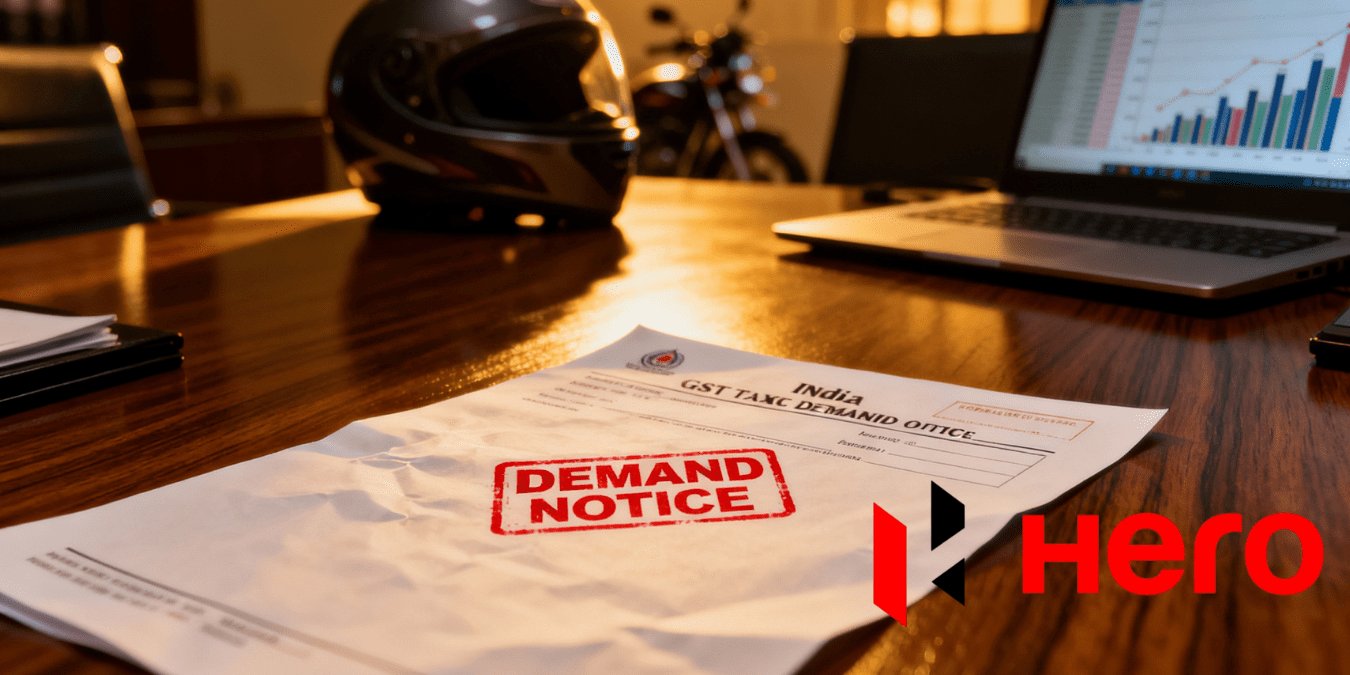
On December 9, 2025, the Uttar Pradesh State Tax Department slapped Hero MotoCorp with a demand for this exact amount. To the casual observer, this is a non-story. Why would a market leader worry about a penalty that costs less than a single TV advertising spot?
But here is the secret that most financial news headlines are missing: It’s not about the money.
This notice isn’t just a random administrative hiccup. It is a symptom of a much larger, invisible shift occurring in India’s regulatory landscape in late 2025—a shift driven by AI-powered surveillance, aggressive retrospective scrutiny, and a crackdown on “blocked credits” that could catch even the smartest CFOs off guard.
What if I told you that this ₹1.22 crore demand is actually the final piece of a puzzle revealing a ₹1,000+ crore headache that has been building up for the auto giant over the last 18 months?
Read on to uncover the surprising “why” behind this notice, the hidden algorithm that flagged it, and the urgent lesson it holds for every business owner and investor in India today.




The Anatomy of the Notice: What Actually Happened?
Let’s strip away the legal jargon and look at the raw facts of the event that unfolded this week.
The Who: The Office of the Deputy Commissioner, State Tax, Lucknow, Uttar Pradesh.
The When: The order was dated December 9, 2025, pertaining to the financial year 2021-22.
The How Much:
- Tax Demand: ₹1,10,99,508
- Penalty: ₹11,09,949
- Total: ₹1,22,09,457
The Charge:
The tax authorities have flagged two specific issues that are becoming the bane of corporate India in 2025:
- Input Tax Credit (ITC) Mismatches: A discrepancy between what Hero claimed (in GSTR-3B) and what their suppliers reported (in GSTR-2A/2B).
- Section 17(5) Violations: Incorrect claims of “blocked” input tax credits.
Hero MotoCorp’s official stance is calm and calculated: “The tax demand is not maintainable in law.” They have stated they will appeal and that there will be “no material impact on financials”.
But while the financial impact is negligible, the strategic implications are massive. This notice signals that the “limitation period” for FY 2021-22 is closing, and tax officers are firing off notices to ensure no potential revenue slips through the cracks.
The Hidden Pattern: The ₹1,000 Crore Context
Here is the “surprising” aspect that changes the narrative. If you view the Lucknow notice in isolation, it’s insignificant. But if you zoom out to the last 18 months, a startling pattern emerges. Hero MotoCorp has been in the crosshairs of GST authorities repeatedly, facing demands that cumulatively exceed ₹1,000 crore.
Let’s look at the timeline of scrutiny:
- December 2025 (UP): ₹1.22 Crore (ITC Mismatch).
- February 2025 (Rajasthan): ₹456 Crore. This was a massive blow involving disputed tax rates on parts and accessories.
- August 2024 (Delhi): ₹17 Crore. A notice regarding disallowance of input tax credit for FY 2019-20.
- April 2024: ₹605 Crore. A mega-demand covering six years (2013-14 to 2017-18 and 2019-20).
The Insight:
The ₹1.22 crore notice is just the latest ripple in a tidal wave. The tax authorities are not just auditing; they are mining data from the last five years with unprecedented aggression. The fact that they are pursuing a relatively small ₹1.22 crore amount after slapping a ₹600 crore notice suggests a zero-tolerance approach. In 2025, no amount is too small to ignore if the algorithm flags it.
The “Silent Auditor”: How AI Caught a Giant
How does a discrepancy from 2021 get flagged with such precision in late 2025? The answer lies in the technological leap of the Indian tax administration.
In 2025, the GST department isn’t relying on manual audits. They are using advanced data analytics and AI that cross-reference millions of invoices in real-time.
The “Mismatch” Trap Explained:
The UP authority’s demand cites a mismatch between GSTR-3B (Hero’s self-declared claim) and GSTR-2A/2B (the auto-populated data from suppliers).
- The Scenario: Hero pays a vendor GST. Hero claims credit. The vendor fails to upload the invoice or uploads it to the wrong GSTIN.
- The Result: The system automatically flags this as an “excess claim.”
For a company with thousands of vendors like Hero, a ₹1.1 crore mismatch is statistically tiny—likely less than 0.01% of their total credit. Yet, the system flagged it. This proves that the automated scrutiny threshold has been lowered effectively to zero. For businesses reading this, the takeaway is chilling: You cannot hide behind the “volume of transactions” excuse anymore.
The Section 17(5) Landmine: A Warning for 2026
The second part of the demand—“incorrect claim of blocked ITC under Section 17(5)”—is where the real lesson lies for business owners and finance professionals.
Section 17(5) of the CGST Act is known as the “blocked credit” list. It specifies expenses for which you cannot claim GST credit, even if you paid GST on them.
What likely triggered this for Hero?
While the specific line items aren’t public, common triggers for large corporates in 2025 include:
- CSR Expenses: A highly debated area. Companies spend millions on Corporate Social Responsibility, but tax authorities often deny GST credit on these expenses.
- Employee Benefits: Canteen services, insurance, or gym memberships provided to staff often fall under blocked credits.
- Promotional Items: Freebies given to dealers or customers (a common practice in the auto industry) can lead to blocked credits.
The Expert View:
If Hero MotoCorp, with its army of tax consultants and lawyers, is getting flagged for Section 17(5) violations, what chance do SMEs have? This notice serves as a potent reminder: Review your “blocked credit” ledger immediately. The interpretation of what is “in the course or furtherance of business” is becoming narrower by the day.
Financial Impact vs. Reputation: The “Material” Truth
Hero MotoCorp was quick to assure the stock exchanges: “There is no material impact on financials, operations, or other activities”.
Mathematically, they are right. ₹1.22 crore is negligible for a company with Hero’s market cap. However, reputational capital works differently.
The Investor Perspective:
- Stock Reaction: Hero’s stock has seen volatility in 2025, partly due to market conditions and partly due to these recurring regulatory headlines. While a single notice doesn’t crash a stock, a stream of notices creates a “governance overhang.”
- The “Litigation Cost”: It’s not just the penalty. It’s the cost of legal fees, the time of senior management, and the contingent liabilities piling up on the balance sheet.
- The “Boy Who Cried Wolf” Risk: If a company repeatedly says “no material impact” while the demands stack up to over ₹1,000 crore, investors might start discounting these assurances.
The 2025 Trend:
We are seeing a trend where ESG (Environmental, Social, and Governance) funds are penalizing companies with poor tax compliance scores. While Hero is fighting these legally (and may well win), the “Tax Dispute” metric is increasingly becoming a red flag for institutional investors.
Actionable Takeaways for Businesses in 2025
This news isn’t just about Hero; it’s a case study for every Indian business. Here is what you need to do to avoid a similar fate:
- Automate Your Reconciliation: If you are still matching GSTR-2A manually in Excel, you are already behind. Use API-based tools that reconcile invoices in real-time.
- Audit Your Vendors: Hero is likely suffering because suppliers made errors. Implement a strict “pay only after GSTR-2A reflection” policy.
- Review Section 17(5) Exposure: Specifically look at your CSR spends and employee perks. If you are claiming GST credit there, consult a tax expert immediately. The department is watching.
- Prepare for FY 21-22 Audits: The Hero notice confirms that authorities are currently scrubbing FY 21-22 data. Ensure your documentation for that year is audit-ready.
Final Thought: The Future is Frictionless… But Ruthless
The ₹1.22 crore demand on Hero MotoCorp is a microcosm of the new Indian tax regime. It is efficient, automated, and unrelenting. We have moved from an era of “negotiated settlements” to an era of “algorithmic demands.” Hero MotoCorp will likely fight this in the appellate tribunal and may even get it quashed. But the message from the Uttar Pradesh tax authority is loud and clear: We are watching every transaction.
As we move into 2026, the question isn’t whether you will get a notice—it’s whether your data is clean enough to answer it.
Think this is the end of the tax scrutiny saga for the auto sector? Think again. Rumors are swirling about a new “Green Tax” compliance audit set to hit major manufacturers in Q1 2026. Is the industry ready for the next wave of regulation? Stay tuned to our blog—we’ll break the story as soon as the first notice lands.
Disclaimer: The use of any third-party business logos in this content is for informational purposes only and does not imply endorsement or affiliation. All logos are the property of their respective owners, and their use complies with fair use guidelines. For official information, refer to the respective company’s website.