UPI-Based PF Withdrawals Are Finally Here — How to Transfer Your EPFO Balance Without Logging Into the Portal
For years, withdrawing your Provident Fund balance meant navigating a maze — logging into the EPFO member portal, uploading documents, waiting for employer approvals, and then sitting through processing delays that could stretch from a few days to several weeks. If you have ever tried withdrawing PF during a medical emergency or a financial crunch, you know exactly how frustrating that experience can be. That changes now. With the rollout of EPFO 3.0, India’s retirement savings infrastructure is getting its most significant digital upgrade yet — one that puts UPI at the center of how 8 crore salaried employees access their hard-earned provident fund savings.
What Is EPFO 3.0 and Why Does It Matter
EPFO 3.0 is the third-generation digital transformation of the Employees’ Provident Fund Organisation, India’s statutory body that manages retirement savings for the formal workforce. At its core, this upgrade is designed to make the EPF ecosystem function less like a legacy government system and more like a modern digital bank. The Central Board of Trustees (CBT) of EPFO approved the foundational changes in October 2025, and the phased implementation began rolling out from April 2026.
The most headline-worthy feature of EPFO 3.0 is the integration of UPI — the Unified Payments Interface — as a withdrawal and transfer mechanism. Under this new system, eligible EPF members can receive their provident fund directly into their linked bank accounts using UPI, bypassing the traditional claim-filing process entirely. Given that EPFO currently processes over 5 crore EPF claims every year, this shift is not just a convenience upgrade — it is a systemic reform that reduces processing overhead while giving workers instant access to their savings.
The Old Way vs. The New Way
To appreciate how transformative this change is, it helps to understand the friction that existed before. The traditional PF withdrawal process required members to log into the EPFO member portal (or use the UMANG app), navigate through multiple menus, raise a formal claim using Form 31, 19, or 10C depending on the withdrawal type, wait for employer digital attestation in many cases, and then wait for the bank to credit the amount — a process that often took anywhere from 3 to 15 working days.
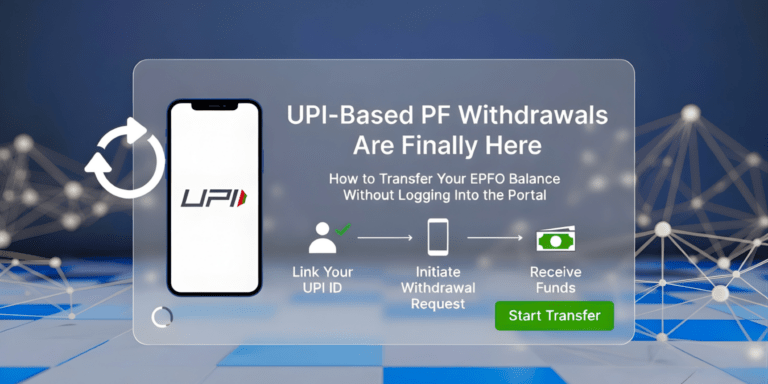
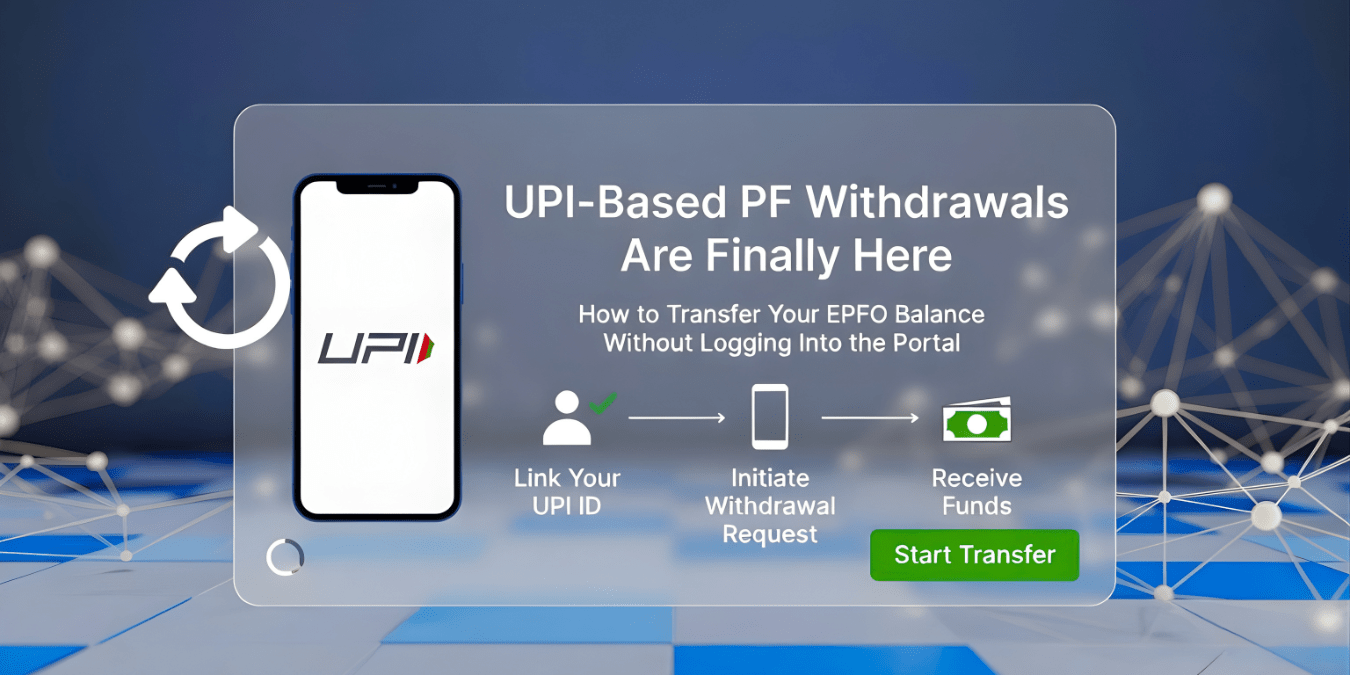
Under EPFO 3.0, the new UPI-based withdrawal system routes the fund directly to the member’s registered bank account in near real-time. Once a withdrawal is initiated — through the new EPFO mobile application or the UMANG app — the member simply selects the UPI withdrawal option, enters the desired amount within the eligible limit, and confirms using their UPI PIN. The funds are credited almost immediately. There is no claim form to fill, no employer to chase, and no processing queue to wait in.
How the UPI Withdrawal Process Works Step by Step
Understanding the end-to-end process is essential before you initiate a withdrawal. Here is how the new UPI-based PF withdrawal system works under EPFO 3.0:
Step 1 — Ensure your KYC is complete. Your UAN must be activated and Aadhaar-seeded. Your bank account and IFSC code must be correctly mapped to your UAN. Your name, date of birth, and gender on EPFO records must match your Aadhaar details exactly.
Step 2 — Download the new EPFO mobile app. EPFO launched a dedicated mobile application as part of EPFO 3.0, designed to give members a bank-like interface for managing their provident fund accounts. This app supports UPI-linked withdrawals and replaces the dependency on the web portal for most routine transactions.
Step 3 — Log in using UAN and biometric/OTP authentication. The authentication process uses Aadhaar-linked OTP or biometric verification, which means you do not need to remember your EPFO portal password or go through the traditional login flow.
Step 4 — Select the withdrawal or transfer option. On the app dashboard, choose the UPI Withdrawal option. The system will display your eligible withdrawal amount based on the new EPFO 3.0 rules, which cap UPI-based withdrawals at a proposed 50% of your total PF balance at any given time.
Step 5 — Enter the amount and verify via UPI PIN. Enter the amount you wish to withdraw (within the allowed limit), and the request is confirmed using your registered UPI PIN through your linked UPI handle.
Step 6 — Funds credited instantly. Once the system processes the request, the amount is credited to your linked bank account within minutes. No separate bank confirmation or claim tracking is required.
Withdrawal Limits You Need to Know
EPFO 3.0 introduces a structured withdrawal framework that balances immediate liquidity with long-term retirement security. Under the proposed rules, members can withdraw up to 50% of their total PF balance through ATM or UPI channels. This cap is deliberate — it ensures that a portion of the corpus always remains protected for retirement, preventing members from inadvertently depleting their entire savings during short-term financial stress.
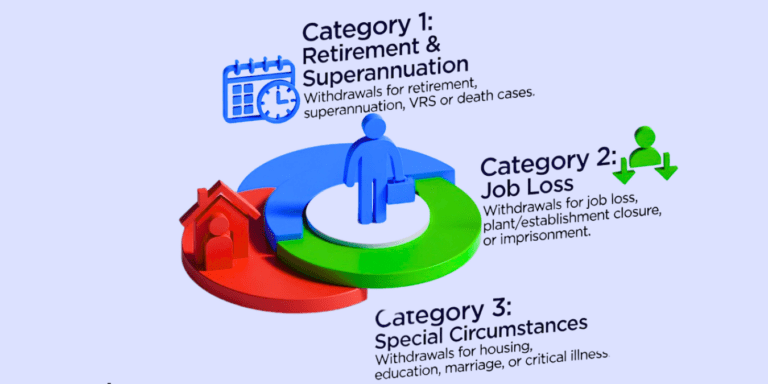
Beyond the UPI channel limit, EPFO 3.0 also significantly liberalizes partial withdrawal rules in general. Members who become unemployed can now withdraw up to 75% of their eligible PF balance immediately after job loss, with the remaining 25% accessible after 12 months of continued unemployment. Additionally, the auto-settlement limit — which allows EPFO to process claims electronically without manual intervention — has been raised from Rs 1 lakh to Rs 5 lakh, covering emergencies like medical treatment, education expenses, and marriage.
A critical protection built into EPFO 3.0 is the minimum corpus retention rule: at all times, at least 25% of the member’s total contribution must remain in the EPF account. This safeguard did not exist under the previous system and is specifically designed to protect members from entering retirement with an empty account due to repeated premature withdrawals.
Transferring Your PF Balance Without Logging Into the Portal
One of the most underreported improvements in EPFO’s recent upgrade cycle is the ability to transfer your PF balance — particularly from a previous employer’s account to your current one — without needing your old employer’s verification or logging through multiple portal workflows. This reform was introduced ahead of EPFO 3.0 and remains a powerful feature within it.
If your UAN is activated and Aadhaar-seeded, and both your old and new PF member IDs are linked to the same UAN, you can initiate a self-transfer directly through the Member e-Sewa portal or UMANG app. The transfer request goes straight to EPFO for processing — no employer attestation required. Your records just need to be clean: name, date of birth, and bank details must align with your Aadhaar data.
This is a massive relief for India’s large mobile workforce — professionals who change jobs every two to three years and previously had to chase former employers for digital approvals, sometimes waiting months. With UAN acting as the single-window identifier and Aadhaar as the KYC backbone, the entire transfer can be initiated within minutes and tracked under the “Track Claim Status” section of the portal.
Who Is Eligible for UPI-Based PF Withdrawals
Not every EPFO member will immediately qualify for the UPI withdrawal feature. Eligibility under EPFO 3.0 is tied to a clean KYC profile and active UAN status. Specifically, you must meet the following conditions:
Your UAN must be active and linked to a verified Aadhaar card. Your bank account registered with EPFO must be operational and the IFSC must be valid. Your exit date from your previous employer (if applicable) must be updated in the EPFO system. Any discrepancies in your name, date of birth, or mobile number between your EPFO records and Aadhaar will block the UPI withdrawal option. Your nomination must be filed to ensure the account is compliant with EPFO’s internal audit requirements.
If any of these conditions are not met, the EPFO app will flag the issue and prompt you to complete the correction before proceeding. In most cases, these corrections can be done digitally through the member portal using Aadhaar-based OTP verification.
Why EPFO Cannot Directly Hold a Bank Licence — And Why That Matters for UPI
A question many members ask is: why does EPFO route withdrawals through banks for UPI, rather than processing them directly? The answer is regulatory. EPFO does not hold a banking licence and therefore cannot directly participate in the UPI ecosystem as a payment service provider. Instead, EPFO routes all UPI-linked withdrawals through its partner banks, which hold the funds and execute the UPI transfers on EPFO’s behalf.
This architecture ensures full regulatory compliance while keeping the transaction speed fast. From the member’s perspective, the experience is identical to any standard UPI transfer — you enter a UPI PIN, the money arrives in your bank account. The fact that a banking intermediary is involved happens silently in the backend and does not introduce any meaningful delay for the end user.
The Broader Context: EPFO’s Digital Transformation Journey
The UPI withdrawal feature does not exist in isolation. It is the culmination of a deliberate, multi-year effort to digitize EPFO’s operations end to end. The journey began with the Universal Account Number (UAN) system, which ensured every EPF member had a portable, employer-agnostic identity. It continued with Aadhaar seeding and KYC digitization, which eliminated paperwork for most transactions. It accelerated with the auto-settlement feature, which allowed EPFO to process up to Rs 5 lakh in withdrawal claims without manual intervention.
EPFO 3.0 is now the logical next step: making the actual disbursement of funds as fast and frictionless as possible. The government has explicitly stated that its goal is to bring EPFO services on par with commercial banks in terms of user experience and processing speed. For a workforce of 8 crore formal sector employees — many of whom are first-generation white-collar workers in Tier 2 and Tier 3 cities — this is a genuinely democratizing shift. Access to retirement savings should never be a bureaucratic ordeal, and EPFO 3.0 makes a strong case that it no longer has to be.
What You Should Do Right Now
If you are an active EPF member and want to be ready to use UPI-based withdrawals the moment they are available for your account, here are the steps you should complete today:
Log into the EPFO Member e-Sewa portal and verify that your UAN is active. Check under the “KYC” section that your Aadhaar, PAN, and bank account are all verified (shown in green). If your previous employer has not updated your exit date, follow up with them or raise a grievance through the EPFIGMS portal — this is required for partial withdrawals. Download the UMANG app or watch for the new EPFO 3.0 mobile application, which will host the UPI withdrawal interface. Ensure the mobile number registered with your UAN is active, as all OTP-based authentications will use this number.
If you have old PF accounts from previous employers still lying untransferred, initiate a self-transfer now using the “One Member – One EPF Account” feature on the portal. This consolidates your savings under a single UAN-linked account, making it eligible for the new UPI withdrawal system once it is fully rolled out for your account.
A Note on Pension (EPS) Withdrawals
It is important to distinguish between EPF (Employee Provident Fund) and EPS (Employee Pension Scheme) withdrawals, as the new UPI system primarily covers the EPF component. Under EPFO 3.0, EPS withdrawal — which applies to the pension corpus — can now only be initiated after 36 months of unemployment, a change from the earlier 2-month window. This change is designed to preserve pension savings and reduce premature depletion of the social security corpus. The UPI-based instant transfer mechanism applies to the EPF balance, not the EPS balance, so members planning a full exit should factor this distinction into their withdrawal planning.
The Road Ahead for EPFO 3.0
EPFO 3.0 is being implemented in phases, and not all features will be uniformly available from day one. The UPI withdrawal and ATM-linked EPF card features are being tested and rolled out progressively, with priority given to members who have fully verified KYC profiles. The centralized pension payment system, which will streamline pension disbursements across states, is another major component expected to come online under the same upgrade cycle.
The transaction limit for UPI-based PF withdrawals has not yet been officially notified at the time of writing, though media reports consistently cite a Rs 25,000 per transaction cap in early discussions. EPFO is also expected to clarify the interaction between the new UPI system and the existing auto-settlement framework to avoid duplicate processing of the same claim.
For India’s formal workforce, EPFO 3.0 represents something significant: the government acknowledging that access to your own savings should be fast, dignified, and technology-enabled. The UPI integration does not just remove friction — it removes the power asymmetry that existed between a government bureaucracy and a worker trying to access money that was theirs all along. That is a meaningful change, and it is finally here.
This article is based on publicly available information from EPFO, the Ministry of Labour, and credible financial publications as of April 2026. EPFO 3.0 features are being rolled out in phases; readers are advised to verify their eligibility and feature availability through the official EPFO portal at epfindia.gov.in or the UMANG app.