SEBI's New Settlement Rules: How the ₹10 Lakh Fast-Track Route Works — and What It Will Now Cost to Settle a Case
SEBI’s New Settlement Rules: How the ₹10 Lakh Fast-Track Route Works — and What It Will Now Cost to Settle a Case
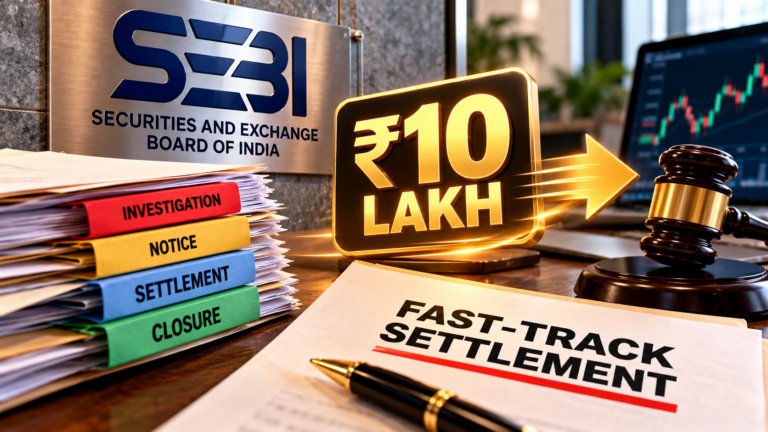
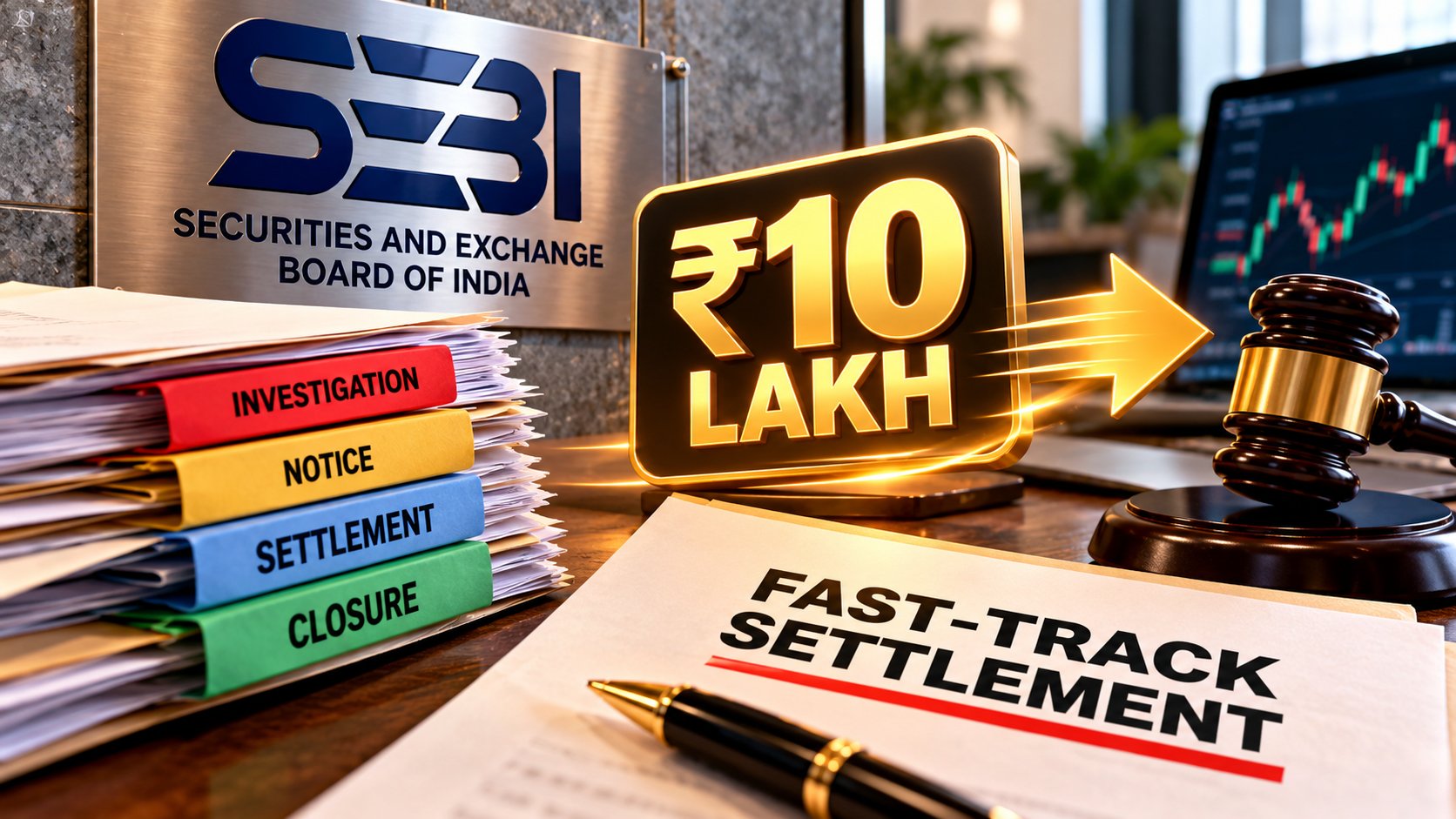
SEBI has notified the Settlement of Administrative and Civil Proceedings Regulations, 2026, replacing the 2018 rules. They introduce a published settlement formula, a 90-day filing window after a show cause notice and fast-track routes, including one for settlement amounts up to ₹10 lakh.
A listed company misses a disclosure deadline. A director files a trading disclosure late. A broker slips on a reporting requirement. None of these is fraud, yet each can trigger a SEBI proceeding that drags on for months or years. Settlement lets the person or entity pay an amount and accept conditions to close the matter, without admitting or denying the findings. For years, though, nobody outside SEBI could easily predict what that amount would be.
That is what the new rules set out to change. The amount now comes from a published formula, the filing window is longer, and smaller cases get a shorter path. Here is how the new system works, who benefits, and where the limits lie.
Why SEBI Rewrote the Rulebook
Settlement in Indian securities law began with a SEBI circular dated April 20, 2007, and was later given a statutory footing under Section 15JB of the SEBI Act. The 2018 regulations, built on the report of a high-level committee chaired by retired Justice A. R. Dave, took effect on January 1, 2019. They worked, but SEBI’s own figures show a system that was slowing down and losing applicants.
That last figure is the heart of the problem. SEBI found that when settlement talks failed and the case went on to adjudication, the amount SEBI had proposed was, on average, about eight times the penalty eventually imposed. Put simply, many applicants had little reason to settle, because fighting the case could cost them far less. ICFM reports that SEBI expects the new formula to bring the ratio down to about four times.
The ₹10 Lakh Fast-Track Route, Explained
Under the 2018 process, an application went through SEBI’s Internal Committee, which worked out terms with the applicant. It then went to the High Powered Advisory Committee, an outside advisory body, and finally to a panel of whole-time members for a decision. Each step adds weeks.
The new rules cut one step for small cases. If the Internal Committee calculates a settlement amount of ₹10 lakh or less, the case goes straight to the panel. SEBI’s board agenda notes that about a quarter of applications over the last three years fell within this band, so the change could affect a large share of cases.
Two features make this route especially attractive. Under Regulation 28, as summarised by CorpLaw Updates, monetary fast-track cases carry no disgorgement and no remedial or regulatory terms. The applicant pays the amount and the matter closes. The route is not an exemption, though. The full formula, minimums and fees still apply.
The second fast track: SEBI makes the first offer
The violation-based route works the other way round. Before starting formal proceedings for a specified default, SEBI can send a notice stating the amount to settle. The entity then has 30 days to apply, pay and comply, or undertake to comply. SEBI can extend that by up to 15 days, with reasons recorded. The panel issues the settlement order after payment.
Monetary route
Up to ₹10 lakhTriggered when the Internal Committee’s calculated amount stays within the cap. Skips the advisory committee. No disgorgement or remedial terms.Violation-based route
30 + 15 daysSEBI issues a notice naming the amount for listed minor defaults, such as delayed disclosures and delayed compliance. Response time can be extended by up to 15 days.Inside the Formula: Who Pays More, and Why
The formula starts with the base amount, which is the minimum penalty the law sets for the violation, multiplied by a factor that depends on who the applicant is. SEBI has set higher multipliers for those it expects to carry more responsibility. An independent director starts at 2, while a stock exchange or other market infrastructure institution starts at 5.5.
The five factors inside the bracket
The bracket then adjusts the base amount. S rewards early action: the later the stage, the higher the factor. R adds 0.10 for each prior administrative warning, 0.20 for each earlier settlement order and 0.30 for each adverse order. G adds weight for specified serious violations, such as 0.5 for certain insider trading breaches and 1.5 for fraudulent and unfair trade practices. A and M allow up to five aggravating and five mitigating factors, each worth 0.20.
One detail changes the arithmetic for many small cases. If the bracket adds up to less than 1, it is rounded up to 1. So for a straightforward first offence settled early, the formula often produces just the base amount, and the minimum settlement amount then becomes the figure that matters.
What a Small Case Could Actually Cost
To see how the pieces fit, we ran the formula for a disclosure lapse carrying a ₹1 lakh minimum penalty, the floor for many failures to file or disclose under the SEBI Act. We assumed the bracket rounds up to 1, which happens whenever the factors add up to less than 1. These are our illustrations, not SEBI’s figures. The minimums are ₹3 lakh for a first-time applicant and ₹7 lakh for others.
| Applicant | Multiplier | Formula amount | Payable, first-time | Payable, others | Fast-track? |
|---|---|---|---|---|---|
| Independent director | 2.0 | ₹2 lakh | ₹3 lakh | ₹7 lakh | Yes |
| Other individual | 2.5 | ₹2.5 lakh | ₹3 lakh | ₹7 lakh | Yes |
| Non-executive director | 3.0 | ₹3 lakh | ₹3 lakh | ₹7 lakh | Yes |
| Executive director or KMP | 3.5 | ₹3.5 lakh | ₹3.5 lakh | ₹7 lakh | Yes |
| Company or intermediary | 4.0 | ₹4 lakh | ₹4 lakh | ₹7 lakh | Yes |
| Market infrastructure institution | 5.5 | ₹5.5 lakh | ₹5.5 lakh | ₹7 lakh | Yes |
Why insider trading cases will rarely qualify
The picture changes quickly for serious violations. Section 15G of the SEBI Act sets a minimum penalty of ₹10 lakh for insider trading. Even an independent director, with the lowest multiplier of 2, would start at a base of ₹20 lakh, twice the fast-track ceiling. On our reading, the ₹10 lakh route is built for procedural lapses, not for market abuse.
Old Rules Versus New: The Changes That Matter
| Item | 2018 regulations | 2026 regulations | Effect |
|---|---|---|---|
| Window after show cause notice | 60 days | 90 days | More time |
| Application fee, individual | ₹15,000 | ₹25,000 | Higher |
| Application fee, others | ₹25,000 | ₹35,000 | Higher |
| Refiling after withdrawal | 50% extra | 20% extra | Cheaper |
| Revised settlement terms | 14 working days | 21 days | More time |
| Demand notice after panel | 7 working days | 10 days | Changed |
| Aggravating factors | Up to 7, total 1.65 | Up to 5, at 0.20 each | Capped lower |
| Wrongful gains | Inside the settlement amount | Disgorged separately | No double count |
Business Today notes that the old “non-monetary terms” are now called remedial and regulatory terms. These can include corrective disclosures and, in some cases, voluntary debarment from board roles or trading. The rules also allow cases involving misrepresented financial statements or diverted funds to be settled, but only alongside corrective steps such as extra disclosures and restoring the diverted money.
Disgorgement now stands on its own
Under the old approach, profits made or losses avoided could be folded into the settlement amount. Now they are kept out of the base amount and recovered separately as disgorgement. Interest runs at 9% a year from the date of the transaction where no final order exists. Where a final order has been passed, it is 9% until that order and 12% a year after it until the application is filed. ICFM notes there is no interest on interest.
A One-Time Window for Old Cases
For people stuck with pending matters, the most useful change may be a transitional window. Anyone who did not apply under the 2018 rules, or whose application was rejected, returned or withdrawn, can apply within 90 days of the new rules taking effect. The price is an extra 20% on the settlement amount. If the rules commence on November 7, 2026, that window would run until about February 5, 2027, by our calculation.
Cases That Cannot Be Settled
Settlement is not available to everyone. Regulation 6, as summarised by CorpLaw Updates, bars or restricts several categories. What people often get wrong is assuming any SEBI proceeding can be closed by paying. It cannot.
What Changes for Companies, Directors and Ordinary Investors
For listed companies and their officers, the biggest gain is predictability. A compliance team can now estimate a likely settlement amount before deciding whether to contest a notice, using the published multipliers and factors rather than guessing from past orders. That should make it easier to weigh the cost of settling against the cost and time of adjudication and appeal.
Independent directors get a specific benefit. Their multiplier of 2 is the lowest in the table, which reflects SEBI’s view that they usually have less control over day-to-day compliance than executive directors or promoters. Repeat applicants, on the other hand, face the higher ₹7 lakh minimum and an R factor that rises with each earlier order, so a pattern of lapses becomes steadily more expensive.
Ordinary investors are not usually parties to settlement proceedings, but they have a stake in how the system works. Separating disgorgement from the settlement amount means profits made from a violation are identified and recovered on their own terms, rather than being lost inside a single negotiated figure. Faster closure of minor cases could also free SEBI’s enforcement staff to concentrate on serious market abuse, though that effect will take time to show up in the data.
If You Receive a SEBI Notice: A Practical Order of Steps
- Note the date of service. The 90-day clock for a show cause notice, or the 60-day clock for a pre-notice settlement notice, starts from receipt, and the 90-day limit cannot be relaxed.
- Check whether the violation falls in an excluded category before spending time on terms.
- Estimate the amount using your applicant multiplier, the minimum penalty for the provision and the factors in the bracket. Compare it with the ₹3 lakh or ₹7 lakh minimum.
- If the estimate is ₹10 lakh or less, expect the fast-track route, with no disgorgement or remedial terms.
- Gather evidence for mitigating factors, such as corrective action already taken, since each one is worth 0.20.
- Budget for the ₹25,000 or ₹35,000 application fee, and plan to pay within 30 days of a demand notice.
Frequently Asked Questions
What is SEBI’s fast-track settlement route?
Under the 2026 settlement regulations, if SEBI’s Internal Committee calculates a settlement amount of ₹10 lakh or less, the case goes directly to a panel of whole-time members, skipping the High Powered Advisory Committee. A separate route lets SEBI offer a fixed amount for specified minor violations, with 30 days to respond.
When do SEBI’s new settlement rules take effect?
The regulations were notified on October 6, 2026, and take effect on the day after the 30th day from gazette publication. CorpLaw Updates calculates this as November 7, 2026. Check the official gazette before relying on a specific deadline.
How is the SEBI settlement amount calculated?
The settlement amount equals the base amount multiplied by (S + R + G + A − M), where the bracket is never less than 1. The base amount is the minimum statutory penalty multiplied by a factor of 2 to 5.5, depending on the applicant. Wrongful gains are disgorged separately.
What is the minimum amount to settle with SEBI?
Under the 2026 rules, the minimum settlement amount is ₹3 lakh for a first-time applicant and ₹7 lakh for others, according to CorpLaw Updates’ summary of the notified text. Application fees of ₹25,000 for individuals and ₹35,000 for others are charged separately.
How long do I have to apply for settlement after a show cause notice?
You have 90 days from service of the show cause notice or supplementary notice, whichever is later, up from 60 days under the 2018 rules. This 90-day limit cannot be relaxed. If SEBI sends a settlement notice before a show cause notice, you have 60 days to apply.
Does settling with SEBI mean admitting guilt?
No. Settlement is made without admitting or denying the findings. However, the formula adds a gravity factor of 0.25 for settlements without admission, reflecting reputational risk, according to CorpLaw Updates’ summary.
Can a case rejected under the 2018 rules be settled now?
Yes, in many cases. A one-time window allows applications within 90 days of the new rules taking effect for matters that were not filed, or were rejected, returned or withdrawn, under the 2018 rules. An additional 20% of the settlement amount applies.
Which SEBI cases cannot be settled?
Wilful defaulters, fraudulent borrowers and fugitive economic offenders cannot settle. Cases with market-wide impact or losses to many investors are generally excluded unless remediable, as are matters still under investigation on the same facts.
The Short Version
SEBI’s 2026 settlement regulations, notified on October 6 and expected to take effect in November, replace guesswork with a formula: the minimum penalty, multiplied by 2 to 5.5 depending on the applicant, and adjusted for stage, record, gravity and conduct. Cases worth ₹10 lakh or less skip the advisory committee and carry no disgorgement or remedial terms. Applicants get 90 days instead of 60, first-timers pay at least ₹3 lakh, and old cases get a one-time window at a 20% premium. Serious fraud and market-wide harm remain outside the system.