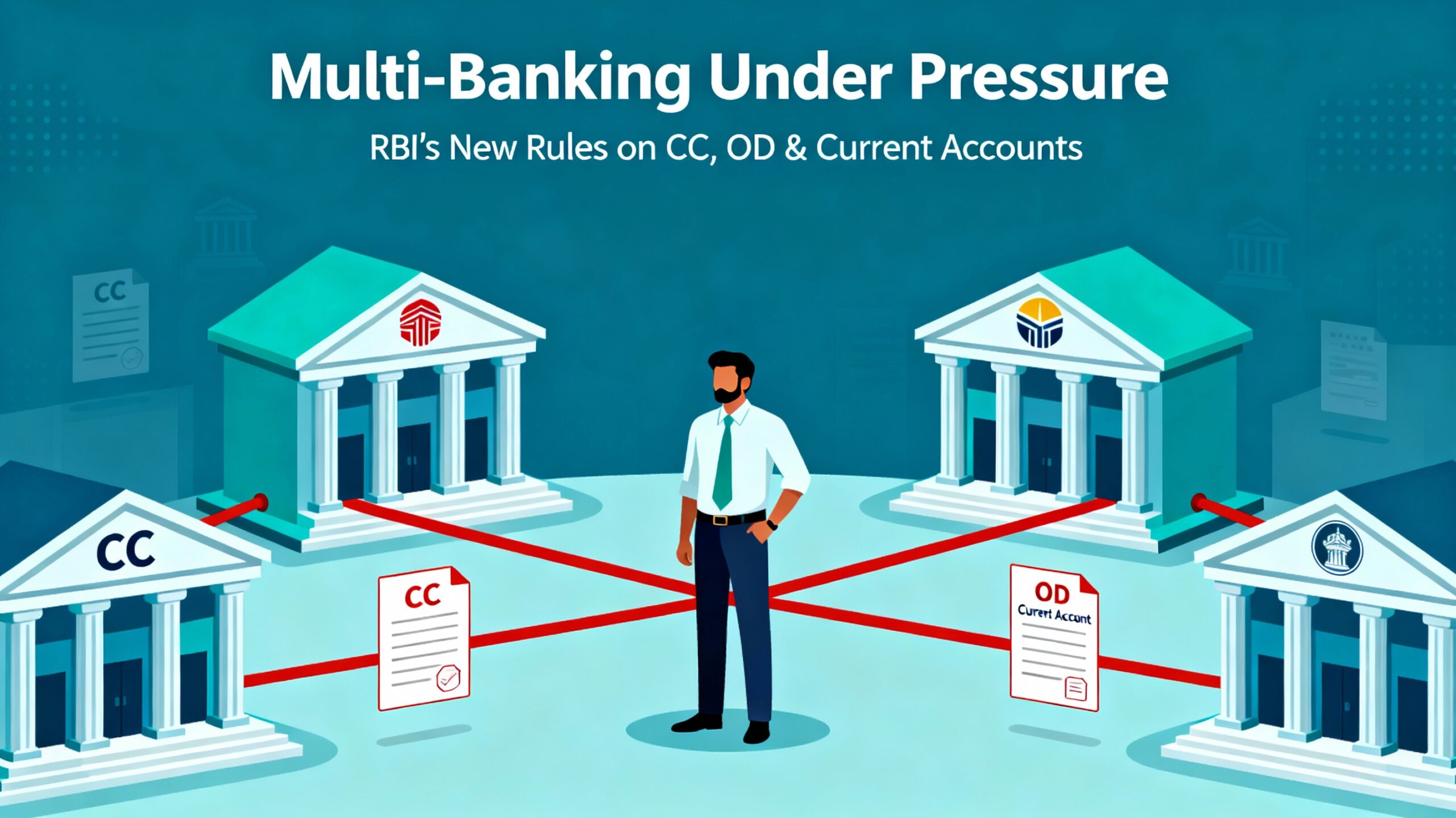
Multi‑Banking Under Pressure: RBI’s Fresh Restrictions on CC, OD and Current Accounts Explained
New RBI rules are about to quietly rewrite how Indian businesses use current, cash credit, and overdraft accounts. Will your favourite bank account survive—or be downgraded to a mere collection hub? Discover the hidden thresholds, surprise exceptions, and fund‑flow traps that could transform your daily banking before 2026 arrives.
What if I told you that for the last five years, your business’s ability to grow was being quietly throttled not by a lack of demand or funds, but by a single, misunderstood definition in a banking rulebook? For half a decade, founders and CFOs have been fighting a “credit discipline” regime that treated their working capital like suspicious contraband. But on Thursday, December 11, 2025, the Reserve Bank of India (RBI) didn’t just issue a circular; they handed Indian businesses a “Get Out of Jail Free” card that most are still too stunned to use.
Here is the secret they aren’t putting on the billboards: The RBI effectively admitted that its strict 2020 experiment on account control was suffocating the very “missing middle” of the economy it meant to protect. By decoupling Cash Credit (CC) accounts from the rigid norms of Current Accounts (CA), the central bank has quietly dismantled the monopoly of “Lead Banks.”
Most will read the headline and miss the goldmine hidden in the fine print of Paragraph 91B. If you run a business in India today, the financial ground beneath your feet just shifted. Here is the deep dive into the surprising, little-known aspects of this 2025 masterstroke that could redefine your balance sheet before the fiscal year ends.
Banks’ rules on current accounts, cash credit and overdraft facilities are changing in an important way from April 1, 2026, and every business that deals with multiple banks should understand what this means in practice.




Why these rules matter
Current Accounts, Cash Credit (CC) and Overdraft (OD) accounts are all used as day‑to‑day transaction accounts by businesses, but they also sit at the heart of banks’ credit monitoring. When money is freely moved across many such accounts with different banks, it becomes harder for lenders to track end‑use of funds, spot early stress, or detect evergreening and diversion.
The Reserve Bank of India has therefore put in place a clearer framework that links the freedom to operate full‑fledged current and OD accounts with a bank’s share of exposure to the borrower. At the same time, it recognises that cash credit remains the main working‑capital tool in India and keeps that relatively flexible.
Cash credit: still the core working capital tool
A Cash Credit facility continues to be treated as a classic working‑capital line tied to the value of current assets such as inventory and receivables. The bank calculates drawing power based on these assets and permits the borrower to draw, repay and redraw within the sanctioned limit.
Under the amended directions, banks are free to offer and run CC limits as per their own credit policies and customer needs; there is no fresh restriction on simply opening or operating a CC account under this chapter. For many borrowers, this means CC will remain the main anchor account for routing business inflows and outflows, especially where exposure is shared among multiple lenders.
Current and OD accounts: the ₹10 crore pivot
The real shift comes in the treatment of Current and Overdraft accounts. Here, the framework draws a sharp line at a system‑wide exposure of ₹10 crore to a borrower.
- If the total exposure of all banks and eligible co‑operative banks to a customer is less than ₹10 crore, any bank may freely maintain that customer’s current or OD account.
- Once the aggregate exposure reaches ₹10 crore or more, only banks that hold at least 10% of the total exposure, or 10% of the total fund‑based exposure, can operate unrestricted current/OD accounts.
This design effectively says: the banks that carry meaningful credit risk should also be the ones controlling the main transaction accounts. Others, including relationship or collection banks, will generally be pushed into a more limited role.
If no bank, or only one bank, meets the 10% threshold, up to two banks with the largest exposures can run full‑service current/OD accounts. Where only one bank has any exposure at all, the borrower may additionally keep one more current account with a bank of choice, but only with a no‑objection certificate (NOC) from the lending bank. And where no scheduled commercial bank qualifies but the borrower still wants a current account with one, the borrower can choose any scheduled commercial bank, again subject to NOCs from all lending institutions.
Collection accounts: controlled inflow hubs
For banks that do not meet the eligibility thresholds, the framework introduces or reinforces the concept of “collection accounts”. A collection account is a current or OD account that is primarily used for receipts – for example, customer payments, refunds, or other inflows – with very limited scope for outgoing payments.
Key features include:
- Funds credited to a collection account must be transferred within two working days to a designated main account, which can be a CC, current or OD account with any bank in the system identified by the borrower.
- Any overdraft limit attached to a collection account cannot be used for free‑form payments; disbursements from such an OD must be routed only via the designated account.
Banks can debit statutory dues like taxes and their own charges before remitting the balance, but otherwise the collection account is meant to be a pass‑through to the main operating account, not a parallel operating account in disguise.
Who is outside the main restriction?
The rules are not one‑size‑fits‑all. Certain categories of accounts are kept outside the core restriction that applies at the ₹10 crore threshold.
These include:
- Accounts opened under FEMA and related notifications, such as certain export‑import or non‑resident accounts mandated for foreign‑exchange compliance.
- Accounts or transactions that are specifically required under a statute, an instruction from a financial‑sector regulator (RBI, SEBI, IRDAI, PFRDA), or orders of the Central or State Governments.
- Accounts of entities that are themselves regulated by a financial‑sector regulator, where the account is used for carrying out their regulated activities.
Even for these exempt accounts, banks must ensure that transactions remain strictly within the permitted purpose, and any surplus funds are pushed back to the borrower’s designated main account.
Special product‑linked current accounts
Banks often launch products or services—such as CMS arrangements, escrow structures or collection services for digital platforms—that need a current account at the service‑providing bank. The framework allows such accounts even where the bank does not qualify under the exposure thresholds, but only under strict safeguards.
Such accounts must:
- Be opened under a Board‑approved policy that explains why the account structure is necessary for the product or service.
- Allow transactions only for specified, narrow purposes; they cannot permit cash handling, free customer‑initiated debits, or the issue of cheques and cards.
- Be subject to robust internal controls so they are not used as shadow current accounts to dodge the primary restrictions or facilitate fund diversion or fraud.
Any surplus build‑up must again be transferred back to the designated main account, reinforcing the principle that the real operating account should be with one of the major lenders.
Compliance, monitoring and re‑eligibility
The framework also expects banks to continually check whether they remain eligible to operate full service current/OD accounts for a given borrower. Changes in exposure—new loans from other banks, repayments, or syndication changes—can all shift the share of a bank’s exposure and, with it, its eligibility.
Banks must:
- Review accounts at least once every half‑year to ensure compliance with the chapter.
- Promptly notify customers, within one month of noticing ineligibility, that a current/OD account must either be converted into a collection account or closed.
- Complete conversion or closure within three months of detecting such ineligibility.
To support this, all relevant accounts need to be properly flagged in the core banking system, and banks with multiple accounts for the same borrower must monitor at both borrower and account level.
Business‑use only, not pass‑through platforms
An important behavioural pillar of the framework is the insistence that these accounts be used only for genuine business of the accountholder. Banks are required to ensure that customers do not use their accounts as generic pass‑through platforms for unrelated third‑party flows.
The only exception is for entities licensed or authorised by a financial‑sector regulator to handle third‑party transactions, such as payment aggregators or certain intermediaries. Even then, the activity must stay within the regulator‑approved scope, and such accounts must be distinctly flagged and closely monitored.
Further, banks must ensure that customers who are not licensed by RBI as deposit‑takers or payment‑service providers do not run quasi‑banking or payment services through their accounts. To enforce this, banks need surveillance that can flag unusually high transaction volumes, repeated pass‑through‑type flows, or patterns that do not match the declared line of business.
Term loans: straight to the end‑use
The directions also encourage a cleaner routing of term‑loan disbursements. Where the ultimate beneficiary or end‑use is clearly identifiable—say, a machinery supplier, a project SPV, or a property seller—the bank is expected to pay directly to that party rather than crediting the borrower’s own account and relying on onward payments.
This is a subtle but important shift away from routing everything through the borrower’s current account and then trying to track end‑use after the fact. Direct routing reinforces the idea that loan funds should flow as close as possible to their intended purpose.
When does all this kick in?
The amended directions are slated to come into force from April 1, 2026. However, banks are free to adopt the full framework earlier if they are ready, and many may move in that direction as they update systems and processes.
For businesses, this is the right time to:
- Map how many current, CC and OD accounts they maintain across banks.
- Identify which accounts are likely to remain full‑service and which may need to become collection accounts under the new exposure‑based rules.
- Engage with lead banks to agree on designated accounts and covenant structures that reflect the new discipline around fund flows.
Handled proactively, the new framework can bring more structure and clarity to multi‑banking, rather than disruption.
Final Thought
These revised rules on current, cash credit and overdraft accounts aim to align transactional freedom with credit responsibility. They push major lenders to anchor a borrower’s main operating accounts, while relegating others to tightly controlled collection roles. Structured fund flows, stricter end‑use monitoring and limits on pass‑through activity should curb diversion and improve early stress detection. Businesses that proactively rationalise accounts, choose clear designated banks and align their cash‑flow architecture with these norms will likely experience less disruption. In the long run, this framework can support healthier credit relationships and a more transparent banking ecosystem.
Disclaimer: The use of any third-party business logos in this content is for informational purposes only and does not imply endorsement or affiliation. All logos are the property of their respective owners, and their use complies with fair use guidelines. For official information, refer to the respective company’s website.

With over 15 years of experience in Banking, investment banking, personal finance, or financial planning, Dkush has a knack for breaking down complex financial concepts into actionable, easy-to-understand advice. A MBA finance and a lifelong learner, Dkush is committed to helping readers achieve financial independence through smart budgeting, investing, and wealth-building strategies, Follow Dailyfinancial.in for practical tips and a roadmap to financial success!