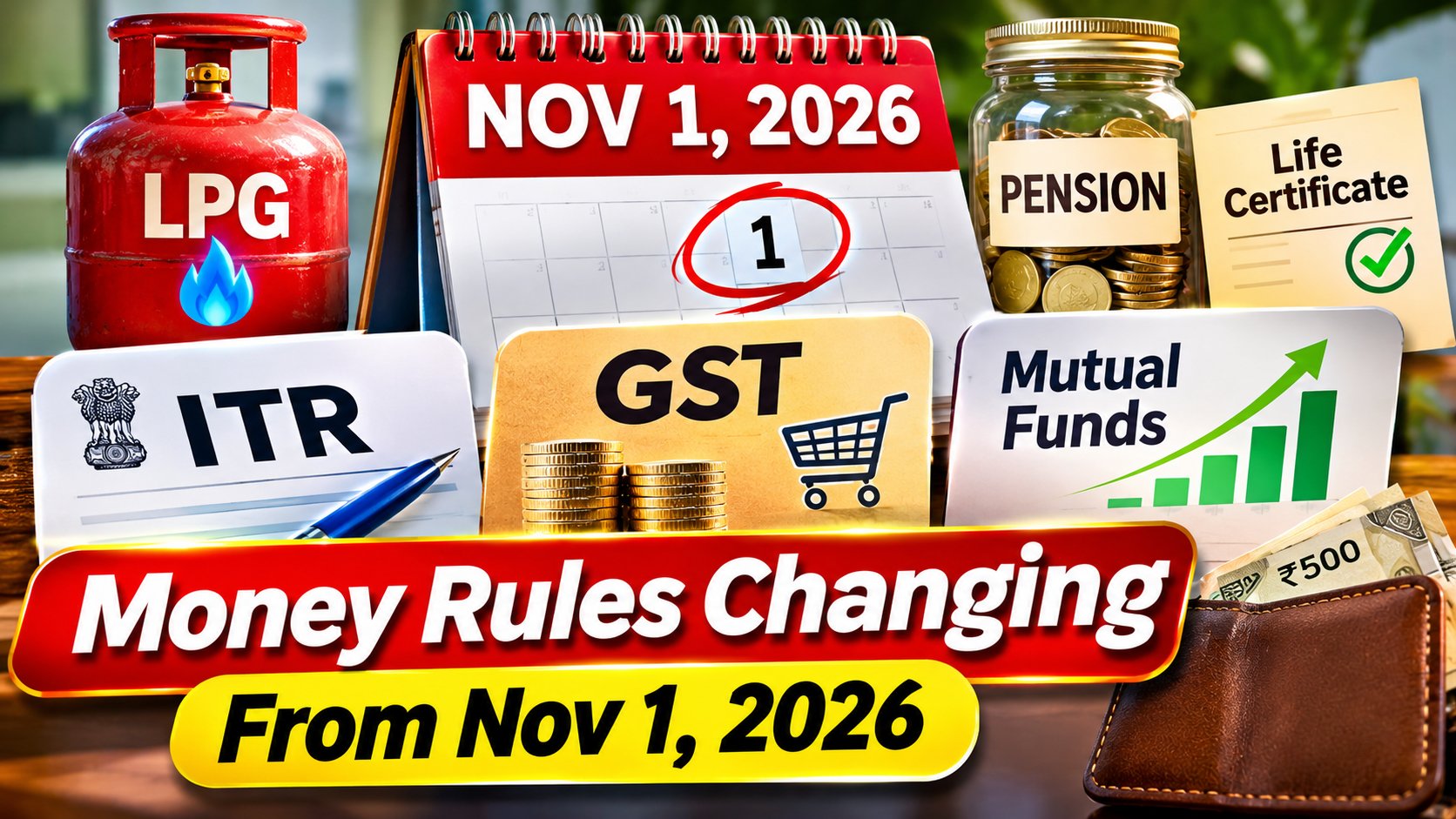
Money Rules Changing From November 1, 2026 — LPG, Pension Life Certificates, ITR, GST and Mutual Funds: What Hits Your Wallet
Commercial LPG is up by ₹10 to ₹17, household LPG is unchanged, pensioners’ life certificate season has begun, audit-case tax returns are due November 21, GST refund reforms start rolling out and direct mutual fund plans become the default on fund house platforms.
The first of every month brings a reshuffle of prices and deadlines, and November 2026 has more than usual. If you run a restaurant, your gas bill rose this morning. If you draw a government pension, you have a few weeks to prove you are alive to your bank. If your business accounts are audited, your tax return is due in three weeks. And if you open a mutual fund app, it may now nudge you towards the cheaper plan by default.
None of these changes is dramatic on its own. Together they touch kitchens, pensions, tax filings, businesses and investments. This guide sets out each one with the exact numbers, who it affects and what to do, and separates what has actually changed from what has only been announced or proposed.
LPG: Restaurants Pay More, Households Do Not
Oil marketing companies revise LPG prices at the start of each month. Goodreturns reported this morning that the 19 kg commercial cylinder rose in all four metros, with Kolkata seeing the biggest increase of ₹17. Domestic 14.2 kg cylinders were left unchanged, as they have been since June 7, 2026.
The booking rules that still apply
Several LPG rules continue this month, according to Goodreturns. Ujjwala beneficiaries who have not completed biometric Aadhaar e-KYC cannot get subsidised refills. The 25-day gap between refill bookings remains for urban and rural customers. Delivery requires an OTP sent to the registered mobile number, so a changed number can delay your cylinder. Households switching to piped gas have 30 days to surrender their LPG connection, a rule in place since May 2026. PNG prices were broadly unchanged at ₹49.60 per standard cubic metre in Delhi and ₹52 in Mumbai and Chennai.
What the hike costs a small eatery (our calculation): a Kolkata restaurant using four 19 kg cylinders a month pays ₹17 more per cylinder, or ₹68 a month and ₹816 over a year if the price holds. In Delhi, the same usage costs ₹40 more a month. For a household on the 14.2 kg cylinder, the change this month is zero.
Why Commercial Gas Moves Every Month but Kitchen Gas Does Not
The two cylinders are priced differently for a reason. The 19 kg commercial cylinder carries no subsidy and is priced closer to market, so oil companies pass on changes in international LPG prices and the rupee almost every month. The 14.2 kg domestic cylinder is a politically sensitive household staple, and its price is changed far less often; it has been held since June 7, 2026. That is why restaurant owners, caterers and tea stalls feel monthly swings that households largely escape.
For businesses, the practical response is to track the first-of-month revision and build it into menu or service pricing, rather than absorbing small increases that add up across a year. For households, the bigger risk this month is not price but paperwork: an incomplete e-KYC or an outdated mobile number can delay a refill far more than a price change ever would.
Pensioners: Life Certificate Season Is Here
Pensioners must submit an annual life certificate to keep receiving their pension. Business Today reported that pensioners aged 80 and above could submit from October 1, 2026 and generally until November 30, while the regular window for others begins in November. Most reports, including Indian Pay Calculator, cite November 30 as the deadline. One Goodreturns report mentioned November 20, so check with your pension disbursing bank if you are close to the date.
Ways to submit
- Face authentication on an Android phone using the Jeevan Pramaan and AadhaarFaceRD apps
- Fingerprint or iris authentication at a centre
- Doorstep banking, where available
- In person at your bank branch or pension agency
Key dates
- October 1: window opened for pensioners aged 80 and above
- November: window opens for other pensioners
- November 30: deadline cited by most reports
- Late submission risks a pause in pension payments
What pensioners often get wrong: waiting until the last week. Bank branches and Aadhaar authentication centres get crowded in late November, and a failed fingerprint scan, common among older people, can force a second visit. Face authentication on a family member’s phone, done early in the month, avoids both problems.
Income Tax: Audit-Case Returns Due November 21
The CBDT extended deadlines for taxpayers whose accounts must be audited, Angel One reported on September 29. The tax audit report moved from September 30 to October 21, 2026, and the income tax return for these cases from October 31 to November 21, 2026. Transfer pricing cases keep their November 30 ITR deadline, with Form 3CEB due October 31.
This extension does not help salaried taxpayers who missed their original deadline; it applies only to audit cases. If you are in that group, the remaining days matter: a late return can mean interest and fees, and some losses cannot be carried forward if the return is filed late.
Who Counts as an Audit Case
Under Section 44AB of the Income-tax Act, a tax audit is generally required for businesses with turnover above ₹1 crore, a limit that rises to ₹10 crore where cash receipts and payments are each no more than 5% of the total, and for professionals with gross receipts above ₹50 lakh, or ₹75 lakh under similar cash conditions. Some taxpayers who opt out of presumptive taxation also fall into audit. If your accountant has already filed the audit report by October 21, the November 21 return deadline is the next step.
Partners in firms that require audit generally follow the same extended deadline for their personal returns. If you are unsure whether you fall in this group, check with your chartered accountant this week rather than in the final days, when the portal tends to slow down.
GST: Faster Refunds and New Return Forms in the Pipeline
The 57th GST Council meeting on October 8, 2026 approved a package of compliance reforms, some of which begin rolling out from November 1, Business Today reported. Draft versions of GSTR-1, GSTR-1A and the Invoice Furnishing Facility go on the myGov portal from November 1 for public comment until November 30. Automated sanctioning of eligible refunds is expected to start after November 1, for new claims only. The revised return forms themselves are targeted for April 1, 2027.
| GST measure | Before | After | Status |
|---|---|---|---|
| Refund acknowledgement or deficiency memo | 15 days | 10 days | Proposed |
| Provisional refund, zero-rated and inverted duty | Manual processing | 90% through automated risk-based process | Proposed; not confirmed for November 1 |
| Draft GSTR-1, GSTR-1A and IFF | Current forms | Drafts on myGov for comment | November 1 to 30 |
| Refund of ITC on input services, inverted duty | Not refundable | For credit availed from November 1, 2026 | Subject to legal changes |
| Prosecution threshold | ₹1 crore | ₹5 crore | Targeted April 1, 2027 |
| Show-cause notice threshold | None | Minimum ₹10,000 aggregate tax | Recommended |
The reason for the return redesign is practical. About 80% of GST notices arise from mismatches between returns, CBIC’s Gaurav Singh said, according to Business Today. Aligning GSTR-1 and GSTR-3B is meant to cut those notices at the source. Businesses should use November to review the drafts and send feedback, rather than wait for April.
Small Businesses: Relief Measures Still Awaiting Notification
Several GST Council recommendations aimed at small businesses have been approved in principle but are not yet confirmed as in force, Business Today reported. An optional Annual Return Quarterly Payment scheme would let businesses with prior-year turnover up to ₹5 crore that supply only to unregistered customers file annually and pay quarterly. Late fees for taxpayers with turnover up to ₹5 crore would be waived if returns are filed by the end of the month in which they were due. Eligible small e-commerce sellers could declare platform warehouses as their principal place of business in states where they have no physical presence, with input tax credit passed to registered buyers capped at ₹2.5 lakh a month.
Until these are formally notified, small businesses should continue filing as usual. The most useful step now is to read the draft forms on myGov and flag practical problems before the November 30 cut-off, since the final versions take effect on April 1, 2027.
Mutual Funds: Direct Plans Become the Default Choice
SEBI chairman Tuhin Kanta Pandey said on October 28 that direct plans will be the default option on fund houses’ digital platforms from November 1, Cafemutual reported, citing Moneycontrol. Investors can still choose regular plans, which pay distributor commissions and carry higher expense ratios, and will be told about the higher costs if they do. The change covers fund houses’ own digital platforms; how it will apply elsewhere has not been detailed.
A difference of about 0.6 percentage points a year looks small, but over 20 years it compounds into nearly ₹6 lakh on a ₹10,000 monthly SIP in this illustration. Direct plans suit investors who choose funds themselves. Those who rely on an adviser should weigh the cost against the value of the advice, and SEBI’s chairman has himself urged caution when buying direct.
Also Landing This Month: DA Arrears and a Look Ahead
Central government employees and pensioners have a separate reason to watch their November credits. The Union Cabinet approved a 3 percentage point increase in dearness allowance and dearness relief, from 60% to 63%, on October 28, effective from July 1, 2026, Business Standard reported. Reports expect arrears for July to October to be paid with the November salary once the Department of Expenditure issues its order. At the entry basic pay of ₹18,000, that is ₹540 more a month and ₹2,160 in arrears for four months by our calculation.
Further ahead, the RBI’s revised rules for fraudulent electronic banking transactions take effect on January 1, 2027. They add a one-time compensation of 85% of net loss, capped at ₹25,000, for losses up to ₹50,000 reported within 5 calendar days. None of this changes on November 1, but it is worth knowing now, because the habits that protect your eligibility, such as keeping your mobile number and email updated with your bank, are the same habits that keep LPG deliveries and pension credits flowing.
Every November 1 Change in One Table
| Change | Who is affected | What changes | Date | What to do |
|---|---|---|---|---|
| Commercial LPG | Restaurants, businesses | +₹10 to ₹17 per 19 kg cylinder | November 1 | Budget for higher fuel cost |
| Domestic LPG | Households | No change; e-KYC and OTP rules continue | November 1 | Keep mobile number updated |
| Life certificate | Central government pensioners | Annual submission window open | By November 30 | Submit early, ideally online |
| ITR, audit cases | Businesses and professionals under audit | Deadline extended | November 21 | File before the deadline |
| GST reforms | GST-registered businesses | Draft forms, faster refunds planned | From November 1 | Review drafts; comment by November 30 |
| Direct plans default | Mutual fund investors | Direct option pre-selected on AMC platforms | November 1 | Check which plan you are buying |
Your November Money Calendar
- November 1New LPG prices; GST drafts on myGov; direct plans default.
- Early NovemberIdeal time for pensioners to submit life certificates.
- November salaryCentral DA arrears at 63% expected, per earlier reports.
- November 21ITR deadline for tax audit cases.
- November 30Life certificate deadline cited by most reports.
- November 30GST draft forms feedback closes; transfer pricing ITRs due.
- December 1Next monthly LPG price revision.
- January 1, 2027RBI digital fraud compensation rules take effect.
- Pensioners: submit the life certificate this week, online if possible, and keep the acknowledgement.
- Households: confirm your LPG connection’s registered mobile number so the delivery OTP reaches you.
- Businesses: factor the LPG increase into monthly costs and review the GST draft forms.
- Audit-case taxpayers: file your ITR before November 21.
- Investors: when using a fund house app, confirm whether you are buying a direct or regular plan.
A quick November checklist
Questions Readers Are Asking
What is the LPG cylinder price from November 1, 2026?
The 19 kg commercial cylinder costs ₹2,820 in Delhi, ₹2,971 in Kolkata, ₹2,775 in Mumbai and ₹2,994.50 in Chennai. The 14.2 kg domestic cylinder is unchanged at ₹942 in Delhi.
Has the domestic LPG price changed in November?
No. Domestic 14.2 kg cylinder prices are unchanged and have stayed the same since June 7, 2026, according to Goodreturns.
What is the last date to submit a life certificate in 2026?
Most reports cite November 30, 2026. Pensioners aged 80 and above could submit from October 1. Check with your pension disbursing bank, as one report mentioned November 20.
What is the ITR due date for audit cases this year?
November 21, 2026, extended from October 31. The tax audit report deadline was extended to October 21. Transfer pricing cases remain due on November 30.
What GST changes start from November 1, 2026?
Draft GSTR-1, GSTR-1A and IFF forms are open for public comment until November 30, and automated refunds are expected to begin. Revised return forms are targeted for April 1, 2027.
What does direct plan as default mean for mutual fund investors?
On fund house websites and apps, the direct plan will be pre-selected from November 1. You can still choose a regular plan, but you will be told about its higher expense ratio.
Can I still book LPG without e-KYC?
Ujjwala beneficiaries who have not completed e-KYC cannot get subsidised refills. Those who cannot complete it can buy 5 kg or 10 kg cylinders at market price, subject to availability.
When will LPG prices change next?
Oil marketing companies usually revise LPG prices on the first day of each month, so the next revision is expected on December 1, 2026.
The Short Version
From November 1, 2026, commercial LPG costs ₹10 to ₹17 more per 19 kg cylinder while household cylinders stay at ₹942 in Delhi. Pensioners should submit life certificates early, with November 30 the deadline most reports cite. Audit-case ITRs are due November 21. GST draft return forms are open for comment until November 30, with faster refunds planned. SEBI says direct plans are now the default on fund house platforms, which over 20 years can mean lakhs saved on a regular SIP.