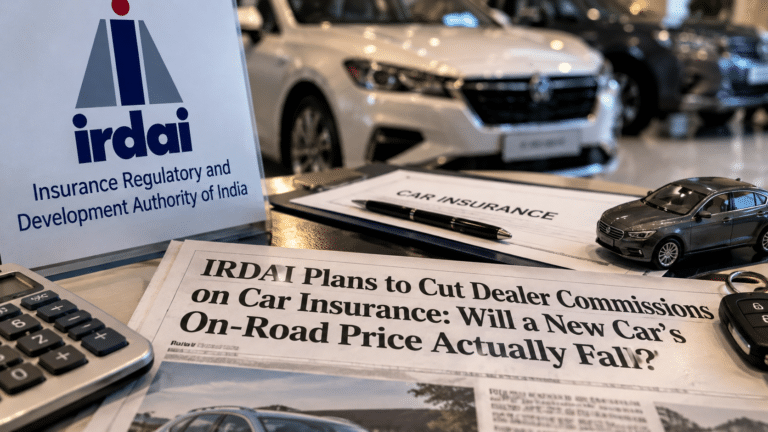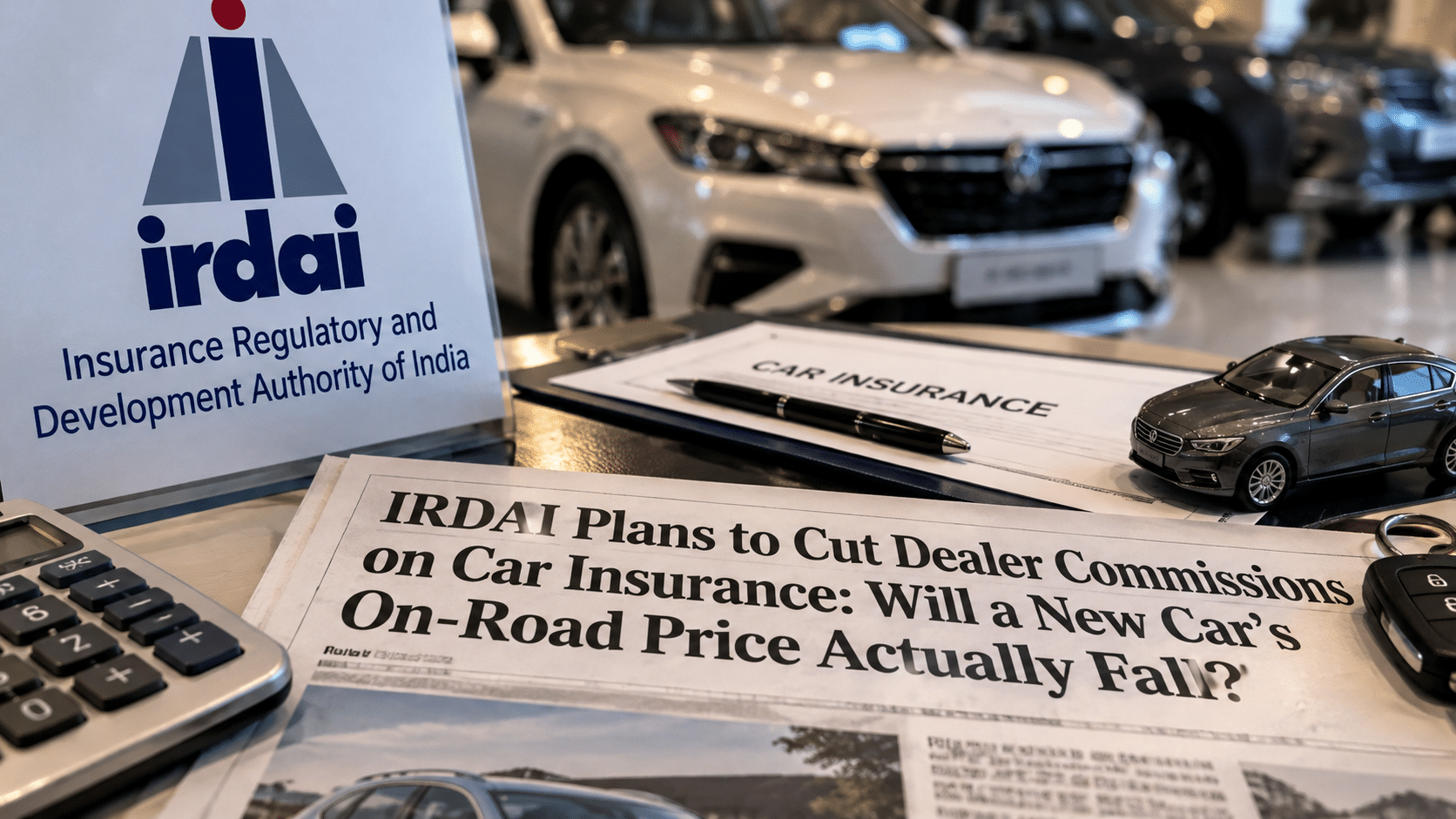
IRDAI Plans to Cut Dealer Commissions on Car Insurance: Will a New Car's On-Road Price Actually Fall?
Motor Insurance · IRDAI Proposal · New Car Buyers
IRDAI Plans to Cut Dealer Commissions on Car Insurance: Will a New Car’s On-Road Price Actually Fall?
A consultation paper released on 23 September 2026 proposes nil commission on third-party cover for new vehicles and caps of 5% to 15% on own-damage cover. Dealers and manufacturer-linked brokers earned about ₹7,050 crore in insurance commission in FY25.
The on-road price sheet for a new car has a line most buyers barely read: insurance. It usually arrives already filled in, with one insurer chosen by the dealer, and it is paid along with the registration charges. Many buyers do not know they could have bought the policy elsewhere, or that a large share of what they paid never reached the insurer at all.
The insurance regulator now wants to change that. Its proposal would cut what dealers earn on the policies they sell with new vehicles and push buyers towards comparing prices. Headlines have read this as “cars will get cheaper”. The real story is narrower, and more useful: one line on your price sheet may shrink, if insurers choose to pass on the saving.
Quick Summary
The car itself will not get cheaper. IRDAI’s draft targets the insurance part of the on-road price. It proposes nil commission to dealers and brokers on third-party cover for new vehicles and a 5% cap on own-damage cover, against an average of 38% that dealers earn on new-vehicle policies today. Dealers would also have to show a QR code for buying elsewhere. Third-party premiums are fixed by the government and will not fall; any saving would come through own-damage premiums. Comments close on 25 October 2026.
What We Know
These points come from IRDAI’s consultation paper, “Recalibrating Economics of Insurance Distribution”, as reported by Upstox, Mint and Finnovate in late September 2026.
- IRDAI released the paper on 23 September 2026 and invited public comments until 25 October 2026.
- For new vehicles, the proposed commission on third-party cover is nil for distribution entities and 2.5% for individual agents.
- Own-damage commission would be capped at 5% to 15%, depending on the channel and the age of the vehicle.
- Dealers would have to display a QR code for buying motor insurance on a market platform, and could not deny cashless repairs to buyers who insure elsewhere.
- Platforms such as Bima Sugam could charge a fee of no more than 5% of the premium.
- General insurers’ overall expense limit would fall from 30% to 25% within two years and 20% within five, starting in FY2027-28.
What Is Still Unclear
- Whether buyers will pay less. Lower commissions cut insurers’ costs. Whether that reaches customers depends on how insurers price own-damage cover. One analysis noted they might simply reduce the discounts they now offer on new-car policies.
- When the rules start. These are proposals. No implementation date has been announced.
- The final numbers. Caps can change after consultation, especially with dealers and brokers pushing back.
- How the platform will work. Upstox reports that not-for-profit platforms are expected to be ready in four to six months. Their pricing tools and claims links are not yet public.
- Current third-party rates. The most recent schedule we could confirm was notified in June 2022. Reports of later revisions should be checked with your insurer.
Where the Money Goes Today
Motor insurance has two parts. Third-party cover pays for damage or injury you cause to others. It is compulsory, and its price is fixed by the government in consultation with IRDAI. Own-damage cover pays for repairs to your own car. It is optional by law, almost always bought with a new car, and insurers set its price.
The regulator’s concern is how much of both is paid out to whoever sells the policy. Its paper puts it bluntly: “Motor insurance is a prime example of lack of transparency driving high commissions.” It adds that “mostly, the choice of motor insurance policy is guided by the motor vehicle dealer than by the choice of the customer.”
The jump in third-party commission, from 4.3% of premium in FY23 to 22% in FY25, is the figure that stands out. Third-party cover is compulsory and its price is fixed, so commission on it rewards nothing but the sale. That is why the paper proposes taking it to zero for new vehicles sold through distributors.
The Proposed Caps, Line by Line
The paper sets maximum commissions by product, by the type of seller and, for motor, by whether the vehicle is new. A distribution entity is a dealer company, broker or corporate agent. An individual agent is a person licensed to sell for an insurer.
| Product | Distribution entities | Individual agents | Reported current average |
|---|---|---|---|
| Motor third-party, new vehicle | Nil | 2.5% | 22% (third-party, broker channel) |
| Motor third-party, old vehicle | 2.5% | 5% | 22% (third-party, broker channel) |
| Motor own damage, new vehicle | 5% | 10% | 38% for dealers on new vehicles, all covers |
| Motor own damage, old vehicle | 10% | 15% | 12% for dealers on old vehicles, all covers |
| Individual health, first purchase | 15% | 20% | About 30% through brokers |
| Pure term life, first year | 25% | 30% | Not reported |
The ceiling on insurers’ total costs
The caps on commission sit inside a wider limit on what insurers may spend running their business, known as expenses of management. For general insurers, according to Upstox and Finnovate, the ceiling would fall from 30% of gross written premium to 20% of gross direct premium within five years, with an interim step to 25% in two years, starting in FY2027-28. That matters because it stops insurers from simply moving payments to dealers into other budget lines, such as marketing support or “advisory” fees.
Why new vehicles get the strictest treatment
A new-car buyer is the least likely customer to shop around. The policy has to be in place before the car can be registered, the dealer handles the paperwork, and the buyer is focused on the car. That captive moment is where commissions have been highest, and the paper treats it differently from renewals, where owners already compare quotes online.
So Will Your New Car Cost Less?
Here is what most headlines get wrong. The ex-showroom price, road tax and registration charges are untouched by an insurance regulator. Only the insurance line can move. And within that line, only part of the premium is open to change.
The third-party part will not fall
Third-party premiums are set by notification. Under the schedule notified in June 2022, the most recent we could confirm, a new private car carries a mandatory three-year third-party premium that depends on engine size. Cutting the commission on it changes who keeps the money, not what you pay.
| Vehicle | Size | 1-year third-party premium | 3-year premium for a new car |
|---|---|---|---|
| Petrol or diesel car | Up to 1,000cc | ₹2,094 | ₹6,521 |
| Petrol or diesel car | 1,000cc to 1,500cc | ₹3,416 | ₹10,640 |
| Petrol or diesel car | Above 1,500cc | ₹7,897 | ₹24,596 |
| Electric car | Up to 30 kWh | ₹1,780 | ₹5,543 |
| Electric car | 30 to 65 kWh | ₹2,904 | ₹9,044 |
| Electric car | Above 65 kWh | ₹6,712 | ₹20,907 |
The own-damage part is where any saving sits
Own-damage premiums are priced by insurers and vary widely with the car’s insured value, add-ons such as zero depreciation, and discounts. If an insurer no longer pays a dealer 30% or more to sell the policy, it has room to charge less. Whether it does is a business decision. Competition between insurers, and buyers able to compare prices through a platform, are what would turn lower costs into lower premiums.
| Own-damage premium (assumed) | Total with ₹10,640 third-party | Commission at 38% | Commission under draft caps | Room for a lower price |
|---|---|---|---|---|
| ₹10,000 | ₹20,640 | ₹7,843 | ₹500 | Up to ₹7,343 |
| ₹20,000 | ₹30,640 | ₹11,643 | ₹1,000 | Up to ₹10,643 |
| ₹30,000 | ₹40,640 | ₹15,443 | ₹1,500 | Up to ₹13,943 |
| ₹50,000 | ₹60,640 | ₹23,043 | ₹2,500 | Up to ₹20,543 |
Two-wheeler buyers are in the same position
New scooters and motorcycles carry five years of third-party cover at purchase. Under the 2022 schedule, that is ₹3,851 for a 75cc to 150cc bike and ₹7,365 for 150cc to 350cc, before GST. The same draft caps apply, so the same logic holds: the third-party amount will not change, while any saving would come from the own-damage portion and from being able to compare quotes at the showroom.
Car loans: no more compulsory bundles
Banks and non-bank lenders that sell insurance with vehicle loans earned an average commission of 16%, according to the figures reported from the paper. The proposal, which covers loans generally, would bar lenders acting as distributors from making insurance a compulsory part of a loan. A package would be allowed only if it showed a clear benefit, such as a lower interest rate tied to specified cover, displayed with and without that cover. The borrower could still buy the policy elsewhere.
Who Gains and Who Loses If the Draft Becomes Final
Dealers stand to lose the most. Insurance commission has been a meaningful source of income for showrooms, especially on new vehicles where it averages 38%. Expect them to argue that the service they provide, from paperwork to claims help at the workshop, has a cost that a 5% cap does not cover.
Manufacturer-linked brokers, which earned an average of 27% on new vehicles, face the same squeeze, and the bar on incentive schemes that reward dealers for insurance sales cuts off a common workaround.
Insurers would keep more of each premium, which could improve profits or fund lower prices. Not-for-profit platforms such as Bima Sugam gain a role at the showroom through the QR code requirement. Buyers gain choice for certain. Whether they gain money depends on competition in own-damage pricing.
Renewals are a different story
The sharpest proposals target the moment of purchase. For older vehicles, the caps are higher, at 10% for distribution entities and 15% for agents on own damage, and dealers already earn far less on them, an average of 12%. Owners renewing a policy online today are unlikely to see much change.
How Buying Cover for a New Car Would Change
The commission caps are paired with rules meant to give buyers a real choice at the showroom. Taken together they describe a different purchase journey.
Two further rules matter. Dealers set up as companies, limited liability partnerships or registered partnerships would need to register as insurance distribution entities, while smaller dealers would work as insurer associates or point-of-sale persons. And agreements that work against policyholders, including manufacturer incentive schemes that reward dealers for insurance sales, would be barred.
How We Got Here
What New-Car Buyers Can Do Before Any Rule Changes
Nothing in the draft stops you acting now. You can already buy cover from any insurer, and the documents needed are the same.
- Ask for the insurance quote separately. Have the dealer show the insurer, insured value, add-ons and premium as their own lines.
- Get two outside quotes. Use the same insured value and add-ons, so the comparison is fair.
- Check the third-party figure. It should match the notified rate for your engine size or battery capacity, plus GST.
- Ask about cashless repairs. Confirm the dealer workshop is on the network of the insurer you choose.
- Buy before registration. Pass the policy to the dealer in time, as registration needs it.
Want to have your say?
The paper is open for public comment until 25 October 2026. IRDAI publishes consultation papers on its website with a format and an email address for responses. Buyers who have been charged for an insurer they did not choose, or refused cashless repairs, are exactly the experience the regulator says it wants to hear about.
Frequently Asked Questions
Will cars become cheaper because of IRDAI’s new motor insurance proposal?
The car’s ex-showroom price is not affected. The proposal targets the insurance part of the on-road price by cutting commissions paid to dealers and making it easier to buy cover elsewhere. Any saving depends on insurers passing lower costs into own-damage premiums, and the proposal is still a draft.
What has IRDAI proposed for motor insurance commissions?
For new vehicles, nil commission on third-party cover for distribution entities such as dealers and brokers, and 2.5% for individual agents. Own-damage commission would be capped at 5% for distribution entities and 10% for agents on new vehicles, and at 10% and 15% on older vehicles.
How much commission do car dealers earn on insurance?
According to figures in IRDAI’s consultation paper as reported by Upstox and Mint, dealers acting as motor insurance service providers earned an average of 38% on new-vehicle policies. Dealers and manufacturer-linked brokers earned about ₹7,050 crore on about ₹29,000 crore of premium in FY25.
Can I buy car insurance from somewhere other than the dealer?
Yes, you can already buy a policy from any insurer or platform before registration. Under the proposal, dealers would have to display a QR code for a market platform such as Bima Sugam, and could not refuse cashless repairs because you bought the policy elsewhere.
Will third-party insurance premiums come down?
Not directly. Third-party premiums are fixed by the government in consultation with IRDAI, so cutting the commission on them does not change the price you pay. The proposal mainly reduces how much of that premium goes to distributors.
When will the new motor insurance commission rules apply?
No date has been fixed. IRDAI released the consultation paper on 23 September 2026 and invited comments until 25 October 2026. Final rules would follow after that, and the wider expense limits are proposed to start from FY2027-28.
How much is third-party insurance for a new car?
Under the schedule notified in June 2022, the base three-year third-party premium for a new private car is ₹6,521 below 1,000cc, ₹10,640 for 1,000cc to 1,500cc and ₹24,596 above 1,500cc, before GST. Check the current notified rates with your insurer.
Is it safe to buy car insurance online instead of at the showroom?
Yes, if you buy directly from an IRDAI-registered insurer or a licensed platform and the policy is issued before registration. Check that the insured declared value, add-ons and nominee details match the car, and share the policy with the dealer for registration.
The Short Version
IRDAI is not making cars cheaper. It is trying to make the insurance sold with them cheaper to distribute. Its draft would end commission on third-party cover for new vehicles sold through dealers and brokers, cap own-damage commission at 5%, and require showrooms to point buyers to a platform where they can compare. Dealers now earn an average of 38% on new-vehicle policies. Third-party premiums are fixed and will not fall; any saving would come through own-damage pricing, and only if insurers pass it on. The rules are open for comment until 25 October 2026. Until then, ask for the insurance line separately and get outside quotes.