HSBC Taj Credit Card: Is the ₹1.1 Lakh Fee Worth It — and Who Actually Comes Out Ahead?
Credit cards · Premium travel · India 2026
HSBC Taj Credit Card: Is the ₹1.1 Lakh Fee Worth It — and Who Actually Comes Out Ahead?
An invite-only Visa metal card built around Taj hotels, priced at ₹1,29,800 a year with GST. Its value rests almost entirely on how often you stay, eat and unwind at IHCL properties.
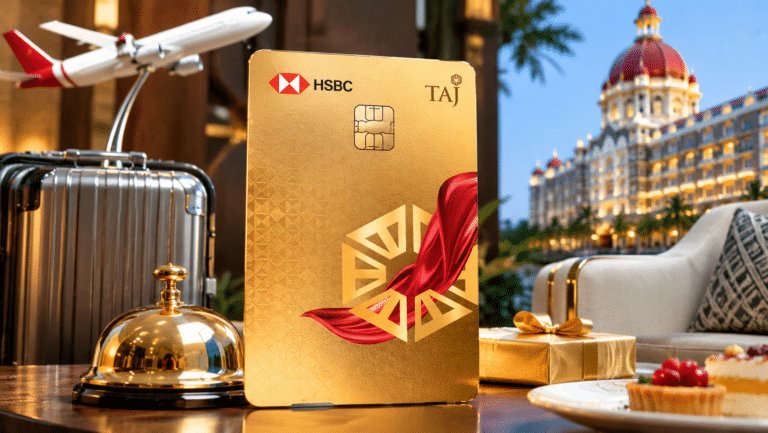
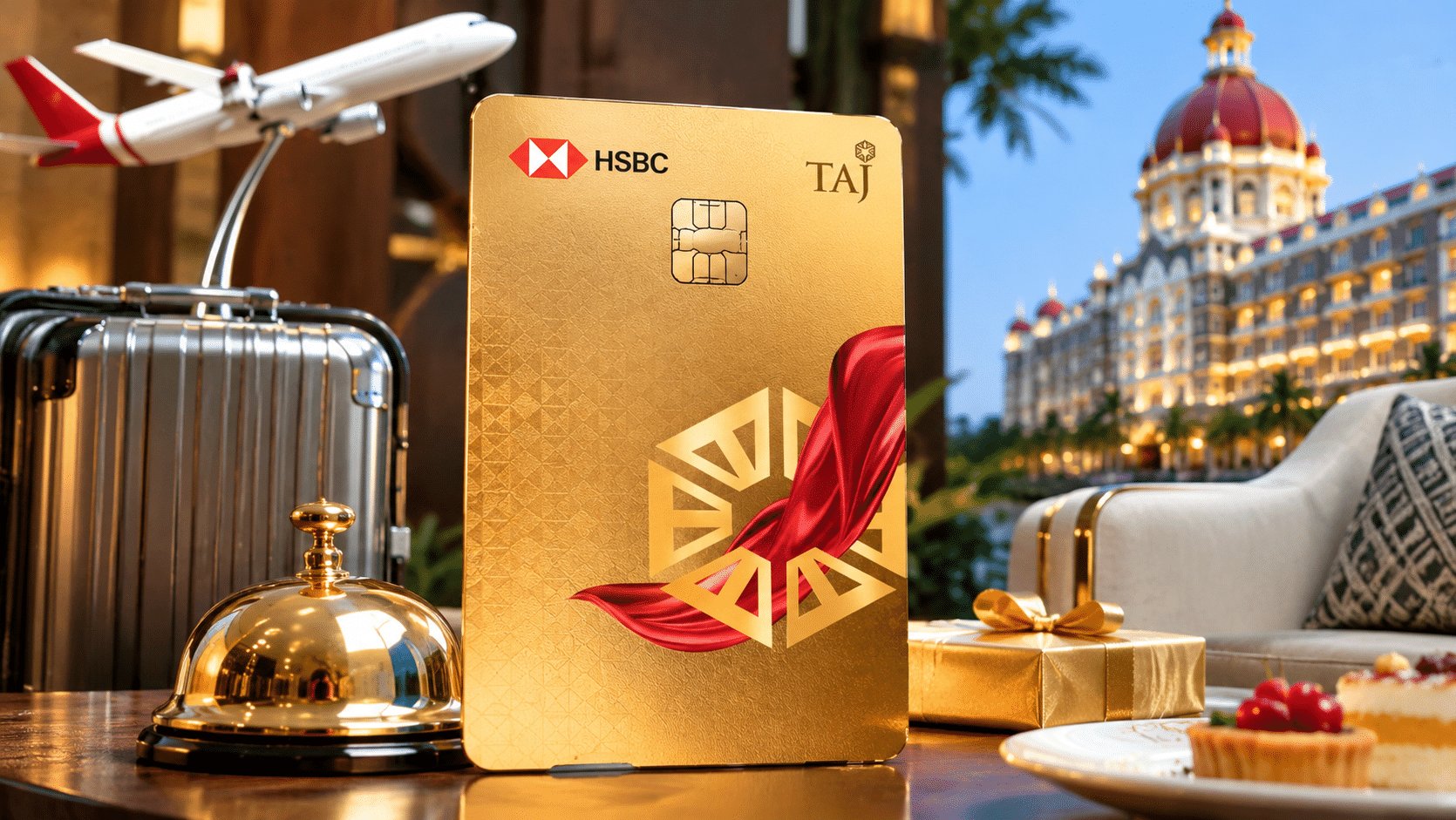
Most premium credit cards sell you a currency, points that can be poured into airlines, hotels or vouchers. The HSBC Taj Credit Card sells something narrower and, for the right person, more tangible: nights in Taj palaces, meals in its restaurants, spa hours and a status tier that upgrades your room. It costs ₹1,10,000 a year before tax, with no spending waiver. For a family that already spends weekends at Taj properties, that can be a bargain. For anyone else, it is one of the most expensive cards in India to carry for a logo.
A hotel brand that wanted its own card
HSBC India and The Indian Hotels Company announced the card on 19 December 2024, describing it as India’s first premium co-branded hospitality credit card. It runs on Visa as a metal card. At the launch, HSBC’s head of wealth and personal banking, Sandeep Batra, linked it to rising spending on luxury and wellness by affluent Indians, while IHCL’s Parveen Chander Kumar pointed to Taj’s 120-year legacy.
The card is invite-only, and HSBC’s own terms set a high bar for who gets an invitation. Applicants must be Indian residents aged 25 to 75, with annual income of at least ₹40 lakh if salaried or ₹60 lakh if self-employed, and live in one of the serviceable cities listed in the terms.
- 19 Dec 2024Launch announced by HSBC India and IHCL
- ₹1,10,000Joining and annual fee, before GST
- ₹40 L / ₹60 LMinimum income, salaried / self-employed
- 25 to 75Eligible age range in years
- 13Cities named in HSBC’s terms document
- 45% a yearInterest on revolved balances, 3.75% a month
What arrives in the welcome envelope
The heart of the card is a voucher package issued on activation and, according to SaveSage and Card Advisor, reissued at renewal. Reports from 2026 describe two breakfast-inclusive nights at participating IHCL hotels and one night at a Taj Palace property, along with meal, spa and access vouchers. The Taj FAQ page says benefits are valid for 365 days from issue and cannot be extended.
- 2 nightsIHCL staysBreakfast-inclusive nights at participating hotels; blackout dates apply.
- 1 nightTaj PalaceA palace stay with breakfast; taxes payable by card on use.
- 4 mealsSet meal for twoThree courses at designated all-day or signature restaurants.
- 4 spa60-minute treatmentsPlus sauna and steam, per Taj’s FAQ.
- 12 visitsEach for Club, Chambers, poolAccess vouchers as described by Card Advisor.
- 25% offRooms, dining and spaOn best available rates at participating hotels.
Cardholders also receive Taj InnerCircle NeuPass Platinum status without qualifying stays, which the Taj FAQ says brings unlimited one-level room upgrades on availability. Magnify’s review adds early check-in, late check-out and dedicated Platinum service.
The detail people miss: every one of these vouchers expires 365 days after issue and is blocked on blackout dates, which include select weekends, public holidays, festivals and peak periods. A palace night you cannot fit into your calendar is worth nothing, however high its room rate.
How the points actually stack up
Reviews from 2026 agree on the base reward structure. The card earns 5 reward points per ₹100 at Taj, SeleQtions, Gateway, Vivanta and amã Stays & Trails, and 1.5 points per ₹100 on other eligible spending. With 1.5 points worth ₹1 in Taj wallet credit, that is about 3.33% at IHCL hotels and 1% elsewhere. Fuel, cash advances and fees do not earn points.
On top of that, Platinum status earns NeuCoins at IHCL hotels: 8 per ₹100, according to the launch coverage and Card Advisor, and 4 per ₹100 at Ginger. Card Advisor values a NeuCoin at about ₹1, which lifts the combined return on Taj spending to roughly 11%.
Based on reward rates reported by Card Advisor and Magnify (2026); 1.5 points = ₹1 and 1 NeuCoin = ₹1 as estimated by Card Advisor. Indicative only.
The catch with a single-brand currency
Card Advisor notes that redemptions are limited to IHCL rooms, dining, spa and Taj gift cards. You cannot move these points to an airline. That is fine if your spending already flows to Taj, and limiting if your travel is mostly flights.
The break-even sum points alone cannot reach
Divide the ₹1,29,800 yearly fee by each reward rate and the scale of the problem becomes clear. Points by themselves rarely justify this card.
Our calculation using the reward values above. Ignores vouchers, which carry most of the card’s value.
Even the best case, ₹11.5 lakh a year spent on Taj rooms and restaurants, is far beyond most households. That is why the voucher package is not a perk on this card. It is the product.
Running the numbers for two kinds of Taj guest
Room rates vary hugely by property and season, so any valuation of the vouchers is an assumption. Magnify’s review estimates a single Taj Palace night at ₹30,000 to ₹80,000. We use deliberately cautious figures below and label them as ours.
Our illustrative assumptions: palace night ₹40,000; IHCL night ₹15,000; meal voucher ₹6,000; spa ₹8,000. Rewards at the rates above. Not hotel quotes.
Occasional guest. Uses the palace night and both IHCL nights (₹70,000), spends ₹5 lakh elsewhere on the card (₹5,000 in points), and lets meals and spa lapse. Total value about ₹75,000, which leaves a gap of about ₹54,800 against the fee.
Regular guest. Uses all three nights (₹70,000), all four meals (₹24,000) and all four spa vouchers (₹32,000), spends ₹3 lakh at IHCL hotels (₹34,000 including NeuCoins) and ₹16.5 lakh elsewhere (₹16,500). Total about ₹1,76,500, roughly ₹46,700 ahead before counting upgrades, lounges or the 25% discounts.
The difference between the two is not income or spending power. It is calendar discipline: whether you plan trips around vouchers that expire in a year and avoid blackout dates.
Travel extras beyond the hotel
The card also carries the usual super-premium travel benefits, though reports differ on some counts. Magnify and Card Advisor both describe unlimited domestic and international airport lounge access and 12 complimentary golf games or lessons a year. For airport transfers through Blacklane, Magnify lists four domestic and four international rides a year, while Card Advisor says the terms cap the total at four.
Launch coverage on Adda247 also mentioned 5% off Emirates flights from India. Reviews list smaller lifestyle offers, including buy-one-get-one BookMyShow tickets up to ₹1,000 twice a month and a ₹1 crore air accident cover.
The forex question needs a direct answer from HSBC
This is where sources conflict most. HSBC’s important terms document lists foreign currency transaction charges as nil. Card Advisor and Magnify, both updated in 2026, describe a 3.5% forex markup, waived only for certain HSBC banking relationship clients. Until HSBC confirms in writing, assume 3.5% on overseas spending; on ₹5 lakh spent abroad, that would be ₹17,500 plus GST.
Charges to know before you carry a balance
A premium card does not come with cheaper credit. HSBC’s terms set the same steep finance charge seen across most Indian cards, and the late fee scales with your minimum due.
| Charge | Amount | When it applies | How to avoid |
|---|---|---|---|
| Annual fee | ₹1,10,000 + GST | Each card anniversary | Cannot be waived by spending |
| Finance charge | 3.75% a month, 45% a year | On any unpaid balance and cash | Pay the full statement amount |
| Late payment | 100% of minimum due, ₹250 to ₹1,200 | If minimum due is unpaid 3 days after due date | Set an autopay for the full bill |
| Cash advance | 2.5%, minimum ₹300, plus interest | On every cash withdrawal | Do not withdraw cash on the card |
| Rent payments | 1% + taxes | On rent and related payments | Pay rent from your bank account |
| Overlimit | ₹500 a month | Only with your consent in the app | Keep overlimit consent switched off |
| Payment due date | 18 days after statement | Every billing cycle | Up to 48 days interest-free if paid in full |
Add-on cards cost nothing extra
HSBC’s terms list no joining or annual fee for add-on cards. For a couple who travel together, routing a spouse’s Taj spending through an add-on card concentrates points on one account, though benefits such as vouchers and Platinum status are described as personal to the primary cardholder and non-transferable. Ask HSBC which perks extend to add-on holders before assuming they do.
At 45% a year, revolving even ₹1 lakh for a year would cost about ₹45,000 in interest plus GST, wiping out a large share of the card’s value. Treat this as a charge card that you clear every month.
How to get one, step by step
Because the card is invite-only, the path runs through HSBC rather than a public application form.
- Check eligibilityAge 25 to 75, ₹40 lakh or ₹60 lakh income, a serviceable city.
- Request a callbackThrough HSBC’s enrolment link or 1800 569 1111.
- Activate the cardThe fee is charged after activation.
- Receive benefitsTaj says within 48 hours, credited to your tajhotels.com account.
- Plan 365 daysBook voucher stays early to avoid blackout dates.
How the offer has shifted since launch
- HSBC and IHCL launch the Visa metal card with a ₹1,10,000 fee and Taj voucher package.
- SaveSage reports a limited-period bonus palace night for applications and renewals by 31 March 2026.
- Magnify reviews the card, valuing a palace night at ₹30,000 to ₹80,000.
- Card Advisor publishes its review, rating the card 4.3 out of 5 for committed Taj guests.
- Card Advisor updates its review, listing a 3.5% forex markup.
- Fee and core reward rates unchanged in reviews checked for this article.
A pre-application checklist
- Count your Taj or IHCL nights in the past 12 months
- Check whether 3 voucher nights fit outside blackout dates
- Budget ₹1,29,800 a year with no spend waiver
- Confirm the forex markup with HSBC in writing
- Pay the full bill every month to avoid 45% interest
- Compare with a flexible travel card if you fly more than you stay
- Note that points cannot move to airline programmes
- Track each voucher’s 365-day expiry date
- Check the Blacklane ride count in your welcome kit
- Keep a second card for rent and fuel, which earn little or cost extra
Common questions about the HSBC Taj Credit Card
What is the annual fee of the HSBC Taj Credit Card?
The joining and annual fee is ₹1,10,000 plus 18% GST, or ₹1,29,800 a year. Reviews and HSBC’s terms indicate no spend-based waiver.
Who is eligible for the HSBC Taj Credit Card?
The card is invite-only. HSBC’s terms require Indian residents aged 25 to 75 with annual income of at least ₹40 lakh if salaried or ₹60 lakh if self-employed, living in a serviceable city.
What are the welcome benefits?
Reports describe two breakfast-inclusive IHCL nights, one Taj Palace night, four set meals for two, four spa treatments, access vouchers and Taj InnerCircle NeuPass Platinum status, all valid for 365 days.
How many reward points does the HSBC Taj card earn?
Reviews report 5 points per ₹100 at Taj, SeleQtions, Gateway, Vivanta and amã, and 1.5 points per ₹100 on other eligible spends, with 1.5 points worth ₹1 in Taj wallet credit.
Does the HSBC Taj card have lounge access?
Reviews describe unlimited domestic and international airport lounge access for the primary cardholder. Check the current terms for guest access.
What is the forex markup on the HSBC Taj Credit Card?
Sources conflict. HSBC’s terms document lists foreign currency charges as nil, while 2026 reviews report 3.5%. Confirm with HSBC before spending abroad.
Can HSBC Taj points be transferred to airlines?
No. Reviews say redemptions are limited to IHCL rooms, dining, spa and Taj gift cards through the Taj wallet.
Is the HSBC Taj Credit Card worth it?
It can be for people who stay at Taj or IHCL hotels several times a year and use the vouchers. On points alone, you would need about ₹1.3 crore of everyday spending to recover the fee, so infrequent guests usually lose money.
The short version for a busy reader
The HSBC Taj Credit Card costs ₹1,29,800 a year and earns 3.33% at IHCL hotels and 1% elsewhere in points. Its real value is a yearly package of palace and hotel nights, meals, spa visits and Platinum status. If you plan Taj stays around those vouchers, it can pay off; if you would not, it is an expensive status symbol. Confirm the forex charge, pay in full every month, and track every voucher’s expiry.