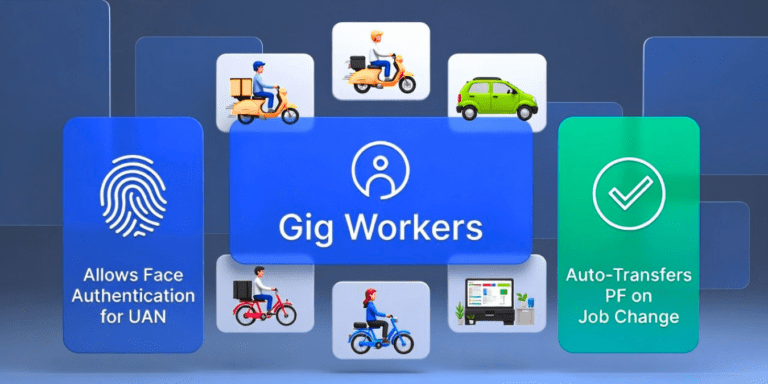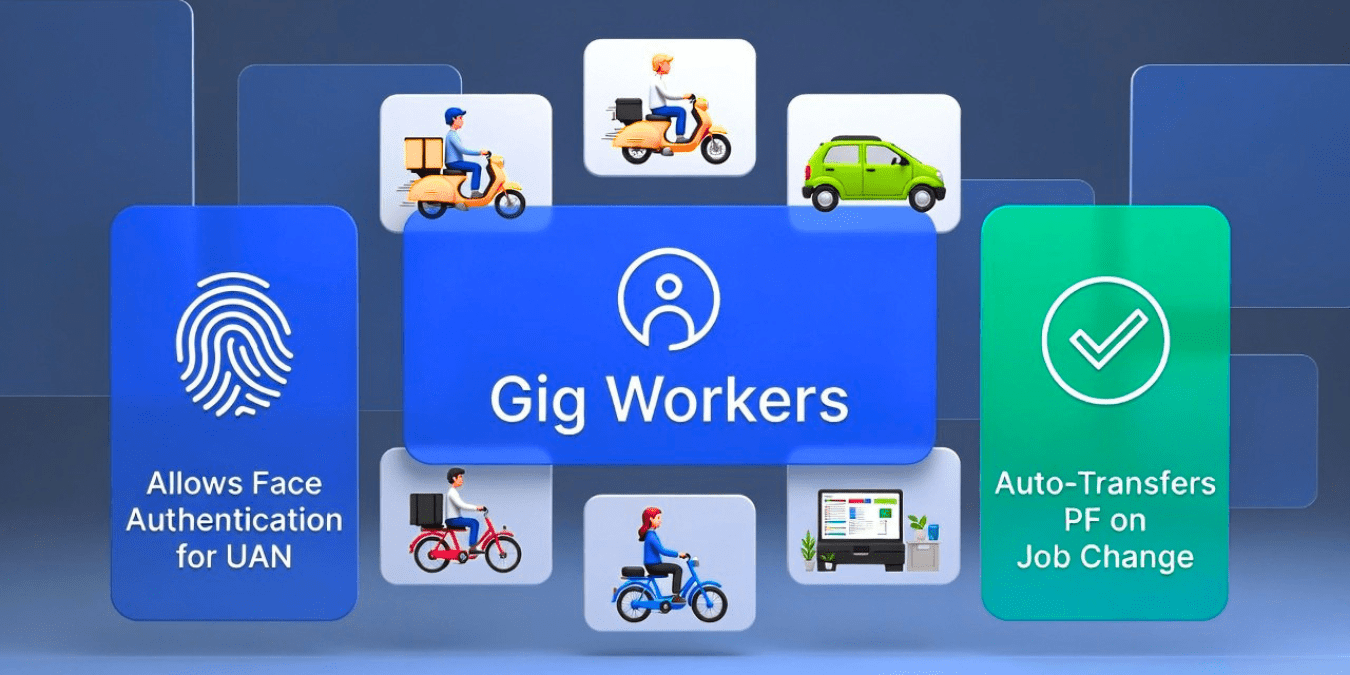
EPFO Now Covers Gig Workers, Allows Face Authentication for UAN, and Auto-Transfers PF on Job Change — The Complete 2026 Upgrade
India’s retirement savings infrastructure just went through its most consequential transformation in decades. The Employees’ Provident Fund Organisation, a body that has historically served only the organised sector, is now at the center of a sweeping policy overhaul that touches three distinct pillars: the formal inclusion of gig and platform workers under a social security framework, the rollout of Aadhaar-based face authentication for UAN generation and activation, and the full operationalisation of automatic PF transfers when employees switch jobs. For anyone who earns a salary, drives deliveries for an app, or has ever dreaded the paperwork of changing companies, understanding this 2026 EPFO upgrade is not optional — it is essential.
Why This Moment Matters
India’s workforce is not what it was even five years ago. The gig economy has exploded, with millions of delivery riders, cab drivers, freelance logistics workers, and platform-based service providers now forming a critical backbone of the urban economy. Yet, until recently, these workers operated in a social security vacuum — no provident fund, no pension, no accident insurance tied to any structured state mechanism. Simultaneously, traditional salaried employees were losing months of interest income every time they changed jobs because of a cumbersome manual PF transfer process that depended on employer cooperation and bureaucratic approval chains. The 2026 EPFO reforms address both of these structural gaps simultaneously, and the implications are enormous.
The Gig Worker Coverage Breakthrough
For the first time in India’s legislative history, gig and platform workers are formally recognised and legally entitled to social security benefits under the Code on Social Security, 2020. The government is actively working to bring these workers under the EPFO and ESIC umbrella, and the structure of this new framework has already been significantly detailed.
The funding mechanism is built on mandatory contributions from aggregators — the companies like food delivery platforms, ride-hailing apps, and e-commerce logistics providers that deploy gig workers at scale. Under Section 114(4) of the Code on Social Security, these aggregators are now required to contribute between 1% and 2% of their annual turnover to a dedicated Social Security Fund, subject to a maximum cap of 5% of the total amount paid or payable to gig workers. This money will directly finance welfare schemes covering provident fund benefits, pension, life insurance, and accident coverage for workers who previously had none of these protections.
The Ministry of Labour and Employment has released draft rules that set clear eligibility criteria. A gig worker associated with a single aggregator must complete at least 90 days of engagement in a financial year to qualify for benefits such as health, life, and personal accident insurance. For workers spread across multiple platforms — a common reality for delivery riders who work simultaneously on two or three apps — the threshold is set at 120 days of cumulative engagement in a financial year, where each day of income-earning counts separately toward the total. This nuanced eligibility design reflects a genuine understanding of how gig work actually operates on the ground, and it signals that the policy architecture is no longer being written by people unfamiliar with the informal economy.
The EPFO has been assigned the responsibility of designing the specific schemes under this new framework. Government officials have indicated that the contribution model will be built for flexibility, acknowledging that gig workers and self-employed individuals do not have fixed monthly incomes. The proposed system may allow workers to contribute at their convenience, with pension and provident fund accumulations calculated based on actual deposits rather than a fixed monthly schedule. This is a philosophically significant departure from the rigid salary-linked contribution model that has defined EPFO’s structure since its inception.
Labour economists have flagged that there are still questions about whether aggregator contributions alone will be sufficient to provide meaningful social security to the rapidly growing gig workforce. Experts like labour economist Shyam Sundar from MDI Gurgaon have noted that the Code on Social Security does not yet clearly define how much will be contributed by the central government, state governments, and the workers themselves — and that without this clarity, the fund may remain undercapitalised. The government has acknowledged these concerns and has stated that the Social Security Fund will also be supported by CSR initiatives and government grants in addition to aggregator contributions.
Face Authentication for UAN: A Digital Identity Revolution
The Universal Account Number is the single most important identifier in the EPF ecosystem. Every provident fund contribution, every transfer, every withdrawal, and every employer linkage flows through the UAN. For years, generating or activating a UAN was a process entirely dependent on the employer, which created delays, data entry errors, and significant vulnerability to fraud. That has now changed fundamentally.
From August 2025, the EPFO introduced Aadhaar-based Face Authentication Technology for UAN allotment and activation through the UMANG app, and by 2026, this is the established standard. The old method required an OTP sent to an Aadhaar-linked mobile number, manual data entry by employers, and a waiting period that could stretch for days. The new system replaces all of that with a biometric face scan that auto-fetches KYC data directly from the Aadhaar database, completing the entire UAN generation or activation process within minutes.
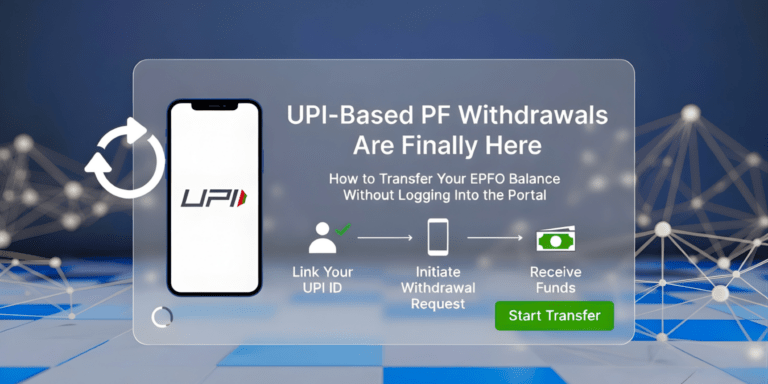
Here is how the process works in practice. A new employee downloads two apps: the UMANG app and the Aadhaar Face RD app. They open UMANG, navigate to the EPFO section, and initiate UAN generation. The system checks whether the Aadhaar number is already linked to an existing UAN. If not, it prompts a face scan using the Aadhaar Face RD app, which communicates with the UIDAI API to verify the individual’s biometric identity in real time. Once verified, the UAN is generated instantly and an SMS is sent to the registered mobile number. For employees who already have a UAN that has not been activated, the same face scan process completes activation immediately, without any employer intervention required.
The practical benefits of this shift are substantial. First, it eliminates the single most common cause of EPF complaints: employer delay in UAN activation. Previously, unscrupulous employers could stall UAN activation to avoid complying with provident fund contribution timelines. Now, the employee holds the power to activate their own account. Second, because data is auto-fetched from Aadhaar rather than manually entered by HR departments, the rate of data mismatches — wrong dates of birth, misspelled names, incorrect father’s names — drops dramatically. These mismatches were historically the primary reason PF withdrawal and transfer claims got rejected. Third, the face authentication system updates the EPFO database with validated Aadhaar data simultaneously, meaning the KYC is essentially complete from day one of employment.
The security architecture underlying this system is robust. Face Authentication Technology relies on UIDAI’s certified liveness detection algorithms, which can distinguish between a live person and a photograph or video replay. This directly addresses the problem of fraudulent UAN creation, which EPFO’s internal audits had flagged as a growing challenge in the era of digital onboarding.
Automatic PF Transfer on Job Change: End of a Long Frustration
If there is one reform that will be most immediately felt by India’s salaried workforce, it is the automatic transfer of PF balances when employees change jobs. This reform technically began rolling out in April 2024 but has been significantly strengthened and operationalised through 2025 and into 2026, with further simplifications added as recently as April 2025.
Under the old system, changing jobs meant initiating a separate PF transfer request through Form 13, getting it verified by the previous employer, waiting for it to be processed by the source EPF office, and then waiting again for the destination office to credit the amount. This process routinely took one to three months, and in many cases, claims sat unprocessed for far longer. During this waiting period, employees lost interest income. According to EPFO data cited in reports, millions of transfer claims remained pending at any given time, representing a massive systemic inefficiency.
The new automatic transfer system works through a simple trigger: when a new employer registers the employee’s date of joining and makes the first contribution to the new PF account under the existing UAN, the system automatically initiates a transfer of the balance from all previous PF accounts linked to that UAN. The employee does not need to file any form. The previous employer does not need to approve anything. The entire process is initiated by the system and completed within 3 to 5 working days.
The April 2025 reform added another layer of simplification by removing the requirement for approval at the destination office for the majority of transfer claims. Previously, even after the source office processed a transfer, the destination office had a separate approval step that added time and created a second potential bottleneck. EPFO has now streamlined this through a revamped Form 13 software functionality that eliminates destination office approval as a mandatory step in standard cases.
For the automatic transfer to work seamlessly, two conditions must be met: the employee’s UAN must be linked to their Aadhaar, and KYC must be fully updated. This is where the face authentication reform for UAN directly connects to the auto-transfer reform — because face authentication ensures that Aadhaar linkage and KYC are completed from the moment the UAN is generated, the auto-transfer machinery has everything it needs to function without friction from day one of a new employment. The two reforms are architecturally complementary in a way that demonstrates genuine systems thinking.
One UAN for Life: The Foundation of Everything
All three reforms rest on a single foundational principle: one UAN for every worker, for their entire career. EPFO has enforced a strict one-UAN policy as part of its 2025-26 reforms, with Aadhaar verification used to detect and merge duplicate accounts. This matters enormously because dormant PF accounts — accounts from previous jobs that employees forgot to transfer — were both a source of unclaimed funds running into thousands of crores and a vector for fraud. The one-UAN-for-life model, backed by Aadhaar biometrics, closes this loophole permanently.
Interest continues to accrue on all PF balances under the UAN even during the period between jobs, as long as the account has not been inactive for more than three years. This is a meaningful financial protection, particularly for employees who take career breaks or spend time between employers.
What Employers Must Do Differently in 2026
The reforms place new and explicit responsibilities on employers that HR departments and compliance teams need to understand clearly. Mandatory exit date updates are now required when an employee leaves. If an employer fails to update the date of exit on the EPFO portal after an employee’s departure, the auto-transfer mechanism cannot be triggered at the new employer’s end, and continuous interest accrual may be affected. This means that employee offboarding checklists now legally and practically must include EPFO exit date updates as a non-negotiable step.
For companies that deploy gig workers or operate as aggregators under the definitions set out in the Code on Social Security, the compliance obligations are even more significant. Calculating the 1–2% turnover contribution, registering with the Social Security Fund administrative authority, and ensuring accurate reporting of gig worker engagement days are all new requirements that carry penalties for non-compliance. India’s HRMS and payroll software providers are already building automated compliance modules to handle this, and businesses that rely on platform-based labour models should treat the 2026 gig worker social security framework as a live compliance requirement rather than a future possibility.
The Road Ahead: What Still Needs to Happen
The 2026 EPFO upgrade is genuinely transformative, but it would be intellectually dishonest to present it as a finished project. The gig worker social security framework is still in the process of being fully designed. The draft rules have been circulated for public comment, but the final notification of the schemes — their exact contribution rates, benefit amounts, and governance structures — has not yet been issued as of April 2026. Trade unions have raised concerns about the adequacy of aggregator contributions and the lack of clarity on state and central government co-financing. These are legitimate concerns, and the speed with which the government finalises the framework will determine whether millions of gig workers actually receive meaningful coverage or whether the promise remains aspirational.
The face authentication system, while impressive in its design, requires that workers have functional smartphones and reliable internet connectivity. For migrant workers, daily wage earners, and workers in areas with poor digital infrastructure, the biometric onboarding process may still present practical barriers that outreach programmes and employer assistance will need to address.
The automatic PF transfer, for all its elegance, remains dependent on employer discipline in updating exit dates. Poor compliance by employers with this specific obligation could undermine the automation. EPFO will need to invest in enforcement and employer education to ensure the system delivers on its promise at scale.
A Genuine Inflection Point
What EPFO has accomplished across these three reform tracks in 2025 and 2026 represents the most significant expansion and modernisation of India’s formal social security architecture since the original Employees’ Provident Funds Act was passed in 1952. Extending the social security net to gig and platform workers — even imperfectly and incrementally — is a structural acknowledgment that the nature of employment has changed and that the state’s obligation to protect workers must evolve with it. Replacing manual, employer-dependent processes with biometric authentication and automatic system triggers is not just an administrative convenience; it is a direct reduction in the power asymmetry between employees and employers that has historically made the PF system less accessible to those who needed it most.
For every person who has ever lost interest on a dormant PF account, waited months for a transfer that should have taken days, or delivered food on a motorcycle with no retirement savings and no accident insurance to their name, the direction of these reforms matters. The 2026 EPFO upgrade is a work in progress — but it is, unmistakably, progress.
The information in this article is based on official government circulars, Ministry of Labour press releases, and reporting from verified financial publications. Readers are encouraged to verify specific eligibility thresholds and process steps directly with EPFO or a certified HR compliance professional, as implementation timelines may vary.