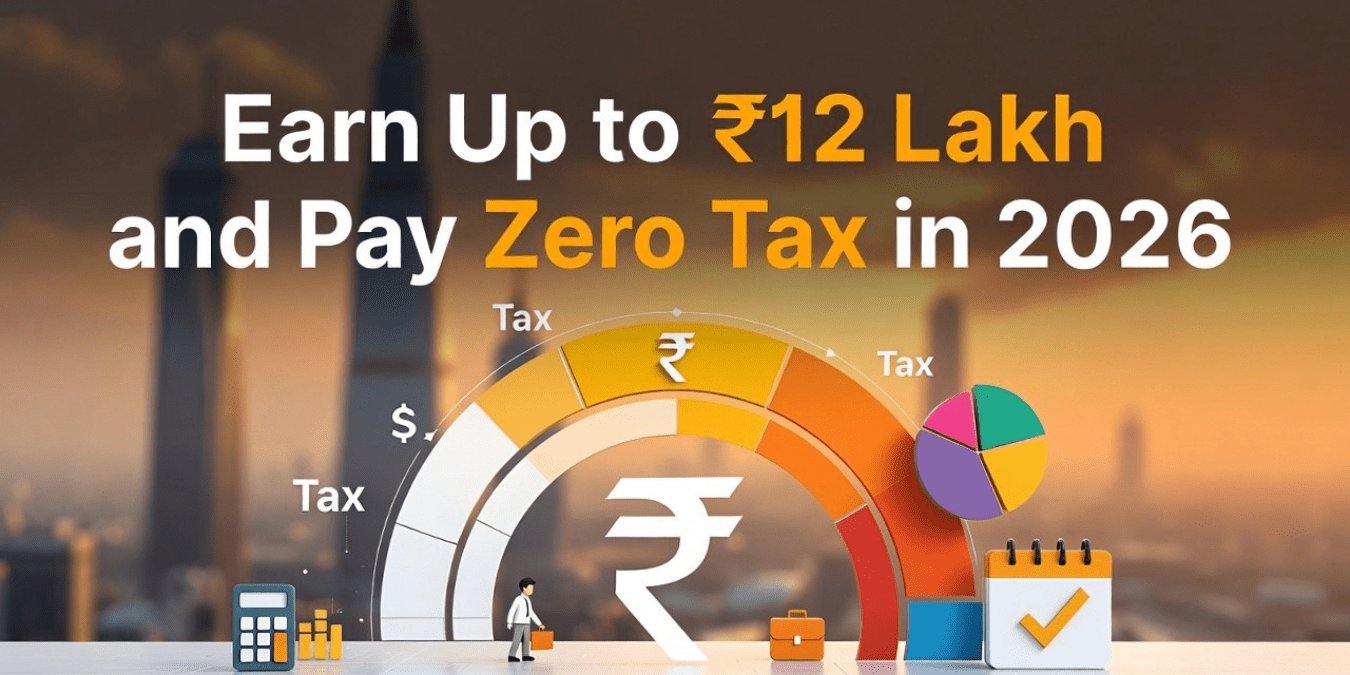
"Earn Up to ₹12 Lakh and Pay Zero Tax in 2026 — The Complete Breakdown Nobody Is Explaining Clearly"
Every year, millions of salaried Indians nervously wait for Form 16, dread the tax filing season, and quietly wonder if there is a legal, clean way to reduce or eliminate their tax burden entirely. In 2026, the answer — for a surprisingly large number of people — is a clear yes. You can earn up to ₹12 lakh and owe the Indian government exactly zero rupees in income tax. Not through loopholes. Not through jugaad. Through the official tax framework introduced by Finance Minister Nirmala Sitharaman, backed by a government press release, and confirmed by the Income Tax Department itself.
But here is where the confusion begins. Most people have only heard the headline. Very few have been walked through exactly how this works, who qualifies, what happens if you earn slightly more than ₹12 lakh, and how with the right salary structure, even a CTC of ₹14.65 lakh can result in zero tax outgo. This post is that complete breakdown.
Why This Matters More Than Ever in 2026
India’s personal income tax structure went through a landmark overhaul with the Union Budget 2025-26, and its effects are fully active in Financial Year 2025-26 (Assessment Year 2026-27). The government made the new tax regime even more taxpayer-friendly by enhancing the rebate under Section 87A and restructuring the tax slabs so that more income falls under lower-rate brackets. This is not a minor tweak. For anyone earning between ₹8 lakh and ₹14 lakh, this is a fundamental shift in how much of your income you actually keep.
The reason this story is still confusing people in mid-2026 is simple: most financial content either oversimplifies the headline (₹12 lakh = zero tax, end of story) or goes so deep into legal jargon that the average salaried professional gives up before finishing the article. What you need is a step-by-step explanation anchored in actual numbers. That is exactly what follows.
The New Tax Regime Slabs for FY 2025-26
Before anything else, you need to understand the updated tax slabs under the new regime, because this is the foundation everything else rests on:
- Up to ₹4 lakh: Nil
- ₹4 lakh to ₹8 lakh: 5%
- ₹8 lakh to ₹12 lakh: 10%
- ₹12 lakh to ₹16 lakh: 15%
- ₹16 lakh to ₹20 lakh: 20%
- ₹20 lakh to ₹24 lakh: 25%
- Above ₹24 lakh: 30%
If you simply apply these slabs to a ₹12 lakh income, the tax would be calculated as: 5% on ₹4 lakh (₹20,000) plus 10% on ₹4 lakh (₹40,000), totalling ₹60,000 before cess. So how does that become zero? That is where Section 87A comes in.
Section 87A: The Rebate That Changes Everything
Section 87A of the Income Tax Act provides a direct rebate — not a deduction, not an exemption, but a rupee-for-rupee reduction in your actual tax liability. For FY 2025-26 under the new regime, the rebate under Section 87A is ₹60,000 for taxable incomes up to ₹12 lakh. Since the calculated tax on ₹12 lakh is exactly ₹60,000, the rebate wipes it out entirely, leaving your tax liability at zero. No income tax payable. Not a single rupee.
This is the mechanism the government officially announced. As the PIB (Press Information Bureau) release confirmed, “There will be no income tax payable up to income of ₹12 lakh under the new regime”. The key qualifier here is taxable income, not gross income. This distinction is crucial and is the gateway to understanding how people with higher gross incomes also end up paying zero.
Salaried? Your Zero-Tax Limit Is Actually ₹12.75 Lakh
If you are a salaried individual — working for a company that pays you a monthly salary and deducts TDS — you get an additional advantage: the standard deduction. For FY 2025-26, the standard deduction under the new regime is ₹75,000, available to all salaried employees and pensioners without needing to show any bills, receipts, or proof.
Here is how this works in practice: if your gross salary is ₹12.75 lakh, subtract the ₹75,000 standard deduction, and your taxable income becomes exactly ₹12 lakh. Apply Section 87A, and your tax is zero. This means that as a salaried person, you do not even need to earn exactly ₹12 lakh — you can earn ₹12.75 lakh and still owe nothing to the taxman. The government itself acknowledged this in the Budget announcement, specifying the salaried exemption limit as ₹12.75 lakh precisely for this reason.
The Hidden Advantage: Employer Perquisites and the ₹15,000 Gift Rule
Here is a detail almost nobody is talking about. Starting from FY 2026-27, employers can provide up to ₹15,000 per year in tax-free gift vouchers or festival allowances to employees. This amount is excluded from taxable income entirely. So if your gross CTC is ₹12.90 lakh and your employer provides ₹15,000 in festival gifts, your effective salary stands at ₹12.75 lakh in taxable terms — and after the standard deduction, your taxable income drops to ₹12 lakh, making your tax zero. What looked like a ₹12.90 lakh salary becomes completely tax-free through a simple and entirely legal employer benefit structure.
How a ₹14.65 Lakh CTC Can Also Mean Zero Tax
This is the part that blows most people’s minds — and the part that too few content creators are explaining clearly. Business Today and Upstox both confirmed that with smart salary structuring, even a CTC of ₹14.65 lakh to ₹14.80 lakh can result in zero tax outgo. The key is not claiming extra deductions (remember, the new regime eliminates most deductions) — it is in how your salary components are designed before you even receive the money.
Here is a realistic breakdown of how this works:
- Annual CTC: ₹14,65,000
- Employer’s NPS contribution (Section 80CCD(2)): Employer contributions up to 14% of basic salary to the National Pension System are exempt from tax even under the new regime
- EPF contribution by employer: Employer’s Provident Fund contribution up to 12% of basic + DA is tax-free
- Standard deduction: ₹75,000
- Festival/Gift vouchers: ₹15,000
When these legitimate components are structured optimally, your taxable income can be brought below ₹12 lakh even on a CTC that appears well above that threshold. The mechanics involve your HR department or payroll team structuring the cost-to-company so that a meaningful portion of the total is routed through exempt components rather than direct salary. This is entirely legal, actively encouraged by the government through these very provisions, and commonly practiced by salaried professionals at large companies.
What Counts as “Income” Here — And What Does Not
A common source of confusion is that the ₹12 lakh zero-tax benefit applies to regular income, not all types of income. Capital gains — whether from equity, mutual funds, or property — are taxed at special rates and are not covered by the Section 87A rebate under the new regime. This is a critical point: if you earn ₹10 lakh in salary and ₹2 lakh in short-term capital gains from stocks, your total is ₹12 lakh, but you will still pay tax on the capital gains portion at the applicable rate.
Similarly, interest income from fixed deposits is counted as normal income and does get factored into your taxable income, but dividend income, agricultural income (up to limits), and PPF maturity proceeds have their own treatment. The zero-tax benefit is clean and broad for salaried income, rent income, and professional income up to ₹12 lakh taxable — but investors and those with diverse income streams need to look at each component separately.
New Regime vs. Old Regime: Which One Actually Works for You?
With all the excitement around the new regime, it is worth being honest about who might still benefit from the old tax regime. The old regime preserves deductions like Section 80C (up to ₹1.5 lakh for ELSS, PPF, life insurance premiums), Section 80D (health insurance), HRA exemption, home loan interest deduction under Section 24(b), and more. If you have a home loan, significant LIC/ELSS investments, pay high rent in a metro city, and max out every deduction, the old regime can still reduce your tax to zero or near-zero even at higher income levels.
However, the new regime wins on simplicity for most people who do not make active tax-saving investments. No paperwork, no receipts, no proofs — just file and go. For FY 2025-26, the new regime is the default regime, meaning you have to explicitly opt out if you want to use the old one. For the vast majority of young professionals, first-time earners, and those whose income primarily comes from salary without heavy investment deductions, the new regime is both simpler and more beneficial.
The Marginal Relief Trap: Why Earning ₹12.1 Lakh Can Feel Worse Than ₹12 Lakh
Here is a rarely discussed anomaly that directly affects people who earn just slightly above ₹12 lakh. Because the Section 87A rebate is only available to those with taxable income up to ₹12 lakh, crossing that threshold by even ₹10,000 means you lose the entire ₹60,000 rebate. That is a brutal tax jump for a small income increase. Someone earning ₹12.10 lakh taxable income would pay approximately ₹61,500 in tax (including cess), while someone at exactly ₹12 lakh pays zero.
This is called the marginal relief problem, and the Income Tax Act does provide a partial buffer: if the tax you owe exceeds the excess income above ₹12 lakh, marginal relief caps your tax to that excess amount. For instance, if your taxable income is ₹12,05,000, the tax cannot exceed ₹5,000 (the amount by which you crossed ₹12 lakh). This is a protective mechanism but it means anyone sitting between ₹12 lakh and approximately ₹12.7 lakh in taxable income is in a sensitive zone where salary restructuring — even minor adjustments — can save substantial amounts.
Practical Steps to Reach Zero Tax Legally
If you are earning between ₹12 lakh and ₹15 lakh CTC and want to legally reach zero tax, here is what you can realistically do:
- Ask HR to restructure salary: Request that employer NPS contributions (Section 80CCD(2)) be included in your CTC. This can reduce taxable income by ₹1–2 lakh depending on your basic pay
- Claim the standard deduction: This is automatic for salaried individuals — ensure your employer applies it in Form 16
- Use the festival/gift allowance: Check if your employer offers the ₹15,000 annual gift voucher benefit, now enhanced from FY 2026-27
- Maximize EPF structuring: Employer’s EPF contribution is not counted in taxable salary — a higher basic ensures a larger EPF contribution
- Avoid surrendering HRA needlessly: If you are in the old regime, ensure HRA exemption is properly calculated and claimed with rent receipts
- File ITR even with zero tax: A common mistake is assuming zero tax means no ITR filing requirement. If your gross income exceeds the basic exemption limit, filing is mandatory
A Note on Professional and Freelance Income
Self-employed professionals and freelancers earning up to ₹12 lakh in net income (after business expenses) can also benefit from the new regime and its zero-tax provision, but the picture is more nuanced. There is no standard deduction of ₹75,000 for them — that benefit is exclusive to salaried individuals and pensioners. However, after legitimate business expense deductions (office rent, equipment, travel, software subscriptions), if their net taxable income falls at or below ₹12 lakh, the Section 87A rebate applies and their tax is zero. Freelancers should maintain proper books, use presumptive taxation schemes if eligible (44ADA for professionals allows 50% of gross receipts as presumed profit), and file accurate ITRs to stay clean with the tax department.
Why Most People Still Get This Wrong
The financial literacy gap around this topic is significant, and it stems from a few key misunderstandings. First, people confuse gross income with taxable income — the zero-tax benefit applies to the latter after all eligible deductions and exemptions. Second, people assume the new regime is always better or always worse, without running the actual numbers for their specific situation. Third, many salaried professionals do not know that their HR team can legally restructure salary components to reduce taxable income — this is not tax evasion, it is tax planning, and it is exactly what the government intended when it built these provisions into the law.
The bottom line is this: if you are a salaried professional earning up to ₹12.75 lakh gross, you already qualify for zero tax without doing a single thing beyond choosing the new regime. If you earn between ₹12.75 lakh and ₹15 lakh CTC, you likely can get to zero tax with some salary restructuring and by optimizing employer contributions to NPS and EPF. And if you earn above ₹15 lakh, you are not eligible for zero tax, but the new lower slab rates — especially at 15% and 20% — still make your overall tax outgo meaningfully smaller than it was before the Budget reforms. Understanding these layers is what separates someone who pays the right amount of tax from someone who pays more than they legally need to.
Disclaimer: This article is for educational and informational purposes only and does not constitute professional tax advice. Tax laws are subject to change. Please consult a qualified Chartered Accountant or tax advisor for advice specific to your financial situation.