Auto-Settlement Limit Raised to ₹5 Lakh and Claims Processed in 3 Days — EPFO's Fastest Reforms Yet
If you have ever filed a claim with the Employees’ Provident Fund Organisation and watched the days stretch into weeks before seeing a single rupee in your account, you already know how frustrating the system could be. India’s largest social security body, managing the retirement savings of over 70 million active subscribers, has historically been synonymous with paperwork delays, rejected claims, and a grievance backlog that seemed permanent. That narrative is now changing — faster than most policy watchers expected.
EPFO has officially raised the auto-settlement limit for PF claims to ₹5 lakh, up from the earlier threshold of ₹1 lakh, and has simultaneously compressed its claim-processing window to just three working days for eligible cases. These are not cosmetic tweaks. They represent a structural overhaul of how India’s workforce accesses its own hard-earned savings during moments of genuine financial need.
What Is the Auto-Settlement System?
To understand why this change matters, it helps to know how EPFO’s claim pipeline worked before these reforms. When a subscriber submitted a withdrawal or advance request, the claim passed through a multi-layered verification process involving employer attestation, field-office scrutiny, and manual data matching. Even digitally submitted claims sat in queues. The auto-settlement system, introduced incrementally over the past few years, was designed to bypass this queue for low-risk, data-verified claims — essentially letting the system approve and disburse funds without human intervention, provided the subscriber’s KYC details (Aadhaar, PAN, bank account) were seeded and verified correctly.
The original auto-settlement limit was set conservatively, allowing only smaller claims to pass through automatically. This was understandable from a risk management perspective — EPFO was cautious about scaling automation before its back-end data quality improved. But as Aadhaar-seeding compliance climbed above 95% among active members and the centralized IT infrastructure matured, that caution became a bottleneck rather than a safeguard.
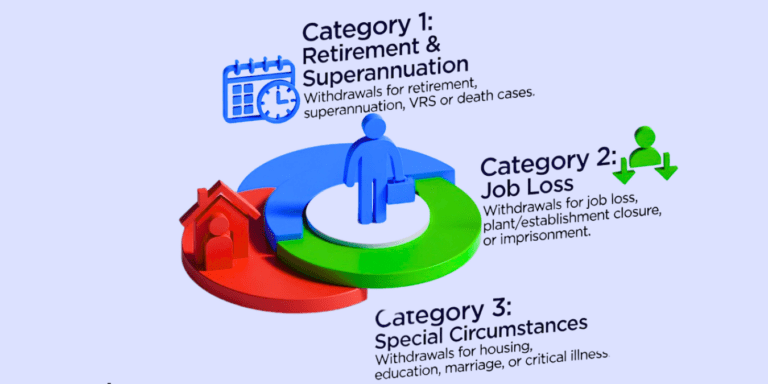
Raising the ceiling to ₹5 lakh changes the calculus entirely. It means the vast majority of partial withdrawal requests — whether for medical emergencies, home loan repayment, higher education, or pre-retirement needs — now fall within the automated corridor. A subscriber with clean KYC records no longer needs to wait for an officer to open a file, verify documents, and push an approval. The system does it, typically within 72 hours.
The Scale of Impact: Who Benefits Most?
The beneficiary profile here is worth examining carefully, because this reform is not just about urban white-collar workers. India’s EPF ecosystem spans organised-sector workers across textiles, construction ancillaries, retail, logistics, and manufacturing — many earning between ₹15,000 and ₹35,000 per month. For these subscribers, a ₹2–4 lakh withdrawal during a medical crisis or job transition is not a luxury; it is a lifeline.
Under the old system, a garment factory worker in Tiruppur or a logistics employee in Bhiwandi filing a claim for ₹2.5 lakh to manage a family health emergency would face an anxious wait of two to four weeks — sometimes longer if there were data mismatches. Banks don’t pause EMIs. Hospitals don’t hold treatment. The mismatch between bureaucratic timelines and real-life urgency was a long-standing indignity embedded in the system.
With auto-settlement now covering amounts up to ₹5 lakh and three-day disbursement becoming the benchmark, EPFO estimates that nearly 70–75% of all advance claims can now be processed without manual intervention. That translates to millions of faster disbursements annually, with compounding benefits for subscriber trust in the formal social security architecture.
Why Three Days Is a Policy Milestone
Three working days may sound modest in an era of instant UPI payments and real-time banking. But in the context of a government welfare body processing nearly 3–4 crore claims annually across a nationwide network, it is an operationally ambitious target. Consider what has to happen within those 72 hours: the claim must be received through the EPFO unified portal or UMANG app, KYC data must be verified against the Aadhaar database and NSDL records, the claim amount must be validated against the member’s passbook balance, the correct claim category must be confirmed (medical, housing, education, etc.), and the disbursement must be routed to the bank account on record. Previously, each of these steps had human touchpoints. The three-day processing commitment effectively signals that EPFO’s IT systems and data hygiene have matured to the point where end-to-end automation is reliable at scale.
This is not just an administrative achievement — it is a trust-building signal. When government systems deliver on a stated timeline consistently, subscriber behaviour changes. People stop hoarding PF money out of fear that they won’t be able to access it when needed. They are more willing to remain in the formal employment ecosystem. Portability anxiety — a real phenomenon among workers who delay job changes fearing PF transfer complications — diminishes.
The Technology Backbone Making This Possible
EPFO’s digital transformation did not happen overnight, and the current reforms are built on a foundation of incremental infrastructure investments. The centralised server migration completed over the past two years moved EPFO away from fragmented regional databases toward a unified member data repository. This was the single biggest technical prerequisite for scaling automation.
The integration of EPFO’s claim portal with Aadhaar’s e-KYC API means identity verification now happens in milliseconds rather than days. Bank account validation through the Penny Drop mechanism — where a small test credit is sent and acknowledged before a full disbursement — has been streamlined. The EPFO’s own AI-assisted anomaly detection layer flags suspicious claims for manual review while letting clean claims sail through, which means fraud prevention and speed are no longer in tension.
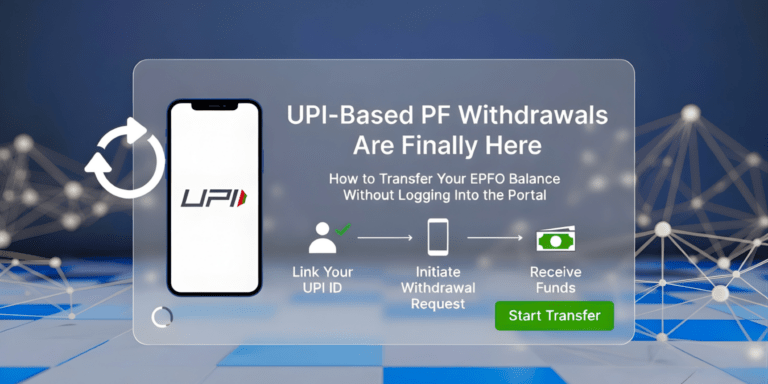
The UMANG app, which consolidates access to multiple government services, has become a meaningful access point for EPFO claims. Mobile-first claim submission matters enormously for subscribers who don’t have employer HR departments guiding them through the process. The combination of app-based submission, automated verification, and faster disbursement creates a genuinely end-to-end digital experience that was previously theoretical.
Employer Compliance: The Remaining Pressure Point
Here is where experience and ground-level observation matter. The auto-settlement reforms work beautifully when a subscriber’s data is complete and accurate — but the system still has blind spots rooted in employer-side compliance failures. A significant portion of EPFO’s troubled claims come from cases where employers have not deposited contributions on time, or where employee data at the time of joining was incorrectly entered.
When a subscriber’s date of birth in EPFO records doesn’t match their Aadhaar, or when their name appears slightly differently across databases, automated systems reject rather than approve — throwing the claim into a manual exception queue that can take considerably longer than three days. EPFO has been pushing employers to clean up historical data mismatches, but this is a slow, ongoing process.
The ministry has been signalling that employer non-compliance penalties will be tightened, and that a dedicated data-correction fast track will be available for subscribers with legacy discrepancies. These are necessary complements to the auto-settlement upgrade. A three-day promise is only meaningful if exceptions are handled gracefully and swiftly, not left to languish.
Comparing With Global Pension Accessibility Standards
India’s direction here aligns with international best practices, though the scale of the challenge is unique. The UK’s National Employment Savings Trust (NEST) and Australia’s Superannuation system both prioritise digital-first claim submissions with defined processing windows. South Korea’s National Pension Service has invested heavily in AI-driven claim triage. What makes EPFO’s reform effort particularly noteworthy is the demographic breadth — serving subscribers across linguistic regions, literacy levels, and income bands, many of whom are first-generation formal-sector workers with limited prior engagement with digital financial systems.
The ₹5 lakh auto-settlement limit is also meaningfully calibrated to Indian economic realities. At current wage levels in the organised sector, it covers a large share of genuine need-based withdrawals without opening the door to speculative or premature full-fund liquidations. This balance — accessibility without encouraging depletion of retirement savings — reflects a degree of policy sophistication that deserves acknowledgment.
What This Means for the EPFO Grievance Backlog
EPFO’s grievance portal, EPFiGMS, has historically received hundreds of thousands of complaints annually, with delayed claims and rejected claims forming the bulk of cases. The auto-settlement expansion and the three-day processing standard are expected to have a direct, measurable impact on this backlog. When claims are settled faster and with less friction, the volume of grievances filed drops structurally.
This matters beyond optics. Every grievance filed and resolved consumes staff time, legal bandwidth, and political capital. A leaner grievance pipeline frees EPFO’s field offices to focus on genuinely complex cases — disputes over employer contributions, beneficiary settlement after a member’s death, cases involving multiple establishments — rather than being buried under routine delay complaints. The reform therefore has a multiplier effect: it improves the subscriber experience at the front end while improving EPFO’s operational capacity at the back end.
Pension Disbursement: The Next Frontier
It would be incomplete to discuss EPFO’s reform momentum without noting that the auto-settlement and three-day processing upgrades currently apply primarily to provident fund withdrawals and partial advances. The Employees’ Pension Scheme (EPS) disbursement pipeline — which serves retiring workers and dependent families — operates under a different, more complex framework.
Pension claims often involve actuarial calculations, nominee verification, and eligibility determination that are harder to automate than straightforward fund withdrawals. EPFO has not yet extended the same three-day promise to pension claim settlement, and that gap is significant for workers approaching retirement who need certainty about their monthly pension timelines.
However, the infrastructure and data-quality improvements driving the PF reforms are foundational for EPS improvements as well. The expectation within the policy community is that pension claim processing will be the next major reform target, likely with a phased automation rollout similar to what PF has undergone over the past three years.
Practical Steps for Subscribers to Benefit Right Now
Knowing the reforms exist is only half the equation — subscribers need to be positioned to take advantage of them. Several practical steps ensure your claim enters the auto-settlement corridor rather than the manual exception queue.
- Verify that your Aadhaar number is seeded and verified in your EPFO UAN (Universal Account Number) profile; unverified Aadhaar is the single most common reason claims fall out of auto-processing
- Confirm your bank account details on the EPFO portal match exactly what your bank holds on record — even minor discrepancies cause rejections
- Check that your PAN is linked to your UAN, particularly if you are withdrawing more than ₹50,000 before completing five years of service
- Use the EPFO member portal or UMANG app rather than submitting physical claim forms, as digital submissions enter the automated pipeline directly
- If you have changed employers, ensure your previous EPF account has been transferred to your current UAN before filing a withdrawal claim, since unsettled transfers create verification loops
These steps take less than 30 minutes for most subscribers with a smartphone and internet access, and they determine whether you receive your money in 3 days or 3 weeks.
The Broader Policy Signal
Reading these reforms in isolation would be a mistake. EPFO’s acceleration is part of a wider government push to make social security infrastructure responsive, not just comprehensive. For decades, India’s formal welfare architecture was praised for its reach and criticised for its delivery. Schemes existed on paper, entitlements were legally guaranteed, but actually accessing benefits required navigating a system designed for an era of paper ledgers and physical verification.
The shift to automated, fast-track settlement signals a maturity in how policymakers are thinking about social security delivery. It acknowledges that the value of a benefit is not just its monetary amount but the speed and dignity with which it reaches the person who needs it. A ₹3 lakh claim settled in 3 days has a materially different real-world value than the same amount settled in 30 days — for a family managing a medical emergency, that difference can be the difference between treatment received and treatment deferred.
For India’s workforce, which is navigating an increasingly dynamic labour market with more frequent job changes, gig transitions, and upskilling breaks, a responsive EPFO is not a luxury. It is structural infrastructure for economic resilience. The auto-settlement expansion and the three-day processing commitment are, in that sense, among the most economically significant administrative reforms of the current year — even if they don’t generate the headline attention of larger legislative announcements.
EPFO has been cautious in the past, sometimes excessively so. But the current reform trajectory suggests an organisation that has genuinely absorbed the lessons of subscriber frustration and is engineering its systems around the worker’s experience rather than the institution’s convenience. That is a meaningful shift — and if the three-day processing standard is maintained consistently across peak claim periods, it will stand as one of the most tangible improvements in India’s organised-sector worker welfare in recent memory.
This article reflects the author’s analysis of EPFO policy developments as of April 2026. Subscribers are advised to verify current claim procedures directly on the official EPFO member portal at epfindia.gov.in or through the UMANG app.