Your LPG Cylinder, EMI, and FD Returns Are All at Risk — Here Is What the Iran War Is Doing to Every Indian's Monthly Budget in 2026
Your LPG Cylinder, EMI, and FD Returns Are All at Risk — Here Is What the Iran War Is Doing to Every Indian’s Monthly Budget in 2026
The Strait of Hormuz has been choked. Brent crude crossed $106 a barrel. The rupee tumbled past ₹93. And 1.4 billion Indians are now absorbing the cost in their kitchens, loan statements, and savings accounts.
War’s Damage to Your Wallet — At a Glance
When missiles began falling on March 1, 2026, the conflict felt distant. Another geopolitical storm, another headline to scroll past. But within 48 hours, every Indian household received the bill — quietly, through a ₹60 increase in the domestic LPG cylinder price, through petrol queues forming in smaller cities, through a rupee that had never been this fragile before.
This is not abstract geopolitics. This is the Iran war landing directly in your monthly budget. And the damage is only beginning.
The Strait That Controls Your Kitchen
The Strait of Hormuz — a narrow, 33-kilometre-wide waterway between Iran and Oman — is arguably the single most important chokepoint for the Indian economy. Approximately 20% of global oil and LNG trade passes through it every single day. For India, the numbers are even more staggering.
India imports approximately 60% of its LPG needs and nearly 90% of its crude oil. Qatar alone supplies about 34% of India’s LPG imports, UAE about 26%, and Kuwait around 8%. Almost all of it travels through the Strait of Hormuz — which has now been functionally impaired for commercial shipping since March 1.
“Every $1 increase in crude oil prices adds approximately $1 billion to India’s annual import bill. A $10 increase raises the country’s annual import costs by $17–18 billion.”
— Economist estimates cited in energy market analyses, March 2026Your LPG Cylinder: The First Casualty
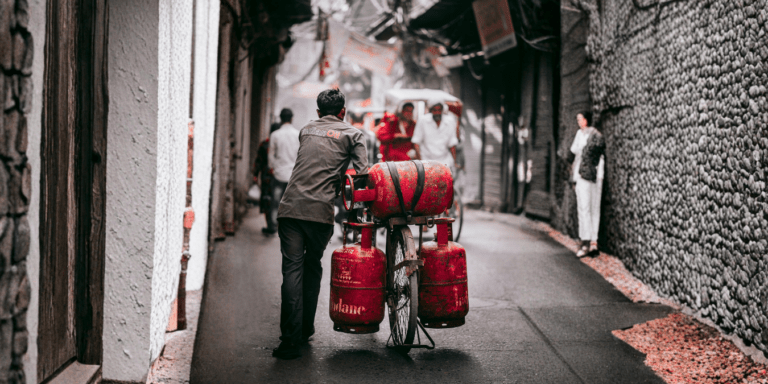
For most Indian families, the LPG cylinder is where the war became real. On March 7, oil marketing companies raised the price of a 14.2 kg domestic cylinder by ₹60, pushing the cost in Delhi to ₹913. In smaller cities and semi-urban areas, the effective price — including dealer commissions and local taxes — is often higher.
Domestic Cylinder (14.2 kg)
Delhi price. +₹60 as of March 7, 2026.
Commercial Cylinder (19 kg)
Delhi price. +₹115 as of March 7, 2026.
Govt Subsidy Bill @ $100/bbl
Rises to ₹3 lakh crore at $150/barrel crude.
The situation for restaurants and commercial establishments is existential. The National Restaurant Association of India has warned that 75% of the food service industry runs on LPG, and that a prolonged shortage could cost the economy between ₹1,200 and ₹1,300 crore per day. In Bengaluru, hotel associations reported that only 10% of establishments received their gas supplies on March 10. In Mumbai, commercial refill delays ranged from two to eight days.
According to Elara Capital, retail petrol and diesel price hikes become unavoidable once crude crosses $110 per barrel. Currently at $106, India is perilously close to this threshold. Every Indian vehicle owner — car, bike, auto, truck — would then absorb another round of fuel cost increases on top of the LPG shock.
Your Home Loan EMI: Under a Slow-Burning Threat
The connection between an Iranian drone attack and your monthly EMI is less obvious — but no less real. Here is the chain of causation that every borrower must understand right now.
When crude prices spike, India’s import bill balloons. The rupee weakens because India needs more dollars to buy the same oil. Foreign investors, nervous about inflation and currency instability, pull money out of Indian markets. The Reserve Bank of India faces a dilemma: cut rates to support growth, or hold (or even hike) to defend the rupee and control inflation.
| Scenario | Crude Price | RBI Action Risk | EMI Impact (₹50L, 20yr) |
|---|---|---|---|
| Pre-war baseline | ~$72/bbl | Rate cuts expected | Decreasing |
| Current (March 2026) | ~$106/bbl | Hold likely; cuts paused | Stable / At Risk |
| Sustained war ($130+) | $130–150/bbl | Hike pressure builds | Rising sharply |
Before the war, most economists expected the RBI to continue its rate-cutting cycle into 2026. The central bank had already reduced the repo rate four times, bringing it to 5.25% by December 2025. Those cuts were translating into lower EMIs for floating-rate home loan borrowers. The Iran war has now thrown this trajectory into serious doubt.
Inflationary pressure from high crude prices could force the RBI to pause — or reverse — its rate-cutting cycle. For borrowers with repo-linked floating-rate home loans, this means the EMI relief they were expecting may not arrive. Worse, if inflation accelerates and the RBI is forced to raise rates, EMIs could increase on a loan of ₹50 lakh over 20 years by ₹1,500 to ₹3,000 per month — a significant hit for a middle-class family already absorbing higher grocery and fuel costs.
If your loan is floating-rate (repo-linked), your EMI was on a downward path. That trajectory is now uncertain. Consider locking in a fixed rate if your lender offers a competitive option — especially if you believe the war will last more than three months. Consult your bank before making any switch; conversion fees apply.
Your Fixed Deposits: A Shrinking Safe Harbour
Here is the cruel irony for India’s millions of FD investors: the war creates a scenario where your FD returns could fall even as your cost of living soars.
Before the Iran conflict, with the RBI on a rate-cutting path, FD rates across major banks were beginning to edge lower. Analysts at Motilal Oswal had noted that FD rates had likely peaked, and that investors should consider locking in longer-term FDs at current rates before further cuts arrived later in 2026.
The war now creates a two-sided risk for FD holders. In the short term, inflation fears may keep rates from falling — offering a temporary reprieve. But a prolonged conflict combined with slower economic growth (lower corporate earnings, reduced tax revenues, fiscal strain) could eventually force the RBI to cut rates anyway to support the economy. When that happens, bank FD rates will follow — and your renewal will offer lower returns than your current FD.
| FD Tenure | Typical Rate (Early 2026) | War Impact | Risk Level |
|---|---|---|---|
| 1 year | 6.5–7.0% | Short-term stable, watch RBI | Moderate |
| 3 years | 7.0–7.5% | Renewal risk if rates fall | Moderate |
| 5 years | 7.0–7.5% | Best hedge if locked now | Lower Risk |
| Tax-saver FD (5yr) | 7.0–7.5% | Consider locking before rate cut | Lower Risk |
The strategic move for FD investors in the current environment: lock in a 3–5 year FD at current rates now, before the RBI resumes its cutting cycle — whether that is in H2 2026 or early 2027. Once rates fall, renewal at the same rate will not be possible.
The Rupee Shock: How It Hits Everything Else
The rupee’s historic fall past ₹93 to the US dollar is not just a macroeconomic headline. It is a tax on every Indian who imports anything — which, increasingly, means almost everyone.
A weak rupee makes imported goods more expensive in rupee terms. This includes electronics (smartphones, laptops, televisions), vehicle components, pharmaceutical raw materials, and edible oils. As per industry estimates, the disruption in global shipping has already pushed the cost of Active Pharmaceutical Ingredients — sourced primarily from China — up by approximately 30% in a two-week period. Medicine prices are at risk of following.
Families planning to buy electronics, appliances, or imported goods will pay more. Those with foreign education loans or children studying abroad face dramatically higher costs. Travel abroad — including medical tourism — becomes significantly more expensive. Even everyday goods like edible oil and pulses sourced from international markets see price pressure.
Petrol, Diesel, and the Domino That Has Not Fallen Yet
As of this writing, petrol and diesel prices have not yet been raised at the pump. The government is absorbing the oil marketing company losses — but this strategy has a breaking point. According to Elara Capital, OMC earnings could drop by 90–190% in the absence of a retail price hike at current crude levels.
At $100 per barrel crude, the government’s LPG subsidy bill alone is projected at ₹1.4 lakh crore. At $150 per barrel, that figure rises to ₹3 lakh crore. Some analysts warn that Brent could reach $130–150 per barrel if the strait remains closed for months — a scenario that Capital Economics considers plausible in a prolonged war.
The moment retail fuel prices are revised upward, inflation in transportation, agriculture, and manufacturing will cascade immediately into food prices, logistics costs, and ultimately into the grocery bills and service prices that ordinary Indians pay every day.
What You Should Do Right Now — A Practical Checklist
- Lock your FDs for 3–5 years today FD rates may appear stable now, but the RBI’s longer-term trajectory is still downward. A 5-year FD locked at 7.25–7.5% today could look very attractive in 18 months if rates fall to 6–6.5%. Act before the next MPC meeting.
- Review your home loan type If you are on a floating rate, your EMI is exposed to any upward RBI action. Ask your bank about fixed-rate conversion costs. If the conversion fee is under 0.5% and you have 10+ years left on your loan, it may be worth locking in.
- Audit your monthly LPG consumption With booking intervals now extended to 25 days, plan your cylinder bookings carefully. Avoid commercial-grade black market cylinders — they are illegal and dangerous. If you have an induction cooktop, now is a good time to reduce LPG dependency for routine cooking.
- Delay large electronics purchases if possible With the rupee at ₹93+, the rupee cost of imported electronics has risen significantly. Unless the purchase is urgent, waiting for currency stabilization — expected if diplomatic efforts succeed — could save you 8–12% on big-ticket items.
- Build a 3-month household expense buffer War-driven commodity shocks are unpredictable. If crude reaches $130, petrol and diesel hikes are near-certain, and food inflation will follow quickly. A liquid emergency fund — in a savings account or short-term FD — covering 3 months of household expenses is essential right now.
- Diversify into gold or liquid mutual funds Gold has historically been a strong hedge against geopolitical shocks and rupee depreciation. Sovereign Gold Bonds or gold ETFs offer a cleaner route than physical gold. Liquid mutual funds provide better returns than savings accounts while maintaining liquidity.
India’s diplomatic engagement with Iran appears to be bearing limited fruit. The passage of two Indian LPG carriers — Shivalik and Nanda Devi — through the Strait on March 14, carrying 92,700 metric tons of LPG, is a positive signal. PM Modi’s direct call with Iranian President Pezeshkian and EAM Jaishankar’s ongoing discussions with Tehran suggest India is actively protecting its supply lines through diplomacy rather than confrontation.
The Big Picture: How Long Will This Last?
Economists at Capital Economics have outlined two scenarios. If the conflict is short-lived and the strait reopens soon, Brent could fall back sharply to $65 per barrel by year-end — a significant relief for India. But if the war lasts three months or longer, oil prices could average $150 per barrel over the next six months. That is a scenario that would fundamentally alter India’s fiscal math, inflation trajectory, and monetary policy.
For now, India is navigating with a combination of diplomatic outreach, emergency commodity legislation, and the Russian crude pivot. The waiver allowing Indian refiners to buy Russian oil provides a temporary buffer — but Indian refiners are now paying a $2–4 premium over Brent for Russian crude, erasing the deep discounts of 2022. The cushion is thinner than it appears.
What is not in doubt is that every Indian household is now financially connected to a war being fought thousands of kilometres away. Your LPG cylinder is the most visible manifestation of that connection. But it is your EMI trajectory, your FD renewal rate, the price of the medicines in your cabinet, and the cost of the groceries in your bag that will tell the fuller story of this war’s impact — over the months ahead.