Supreme Court Asks WhatsApp and Other Platforms for Plans to Stop Digital Arrest Scams — What Changes for Users and Banks
Cybercrime · Supreme Court · November 2026
Supreme Court Asks WhatsApp and Other Platforms for Plans to Stop Digital Arrest Scams — What Changes for Users and Banks
A bench led by Chief Justice Surya Kant has directed messaging platforms to set out anti-scam measures and told the RBI that banks failing in due diligence should compensate victims at least the amount lost. The case returns on 23 November 2026.
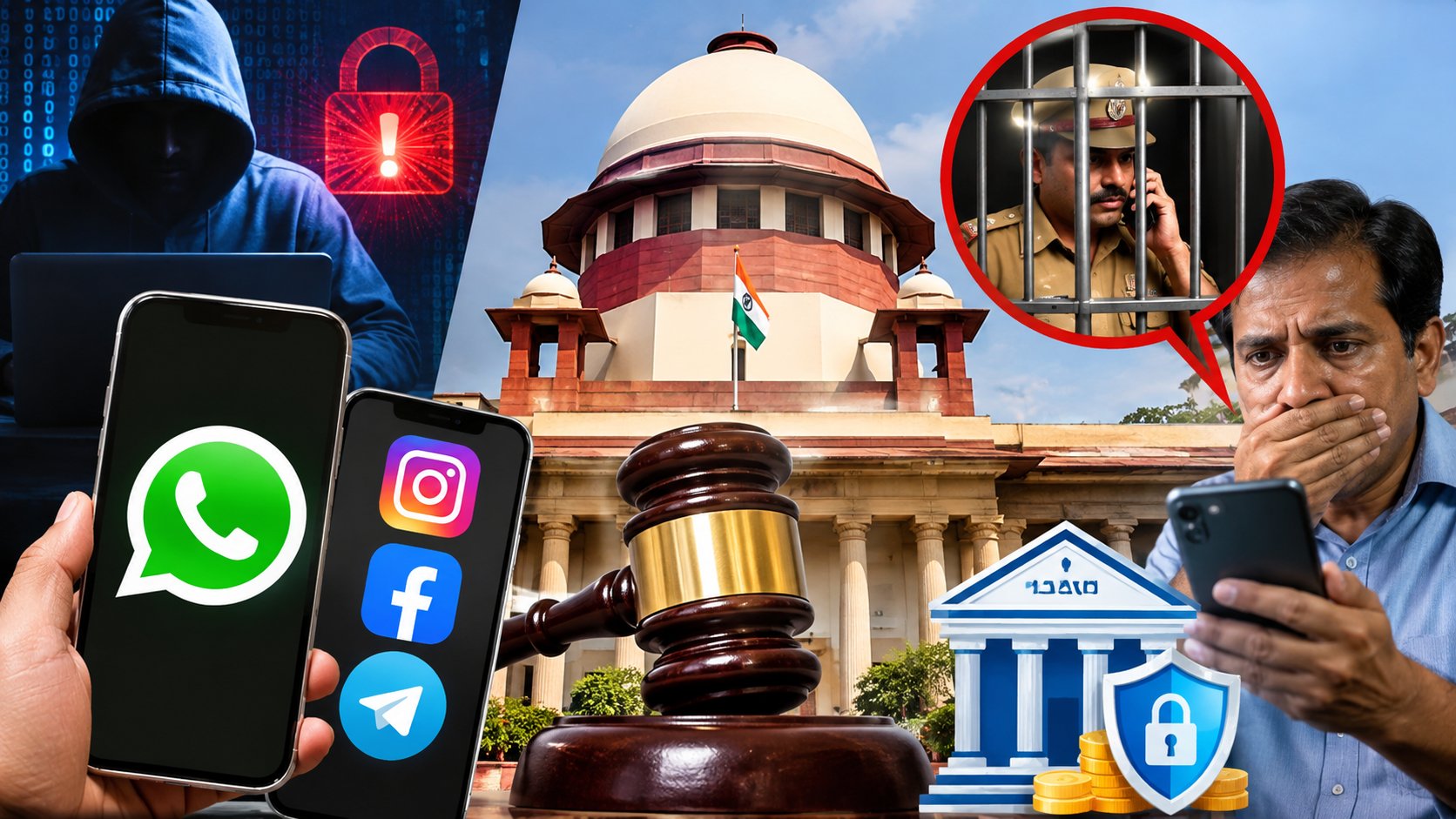
The call comes on WhatsApp. A man in a police uniform, a CBI logo behind him, says your Aadhaar is linked to money laundering. You are told not to hang up, not to tell your family, and to “verify” your savings by moving them to a “safe RBI account”. Hours later the money is gone. This is a digital arrest, and India’s Supreme Court has now done something it had not done before in this case: it has asked WhatsApp and other platforms directly to explain how they will stop it. It has also signalled that banks may have to repay victims when their own checks fail.
What the bench actually asked for
The order was passed by Chief Justice Surya Kant with Justices Joymalya Bagchi and V Mohana in the suo motu case In Re: Victims of Digital Arrest Related to Forged Documents, as reported by The Swipe Up and MediaNama. WhatsApp LLC and other intermediaries must set out “measures they propose to undertake to prevent the digital arrest scams and related cybercrimes”, and “shall also simultaneously submit their proposals to the I4C”.
MediaNama noted that this is the first time the court has sought plans directly from platforms in this matter; earlier directions went through the government. Senior advocate Kapil Sibal, appearing for WhatsApp, told the court the platform had acted against 9,400 accounts, would file an affidavit on steps taken, and was building software to detect suspicious accounts and alert users.
“The biggest financial fraud on the economy of the country.” That is how Chief Justice Surya Kant described digital arrest scams, according to MediaNama. Justice Bagchi added: “We will put up a strict liability on the financial institutions.”
Four sets of directions, four audiences
| Who | What the court asked | Timeline | What it could mean for you |
|---|---|---|---|
| WhatsApp and other platforms | Propose measures against digital arrest scams; file with the court and I4C | Before 23 Nov 2026 hearing | Possible new alerts, account checks and faster takedowns |
| RBI | Frame enforceable rules on compensation, prevention and accountability; list all authorised financial institutions | KYC directions to be notified by 30 Nov, in force by 31 Dec 2026 | Clearer route to refunds when a bank’s checks fail |
| Banks | Hold transactions that do not match account history, alert the nearest police station, verify physically | Through RBI’s framework | A large, unusual transfer may be paused for checks |
| State and UT police | Report digital arrest FIRs and investigation status; suggest prevention steps | Before next hearing; DGPs responsible | Better tracking of your complaint |
| Centre and I4C | Coordinate through the inter-departmental committee; receive platform proposals | Ongoing | One body collating platform, bank and police data |
How big the problem became, and how fast
Ministry of Home Affairs data reported by ThePrint in February 2026 shows digital arrest complaints rising from 39,925 in 2022 to 1,23,672 in 2024, before falling sharply in 2025 after a crackdown.
Number of cases. Source: MHA and I4C data via ThePrint, 18 February 2026.
Money lost followed the same curve, but fell less steeply. Losses rose from ₹91 crore in 2022 to ₹1,918 crore in 2024, a 465% jump in one year, before dropping to ₹644 crore in 2025.
₹ crore lost per year, MHA and I4C data via ThePrint. Average loss per case is our calculation: losses divided by cases.
Reading the numbers: fewer victims, bigger hits. Divide losses by cases and a worrying pattern appears. The average loss per reported case was about ₹22,793 in 2022 and about ₹1.55 lakh in 2024. In 2025, with cases down 86%, it was about ₹3.73 lakh, more than double 2024’s level. Our calculation from MHA data.
One plausible reading: scammers are making fewer attempts but targeting people with larger savings, often senior citizens. The case that triggered the court’s action involved a Haryana senior citizen couple who lost ₹1.5 crore between 3 and 16 September 2025, according to The Week.
- ₹22,495 crAll cyber fraud losses in 2025, MHA data
- ₹3,000 crLost to digital arrests, as cited in earlier hearings
- 19%Share of defrauded money blocked by 2026, up from 6% in 2021
- 3.5 secHow often someone falls victim to cybercrime, per Amit Shah
- 500+Indians repatriated from Southeast Asian scam centres in 2025
- 50%Fall in incidents, as stated by the Attorney General in court
What platforms have done so far, and why the court wants more
According to MediaNama, WhatsApp banned about 9,400 scam-linked accounts over 12 weeks from January 2026, using each government flag as a starting point to find related accounts through logo detection, an AI tool and display-name logs. The government had flagged about 3,800 accounts under Section 79(3)(b) of the IT Act, of which only 17 involved digital arrests. In 2024, authorities blocked more than 59,000 WhatsApp accounts and 1,700 Skype IDs.
Number of accounts or IDs. Sources: MediaNama and The Swipe Up, November 2026. Periods differ; see labels.
The gap is the point. Scammers can open new accounts faster than old ones are banned. The court’s request moves the focus from reacting to individual flags towards preventing abuse in the first place, such as detecting impersonation of police or court logos before a victim is contacted.
Rules already on the way for messaging apps
MediaNama reported that the Department of Telecommunications has directed messaging apps to bind accounts to the SIM used to register them, with the deadline extended to December 2026 and the rules reportedly effective from 1 January 2027. Web versions of messaging apps must also log users out at least every six hours. Both are aimed at stopping scammers from running accounts on numbers or devices they do not physically control.
Banks in the dock: the compensation question
The most consequential part of the order for victims may be the one aimed at banks. The Swipe Up reported that the Chief Justice asked why banks did not step in when customers tried to send unusually large sums that did not match their normal patterns. The court said the RBI’s framework should require compensation “not less than the amount lost by the customer” where an investigation finds a failure of due diligence by the financial institution.
What people get wrong: assuming this means every victim will automatically get money back. The court’s wording ties compensation to a bank’s failure of due diligence, established through investigation. A transfer you authorised under pressure may still be disputed. Reporting quickly, within the “golden hour”, remains the single biggest factor in recovering money.
The RBI’s draft rules on mule accounts, being examined by the court, propose temporary holds of up to 60 days on suspected mule accounts and flagged transactions of ₹1,000 or more, according to MediaNama, with a proposed implementation date of 1 April 2027. The court will review these before issuing its own directions. The RBI must also produce a list of all authorised financial institutions at the next hearing.
- Step 1Unusual transferTransaction does not match your account history.
- Step 2Temporary holdBank pauses it; RBI draft allows holds of up to 60 days on suspect accounts.
- Step 3Police alertNearest police station is notified automatically.
- Step 4Physical checkTransaction verified in person before release.
This sequence reflects safeguards proposed in the court’s order. It is not yet in force; the RBI’s rules will set the final details.
From one couple’s complaint to a national case
- A Haryana senior citizen couple is coerced into transferring ₹1.5 crore using forged court orders.
- Supreme Court takes suo motu cognisance, calling the forgery “a direct assault on the dignity of the institution”.
- Court asks the CBI to lead a nationwide probe of digital arrest scams, including the role of bank staff in mule accounts.
- WhatsApp bans about 9,400 scam-linked accounts over 12 weeks.
- Committee asked to study a shared liability framework; MeitY, DoT and I4C to study call time limits.
- Amicus N S Nappinai and Attorney General R Venkataramani file notes.
- Order directing platforms, RBI, banks and police; uploaded on 7 November.
- Next hearing to review proposals and RBI framework.
- RBI KYC Amendment Directions, 2026 expected to be notified.
- KYC directions expected in force; SIM-binding deadline for messaging apps.
Spot the script: what a digital arrest call sounds like
Scammers follow a predictable script. Recognising it is still the best defence, whatever platforms and banks do next.
| What the caller says | The reality | Red flag level | What to do |
|---|---|---|---|
| “You are under digital arrest” | No such procedure exists in Indian law | Certain scam | Hang up immediately |
| “Stay on video call; tell no one” | Police do not keep suspects on video calls | Certain scam | End the call; tell family |
| “Your Aadhaar or parcel is linked to drugs or laundering” | Standard opening to cause fear | Very high | Verify through official numbers yourself |
| “Transfer money to an RBI or court account for checking” | No agency asks for transfers to verify funds | Certain scam | Do not pay; call 1930 |
| Sends a court order or arrest warrant on WhatsApp | Courts do not serve orders this way; forgeries are common | Very high | Check with a lawyer or local police |
| Uses CBI, ED, customs or police logos on display | Logos are easy to copy | High | Report the account in the app |
If it happens to you: the first 60 minutes
An MHA official told ThePrint: “The only way to block the money is to react fast. There is a golden hour.” The rising share of money blocked, from 6% in 2021 to 19% by 2026, shows that fast reporting works.
- Call the 1930 cyber helpline at once, ideally within 1 hour
- Report online at cybercrime.gov.in with transaction IDs
- Call your bank’s fraud line and ask for a debit freeze
- Note every UTR number, account and time of transfer
- Screenshot the caller’s profile, numbers and messages
- Report the account in WhatsApp or the app used
- File an FIR and keep its number for any bank claim
- Write to the bank within 3 working days to protect your liability position
- Escalate to the RBI Ombudsman if the bank does not respond within 30 days
- Tell family members over 60 about the scam script today
The 3-working-day and 30-day markers reflect the RBI’s existing customer liability and ombudsman rules for unauthorised electronic transactions; how they apply to transfers made under coercion is part of what the court is now examining.
Digital arrest and the court order: common questions
What did the Supreme Court ask WhatsApp to do?
To set out the measures it proposes to prevent digital arrest scams and related cybercrimes, and to submit those proposals to the Indian Cybercrime Coordination Centre (I4C). Other intermediaries were given the same direction.
What is a digital arrest scam?
A fraud in which callers pose as police, CBI, customs or court officials, claim the victim is under investigation, keep them on video calls and pressure them into transferring money. There is no such thing as a digital arrest under Indian law.
Will banks refund money lost to digital arrest scams?
The court said RBI rules should require compensation of at least the amount lost where an investigation finds the bank failed in due diligence. The RBI’s rules are still being framed, so refunds are not automatic yet.
When is the next hearing in the digital arrest case?
23 November 2026, when the court is expected to review platform proposals, the RBI’s framework and police reports.
How many digital arrest cases were there in India?
MHA data shows 39,925 cases in 2022, 60,676 in 2023, 1,23,672 in 2024 and 17,264 in 2025.
Where do I report a digital arrest scam?
Call the national cyber helpline 1930 immediately and file a complaint at cybercrime.gov.in. Then alert your bank and file an FIR.
What is SIM binding for WhatsApp?
A DoT direction requiring messaging accounts to stay linked to the SIM used to register them, with the deadline extended to December 2026 and rules reportedly effective from 1 January 2027.
Can police or CBI arrest someone over a video call?
No. Indian law has no procedure for arrest by video call, and genuine agencies do not ask people to transfer money to verify their accounts.
The short version
The Supreme Court has asked WhatsApp and other platforms to set out how they will stop digital arrest scams, and to file those plans with the I4C. It has told the RBI that banks failing in due diligence should repay victims at least what they lost, and asked every state for FIR data. Cases fell 86% in 2025, but the average loss per case more than doubled. Nothing changes overnight; the court reviews proposals on 23 November. Until then, remember: no agency arrests anyone on a video call, and calling 1930 within the first hour gives you the best chance of recovery.