EPFO's New EPS 95 Pension Scheme 2026: Will the Minimum Pension Finally Rise to ₹7,500 + DA?
For over 78 lakh retired employees across India, the monthly journey to the bank has been one of quiet desperation. They receive ₹1,000 — a figure frozen in time since 2014 — and are expected to survive inflation, medical bills, and the ordinary costs of a life already lived in service. In 2026, that reality is finally being challenged at the highest institutional levels, and the question on every pensioner’s lips is no longer whether the minimum pension under the Employees’ Pension Scheme 1995 (EPS-95) will change, but when — and by how much.
What Is EPS-95 and Why Does It Matter
The Employees’ Pension Scheme 1995 is a social security initiative managed by the Employees’ Provident Fund Organisation (EPFO) under the Ministry of Labour and Employment. It was designed to provide a lifelong monthly pension to workers in the organised private sector after they complete a minimum of 10 years of contributory service and retire at the age of 58. Unlike the Employees’ Provident Fund (EPF), which is a savings corpus that workers can withdraw, EPS-95 is a defined-benefit pension that continues until the pensioner’s death — and thereafter as a family pension. Over 6.5 crore employees are active subscribers under EPFO today, and millions of those already retired depend entirely on this pension as their only structured income.
The funding structure of EPS-95 operates on a tripartite contribution model. The employee does not directly contribute to EPS; instead, the employer contributes 8.33% of the employee’s basic wages (capped at ₹15,000 per month), which goes into the pension fund. The Central Government adds a further 1.16% of wages as a budgetary contribution. The ceiling of ₹15,000, which has not been revised since September 2014, means the maximum employer contribution to the pension fund is capped at ₹1,250 per month — regardless of what the worker actually earns. This structural ceiling is at the heart of why pensioners receive such meagre amounts.
The ₹1,000 Problem: A Number That Defies Dignity
When the minimum pension was set at ₹1,000 per month in 2014, it was already considered modest. Over a decade later, with cumulative inflation having eroded purchasing power substantially, it has become indefensible. Trade unions, pensioner associations, and individual retired workers have been vocal — and increasingly visible — in their protests. The EPS-95 National Agitation Committee, led by Commander Ashok Raut, has consistently spearheaded demonstrations across the country demanding a raise to ₹7,500 per month, along with Dearness Allowance (DA) linkage and free medical care.
In March 2026, pensioners took their protest to Jantar Mantar in New Delhi, conducting a three-day sit-in that drew attention from national media and political commentators. Their core argument was simple and irrefutable: no senior citizen can meet basic food, shelter, and healthcare needs on ₹1,000 in contemporary India. Congress leader Jairam Ramesh publicly criticised the government’s inaction, pointing out that despite multiple committee recommendations, nothing had moved for nearly 12 years under the Modi administration.
Parliamentary Panel Speaks: A Watershed Moment in 2026
The most consequential development in the EPS-95 debate came in March 2026, when the Parliamentary Standing Committee on Labour, Employment, and Skill Development issued a formal recommendation calling for an “urgent and comprehensive review” of the ₹1,000 minimum pension. The committee stated unequivocally that the existing amount is “inadequate to meet even the basic needs of pensioners, particularly in the present economic scenario marked by inflation and rising healthcare and living expenses.”
This is not a routine bureaucratic observation — it is a parliamentary body directing the Ministry of Labour and Employment to act. The committee further recommended that the government explore options to increase budgetary support for the EPS-95 scheme, acknowledging that internal fund dynamics alone cannot bear the load of a meaningful pension hike. The significance of this recommendation lies in its institutional weight: parliamentary committees set the legislative and policy tone, and their directives carry far more force than public agitation alone.
The ₹7,500 + DA Demand: What It Would Mean in Practice
The figure of ₹7,500 per month has not emerged arbitrarily. Trade union federations and pensioner bodies arrived at it after accounting for minimum living standards, current Consumer Price Index (CPI) data, and comparisons with other social security schemes. If implemented, the hike would represent a 650% increase over the current minimum — from ₹1,000 to ₹7,500 — which, while seemingly dramatic, actually aligns with the inflation-adjusted value of the 2014 figure extrapolated to 2026. The additional demand for Dearness Allowance linkage is equally critical: DA ensures that pension values are not eroded by future inflation, making them self-adjusting rather than requiring periodic governmental intervention to maintain relevance.
As things stand in April 2026, the government has not officially approved the ₹7,500 figure. The Ministry of Labour and Employment clarified in Parliament in January 2026 that there is “no immediate proposal” to raise the minimum EPS pension to ₹7,500, citing the need to ensure long-term fund sustainability. However, the parliamentary committee’s March 2026 recommendation has significantly shifted the pressure dynamics, and many labour analysts now believe a partial hike — possibly to ₹3,000 or ₹5,000 — may precede a more comprehensive revision.
EPFO 3.0 and the Salary Ceiling Reform: A Parallel Revolution
While the minimum pension debate dominates headlines, there is a quieter but equally transformative reform underway: the proposed revision of the EPS wage ceiling from ₹15,000 to ₹25,000 per month. This change is central to the broader EPFO 3.0 reform agenda and has been under active consideration by the Ministry of Labour and Employment. If implemented, the employer’s monthly EPS contribution would rise from ₹1,250 to approximately ₹2,083 — a 66% increase that would meaningfully strengthen future pension payouts for current employees.
The Supreme Court of India, in a January 2026 directive, instructed EPFO to revise the wage ceiling within four months, adding judicial pressure to what was already building legislative momentum. EY India’s Puneet Gupta, partner in People Advisory Services, noted that revising the ceiling to ₹25,000 would “expand mandatory PF coverage to all employees earning up to the new limit, resulting in higher monthly inflows into EPF and EPS and strengthening the overall corpus.” It is important to note that this ceiling revision primarily benefits future retirees; for the current pensioners drawing ₹1,000 today, it provides no immediate relief unless accompanied by a retrospective minimum pension hike.
The Fund Sustainability Argument: Government’s Core Concern
Every time the government has been asked about the pension hike, the answer has returned to the same concern: fund sustainability. The EPS-95 corpus is not a fully funded actuarial reserve — it is partially subsidised through budgetary support. A jump from ₹1,000 to ₹7,500 would require either a massive injection of government funds or a structural redesign of how the pension scheme accumulates and disburses money.
The parliamentary committee’s recommendation acknowledged this by explicitly asking the government to “explore options to increase budgetary support” — a tacit recognition that the current architecture cannot support a 650% hike without fiscal backing. This is where DA linkage becomes particularly complex: once a pension is linked to DA, the government’s long-term liability increases with every CPI revision, making fiscal planners understandably cautious. The debate, therefore, is not only moral but deeply actuarial.
EPFO’s Broader 2026 Reforms: Context That Matters
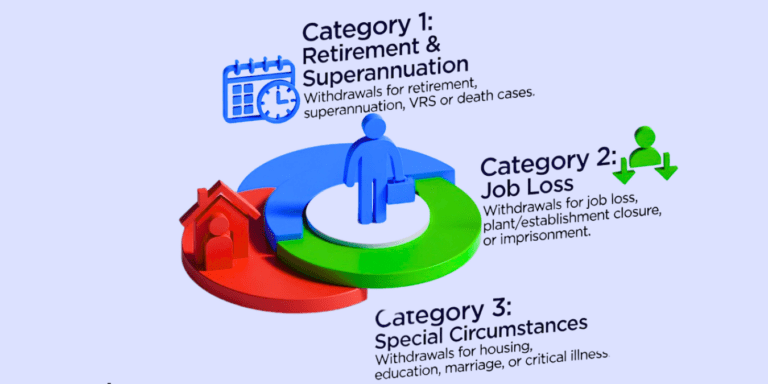
The pension hike discussion is unfolding against a backdrop of the most sweeping EPFO reforms in decades. EPFO has introduced 15 major rule changes under the EPFO 3.0 framework, including the consolidation of withdrawal rules into three simplified categories, a 75% immediate withdrawal option after job loss, and a highly anticipated ATM and UPI-based withdrawal facility that went live in April 2026. The auto-settlement limit has been raised to ₹5 lakh, and the current EPF interest rate stands at 8.25%.
Under the new rules, EPS pension withdrawals now require a minimum waiting period of 36 months instead of the previous two months, a change designed to encourage long-term pension continuity rather than premature withdrawal. Members must also retain at least 25% of their PF balance as a retirement buffer. These digital-first, member-centric reforms signal that EPFO is institutionally committed to modernising its framework — but they do not automatically translate into higher pension payouts for existing EPS-95 beneficiaries who retired before these changes took effect.
Who Are the Real Pensioners Behind the Numbers?
It is easy to discuss EPS-95 as a policy question. It is harder — and more honest — to remember who actually receives this pension. These are the men and women who spent 20, 25, sometimes 35 years working in textile mills, construction firms, small manufacturing units, and service industries. Many have no other savings. Many suffer from age-related health conditions that make every rupee matter. A 70-year-old former factory worker in rural Maharashtra or a retired security guard in Uttar Pradesh paying for hypertension medicines and basic groceries cannot realistically be expected to survive on ₹1,000 a month.
This is precisely the human dimension that the parliamentary committee brought into focus. When it described the pension as “inadequate to meet even the basic needs of pensioners,” it was not using bureaucratic language — it was stating a fact of daily life for millions of Indian senior citizens. The EPS-95 issue is therefore not just a labour dispute. It is a test of India’s social contract with its ageing workforce and, ultimately, a measure of the country’s commitment to dignified retirement for everyone, not just the privileged few with pension-linked government jobs.
What Pensioners Should Watch in the Coming Months
Given the pace of developments in early 2026, several key triggers are worth watching closely. The Labour Ministry’s formal response to the parliamentary committee’s March 2026 recommendation is expected within the next few months, and its contents — whether it commits to a timeline or dismisses the recommendation as aspirational — will set the direction. The EPFO Central Board of Trustees’ next scheduled meeting may also take up the wage ceiling revision as a formal agenda item, which would have downstream implications for future pension levels.
Pensioner organisations have indicated they will continue protests if no concrete announcement is made before May 2026. For current EPS-95 beneficiaries, the practical advice is to ensure KYC details are updated on the EPFO portal, as the organisation is digitising pension disbursal processes under EPFO 3.0. Any pension revision, when it does come, will be processed faster for members whose Aadhaar, bank details, and PAN are correctly linked in the system.
The Larger Policy Question: India’s Retirement Security Gap
India has no universal pension system for its private-sector workforce. Unlike government employees who benefit from the National Pension System (NPS) or the older defined-benefit pension, private-sector workers depend almost entirely on EPF, EPS-95, and personal savings. The gap between what a retired government employee receives and what an EPS-95 pensioner gets is staggering — and reflects a structural asymmetry in how India values different categories of labour.
The ₹7,500 + DA demand is not just a number. It represents the minimum floor below which dignified retirement is simply not possible. Whether India’s policymakers find the political will to act on the parliamentary committee’s recommendation — and whether the EPFO fund structure can be reformed to sustain such a revision — will define the trajectory of social security for hundreds of millions of private-sector workers for the next generation. The EPS-95 pension issue of 2026 is, at its core, a question about what kind of nation India chooses to be for the people who built it.
Disclaimer: This article is based on publicly available information, parliamentary reports, and news sources as of April 2026. Readers are advised to verify the latest official notifications from EPFO and the Ministry of Labour and Employment before making any financial or legal decisions.