Fixed Deposits (FDs) are among the safest investment options available in the financial markets. They not only provide security of capital but also offer guaranteed returns over a specific period of time. Despite the low-risk nature of Fixed Deposits, investors should always compare the interest rates offered by various banks to maximize their returns. In this blog post, we will explore the current top 10 bank FD rates, along with insights into choosing the right Fixed Deposit according to individual financial goals.
Understanding Fixed Deposits
Before delving into the rates offered by different banks, let’s get a general overview of Fixed Deposits. A Fixed Deposit is a financial instrument provided by banks and non-banking financial companies (NBFCs) that allows individuals to deposit a lump sum amount for a fixed tenure, earning interest at a predetermined rate.
Benefits of Fixed Deposits
- Safety and Security: FDs are considered low-risk investments, and the principal amount is usually secured against market fluctuations.
- Guaranteed Returns: The interest earned stays constant regardless of the market volatility, making it easier to estimate returns.
- Flexible Tenures: Banks typically offer various tenure options, ranging from a few days to several years.
- Loan Against FD: Banks often allow you to take a loan against your Fixed Deposit, helping you access cash in emergencies.
- Tax Benefits: Certain Fixed Deposits can qualify for tax exemptions under Section 80C of the Income Tax Act in India, provided they have a lock-in period of 5 years.
Top 10 Bank Fixed Deposit Rates (2024)
The interest rates on Fixed Deposits can vary significantly from one bank to another. Below is a current list of the top 10 banks offering competitive FD rates as of August 2024:
Top 10 Small Finance Bank Fixed Deposits Interest Rates
| Bank | Time Period | Interest Rate (p.a.) |
| Unity Small Finance Bank | 1 year | 9.00% |
| North East Small Finance Bank | 1 year | 9.00% |
| Suryoday Small Finance Bank | 1 year | 8.65% |
| Shivalik Small Finance Bank | 1 year | 8.55% |
| Equitas Small Finance Bank | 1 year | 8.50% |
| Utkarsh Small Finance Bank | 1 year | 8.50% |
| Jana Small Finance Bank | 1 year | 8.25% |
| Ujjivan Small Finance Bank | 1 year | 8.25% |
| ESAF Small Finance Bank | 1 year | 8.25% |
| SBM Bank | 1 year | 8.25% |
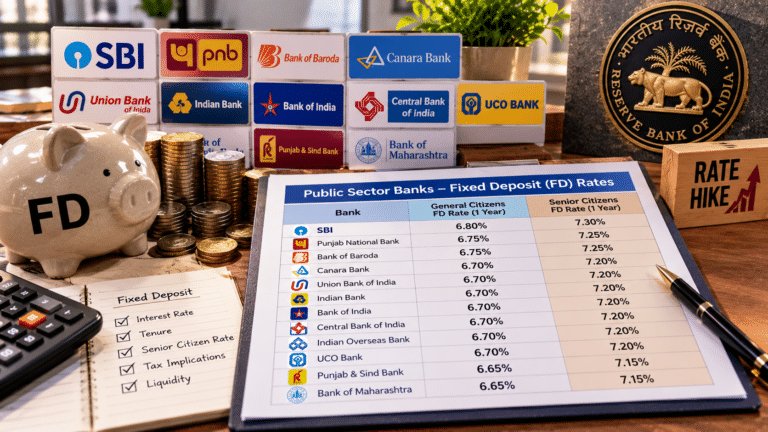
Top 10 Nationalised Bank Fixed Deposits Interest Rates
| Bank | Time Period | Interest Rate (p.a.) |
| Punjab National Bank (PNB) | 400 days | 7.25% |
| Union Bank of India | 333 days | 7.40% |
| Bank of India | 666 days | 7.30% |
| State Bank of India (SBI) | 1 year | 6.80% |
| Canara Bank | 1 year | 6.75% |
| Bank of Baroda | 1 year | 6.75% |
| Indian Bank | 1 year | 6.70% |
| Central Bank of India | 1 year | 6.70% |
| Indian Overseas Bank | 1 year | 6.65% |
| UCO Bank | 1 year | 6.60% |
Top 10 Private Bank Fixed Deposits Interest Rates
| Bank | Time Period | Interest Rate (p.a.) |
| DCB Bank | 1 year | 8.05% |
| RBL Bank | 1 year | 8.00% |
| Yes Bank | 1 year | 8.00% |
| Bandhan Bank | 1 year | 7.85% |
| IDFC First Bank | 1 year | 7.90% |
| IndusInd Bank | 1 year | 7.75% |
| CSB Bank | 1 year | 7.75% |
| Federal Bank | 1 year | 7.40% |
| Kotak Mahindra Bank | 1 year | 7.40% |
| HDFC Bank | 1 year | 7.25% |
Note: The interest rates mentioned can vary based on factors like the amount deposited, age of the depositor (senior citizens may receive higher rates), and specific promotional offers.
Factors to Consider When Choosing a Fixed Deposit
When evaluating options for Fixed Deposits, consider the following factors:
- Interest Rate: This is perhaps the most critical factor. A higher interest rate generally leads to better returns. However, it’s essential also to look at the bank’s reputation and stability.
- Tenure: Depending on your financial goals, the tenure of the FD should align with when you might need access to the funds. Longer tenures tend to offer better interest rates.
- Premature Withdrawal Charges: If you might need access to your money before the tenure concludes, check the bank policies on premature withdrawals, including any penalties involved.
- Minimum Deposit Amount: Different banks have varying minimum deposit requirements. Make sure the bank you choose accommodates your budget.
- Bank Reputation: The trustworthiness of the bank is crucial, so consider well-established banks or those rated favorably by financial agencies.
- Tax Treatment: Be aware of the tax implications of your Fixed Deposit earnings and consider tax-saving FD options if applicable.
Comparison Tools and Resources
To effectively compare FD rates across various banks, numerous online financial tools and resources are available. Websites that aggregate FD rates help visualize options clearly, enabling more informed decision-making.
Additionally, banks often maintain online calculators to help prospective investors estimate their returns based on the principal amount, interest rate, and tenure.
Conclusion
In summary, Fixed Deposits serve as a reliable and secure investment avenue, especially in an environment marked by economic uncertainties. By understanding the top bank FD rates and what to look for, you can maximize your investment returns while enjoying peace of mind regarding your capital’s safety.
Remember, not all Fixed Deposits are the same. Review your financial goals, evaluate the current rates, and pick an FD that best aligns with your needs. Happy investing!
-

OnePlus 16 First Look: A 185Hz Screen, Snapdragon 8 Elite Extreme and a 9,000mAh Battery — but Not for Most of the World
> SMARTPHONES / ONEPLUS / CHINA LAUNCH OCT 12, 2026 OnePlus 16 First Look: A 185Hz Screen, Snapdragon 8 Elite Extreme and a 9,000mAh Battery — but Not for Most of the World OnePlus launched the OnePlus 16 in China on October 12, 2026, starting at CNY 5,999. It pairs a 6.78-inch display that hits…
-
Gujarat’s 5th Pay Commission Pensioners Get DA Raised to 443% — With Arrears Going Back to 2021
Gujarat 5th Pay Commission Pensioners Get DA Raised to 443%, With Arrears From 2021 Pensions · Gujarat · 5th Pay Commission Gujarat’s 5th Pay Commission Pensioners Get DA Raised to 443% — With Arrears Going Back to 2021 A Gujarat Finance Department resolution dated October 22, 2026 lifts the temporary increase for state pensioners on…
-

What Really Sets Your Term Insurance Premium — 7 Factors and What Each One Costs You
7 Factors That Decide Your Term Insurance Premium, and How Much Each Costs (2026) Life InsuranceTerm PlansIndia 2026 What Really Sets Your Term Insurance Premium — 7 Factors and What Each One Costs You Two healthy 35-year-olds can be quoted premiums that differ by 80% for the same ₹1 crore cover. Age, tobacco, gender, health,…
-

Is a Gangster Killing an “Accident” for Insurance? A Punjab Ruling Says It Can Be
Is Murder an Accidental Death for Insurance? Punjab Commission Orders LIC to Pay Double Accident Benefit Insurance Law · Claims & Consumer Rights · India 2026 Is a Gangster Killing an “Accident” for Insurance? A Punjab Ruling Says It Can Be On October 13, 2026, the Punjab State Consumer Commission ordered LIC to pay double…
-
Your 8.25% EPF Interest Was Credited in July — So Why Doesn’t Your Passbook Show It?
Provident Fund · EPFO · FY 2025-26 Your 8.25% EPF Interest Was Credited in July — So Why Doesn’t Your Passbook Show It? EPFO credited 8.25% interest for 2025-26 to about 34 crore accounts by July 15, 2026, its fastest annual credit in recent years. If your passbook still shows nothing, the reason is usually…
-
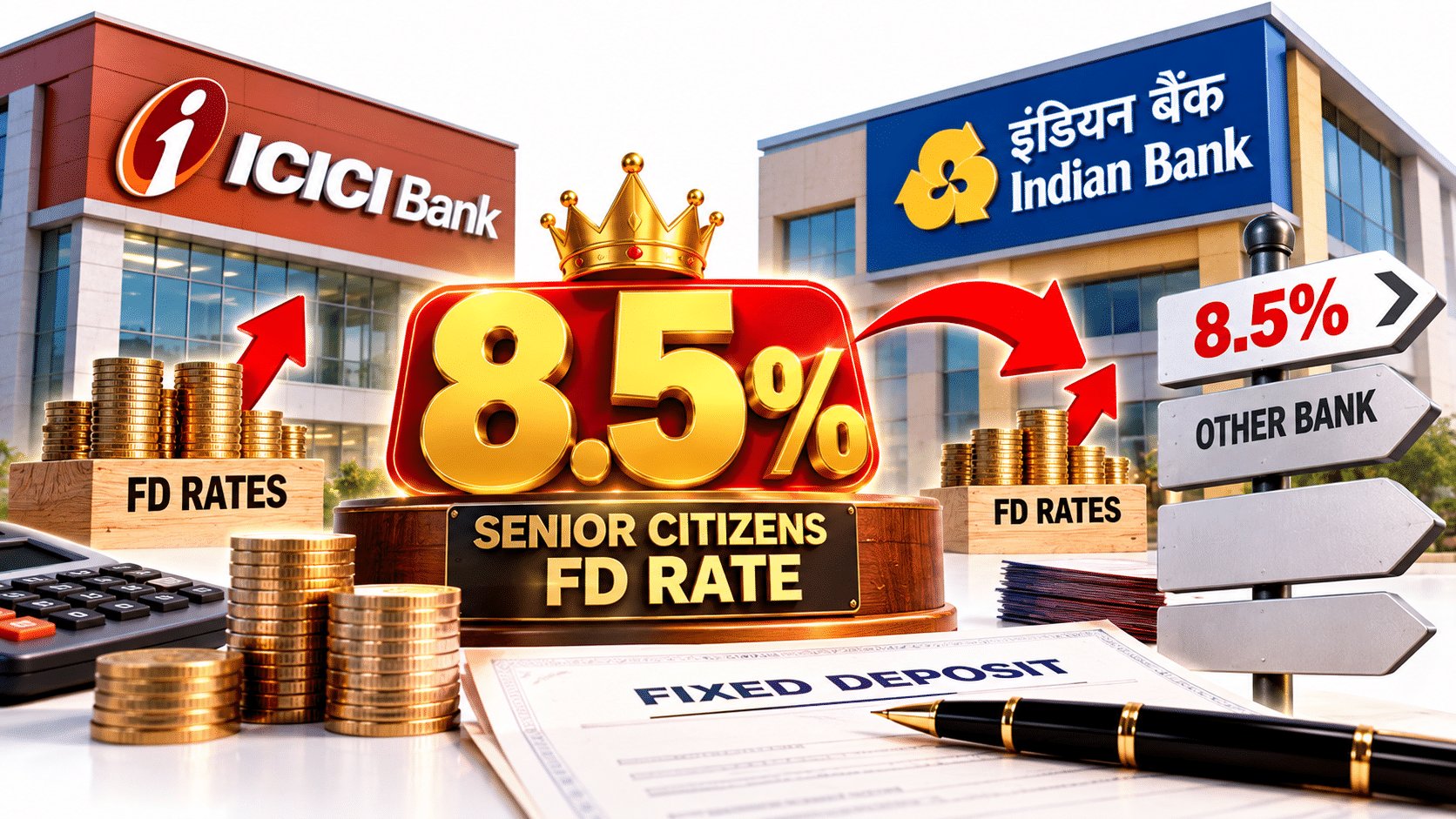
ICICI Bank and Indian Bank Raise FD Rates — but the 8.5% Senior Citizen Rate Comes From Elsewhere
ICICI, Indian Bank Raise FD Rates: Where Seniors Actually Get 8.5% (October 2026) Fixed Deposits · Senior Citizens · Rates as of October 24, 2026 ICICI Bank and Indian Bank Raise FD Rates — but the 8.5% Senior Citizen Rate Comes From Elsewhere ICICI Bank and Indian Bank lifted fixed deposit rates on October 23,…
-

Lost Money to Online Fraud? When Your Bank Must Pay — and What Changes From January 2027
Online Bank Fraud: When Banks Must Refund You, and RBI’s New 2027 Rules Explained BankingFraud & Consumer RightsIndia 2026 Lost Money to Online Fraud? When Your Bank Must Pay — and What Changes From January 2027 RBI rules already make banks bear losses from their own failures and from third-party breaches reported quickly. New directions…
-

AU Bank and Paytm’s New Card Gives Families Up to 12 Free Lounge Visits — If You Book Flights on Paytm
Paytm AU SFB Credit Card: 12 Family Lounge Visits, Fees and Rewards Explained (2026) Credit Cards Travel India 2026 AU Bank and Paytm’s New Card Gives Families Up to 12 Free Lounge Visits — If You Book Flights on Paytm The lifetime-free Paytm AU SFB RuPay Credit Card, launched on October 21, 2026, lets up…
-

Failed UPI or ATM Transaction? Your Bank May Owe You ₹100 for Every Day It Is Late
Failed UPI, ATM or Card Transaction: When Banks Must Pay ₹100 a Day (RBI Rules) Banking · Digital Payments · India 2026 Failed UPI or ATM Transaction? Your Bank May Owe You ₹100 for Every Day It Is Late RBI’s turnaround-time rules give banks one day or five days to reverse money debited in a…
-

Paying Only the Minimum on Your Credit Card? A ₹1 Lakh Bill Could Take About 28 Years to Clear
Paying Only the Minimum Credit Card Bill: What It Really Costs in India (2026) Credit Cards · Debt & Interest · India 2026 Paying Only the Minimum on Your Credit Card? A ₹1 Lakh Bill Could Take About 28 Years to Clear The minimum amount due keeps your card in good standing, but it barely…