8th CPC: Central Govt Employee Body Threatens February 12 Strike – What Unions Want from 8th Pay Commission
Central government employees across India are on edge as the Confederation of Central Government Employees and Workers (CCGEW) threatens a massive one-day strike on February 12, 2026, over delays in the 8th Central Pay Commission (CPC). With over 50 lakh employees and 65 lakh pensioners awaiting salary hikes amid soaring inflation, this standoff could disrupt essential services nationwide. The 8th CPC isn’t just numbers—it’s about dignity, family security, and economic stability in Amrit Kaal
What is the 8th CPC and Why the Urgency Now?
The 8th Central Pay Commission aims to revise pay structures, pensions, and allowances for central government staff, effective ideally from January 1, 2026. Approved by the Union Cabinet in late 2025 with Terms of Reference (ToR) finalized, it follows the 7th CPC pattern but faces delays in full setup and member appointments.
From an Indian viewpoint, especially in regions like Delhi where many railway and postal workers reside, these commissions are lifelines against inflation eroding purchasing power. The commission’s report, due within 18 months, will consider fiscal prudence amid India’s GDP growth targets under President Trump’s global trade influences.
Expectations include a fitment factor of 2.28 to 2.86, potentially raising minimum basic pay from ₹18,000 to ₹41,000, though DA resets could temper net hikes to 13-30%.
Historical Evolution of Pay Commissions
India’s Pay Commissions began in 1946 to ensure “living wages” post-independence, evolving through seven iterations. The 1st CPC (1946-47) under Srinivasa Varadachariar structured civilian pay amid partition chaos.
Key milestones include the 2nd CPC (1957-60) rationalizing scales with ₹39.6 crore impact; 4th (1983-86) reforming allowances at ₹1,282 crore; and 6th (2006-08) introducing grade pay, boosting minimum to ₹7,000.
The 7th CPC (2016) multiplied pay by 2.57, adding ₹1 lakh crore burden but aligning with private sector via pay matrices. Each has widened max-min pay gaps to 12.5 times, fueling equity debates.


CCGEW Strike Demands and February 2026 Updates
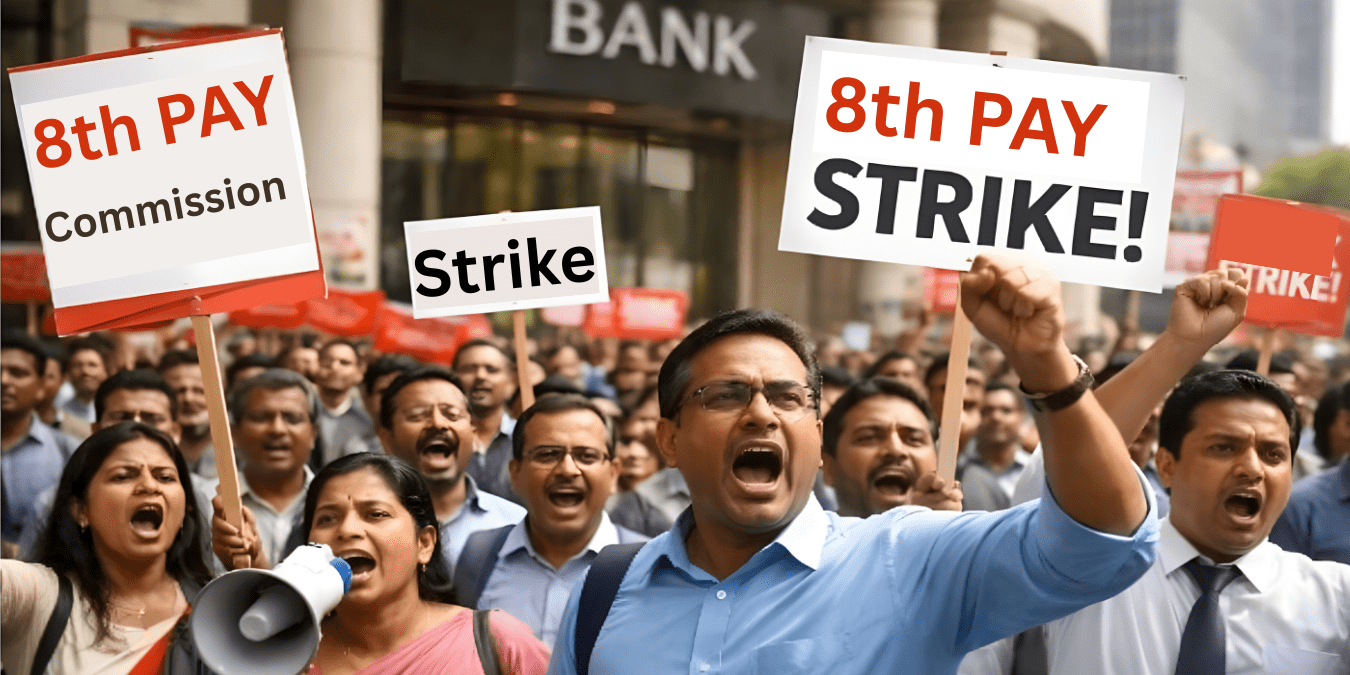
The Confederation of Central Government Employees & Workers (CCGEW), an umbrella body uniting major employee federations like AIRF, NFPE, and AIDEF, issued a formal strike notice on January 28, 2026, to Cabinet Secretary Rajneesh. Secretary General S.B. Yadav warned of a one-day nationwide strike on February 12 if demands remain unmet, potentially halting railways, posts, and defense services.
As of January 30, 2026, no official government response has emerged; unions intensify dharnas. Railways and Posts lead mobilization, with “Dies Non” salary deductions looming for participants per DoPT rules. The NC-JCM staff-side drafting committee meets February 25 at 13-C Ferozeshah Road, New Delhi, to consolidate 8th CPC memorandum—members stay a week for deliberations. This could de-escalate if progress shown, echoing 1960s gheraos that birthed JCM framework.
Core 8th CPC and Service Demands
CCGEW’s 25-point charter prioritizes pay commission reforms amid 70% DA buildup.
Immediate 8th CPC Interventions:
- Modify Terms of Reference (ToR) to mandate staff-side consultations on pay, fitment factor (target 3+), allowances, and minimum wage via Aykroyd formula.
- Grant 20% interim relief on basic pay/pension from January 1, 2026, until full implementation.
- Merge 50% Dearness Allowance/Dearness Relief (DA/DR) with basic pay/pension before new scales.
Pension Reforms (Dominant Focus):
- Scrap NPS (2004+) and Unified Pension Scheme (UPS); restore Old Pension Scheme (OPS) guaranteeing 50% last-drawn pay for all, irrespective of join date.
- Eliminate date-of-retirement disparities; ensure uniform benefits across pre/post-2004 retirees.
- Release 18 months (3 installments) Covid-frozen DA/DR immediately.
- Restore commuted pension portion after 11 years (not current 15).
- Minimum pension ₹9,000+; enhanced family pension 60% first 10 years.
Staffing and Welfare Reforms:
- Scrap 5% ceiling on compassionate appointments; extend to all dependents of deceased employees.
- Fill all vacancies; ban outsourcing, contractualization, and privatization in government departments.
- Regularize all casual/contingent/contract workers and Gramin Dak Sevaks (GDS); grant pay parity for autonomous body staff with central employees.
- Implement equal pay for equal work; no casualization via four Labour Codes.
Broader Socio-Economic Asks:
- Remove ceilings on bonus, PF, gratuity; ensure right to work as fundamental right.
- Minimum wage guarantees, ESI for unorganized/e-Shram workers, maternity/life insurance.
- Generate employment; social security for agricultural labourers.
These demands, rooted in 7th CPC partial wins (e.g., OROP), reflect middle-class fury over eroded real wages.
Government faces dilemma: Concede interim relief risks fiscal slippage (0.5% GDP), but ignore invites unrest like 2019 no-pay hikes. NC-JCM Feb 25 pivotal—watch for ToR tweaks or OPS signals.
Economic Implications of 8th CPC for India
Central Pay Commissions profoundly shape India’s fiscal landscape, balancing employee welfare with macroeconomic stability. The 7th CPC (implemented 2016) spiked central salary bills by 23.5% on average, with pensions surging up to 119% in peaks, contributing 0.4-0.5% to fiscal deficit/GDP in initial years. For the 8th CPC, Ambit Capital estimates a ₹1.8 lakh crore central outlay (30-34% hikes for 50 lakh employees + 65 lakh pensioners), plus 0.5% GSDP hit for states following suit—straining 2026-27 budgets amid 4.3% deficit targets.
In Uttar Pradesh, where government salaries/pensions fuel 10-15% of urban consumption (railways, ordnance factories key), hikes could invigorate real estate, automobiles, and MSMEs via multiplier effects (1.2-1.5x GDP boost per rupee spent). However, risks include 1-2% inflation pass-through and private wage pressures, as seen post-7th CPC when unorganized sector wages rose 12%. Delays to FY27-FY28 balloon arrears, mirroring 7th CPC’s two-instalment model (₹50,000 crore paid 2016-18).
Fiscal Strain Breakdown
- Central Impact: ₹1.8 trillion added expenditure (FY27), 0.7-1% GDP (~₹35-50 lakh crore economy). ICRA warns retrospective 2026 rollout swells FY28 salaries 40-50%, crowding capex.
- State Burden: UP, Maharashtra etc. adopt quickly; wages claim 30-35% revenue post-revision, hiking GSDP deficits 0.5%.
- Pension Load: OPS restoration (unions demand) adds 20-30% vs NPS, minimum pension from ₹9,000 to ₹20,500-₹25,000.
- Arrears Risk: 12-24 months delay = ₹2-3 lakh crore lumpsum (Level 1-5: ₹1-5 lakh each), paid in 2-4 instalments.
With projected 70-78% DA by implementation, net hikes moderate to 20-30% post-reset, but arrears provide windfall.
| Aspect | 7th CPC (2016-20) Impact | Expected 8th CPC (2026+) |
| Salary Bill Rise | 23% avg; min pay ₹7,000→₹18,000 (2.57 FF) | 20-34% net; min ₹41,000-₹51,000 (2.28-2.86 FF) |
| Pension Load | 70-119% peak; ₹1L Cr annual | Higher w/OPS; +₹80,000 Cr, min ₹20,500 |
| Fiscal Deficit/GDP | +0.4-0.5% (₹11,516 Bn total) | +0.5-1%; ₹1.8 Tn central + state |
| Arrears Payout | ₹50,000 Cr (2 yrs) | ₹2-3 Tn (18-24 months) |
| Inflation Spillover | 1-2%; private wages +12% | 1-2%; MSME wage push |
Positive Multipliers and Regional Boost
Direct beneficiaries (3% organized workforce) drive indirect gains: Consumption up 5-7% (festivals, durables), especially UP’s Tier-2 cities where govt pay > private avg. MSMEs gain from demand; real estate booms (EMI affordability). RBI models show 0.3-0.5% GDP lift offsetting fiscal drag.
Yet, equity concerns: Small workforce (0.7% labour force) benefits disproportionately, widening urban-rural gaps unless states cascade.
In 2026’s high-DA context (no reset till report), delays favour unions—arrears act as forced savings release, fuelling post-FY28 recovery. Government eyes FY27 rollout for fiscal glide path.
Government Stance and Challenges on 8th CPC
The Indian government maintains a cautious approach to the 8th Central Pay Commission (CPC), prioritizing fiscal consolidation amid global headwinds like U.S. President Donald Trump’s proposed tariffs, which could inflate import costs by 10-20% for oil and electronics. The Union Budget 2026-27 eyes a fiscal deficit below 4.4% of GDP (April-Dec FY26 already at 54.5% of target), with Finance Minister Nirmala Sitharaman signaling 4.2% glide path—leaving limited room for aggressive hikes.
No direct response to CCGEW’s January 28 strike notice as of January 30, 2026; DoPT sources indicate ongoing stakeholder consultations via JCM, but prioritize “economic conditions and fiscal prudence” per ToR. The 8th CPC’s mandate explicitly requires balancing “social justice with fiscal prudence,” ensuring resources for development/capex while assessing state finances—signalling conservative fitment (likely 1.8-2.28x vs unions’ 3.68).
Key Appointments and Structure
Justice Ranjana Prakash Desai (former Supreme Court judge, Press Council chairperson) leads as first woman chairperson, appointed October 2025. IIM-Bangalore Prof. Pulak Ghosh serves part-time member; Petroleum Secretary Pankaj Jain as member-secretary. Report due April 2027 (18 months), with flexibility for experts. First meetings focused stakeholder inputs from DoPT, Defence, Finance—emphasizing performance-linked pay.
Pension Compromises: UPS vs OPS
Unified Pension Scheme (UPS, notified Jan 2025) offers NPS-covered employees assured 50% last pay (post-25 yrs), 30% family pension, govt topping corpus (8.5% DA)—a middle-ground rejecting full OPS rollback. Unions dismiss as inadequate; govt views as reform balancing equity (DR on pensions) without fiscal blowout (OPS est. +₹2.5 lakh Cr/decade).
Challenges and Headwinds
- Fiscal Math: ₹1.8 Tn wage bill + arrears strains FRBM; Trump’s tariffs add ₹50,000 Cr import bill.
- Stakeholder Balance: 50 lakh employees vs 140 Cr population; states demand parity, risking 1% aggregate GDP drag.
- Inflation/DA: 70%+ DA mandates merge/reset, tempering hikes.
- Strike Risks: Feb 12 disruption (railways 70% participation risk); past no-work pay deductions deterred.
8th CPC Pay Matrix Examples
The 7th CPC introduced a 18-level pay matrix (Level 1-18), simplifying grade pay with annual increments at 3%. The 8th CPC will retain this structure, scaling all cells via fitment factor (FF) while recalibrating allowances: HRA (27%/18%/9% for X/Y/Z cities), Transport Allowance (doubled indices), and CCA revisions. Full matrix awaits commission report (est. Apr 2027), but projections use Aykroyd formula for min wage.
Sample Projected 8th CPC Pay Matrix (Conservative 2.28 FF):
| Pay Level | Entry Basic (7th) | Entry Basic (8th) | 10 Yrs Inc. (8th) | 20 Yrs Inc. (8th) |
| Level 1 | ₹18,000 | ₹41,040 | ₹48,500 | ₹62,300 |
| Level 5 | ₹29,200 | ₹66,576 | ₹78,600 | ₹1,01,000 |
| Level 10 | ₹56,100 | ₹1,27,908 | ₹1,51,000 | ₹1,94,500 |
Optimistic 2.86 FF Variant (Unions’ demand):
| Pay Level | Entry Basic (8th) | 10 Yrs (8th) |
| Level 1 | ₹51,480 | ₹60,800 |
| Level 5 | ₹83,512 | ₹98,700 |
| Level 10 | ₹1,60,446 | ₹1,90,000 |
HRA example (Delhi, 27%): Level 1 entry ₹41,040 basic → ₹11,080 HRA. Total gross (w/50% DA est.) ~₹70,000+.
Comparison: 8th CPC vs 7th CPC Salary Hikes
7th CPC averaged 14.27% net hike (23.55% gross pre-DA merge), generous amid low deficits. 8th CPC eyes 20-30% net (13-34% gross), conservative due to 4.4% deficit cap.
| Metric | 7th CPC (2016) | 8th CPC (Exp. 2026-28) |
| Fitment Factor | 2.57 | 2.28-2.86 (Kotak:2.46) |
| Min Basic Pay | ₹18,000 (from ₹7,000) | ₹41,000-₹51,500 |
| Avg Salary Hike | 14% net / 23.5% gross | 13-25% net / 20-34% gross |
| Pension Multiplier | 2.57 | 2.5+ w/UPS/OPS tweaks |
| Wage Bill Impact | +₹1.02 lakh Cr (FY17) | +₹1.15-1.8 lakh Cr |
| Implementation Delay | 19 months (notif. Feb 2015) | 12-24 months (ToR Oct 2025) |
8th tempers via DA reset; 7th pre-dated high inflation.
How 8th CPC Pensions Will Change for Retirees
The 8th Central Pay Commission (CPC) promises transformative relief for 65-69 lakh central pensioners, recalibrating payouts via fitment factor while navigating OPS-NPS-UPS tensions. Pre-2004 retirees hold Old Pension Scheme (OPS: 50% last basic pay + DR). Post-2004: NPS (60% corpus lump, annuity volatile, hist. 9-12% returns). Unified Pension Scheme (UPS, Jan 2025) hybrids: 50% assured last pay (25-yr service), 30% family, govt guarantees 8.5%+ on 18.5% contributions—unions demand full OPS universality, but 8th CPC likely bolsters UPS with DR merge and parity. Automatic revisions assured for all, per Minister Jitendra Singh.
Key Pension Reforms and Mechanics
- Basic Pension Formula: Revised = Current Basic Pension x Fitment Factor (FF 2.28-2.86). DR resets to 0 post-implementation, restarts biannual.
- Minimum Pension: Current ₹9,000 → ₹18,000 (2.0 FF), ₹23,130 (2.57), ₹25,740 (2.86)—186% potential rise. UPS floor: ₹10,000 (10+ yrs service).
- Family Pension: 40% last pay standard; enhanced 60% (widow/minor/parents) first 7-10 yrs or till age 67. Separate life certificates for parents post-deceased employee.
- Arrears: Effective Jan 1, 2026; 18-24 months delay paid in 2-4 installments (monthly diff x months), like 7th CPC ₹50,000 Cr.
- Other Boosts: Commuted value tweaks, medical/funeral aid up, anomaly fixes (old vs new pensioners parity).
Detailed Examples Across FF Scenarios
Minimum Pensioner (Current ₹9,000 basic pension):
| Fitment Factor | Revised Basic Pension | % Increase |
| 2.0 | ₹18,000 | 100% |
| 2.57 | ₹23,130 | 157% |
| 2.86 | ₹25,740 | 186% |
Level 5 Mid-Level Retiree (Current basic pay ₹29,200; pension ₹14,600 basic + DR ~₹24,000-₹25,000 total):
| FF | Revised Basic Pay | Revised Pension (50%) | Monthly Gain (basic) | 24-Mo Arrears Est. |
| 2.28 | ₹66,500 | ₹33,250 | +₹18,650 | ₹4.5-₹9 lakh |
| 2.5 | ₹73,000 | ₹36,500 | +₹21,900 | ₹5.2-₹10 lakh |
| 2.86 | ₹83,500 | ₹41,750 | +₹27,150 | ₹6.5-₹12 lakh |
Senior Officer (Level 14, Current basic pension ₹61,550):
| FF | Revised Pension | Monthly Gain |
| 2.0 | ₹1,23,100 | +₹61,550 |
| 2.57 | ₹1,58,183 | +₹96,633 |
| 2.86 | ₹1,76,033 | +₹1,14,483 |
OPS revival adds certainty (no market risk); UPS mitigates NPS volatility. Post-DR (est. 50% in 2 yrs), totals rise further.
Why 8th CPC Matters for India’s Middle Class
Central government employees and pensioners—over 1.15 crore strong—form the bedrock of India’s aspirational middle class, embodying stability in an economy where private jobs fluctuate. Their collective spending power (₹3-4 lakh crore annually post-hikes) drives 5-7% of national consumption growth, fueling sectors from FMCG to real estate and amplifying GDP via 1.2-1.5x multipliers. In Uttar Pradesh, with 3-4 lakh central workers/pensioners (railways, defense dominant), CPC revisions sustain Diwali booms, wedding seasons, and education investments—e.g., coaching hubs thrive on salaried parents funding IIT/JEE dreams.
Broader Socio-Economic Ripple
- Consumption Engine: Hikes boost disposable income 15-25%, lifting durables (autos +8% sales post-7th CPC), housing (EMI ease), and services—UP’s Tier-2 cities see 10% retail surge.
- Private Wage Parity: Spillover pressures corporates for 12-15% hikes, narrowing organized-unorganized gap; MSMEs hire more amid demand.
- Social Mobility: Funds tuitions, healthcare—middle class (₹5-30L income) expands, aiding Amrit Kaal’s $5 Tn economy goal. Pension security enables elder care without family burden.
- Inflation Hedge: Real wages erode 20% since 2016 (6% avg CPI); timely CPC restores purchasing power, curbing discontent.
Government Response and Negotiation Roadmap
As of January 30, 2026, the government has issued no formal rebuttal to CCGEW’s January 28 strike notice, with DoPT spokesperson hinting at “ongoing consultations through established JCM channels” to avoid escalation. Internal memos prioritize stakeholder memos before Feb 25 NC-JCM, signalling intent to engage without concessions yet. This measured stance tests Modi 3.0’s labour policy, balancing fiscal hawkishness with workforce harmony post-2024 reelection.
Historically, 80% of union demands achieve partial fulfilment—e.g., 7th CPC rejected 3.7 FF for 2.57 but granted OROP; 1968 strike birthed assured DA. Feb 12 deadline (Dies Non risks) pressures talks, but govt holds leverage via no-work-no-pay.
Phased Negotiation Roadmap
- Pre-Feb 12 (Immediate): Informal JCM huddles; possible DA instalment release (Covid arrears) as goodwill.
- Feb 25 NC-JCM Meet: Staff-side presents 25-pt charter; govt nods ToR tweaks (staff inputs), interim relief nod.
- March Budget (Interim): 20% relief allocation (~₹20,000 Cr), UPS opt-ins; defuse strike.
- Apr-Jun (ToR/Mid-Term): Amend ToR for parity/OPS study; chairperson briefs unions.
- FY27 Rollout: Report integration, arrears phased—mirroring 7th CPC timeline.
UP focus: Northern Railway divisional meets key to de-escalation. Success hinges on dialogue—JCM’s 70% resolution rate.
Final Thoughts on Employee Aspirations
February 12, 2026, looms as a litmus test for India’s social fabric, pitting 1.15 crore central employees and pensioners against fiscal realities. The 8th CPC embodies their core aspirations—financial dignity amid 7% inflation, family security through OPS revival, and equity in Amrit Kaal’s growth story. These middle-class anchors, from railway families to Delhi’s clerks, don’t just seek hikes; they demand recognition for powering bureaucracy that underpins Viksit Bharat.
Government must balance ₹1.8 lakh crore outlays with 4.2% deficit goals, echoing 7th CPC’s calibrated wins. NC-JCM Feb 25 outcomes—ToR tweaks, interim relief—hold the key to averting strikes and sustaining morale. Ultimately, honoring 80 crore workforce dreams via timely justice fosters productivity, consumption, and trust. Employees’ resolve shines; equitable 8th CPC can illuminate shared prosperity. Stay tuned—this saga shapes India’s workforce narrative.