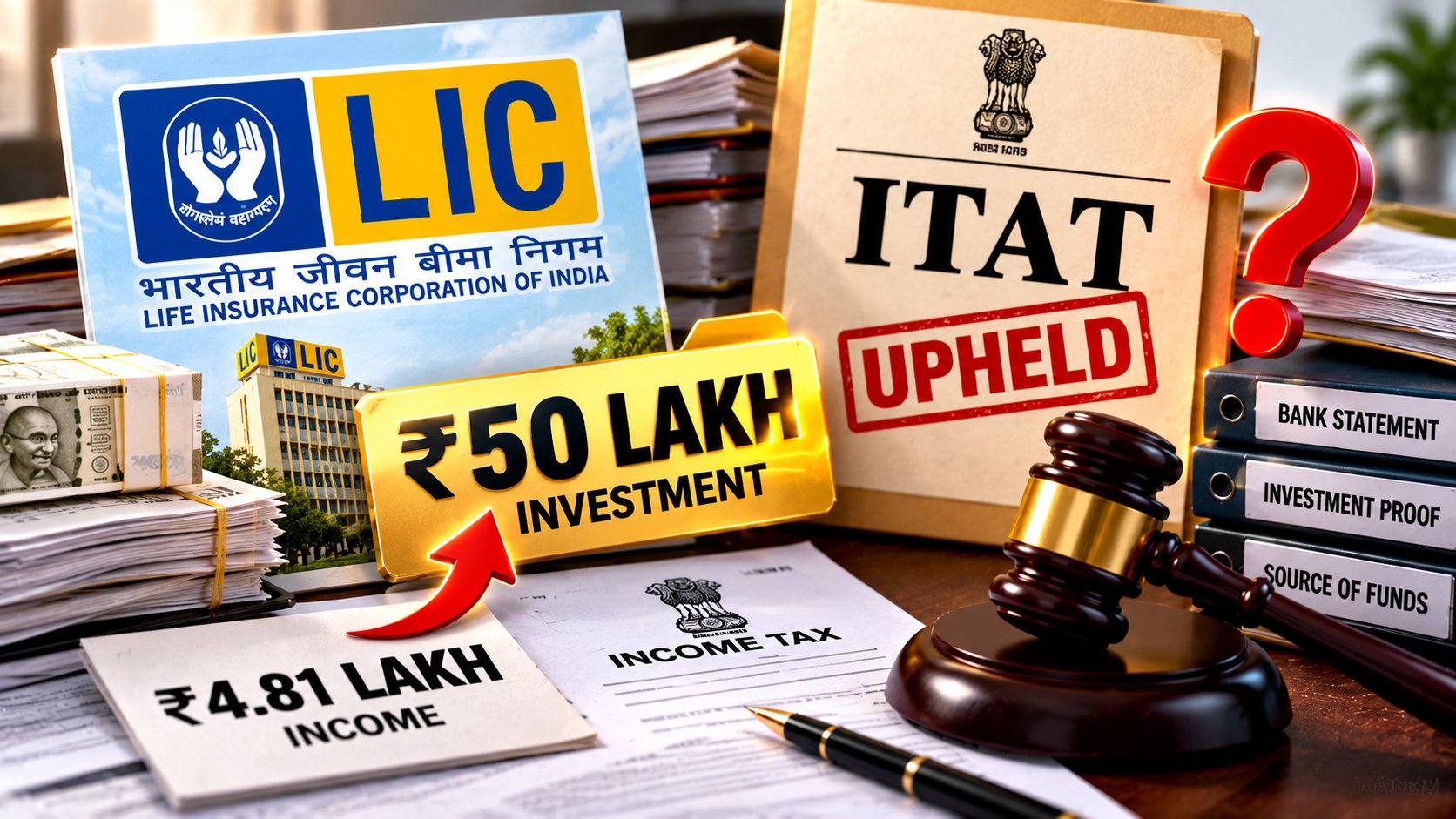
₹50 Lakh LIC Investment on ₹4.81 Lakh Income: Why ITAT Upheld the Tax Addition — and How to Prove Your Source
₹50 Lakh LIC Investment on ₹4.81 Lakh Income: Why ITAT Upheld the Tax Addition — and How to Prove Your Source
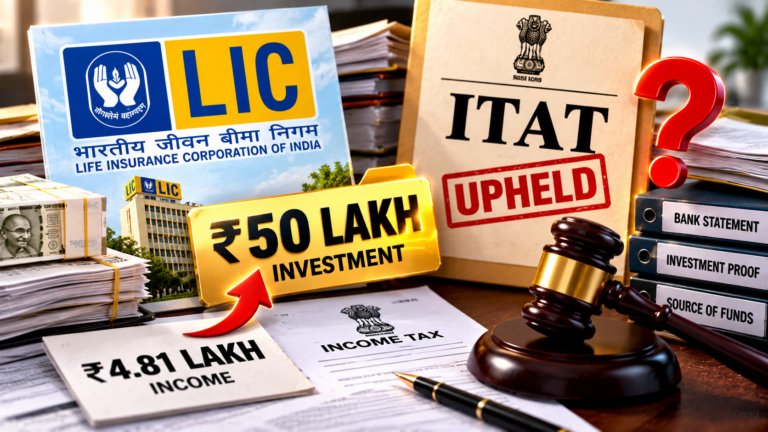
The Income Tax Appellate Tribunal’s Chandigarh bench upheld a ₹50 lakh addition as unexplained investment against a taxpayer who declared ₹4.81 lakh of income, ruling that she had not proved the money came from her late husband’s Hindu Undivided Family. The order is dated 25 February 2026.
An insurance policy feels like the most ordinary financial decision a family can make. An agent visits, a cheque is written, and years later a maturity amount arrives. But when the premium paid in a year is ten times the income you declared, the tax department asks a simple question: where did the money come from? If you cannot answer with documents, the law lets it treat the investment itself as your income.
That is what happened in a case decided by the Income Tax Appellate Tribunal in Chandigarh. The taxpayer, Pratibha Singh, had declared income of ₹4.81 lakh for assessment year 2009-10, while LIC investments of ₹50 lakh were made in her name. She argued the money belonged to her late husband’s Hindu Undivided Family and came from apple orchard income. The tribunal ruled that the claim was not backed by evidence and upheld the addition. The reasons matter to anyone who makes a large purchase or investment with family money.
Quick Summary
ITAT upheld the ₹50 lakh addition because ownership of land is not proof of cash, and an HUF’s separate status is not proof that it funded an investment held in someone else’s name. No books of account, sales records, cash book or cash-flow statement were produced, and the claimed memorandum of understanding with the LIC agent was never filed, not even as a copy. Under Section 69, the burden of explaining the source of an investment lies on the person in whose name it is held. The tribunal also rejected her pleas for a protective addition and of double taxation.
What We Know
- The case is Pratibha Singh vs ACIT, Circle Shimla, ITA No. 860/Chd/2025, decided on 25 February 2026.
- The Assessing Officer added ₹50 lakh as unexplained investment under Section 69 for assessment year 2009-10.
- She argued the funds belonged to Virbhadra Singh HUF and came from agricultural income.
- No books, sales records, cash book, cash-flow statement or MoU copy was produced.
- The tribunal upheld the addition and dismissed her appeal.
What Is Still Unclear
- The exact tax and interest payable on the addition; reports do not state the final demand.
- Whether the order will be challenged before the High Court.
- The outcome of separate tax proceedings in the hands of the HUF, which were not final.
- The first appellate authority’s reasoning, which reports summarising the order do not detail.
The Money Trail the Tribunal Was Asked to Accept
According to the order as reported, the taxpayer’s case rested on a chain of events in June 2008. Her late husband’s HUF was said to own an apple orchard of about 100 bighas in Himachal Pradesh. The LIC agent, Anand Chauhan, received ₹5 lakh each from Universal Apple Associated on 7 June and 13 June 2008. A memorandum of understanding between the HUF and the agent was said to have been executed on 15 June 2008. On 19 June 2008, ₹10 lakh was invested with LIC, part of ₹50 lakh in total invested in her name during 2008-09.
The story was plausible on its face. Apple orchards in Himachal Pradesh can generate substantial income, and an HUF is a separate taxpayer under Indian law. The problem, the tribunal found, was that none of the links in the chain was proved with documents that could be verified.
A Tenfold Gap Between Income and Investment
Tax officers rarely look at an investment in isolation. They compare it with the income the taxpayer reported. Here, the gap was stark: ₹50 lakh of LIC investment against ₹4.81 lakh of declared income, a ratio of about 10.4 to 1. Even the single ₹10 lakh payment on 19 June 2008 was more than twice her declared income for the whole year.
A gap like this does not by itself prove anything wrong. Many people invest gifts, inheritances, savings from earlier years or loans. But it shifts the burden. Once the department shows an investment that your declared income cannot explain, you have to show where the money came from, and the explanation has to be supported by evidence.
How Many Years of Saving Would ₹50 Lakh Take?
One way to see why the tax officer was not persuaded is to ask how long it would take to save ₹50 lakh from ₹4.81 lakh a year. Even if every rupee of declared income were saved and nothing spent on living, it would take more than ten years. At realistic saving rates, it would take decades.
This is why the “earlier savings” explanation, which taxpayers often offer in such cases, rarely works on its own. If you claim money came from past savings, you need bank statements, deposits or earlier tax returns showing that those savings existed, and a trail showing they were used for the investment. A round figure of past savings mentioned only in a reply to a notice carries little weight.
The same arithmetic applies to anyone. A salaried person earning ₹12 lakh a year who suddenly pays a ₹40 lakh single premium, or buys a flat with a large down payment, will be expected to explain the gap. The explanation might be perfectly genuine, such as a parent’s gift, a home loan or the sale of an old property. The difference between a successful and a failed explanation is almost always the paperwork.
Section 69 in Plain Language
Section 69 of the Income-tax Act, 1961 covers unexplained investments. If you have made an investment that is not recorded in your books, or if you have no books, and you offer no explanation about its nature and source, or the Assessing Officer finds your explanation unsatisfactory, the value of the investment can be treated as your income for that year.
Two features make it powerful. First, the burden is on the taxpayer, because only the taxpayer knows where the money came from. Second, the test is not whether a story is possible but whether it is proved. For later years, income added under Sections 68 to 69D attracts a special rate under Section 115BBE, explained further below. Under the new Income-tax Act, 2025, which applies to income from 1 April 2026, the equivalent provisions are Section 103 for unexplained investments and Section 195 for the special rate, according to Ujjivan Small Finance Bank’s explainer.
| Provision | Covers | 1961 Act section | 2025 Act section |
|---|---|---|---|
| Cash credits | Unexplained credits in books | 68 | 102 |
| Unexplained investments | Investments with no satisfactory source | 69 | 103 |
| Unexplained money or assets | Cash, jewellery and valuables | 69A | 104 |
| Understated investments | Investment beyond amount recorded | 69B | 103 and 104 |
| Unexplained expenditure | Spending with no satisfactory source | 69C | 105 |
| Special tax rate | Rate on income under these sections | 115BBE | 195 |
Four Reasons the HUF Argument Failed
The tribunal dealt with each of the taxpayer’s arguments. Read together, they show the evidence an income tax officer and the tribunal expect when someone says “the money was not mine”.
What taxpayers often get wrong
Many people believe that showing a family member could have afforded a payment is enough. It is not. The tribunal, as reported, said the burden was on the taxpayer to demonstrate “with reliable evidence” that the investment came from identifiable HUF funds. Capacity is only one part of the test; you also need to prove the actual movement of money from that source to the investment.
What an Unexplained ₹50 Lakh Can Cost Today
The tax treatment of unexplained investments has changed sharply over the years. For assessment year 2009-10, the one in this case, the special Section 115BBE rate did not yet exist; it was introduced from assessment year 2013-14, so the addition would generally be taxed at normal slab rates, with interest for the long gap. Reports of the order do not state the final demand.
For the years when 115BBE carried its highest rate, the burden was far heavier. Ujjivan Small Finance Bank’s explainer describes the 1961 Act rate as 60%, plus a 25% surcharge on that tax and 4% cess, an effective 78%, with no deductions or set-off of losses allowed. A further penalty of 10% of the tax could apply under Section 271AAC. The same explainer says the Finance Act, 2026 reduced the rate to 30% from 1 April 2026; check current law before relying on that figure.
At the 78% rate, ₹50 lakh of unexplained investment would mean ₹39 lakh of tax, and with the 10% penalty on that tax, about ₹42.9 lakh, leaving little more than ₹7 lakh of the original amount. That is why documentation matters so much more than the size of the investment.
| Unexplained amount | Tax at 60% | Surcharge and cess | Total at 78% | With 10% penalty |
|---|---|---|---|---|
| ₹5 lakh | ₹3 lakh | ₹0.9 lakh | ₹3.9 lakh | ₹4.29 lakh |
| ₹10 lakh | ₹6 lakh | ₹1.8 lakh | ₹7.8 lakh | ₹8.58 lakh |
| ₹20 lakh | ₹12 lakh | ₹3.6 lakh | ₹15.6 lakh | ₹17.16 lakh |
| ₹50 lakh | ₹30 lakh | ₹9 lakh | ₹39 lakh | ₹42.9 lakh |
| ₹1 crore | ₹60 lakh | ₹18 lakh | ₹78 lakh | ₹85.8 lakh |
Table figures are our arithmetic on the rates described above and exclude interest. Whether the penalty applies depends on facts, such as whether the income was declared in the return and tax paid.
The Paper Trail That Would Have Changed the Outcome
Indian tax tribunals generally look at three things when a taxpayer says money came from someone else: the identity of the source, its capacity to pay, and the genuineness of the transaction. Each needs documents. Here is how the evidence in this case compares with what typically satisfies those tests.
| Evidence | What it proves | In this case | Strength if produced |
|---|---|---|---|
| Books of account of the HUF | Capacity: income and cash available | Not produced | Strong |
| Sales records of apples | Capacity: actual orchard income | Not produced | Strong |
| Cash book or cash-flow statement | Availability on the date of payment | Not produced | Strong |
| Original or copy of the MoU | Genuineness of the arrangement | Not produced at any stage | Medium |
| Bank trail from source to insurer | Genuineness: actual movement of money | Not established, as reported | Strongest |
| Gift deed and donor’s bank statement | Identity, capacity and intent | Not relevant to the claim made | Strong for gifts |
Worked example: how a family can document a ₹10 lakh policy
Meena earns ₹6 lakh a year and wants to buy a policy with a ₹10 lakh single premium. Her father, who has ₹40 lakh in fixed deposits, gives her ₹10 lakh. If he transfers it by bank from his account to hers, signs a simple gift deed, and she pays LIC by cheque from that same account within days, the trail shows identity, capacity and genuineness. Gifts from a father are exempt in her hands as a gift from a relative. If instead the money arrived in cash with no deed, and she paid the premium in cash, her ₹6 lakh income could not explain it, and she would face the same problem as in this case.
Before You Make a Large Investment With Family Money
Large insurance premiums, property purchases and deposits in your name are routinely visible to the tax department through reporting by financial institutions. A premium that far exceeds your reported income is exactly the kind of mismatch that prompts a query, even years later.
- Route the money through bank accounts, never cash, from the source to your account to the investment.
- If the money is a gift, sign a gift deed and keep the donor’s bank statement showing the transfer.
- If it belongs to an HUF, keep the HUF’s books, bank statements and proof of income such as sale bills.
- If it is a loan, document it with a loan agreement and repayments through the bank.
- Keep these records for as long as the assessment for that year can be reopened.
Fact box: a separate case in the background
Business Standard reported in July 2016 that the Enforcement Directorate had arrested LIC agent Anand Chauhan in a money laundering case relating to the late Virbhadra Singh, then Himachal Pradesh chief minister. The ITAT ruling discussed here is a tax assessment decision on the source of an investment. It is not a finding in any criminal case, and this article draws no conclusion about those proceedings.
Frequently Asked Questions
Why did ITAT uphold the ₹50 lakh addition in the LIC policy case?
Because the taxpayer could not prove with reliable evidence that the money came from her late husband’s HUF. No books, sales records, cash book, cash-flow statement or copy of the claimed MoU was produced, and the policy was in her name.
What is Section 69 of the Income Tax Act?
It allows the tax officer to treat an investment as income if the taxpayer offers no explanation of its source, or the explanation is not satisfactory. The burden of explaining lies on the taxpayer. The equivalent in the Income-tax Act, 2025 is Section 103.
Can I invest family money in my name without tax problems?
Yes, if you can document it. Gifts from relatives are generally tax-free, but keep a gift deed, a bank trail from the donor and proof of the donor’s capacity. Avoid cash.
Is agricultural land enough to prove agricultural income?
No. The tribunal said owning land does not prove that cash was available. Sales records, books of account and bank deposits of the income are needed.
What is the tax rate on unexplained investment?
Under Section 115BBE of the 1961 Act, it was 60% plus 25% surcharge and 4% cess, about 78%, with no deductions. A 10% penalty could also apply. A bank explainer reports the rate was cut to 30% from 1 April 2026; verify current law.
What is a protective assessment in income tax?
It is an addition made in one person’s hands as a safeguard when it is unclear who really owns the income. The tribunal held the taxpayer could not demand a protective addition once the officer had concluded the investment was hers.
Can the tax department question an old insurance policy?
Yes. This case concerned investments made in 2008-09 and was decided in 2026. Keep records of large investments for many years.
Does buying a big LIC policy trigger income tax scrutiny?
A large premium alone does not, but a premium far above your declared income can prompt questions about its source. Paying through the bank from documented funds is the best protection.
The Short Version
ITAT Chandigarh upheld a ₹50 lakh addition under Section 69 against a taxpayer who declared ₹4.81 lakh of income for assessment year 2009-10 while ₹50 lakh of LIC investments were made in her name. She said the money came from her late husband’s HUF and its apple orchard, but produced no books, sales records, cash-flow statement or copy of the claimed MoU. The tribunal said land is not cash, the policy was in her name, and the burden of proof was hers. The lesson for every family: move money by bank, document gifts and loans, and keep records for years.