Gold Fever Hits South Africa: How a Cattle Pen in Springs Sparked a Modern-Day Gold Rush
A cattle pen. A shovel. One lucky dig — and suddenly an entire South African township abandoned everything to tear up the earth with bare hands. Children ditched school uniforms. Jobless fathers found more in five days than a week’s wages. But is the gold real — or history repeating itself?
It began quietly, with a single man and a shovel in a muddy cattle enclosure. Within days, it had become something much bigger — a full-blown gold rush that has reignited the ancient dream of striking it rich beneath the South African soil. The story coming out of Springs, a former mining town on the eastern fringes of Johannesburg, reads like something from another century. But it is happening right now, in 2026, and it is telling us something profound about poverty, desperation, the price of gold, and the enduring power of hope.
The Discovery That Started Everything
It was around February 8, 2026, when a resident of the Gugulethu informal settlement in Springs reportedly unearthed something glittering while digging in an outdoor enclosure that had once been used to pen cattle. According to local accounts, the man found several gold nuggets — small, raw, unmistakable. Word spread through the neighbourhood the way all wildfire news does in close-knit communities: fast, unstoppable, and electric.
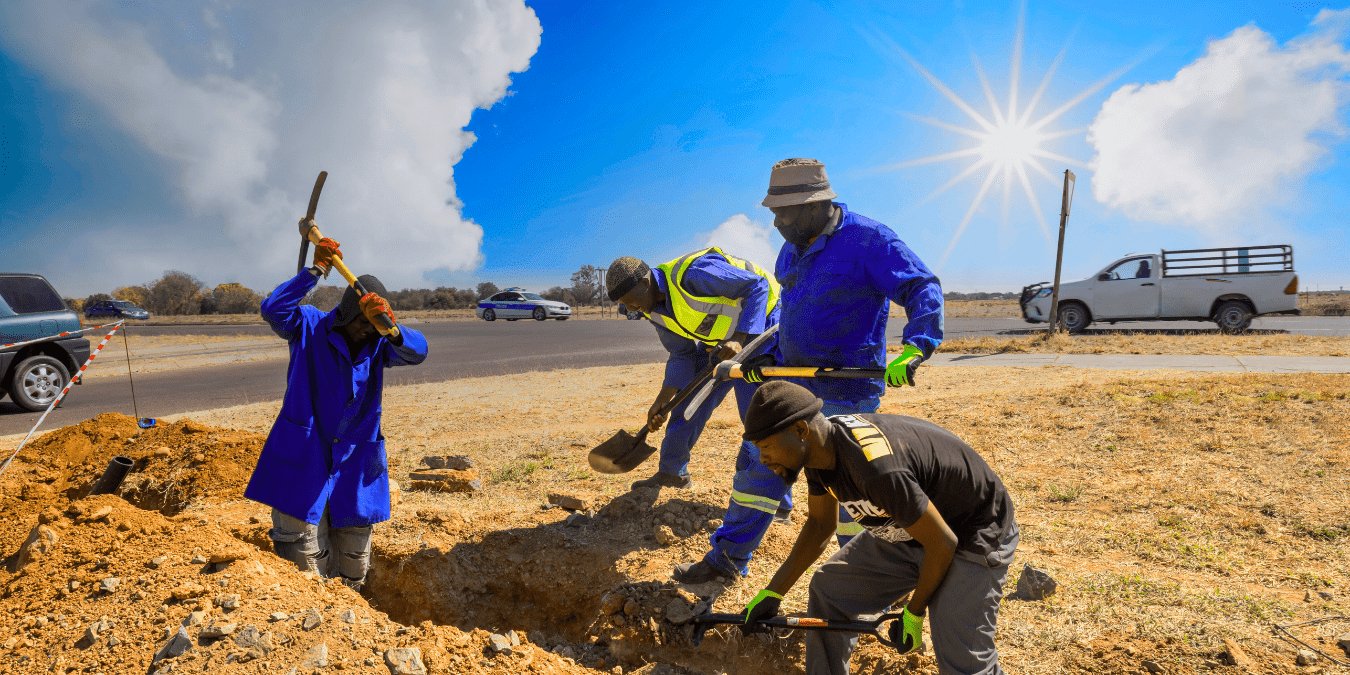
Within hours, dozens of people had descended on the same patch of earth. Within days, the cattle kraal — a humble, barbed-wire-fenced field that once smelled of manure and livestock — had been transformed into a pockmarked landscape of hope and desperation, its surface riddled with holes dug by hand. Men arrived with pickaxes and shovels. Some came with wheelbarrows. Others came with nothing but their bare hands and a prayer.
“They spread like a virus,” security guard Princess Thoko Mlangeni, 33, told AFP, standing outside her tin-shack home overlooking the field. She had watched them arrive on February 8 and had, at one point, tried her own luck in the soil. She found a fragment no bigger than a fraction of her little fingernail — not worth the effort of a 12-hour night shift ahead, she admitted. But for others living in the same conditions of chronic unemployment and financial precarity, even that tiny fragment represented something: possibility.
Springs: A Town That Gold Built — And Then Abandoned
To understand why this discovery detonated such a frenzy, you need to understand what Springs means to South Africa — and what South Africa’s gold mining history means to the world.
Springs is not just any town. It sits approximately 50 kilometres east of Johannesburg in Ekurhuleni, and it was once one of the booming arteries of South Africa’s legendary gold belt. The Witwatersrand gold rush of the late 19th century transformed a rural backwater into the financial capital of an entire continent. Johannesburg — known today as “Joburg” or “eGoli” (City of Gold) — was built almost entirely on the mineral wealth extracted from seams running deep beneath the highveld soil.
Springs was a proud part of that legacy. Its mines hummed for decades, drawing workers from across southern Africa, fuelling local economies, and defining the identity of a region. But as the decades passed and the gold seams grew thinner and deeper — requiring ever more expensive and dangerous extraction — the economics became impossible. The Springs mines were eventually shut down. The booming town faded. What was left was a landscape of informal settlements surrounding a shell of former industrial glory, populated by migrants from neighbouring countries, long-term unemployed residents, and communities with deep historical ties to mining work and its culture.
It is the kind of place where a gold nugget found in a cattle pen does not just cause excitement. It causes a stampede.




The Human Face of the Rush
Among those who came to dig was Siyabonga Sidontsa, a 47-year-old father of three who lost his gardening job five years ago. Speaking to AFP reporters on the scene, Sidontsa described his method: he spent hours each day stuffing soil into empty maize-meal sacks, loading his wheelbarrow, and walking them back home to process. Ten sacks a day, day after day.
After five days of this gruelling, uncertain work, he had earned approximately 450 South African rand — less than $30 (USD). But here is the remarkable thing: he said that was more money than he typically earned in a normal week. For a man with no income and three mouths to feed, a cattle pen full of trace gold dust was not a fantasy. It was a lifeline.
That human dimension — the quiet arithmetic of survival — is what separates this story from a simple tale of greed or recklessness. The people digging in Springs are not treasure hunters with metal detectors and hobby interests. They are parents who ran out of options. They are school-uniformed children who rushed to the site after 14:00, still dusty from their classrooms, wanting to help their families. They are workers who know the soil intimately and understand, in their bones, that sometimes the earth gives back.
The Context: Gold Prices at Historic Heights
There is a broader macroeconomic backdrop to this story that makes it even more understandable. Gold prices in 2026 have surged dramatically. According to reports from AFP and African Insider, gold has risen past $5,000 per ounce — more than double the levels seen in early January. This is not a random spike. It reflects global economic anxiety, currency instability, geopolitical tensions, and the ongoing role of gold as the world’s ultimate store of value in times of crisis.
When gold is expensive, every fleck of it matters more. A handful of gold dust that might have been barely worth processing at $1,500 an ounce becomes genuinely valuable at $5,000. The poor residents of Springs are not oblivious to commodity markets — they live in the shadow of mines, have family histories in extraction work, and understand deeply that the ground beneath their feet holds wealth. The price signal simply lowered the threshold at which digging made sense.
This is also not the first time South Africa has seen a modern-day resource rush. In 2021, a discovery of crystal-like stones in KwaZulu-Natal province triggered what many called a “diamond rush” — only for geologists to confirm the stones were merely quartz. That episode ended in disappointment, but it revealed the same underlying dynamic: when poverty is severe enough and the dream of mineral wealth is culturally embedded enough, even rumour becomes action.
The Legal and Safety Reality
South Africa’s Department of Mineral Resources has been unambiguous: what is happening in Springs is illegal. The ministry issued a statement condemning the mining activity in the Gugulethu informal settlement, warning that unregulated excavation risks ground instability and poses a direct threat to nearby residents — particularly children.
“Unregulated excavation may result in ground instability, placing nearby communities and particularly children at significant risk of injury or loss of life,” the ministry’s statement read.
Illegal mining — known locally under the term “zama zama,” a Zulu phrase roughly meaning “those who try their luck” — is a complex and serious issue in South Africa. The zama zamas are often characterised by authorities as armed criminal networks, typically involving undocumented foreign nationals operating in dangerous, gang-controlled underground environments. Several horrifying episodes in recent years — including miners trapped underground and violent conflicts between rival groups — have drawn international attention to the problem.
However, officials have been careful to note that there is no specific indication at this stage that the Springs cattle pen activity is connected to organised zama zama syndicates. What is happening in Springs appears more spontaneous, more community-driven, and more directly rooted in local poverty than the organised criminal underground mining operations that plague abandoned mine shafts elsewhere in the country.
President Cyril Ramaphosa had already, in the week before this story broke, announced plans to deploy the South African army to assist police in cracking down on criminal gangs and illegal mining operations nationwide. The Springs situation adds urgency and complexity to that challenge.
A Mirror Held Up to Inequality
What the cattle pen of Gugulethu really reflects is the deep, structural inequality that still defines post-apartheid South Africa. The country sits atop some of the world’s most extraordinary mineral wealth, yet consistently ranks among the most unequal nations on earth by income distribution. The Gini coefficient — the standard measure of economic inequality — places South Africa at or near the top of global rankings year after year.
Springs, once a symbol of mining prosperity, is now a symbol of what happens when extractive industries move on without ensuring that the communities built around them can survive the transition. The informal settlements ringing the town are home to people who are one generation removed from the mines — whose parents and grandparents laboured underground for wages that were never fair, building wealth for others, and who now have neither those wages nor the wealth.
When gold appears, even fleetingly, in the soil of a cattle pen, the response is not irrational. It is the perfectly logical expression of a community that has never stopped looking for what was taken from the earth beneath their feet — and from their labour.
What Happens Next?
The immediate future of the Springs cattle pen is uncertain. Authorities are likely to increase their presence at the site, and at some point the digging will be formally stopped. The ground, already unstable in places and riddled with holes, will be declared dangerous. The fortune-seekers will disperse.
But the underlying conditions — the poverty, the unemployment, the proximity to a land once soaked in gold, and the soaring commodity prices — will not disappear. And the story of the cattle pen will pass into local legend, like a hundred other stories of gold found in the Witwatersrand soil, each one a small chapter in the longer, more complicated story of a nation still reckoning with its mineral past.
For now, the men keep digging. The children keep arriving after school. And somewhere beneath the churned, black earth of a former cattle enclosure in Springs, the gold — if it is truly there — keeps its silence.