Galgotias University's "ORION" Robot Dog: What Really Happened at India's Biggest AI Summit?
A robot dog stole the show at India’s biggest AI summit — but something felt off. Netizens ran a quick search and froze. Was Galgotias University’s ₹350 crore AI dream built on a ₹2.5 lakh Chinese purchase? The university finally broke its silence. What they admitted will surprise you.
It was supposed to be India’s proudest moment on the artificial intelligence stage. The India AI Impact Summit 2026, held in New Delhi from February 17–20, was billed as a landmark event — a platform where Indian institutions, startups, and government bodies would declare to the world that Bharat is ready to lead in the age of intelligent machines. Cameras flashed. Officials spoke. And then, a four-legged robot trotted into the spotlight.
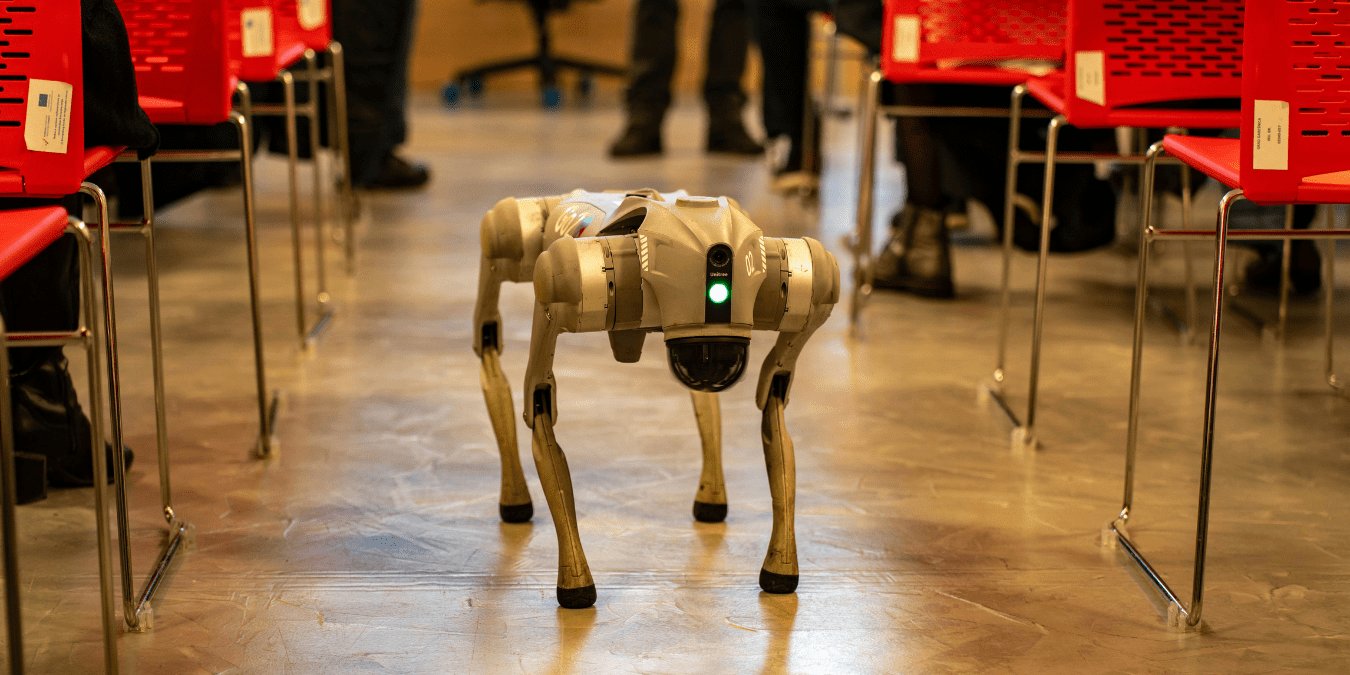
The robot’s name was “ORION.” It belonged, according to the display, to Galgotias University — a prominent Noida-based private institution claiming to have built a ₹350 crore AI ecosystem. DD News, the national broadcaster, aired a segment featuring a university official speaking enthusiastically about the robot. It was being framed as a symbol of India’s homegrown AI ambition.
Within hours, the internet had other ideas.
How the Controversy Unfolded
A viral post on X (formerly Twitter) by user Roshan Rai on February 17, 2026, ignited the firestorm. “So Galgotia university purchased a commercially available robot worth ₹2.5 lakhs, called it their own and passed it off in the Delhi AI Summit as a part of their 350 crore AI ecosystem,” he wrote.
The post quickly gained tens of thousands of views, shares, and anguished reactions from India’s tech community.
Digital investigators used reverse image searches to compare the ORION unit with international models. Critics pointed to striking physical similarities between the university’s demonstrator and the Unitree Go2, a commercially available quadruped robot manufactured by the Chinese firm Unitree Robotics.
The Unitree Go2 is a commercially available AI-powered robotic dog that can be purchased on Chinese websites for roughly ₹2–3 lakh, and is widely sold on global online marketplaces.
The comparison was damning in its simplicity: on one side, a robot labelled as part of India’s bold AI future. On the other, a product page on a Chinese retailer with a price tag that could fit in a middle-class family’s annual budget.
What Galgotias University Said in Its Defence
To their credit, Galgotias University did not stay silent for long. In response to the criticism, the university issued a clarification stating that it “never claimed to have built the device” and that the robot was procured from a Chinese manufacturer for academic purposes. “Let us be clear, Galgotias has not built this robodog, nor have we claimed to do so. What we are building are minds that will soon design, engineer, and manufacture such technologies in Bharat,” the university said.
The university went further, contextualising the purchase within a broader pedagogical philosophy. “From the US to China and Singapore, we bring advanced technologies to campus because exposure creates vision, and vision creates creators. The robodog is actively being used by students to test capabilities and explore real-world applications,” the university added.
This is, on its face, a reasonable argument. Universities worldwide — from MIT to IIT — procure commercial hardware platforms for student research and training. The Unitree Go2, for instance, is widely used in robotics labs across North America, Europe, and Asia as a programmable learning tool. Buying a commercially available robot does not automatically make an institution fraudulent.
But here’s where it gets complicated.




The Real Question: What Was Actually Claimed at the Summit?
The controversy isn’t simply about whether Galgotias bought a robot from China. The controversy is about what was implied when that robot stood on a national summit floor under the banner of a ₹350 crore AI ecosystem.
Several posts on X claimed the robot was an off-the-shelf product and questioned why it was being projected as part of an “AI ecosystem” pitch at a national-level summit. The criticism escalated through the day, with users posting side-by-side comparisons and accusing the university of passing off a purchased product as homegrown.
One video circulating on social media showed what appeared to be a university professor suggesting the device was developed by Galgotias University. The university has neither confirmed nor denied the content of this specific video at the time of writing.
Screenshots shared alongside the original viral post showed a comparison between a robot displayed at the summit and the Unitree Go2 product listing, priced at approximately $2,800 (around ₹2.3–2.5 lakh depending on exchange rates and shipping). The user alleged that the robot was showcased as part of Galgotias University’s reported ₹350 crore AI ecosystem initiative.
There is an enormous difference between “we use this tool to train students” and “look at what we’ve built as part of our ₹350 crore AI initiative.” The controversy intensified as some international outlets labelled the university’s 350+ crore AI investment exhibit a “sham.” Critics argued that showcasing a mass-produced Chinese robot under a new name created confusion about its origin.
What Is the Unitree Go2, Anyway?
For those unfamiliar with robotics, the Unitree Go2 deserves context. It is not a cheap toy. Developed by Unitree Robotics — a company that has emerged as one of the world’s leading manufacturers of quadruped robots — the Go2 is a sophisticated piece of engineering. It uses a combination of sensors, AI-driven motion planning, and onboard computing to navigate complex terrain.
The Go2 is genuinely impressive hardware. It is programmable, extendable, and widely used in serious research settings. When Boston Dynamics’ Spot robot became globally famous, Unitree’s products emerged as an accessible, open-platform alternative for universities and startups that couldn’t afford Spot’s significantly higher price tag.
The point being: buying a Unitree Go2 is not a sin. The question was always about the framing at a national event — not the purchase itself.
India’s AI Narrative and the Pressure to Perform
The Galgotias episode is symptomatic of a broader pressure that Indian institutions, both academic and governmental, currently face. India’s AI ambitions are real — the government has committed significant resources through the IndiaAI Mission, and the country’s engineering talent pool is genuinely world-class. But there is an intense pressure to show results at high-profile moments, even when the deeper, less glamorous work is still ongoing.
When the national mood around AI is being built through summits, photo-ops and big numbers, the question becomes: what gets rewarded? The sharp demo or the quiet deployment? The shiny exhibit or the boring documentation? A government can genuinely want AI progress and still end up building a PR-first ecosystem if the structure rewards spectacle.
This is not unique to India. The history of technology exhibitions globally is littered with overhyped demonstrations. What makes the Indian context particularly sensitive right now is the moment we’re in — a period where the country is trying to establish genuine credibility in a race that is moving extraordinarily fast.
AI is not a prop. It is not a poster. It is not a robot that moves and makes people clap. AI is also data, methods, testing, safety, failure, and the discipline to be honest about what a system can and cannot do.
What This Means for India’s Academic Institutions
The fallout from this controversy should prompt a genuine conversation — not a pile-on, but a structured reckoning — about how Indian universities present themselves and their capabilities.
Here are the uncomfortable questions that need answering:
On transparency: When an institution displays technology at a national summit, what obligation does it have to clearly communicate the origins of that technology? The answer, in the context of events designed to showcase indigenous innovation, should be obvious.
On the ₹350 crore figure: Where exactly is this money being allocated? If a significant portion is going toward procuring existing global platforms — which is a legitimate educational investment — that should be communicated clearly rather than packaged as original innovation.
On student welfare: Galgotias University has over 20,000 students. Many of them chose this institution partly on the basis of the AI ecosystem it advertised. They deserve to know what that ecosystem actually comprises — what is homegrown, what is procured, and what the roadmap to genuine indigenous development looks like.
On media literacy: National broadcasters like DD News play a crucial role in shaping public understanding of technology. When a robot is presented on air without basic due diligence about its provenance, it does a disservice not just to viewers but to the institutions themselves.
The Balanced Verdict
Let’s be fair to Galgotias University on one key point: procuring a Unitree Go2 for student education is not inherently wrong. It is, in fact, a sensible pedagogical choice. Robotics education requires hands-on hardware, and the Go2 is a capable platform.
The problem was context, communication, and the gap between what was implied and what was true.
India’s AI journey will not be built on hype. It will be built on the hard, invisible work happening in labs, classrooms, and data centers across the country — work that often doesn’t make for flashy summit demonstrations. The engineers, researchers, and students doing that work deserve to be celebrated honestly, not overshadowed by optics-driven shortcuts.
If Galgotias University’s ORION moment serves as a catalyst for more honest, transparent conversations about what Indian institutions are actually building versus what they’re buying, then something useful may yet emerge from the controversy.
The robot may have been made in China. But the lesson it teaches is entirely homegrown.