US Supreme Court Strikes Down Trump's Global Tariffs as 'Unlawful' — The 18% Tariff on India Is Now Illegal
The highest court in the United States just delivered one of the most consequential trade rulings in modern history. In a landmark 6-3 verdict, the Supreme Court declared Trump’s sweeping IEEPA-based tariffs — including the 18% reciprocal tariff on India — as illegal and unconstitutional overreach.
Breaking: What Happened on February 20, 2026?
In a historic ruling that has sent shockwaves through global financial markets, the United States Supreme Court on Friday, February 20, 2026, struck down President Donald Trump’s sweeping global tariffs, ruling them unlawful. The court voted 6-3 that Trump exceeded his legal authority when he used the International Emergency Economic Powers Act (IEEPA) — a 1977 emergency powers law — to unilaterally impose massive import duties on virtually every country in the world, including a 18% “reciprocal” tariff on India.
The majority opinion was authored by none other than Chief Justice John Roberts, a conservative appointed by President George W. Bush, and was joined by Justices Sotomayor, Kagan, Gorsuch, Barrett, and Jackson — a rare ideological coalition. Justices Thomas, Kavanaugh, and Alito dissented.
The official case name: Learning Resources Inc. v. Trump and V.O.S. Selections v. United States.
What Exactly Were These Tariffs?
To understand the magnitude of this ruling, one must go back to April 2, 2025 — what the Trump administration dubbed “Liberation Day” — when President Trump stood in the White House Rose Garden and unveiled a sweeping set of so-called “reciprocal tariffs” on goods from dozens of countries.
The rationale was straightforward in White House messaging: the US had been “cheated” by its trading partners for decades, and these tariffs were a correction. The duties imposed included:
- 18% tariff on India
- 25% on several European Union countries
- Tariffs as high as 50% on Brazil and other key trading partners
- Up to 145% on China (though the China-specific tariffs involved additional legal mechanisms)
The legal vehicle Trump used for nearly all of these was the IEEPA — a law passed in 1977 that allows a president to declare a national economic emergency and then “regulate” imports and exports. Trump declared that America’s trade deficits and the flow of fentanyl constituted such emergencies. He then used these declarations to impose tariffs that no president before him had ever attempted using this law.
The Supreme Court’s Core Finding: “He Cannot”
The ruling is blunt and historic. The court found that while IEEPA allows the President to “regulate” importation during national emergencies, it nowhere mentions the words “tariff” or “duty.” The majority held that imposing sweeping, revenue-generating taxes on imports is a power explicitly granted by the Constitution to Congress, not the Executive.
Chief Justice Roberts wrote: “The Framers did not vest any part of the taxing power in the Executive Branch.”
The majority further noted that before Trump, no president had ever used IEEPA to impose tariffs of any kind — let alone tariffs of this “magnitude and scope.” For Trump to justify such an “extraordinary” assertion of executive power, he must “point to clear congressional authorization,” the court wrote. “He cannot.”
This is a direct application of the “major questions doctrine” — the legal principle that when a policy decision is of vast economic and political significance, the executive branch needs explicit Congressional authorization to act.



What This Means for India: The 18% Tariff Is Legally Dead
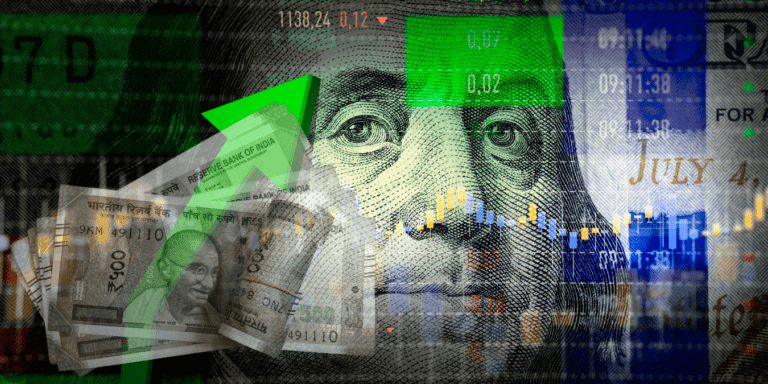
For Indian exporters, businesses, and policymakers, this ruling is deeply significant. The 18% reciprocal tariff imposed on Indian goods — which had disrupted sectors from IT hardware and pharmaceuticals to textiles and engineering goods — has now been declared illegal.
The tariff had been a major irritant in India-US trade relations ever since it was announced in April 2025. Indian goods exported to the United States were suddenly 18% more expensive to American buyers, affecting the competitiveness of Indian manufacturers, IT hardware exporters, and pharmaceutical companies that supply generic medicines to the US market.
India’s merchandise exports to the US, worth approximately $83-85 billion annually, were directly impacted. Key affected sectors included:
- Pharmaceuticals — India supplies nearly 47% of all generic drugs consumed in the United States. The tariff had strained cost structures for API and formulation exporters.
- Textiles and Garments — Indian garment manufacturers had reported order cancellations as American buyers shifted sourcing.
- Engineering Goods — Machinery, auto components, and industrial hardware exporters had seen margin compression.
- IT Hardware — Indian electronics exporters had been caught in the crossfire.
With this tariff now struck down as unconstitutional, the legal obligation to pay it on Indian goods no longer exists.
Trump’s Response: Defiant and Already Pivoting
Predictably, President Trump was furious. He called the ruling “deeply disappointing” and said he was “ashamed” of the justices who voted against him — including his own two appointees, Neil Gorsuch and Amy Coney Barrett. At a press conference, Trump said their decision was “terrible” and called it “an embarrassment to their families.”
However, Trump moved quickly to announce a workaround. Within hours of the ruling, he announced a 10% global tariff under Section 122 of the Trade Act of 1974 — an entirely different law that does explicitly authorize presidential tariff powers. He later confirmed he had signed this new 10% tariff from the Oval Office.
There is a critical caveat though: Section 122 tariffs can only remain in place for 150 days without Congressional extension. This means the new tariff is a temporary measure, not the permanent, open-ended weapon IEEPA had offered.
Vice President JD Vance blasted the ruling as “lawlessness from the Court,” while the business community largely welcomed it. The National Retail Federation called it “much-needed certainty for US businesses.”
The Refund Question: $160+ Billion on the Table
One of the most consequential downstream effects of this ruling is the question of refunds. Since the IEEPA tariffs were declared unlawful from the start, the amounts collected under them were, in the court’s view, unlawfully obtained.
Estimates of the total IEEPA tariff revenue collected vary:
- The Tax Foundation estimates at least $160 billion was collected under IEEPA tariffs between Trump’s inauguration and the ruling date.
- Penn Wharton Budget Model puts the figure above $175 billion.
- The US government’s own data (as of December 14, 2025) showed $133.5 billion collected.
The Supreme Court’s ruling was silent on the specific question of mandatory refunds, remanding that question to the lower courts (US International Trade Court). However, legal experts note that since the tariffs were illegally collected, businesses have a strong basis to demand repayment.
Major companies including Costco, Crocs, and Revlon had already filed suits seeking full refunds. The US Chamber of Commerce immediately called for “swift refunds” following the ruling. For Indian exporters who had absorbed higher US customs costs through price negotiations or margin cuts, refund claims may now also become possible through their American importer partners.
What Tariffs Remain in Effect?
This ruling does not wipe out all Trump tariffs. It specifically invalidates only those imposed under IEEPA. The following tariffs remain legally in place:
- Steel and Aluminum tariffs under Section 232 (national security basis)
- Automobile tariffs under Section 232
- China-specific tariffs imposed through earlier mechanisms (some were under separate legal authority)
- Trump’s new 10% global baseline tariff signed under Section 122 of the Trade Act of 1974 (temporary, 150-day window)
For India, this means the 18% reciprocal tariff is gone, but if Trump’s new 10% global tariff survives legal scrutiny, Indian exports may still face a 10% duty — far lower than before, but not tariff-free.
India-US Trade: Where Do We Go From Here?
From India’s vantage point, this ruling represents an opportunity to reset the trade dialogue with Washington. The Modi government had been quietly engaged in trade negotiations with the Trump administration even as the tariff regime disrupted bilateral commerce. With the reciprocal tariff framework now legally dismantled, New Delhi will likely push for:
- A Bilateral Trade Agreement (BTA) that provides India with more durable, negotiated tariff certainty rather than depending on executive whims.
- Restoration of Generalized System of Preferences (GSP) benefits, which Trump revoked in his first term and never fully restored.
- Strengthening pharmaceutical supply chain ties, given India’s outsized role in the US generic drug market.
- Expanded IT and digital services trade frameworks that weren’t directly impacted by goods tariffs but benefit from a more cooperative trade atmosphere.
Industry bodies like CII, FICCI, and EEPC India are expected to closely monitor the refund process and advise Indian exporters who may have indirectly borne tariff costs.
A Landmark for Separation of Powers
Beyond the trade implications, constitutional law scholars are already calling this one of the most significant separation-of-powers rulings in decades. The court drew a clear line: the power to tax — and tariffs are taxes — belongs to Congress, not the President. No matter how urgent the president believes an economic situation to be, that power cannot be seized through an emergency law that doesn’t explicitly authorize it.
This ruling will have implications well beyond tariffs. It reinforces that the major questions doctrine applies robustly to executive action, and that emergency powers laws cannot be stretched to grant unlimited authority over core constitutional functions.
Key Takeaways for Indian Readers
- The US Supreme Court ruled 6-3 on February 20, 2026 that Trump’s IEEPA-based tariffs are unconstitutional and unlawful.
- The 18% reciprocal tariff on Indian goods stands legally nullified.
- Trump has already pivoted to a temporary 10% global tariff under different authority.
- $160+ billion in illegally collected tariffs may need to be refunded to US importers.
- India-US trade relations now enter a new phase, with a window for negotiating a more stable bilateral trade framework.
- Non-IEEPA tariffs (steel, aluminum, autos) remain in effect.
Final Thought
February 20, 2026, will be remembered as the day the US Supreme Court drew a constitutional line in the sand. Chief Justice John Roberts and five colleagues delivered a clear message to the executive branch: tariff policy is a Congressional prerogative, and emergency laws are not blank checks for economic statecraft. For India, for global trade, and for the rule of law, this ruling matters enormously.
The immediate relief for Indian exporters is real. The legal uncertainty is not fully over — Trump’s 10% tariff and potential Congressional action could still reshape the landscape. But the era of unchecked IEEPA tariffs, threatening imports from virtually every nation on earth with duties that had no congressional backing, is over.
Watch this space. The global trade order just shifted — and India is better positioned for it.